

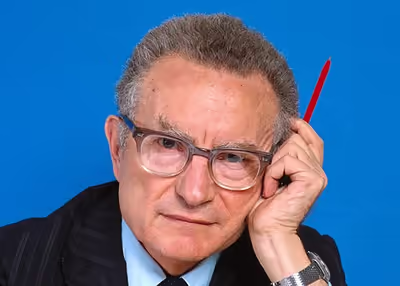
Paul Samuelson
American economist and Nobel Laureate (1915–2009)
- 7 min read
- 5 chapters

Related on Lably
Through Mathematics, Jews and Poland
Samuelson was one of the most influential economists of the latter half of the 20th century. In 1996, he was awarded the National Medal of Science. Samuelson considered mathematics to be the "natural language" for economists and contributed significantly to the mathematical foundations of economics with his book Foundations of Economic Analysis. He was author of the best-selling economics textbook of all time: Economics: An Introductory Analysis, first published in 1948. It was the second American textbook that attempted to explain the principles of Keynesian economics.
Samuelson served as an advisor to President John F. Kennedy and President Lyndon B. Johnson, and was a consultant to the United States Treasury, the Bureau of the Budget and the President's Council of Economic Advisers. Samuelson wrote a weekly column for Newsweek magazine along with Chicago School economist Milton Friedman, where they represented opposing sides: Samuelson, as a self described "Cafeteria Keynesian", claimed taking the Keynesian perspective but only accepting what he felt was good in it. By contrast, Friedman represented the monetarist perspective. Together with Henry Wallich, their 1967 columns earned the magazine a Gerald Loeb Special Award in 1968.
Biography
Samuelson was born in Gary, Indiana, on May 15, 1915, to Frank Samuelson, a pharmacist, and Ella née Lipton. His family, he later said, was "made up of upwardly mobile Jewish immigrants from Poland who had prospered considerably in World War I, because Gary was a brand new steel-town when my family went there". In 1923, Samuelson moved to Chicago where he graduated from Hyde Park High School (now Hyde Park Career Academy).
Samuelson attended the University of Chicago as an undergraduate, earning a Bachelor of Arts degree in 1935. He said he was born as an economist at 8:00 am on January 2, 1932, in the University of Chicago classroom. The lecture mentioned as the cause was on the British economist Thomas Malthus, who most famously studied population growth and its effects. Samuelson felt there was a dissonance between neoclassical economics and the way the system seemed to behave; he said Henry Simons and Frank Knight were a big influence on him. He next completed his Master of Arts degree in 1936, and his Doctor of Philosophy in 1941 at Harvard University. He won the David A. Wells Prize in 1941 for writing the best doctoral dissertation at Harvard University in economics, for a thesis titled "Foundations of Analytical Economics", which later turned into Foundations of Economic Analysis. As a graduate student at Harvard, Samuelson studied economics under Joseph Schumpeter, Wassily Leontief, Gottfried Haberler, and the "American Keynes" Alvin Hansen.
Samuelson moved to MIT as an assistant professor in 1940 and remained there until his death. Samuelson's biographer argues that a central reason for Samuelson's move from Harvard to MIT was the anti-Semitism that was famously widespread at Harvard at the time. In a 1989 letter to his friend Henry Rosovsky, Samuelson blamed anti-Semitism in Harvard economics above all on chair Harold Burbank, as well as on Edward Chamberlin, John H. Williams, John D. Black, and Leonard Crum.
Samuelson's family included many well-known economists, including brother Robert Summers, sister-in-law Anita Summers, brother-in-law Kenneth Arrow and nephew Larry Summers.
During his seven decades as an economist, Samuelson's professional positions included:
- Assistant professor of economics at MIT, 1940; associate professor, 1944.
- Member of the Radiation Laboratory 1944–45.
- Professor of international economic relations (part-time) at the Fletcher School of Law and Diplomacy in 1945.
- Guggenheim Fellowship from 1948 to 1949
- Professor of economics at MIT beginning in 1947 and Institute Professor beginning in 1962.
- Vernon F. Taylor Visiting Distinguished Professor at Trinity University (Texas) in spring 1989.
Death
Samuelson died after a brief illness on December 13, 2009, at the age of 94. His death was announced by the Massachusetts Institute of Technology. James M. Poterba, an economics professor at MIT and the president of the National Bureau of Economic Research, commented that Samuelson "leaves an immense legacy, as a researcher and a teacher, as one of the giants on whose shoulders every contemporary economist stands". Susan Hockfield, the president of MIT, said that Samuelson "transformed everything he touched: the theoretical foundations of his field, the way economics was taught around the world, the ethos and stature of his department, the investment practices of MIT, and the lives of his colleagues and students". His second wife died in 2019.
Sign in to keep reading
4 more chapters are free with a Lably account.
Fields of interest
As professor of economics at the Massachusetts Institute of Technology, Samuelson worked in many fields, including:
- Consumer theory, where he pioneered the revealed preference approach, which is a method by which one can discern a consumer's utility function, by observing their behavior. Rather than postulate a utility function or a preference ordering, Samuelson imposed conditions directly on the choices made by individuals – their preferences as revealed by their choices.
- Welfare economics and public finance theory, in which he popularised the Lindahl–Bowen–Samuelson conditions (criteria for deciding whether an action will improve welfare) and demonstrated in 1950 the insufficiency of a national-income index to reveal which of two social options was uniformly outside the other's (feasible) possibility function, and he is particularly known for his work on determining the optimal allocation of resources in the presence of both public goods and private goods.
- Capital theory, where he is known for 1958 consumption loans model and a variety of turnpike theorems and involved in Cambridge capital controversy.
- Finance theory, in which he is known for the random walk hypothesis and efficient-market hypothesis.
- International economics, where he influenced the development of two important international trade models: the Balassa–Samuelson effect, and the Heckscher–Ohlin model (with the Stolper–Samuelson theorem).
- Macroeconomics, where he popularized the overlapping generations model as a way to analyze economic agents' behavior across multiple periods of time, developed multiplier-accelerator model, analyzed Phillips curve, and contributed to formation of the neoclassical synthesis.
Impact
Samuelson is considered one of the founders of neo-Keynesian economics and a seminal figure in the development of neoclassical economics. In awarding him the Nobel Memorial Prize in Economic Sciences, the committee stated:
More than any other contemporary economist, Samuelson has helped to raise the general analytical and methodological level in economic science. He has simply rewritten considerable parts of economic theory. He has also shown the fundamental unity of both the problems and analytical techniques in economics, partly by a systematic application of the methodology of maximization for a broad set of problems. This means that Samuelson's contributions range over a large number of different fields.
He was also essential in creating the neoclassical synthesis, which ostensibly incorporated Keynesian and neoclassical principles and still dominates current mainstream economics. In 2003, Samuelson was one of the ten Nobel Prize–winning economists signing the Economists' statement opposing the Bush tax cuts.
Samuelson believed unregulated markets have drawbacks, he stated, "free markets do not stabilise themselves. Zero regulating is vastly suboptimal to rational regulating. Libertarianism is its own worst enemy!" Samuelson strongly criticised Friedman and Friedrich Hayek, arguing their opposition to state intervention "tells us something about them rather than something about Genghis Khan or Franklin Roosevelt. It is paranoid to warn against inevitable slippery slopes ... once individual commercial freedoms are in any way infringed upon."
Aphorisms and quotations
Stanislaw Ulam once challenged Samuelson to name one theory in all of the social sciences that is both true and nontrivial. Several years later, Samuelson responded with David Ricardo's theory of comparative advantage: "That it is logically true need not be argued before a mathematician; that it is not trivial is attested by the thousands of important and intelligent men who have never been able to grasp the doctrine for themselves or to believe it after it was explained to them."
For many years, Samuelson wrote a column for Newsweek. One article included Samuelson's most quoted remark and a favorite economics joke:
To prove that Wall Street is an early omen of movements still to come in GNP, commentators quote economic studies alleging that market downturns predicted four out of the last five recessions. That is an understatement. Wall Street indexes predicted nine out of the last five recessions! And its mistakes were beauties.
In the early editions of his famous, bestselling economics textbook Paul Samuelson joked that GDP falls when a man "marries his maid".
Memberships
- Member of the American Academy of Arts and Sciences, the American Philosophical Society, the United States National Academy of Sciences,
- Fellow of the British Academy
- President (1965–68) of the International Economic Association
- Member and past president (1961) of the American Economic Association
- Member of the editorial board and past president (1951) of the Econometric Society
- Fellow, council member and past vice-president of the Royal Economic Society.
- Member of Phi Beta Kappa.