


Related on Lably
Through Leaf, Bark (botany) and Cyanide
Description
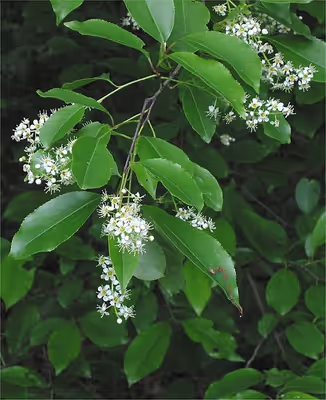
Prunus serotina is a medium-sized, fast-growing deciduous forest tree or shrub growing to a height of 15–24 metres (49–79 feet). The leaves are 5–13 centimetres (2–5 inches) long, ovate-lanceolate in shape, with finely toothed margins. The fall leaf color is yellow to red. The flowers are small, white and 5-petalled, in racemes 10–15 cm (4–6 in) long which contain several dozen flowers. The flowers give rise to reddish-black "berries" (drupes) fed on by birds, 5–10 millimetres (1⁄4–3⁄8 in) in diameter.
For about its first decade the bark of a black cherry tree is thin, smooth, and banded, resembling a birch. A mature tree has very broken, dark gray to black bark. The leaves are long and shiny, resembling a sourwood's. An almond-like odour is released when a young twig is scratched and held close to the nose, revealing minute amounts of cyanide compounds produced and stored by the plant as a defense mechanism against herbivores.
Biochemistry
Like apricots and apples, the seeds of black cherries contain cyanogenic glycosides (compounds that can be converted into cyanide), such as amygdalin. These compounds release hydrogen cyanide when the seed is ground or minced, which releases enzymes that break down the compounds. These enzymes include amygdalin beta-glucosidase, prunasin beta-glucosidase and mandelonitrile lyase. In contrast, although the flesh of black cherries also contains these glycosides, it does not contain the enzymes needed to convert them to cyanide, so the flesh is safe to eat.
The foliage, particularly when wilted, also contains cyanogenic glycosides, which convert to hydrogen cyanide if eaten by animals. Farmers are recommended to remove any trees that fall in a field containing livestock, because the wilted leaves could poison the animals. Removal is not always practical, though, because these trees often grow in very large numbers on farms, taking advantage of the light brought about by mowing and grazing. Entire fencerows can be lined with this poisonous tree, making it difficult to monitor all the branches falling into the grazing area. Black cherry is a leading cause of livestock illness, and grazing animals' access to it should be limited.
Similar species
Black cherry is closely related to the chokecherry (Prunus virginiana), which tends to be shorter (a shrub or small tree) and has smaller, less glossy leaves.
Sign in to keep reading
4 more chapters are free with a Lably account.
Subdivisions
Prunus serotina belongs to Prunus subg. Padus and has the following subspecies and varieties:
- Prunus serotina subsp. capuli (Cav. ex Spreng.) McVaugh – central + southern Mexico
- Prunus serotina subsp. eximia (Small) McVaugh – Texas
- Prunus serotina subsp. hirsuta (Elliott) McVaugh (syn. Prunus serotina var. alabamensis (C. Mohr) Little) – southeastern United States
- Prunus serotina subsp. serotina – Canada, United States, Mexico, Guatemala
- Prunus serotina subsp. virens (Wooton & Standl.) McVaugh – southwestern United States, northern + central Mexico
- Prunus serotina var. virens (Wooton & Standl.) McVaugh
- Prunus serotina var. rufula (Wooton & Standl.) McVaugh
Distribution and habitat
The species is widespread and common in North America and Central America.
Ecology
Prunus serotina is a pioneer species. In the Midwest, it is seen growing mostly in old fields with other sunlight-loving species, such as black walnut, black locust, and hackberry. Gleason and Cronquist (1991) describe P. serotina as "[f]ormerly a forest tree, now abundant as a weed-tree of roadsides, waste land, and forest-margins". It is a moderately long-lived tree, with recorded ages reaching 258 years. It is prone to storm damage, with branches breaking easily; any decay resulting from it however, progresses slowly.
Some seeds may remain in the soil bank and not germinate for as long as three years. All Prunus species have hard seeds that benefit from scarification to germinate (which in nature is produced by passing through an animal's digestive tract). The tree is hardy and can tolerate poor soils and oceanic salt sprays.
The species hosts the caterpillars of more than 450 species of butterflies and moths, including those of the eastern tiger swallowtail, cherry gall azure, viceroy, and red-spotted purple/white admiral butterflies and the cecropia, promethea, polyphemus, small-eyed sphinx, wild cherry sphinx, banded tussock, spotted apatelodes, and band-edged prominent moths.
Pests and diseases
Hyphantria cunea can inhibit the impact of cyanide within the plants' leaves due to its alkaline stomach acid. The eastern tent caterpillar defoliates entire groves some springs.
Cultivation and uses
Prunus serotina subsp. capuli was cultivated in Central and South America well before European contact.
Known as capolcuahuitl in Nahuatl (the source of the capuli epithet), it was an important food in pre-Columbian Mexico. Edible raw, the fruit is also made into jelly, and the juice can be used as a drink mixer, hence the common name 'rum cherry'.
Prunus serotina timber is valuable, perhaps the premier cabinetry timber of the U.S., traded as "cherry". High quality cherry timber is known for its strong orange hues, tight grain and high price. Low-quality wood, as well as the sap wood, can be more tan. Its density when dried is around 560 kg/m3 (35 lb/cu ft).
Prunus serotina was widely introduced into Western and Central Europe as an ornamental tree in the mid-20th century, where it has become locally naturalized. It has acted as an invasive species there, negatively affecting forest community biodiversity and regeneration.