

Pyrus pyrifolia
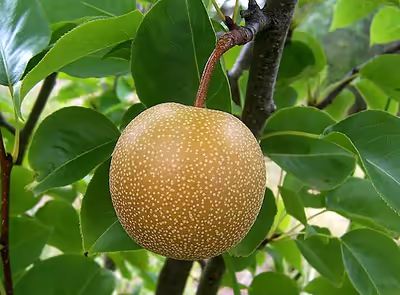
Species of pear with round crisp grainy fruit
- 3 min read
- 2 chapters

Related on Lably
The fruits are not generally baked in pies or made into jams because they have a high water content and a crisp, grainy texture, very different from the European varieties. They are commonly served raw and peeled. The fruit tends to be quite large and fragrant. If not carefully wrapped, having a tendency to bruise because of its juiciness, it can last for several weeks (or more) in a cold, dry place.
Culture
Due to their relatively high price and the large size of the fruit of cultivars, the pears tend to be served to guests, given as gifts, or eaten together in a family setting.
In cooking, ground pears are used in vinegar- or soy sauce-based sauces as a sweetener, instead of sugar. They are also used when marinating meat, especially beef, with a notable example being in the Korean dish bulgogi, due to the presence of enzymes to tenderize the proteins in the meat.
In Australia, these pears were first introduced into commercial production beginning in 1980.
In Japan, fruit is harvested in Chiba, Ibaraki, Tottori, Fukushima, Tochigi, Nagano, Niigata, Saitama and other prefectures, except Okinawa. Nashi (梨) may be used as a late autumn kigo, or "season word", when writing haiku. Nashi no hana (梨の花, pear flower) is also used as a kigo of spring. At least one city (Kamagaya-Shi, Chiba Prefecture) has the flowers of this tree as an official city flower.
In Nepal (Nepali: Naspati नस्पाती) and the Himalayan states of India, they are cultivated as a cash crop in the Middle Hills between about 1,500 and 2,500 metres (5,000 and 8,000 ft) in elevation, where the climate is suitable. The fruit are carried to nearby markets by human porters or, increasingly, by truck, but not for long distances because they bruise easily.
In Taiwan, pears harvested in Japan have become luxurious presents since 1997 and their consumption has jumped.
In China, the term "sharing a pear" (Chinese: 分梨; pinyin: fēn lí) is a homophone of "separate" (simplified Chinese: 分离; traditional Chinese: 分離; pinyin: fēnlí). As a result, sharing a pear with a loved one can be read as a desire to separate from them.
In Korea, the fruit is known as bae (배), and it is grown and consumed in great quantity. In the South Korean city of Naju, there is a museum called The Naju Pear Museum and Pear Orchard for Tourists (나주 배 박물관 및 배밭 관광체험).
In Cyprus, the pears were introduced in 2010 after initially being investigated as a new fruit crop for the island in the early 1990s. They are currently grown in Kyperounta.
Sign in to keep reading
One more chapter is free with a Lably account.
Cultivars
Cultivars are classified in two groups. Most of the cultivars belong to the Akanashi ('Russet pears') group, and have yellowish-brown rinds. The Aonashi ('Green pears') have yellow-green rinds.
Important cultivars include:
- 'Chojuro' (長十郎, Japan, 1893?) ('Russet pears')
- 'Kosui' (幸水, Japan, 1959; the most important cultivar in Japan) ('Russet pears')
- 'Hosui' (豊水, Japan, 1972) ('Russet pears')
- 'Imamuraaki' (今村秋, Japan, native) ('Russet pears')
- 'Nijisseiki' (二十世紀, Japan, 1898; name means "20th century", also spelled 'Nijusseiki') ('Green pears')
- 'Niitaka' (新高, Japan, 1927) ('Russet pears')
- 'Okusankichi' (晩三吉, Japan, native) ('Russet pears')
- 'Raja' (new) ('Russet pears')
- 'Shinko' (新興, Japan, pre-1941) ('Russet pears') ('Russet pears')
- 'Hwangkeum' (황금, 黄金, Korea, 1984, 'Niitaka' × 'Nijisseiki')
- 'Huanghuali' (not to be confused with the wood of Dalbergia odorifera, also called Huanghuali)
Kanji
The Japanese kanji for this fruit (梨) is one of the kyōiku kanji, the kanji taught in elementary school in Japan. Added in 2017, it was one of 20 new kyōiku kanji that were found in the names of prefectures of Japan.
In Chinese, the character refers to pears generally.