

Quotations from Chairman Mao Tse-tung
1964 book of statements by Mao Zedong
- 9 min read
- 4 chapters

Related on Lably
Through Quotation, United Kingdom and Japan
Publication process
Quotations from Chairman Mao Tse-tung was originally compiled by an office of the PLA Daily (People's Liberation Army Daily) as an ideological handbook. It developed out of Lin Biao's practice of incorporating the study of Mao's texts and model soldiers like Lei Feng into daily drills. Lin's approach became known as the "lively study, lively application" of Mao Zedong Thought. In 1961, Lin had required PLA Daily to publish a Mao quote each day to emphasise the central theme of the day's editorial. To facilitate this, PLA Daily editors used a Tianjin Daily index of Mao's quotes arranged by topic. The daily Mao quote became a popular feature and PLA Daily's use of the Tianjin Daily index became the core of Quotations from Chairman Mao.
In December 1963, a deputy editor-in-chief of the PLA Daily proposed compiling a selection of Mao's quotations in a book for use by the PLA. The response at a General Political Department work conference was strongly positive, and the initial draft was prepared as 200 Quotations from Chairman Mao. It was revised several times over the next few months based on input from conference participants and PLA units that piloted the study of the text.
In May 1964, the General Political Department released the internal publication Quotations from Chairman Mao, adding a half title page with the slogan "Workers of the world, unite!" (全世界无产者,联合起来!) in bold red letters, and endorsement leaves written by Lin Biao, Mao's chosen successor, that included three lines from the diary of model Lei Feng. This version had 30 topics under which 355 quotations were grouped. Following discussions that expanded the book twice more. The definitive 1965 version contained 33 thematic chapters of 427 total quotations excerpted from Mao's speeches and writing over the period 1929–1964. As of August 1965, new copies of the book had their distinct red vinyl covers (as opposed to the previously used white paper binding) to increase durability for fieldwork.
Demand for the book increased sharply including for use outside the military and in August 1966 People's Publishing House took over the work of printing Quotations. It was made available to the public through Xinhua Bookstores.
The Ministry of Culture held special study meetings to develop a production and distribution plan. It sought assurances that the book would receive publishing priority and that there would be sufficient paper, ink, and printing presses available. The goal was for "ninety-nine percent (of the population of China to) read Chairman Mao's book", according to a catalogue of publication records of the People's Publishing House. Provinces, municipalities, and autonomous regions across China were ordered to build hundreds of new printing houses to publish the Quotations during the second half of 1966, which pushed the limits of the Chinese printing industry.
This disrupted plans for publishing any new volumes of The Complete Works of Marx and Engels that was already in progress. It also halted distribution of other ideological works. As late as 1970, more than 8 million copies of the 4-volume set of Selected Works of Marx and Engels that had already been printed (both in cloth hardcover and paperback) remained undistributed in storage warehouses on the grounds that other works "should not interfere with learning Quotations from Chairman Mao Tse-Tung".
On the other hand, several other works by Mao had very large printings during the same period, even though these editions were not produced in the large numbers of Quotations from Chairman Mao. These include Selected Works of Mao Zedong (in four volumes, 2.875 million copies in 14 languages), Selected Articles of Mao Zedong (various editions totalling 252 million copies), single article books, and works of poetry.
The emphasis on Quotations started decreasing after the 9th Party Congress in April 1969.
On 12 February 1979, the Publicity Department of the Chinese Communist Party ordered a halt to publishing Quotations from Chairman Mao Tse-tung. The department stated that Quotations was a distortion of Mao Zedong Thought and had a "widespread and pernicious influence".
Formats
Earlier versions and predecessors of the compilation book featured blue or white covers and sleeves.
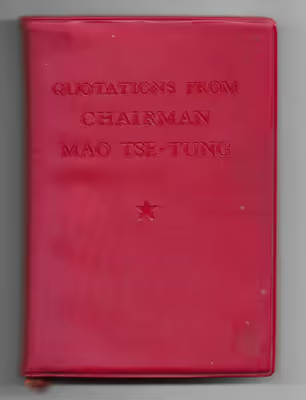
The most widely produced editions of the Quotations of Chairman Mao were published with a printed red vinyl cover wrapper over cardboard with pages bound in 64 folios that included photos of Mao. Other editions of the book were covered in cloth, silk, leather, paper, and other materials.
Most editions were produced in a functional, compact size that fit into a pocket, were easy to carry, and could be taken out at any time "for practice, learning, application." It was published in 32 other common sizes, allegedly the largest format printed on only four pages as large as the newspaper Reference News, and the smallest format the size of a matchbox.
Sign in to keep reading
3 more chapters are free with a Lably account.
Content
Quotations from Chairman Mao Tse-Tung consists of 427 quotations, organized thematically into 33 chapters. It is also called "Thoughts of Chairman Mao" by many Chinese. The quotations range in length from a sentence to a few short paragraphs, and borrow heavily from a group of about two dozen documents in the four volumes of Mao's Selected Works.
Usually the quotations are arranged logically, to deal with one to three themes in the development of a chapter. The table below summarizes the book.
Distribution
The book was known as the "Treasured Red Book" (simplified Chinese: 红宝书; traditional Chinese: 紅寶書; pinyin: hóng bǎoshū) or "Little Treasure Book" in China. From the mid-1960s through the mid-1970s, it was the most printed book globally. It has produced a wide array of sales and distribution figures. Some sources claim that over 6.5 billion printed volumes have been distributed in total, others contend that the distribution ran into the "billions", and others cite "over a billion" official volumes between 1966 and 1969 alone as well as "untold numbers of unofficial local reprints and unofficial translations."
The initial print run was distributed only within the PLA, with 4.2 million copies printed.
During the Learn from the People's Liberation Army campaign, the book became hugely popular among the revolutionary youth.
Demand grew so high that the PLA Publishing House's printing resourced became over extended, and after September 1964, printing moulds were provided to civilian printing presses at times to relieve the pressure. Twelve million copies had been printed by August 1965.
During the early phase of the Cultural Revolution, copies of quotations were frequently donated to those deemed the revolutionary masses. On National Day in 1966, one million copies were handed out to Red Guards who traveled to Beijing.
Overseas distribution
Outside China, the work was called the "Little Red Book" due to the red cover of its most widely printed version.
The Foreign Affairs Department of the State Council issued a March 1966 circular requesting any foreigners who had obtained a copy of Quotations to return it, stating that the book was for internal education and study only and was not a complete description of Mao Zedong Thought. This proved not practical and the next month the Central Propaganda Department stated that copies already distributed should not be recalled and that foreign experts and exchange students could request copies to borrow or buy.
In 1966, the Publicity Department of the Chinese Communist Party approved Quotations from Chairman Mao for export. To meet overseas requirements, the editors of the Chinese Foreign Languages Press made revisions necessitated by the situation. They added a "second edition preface" endorsement by Lin Biao, dated 16 December 1966 (which was torn out following Lin Biao's death and public disgrace in September 1971). On the last page, they listed the names of the publisher (PLA General Political Department) without an ISBN, the printer and distributor (both Xinhua Bookstore), and the publication year.
By May 1967, bookstores in 117 countries and territories around the world—including the United Kingdom, France, Spain, Japan, the Soviet Union, West Germany, Italy, Nepal, Indonesia, Philippines, Burma, Iran, various Arab and African nations and others—were distributing Mao's Quotations. It was translated into more than 50 languages.
After the 12 February 1979 directive withdrawing Quotations from circulation, foreigners seeking copies of Quotations were instead to be offered Mao's Selected Works.
Social impact
China
During the 1960s, the book was the single most visible icon in mainland China, even more visible than images of Mao himself. In posters and pictures created by the CCP's propaganda artists, nearly every painted character, whether smiling or looking determined, was seen with a copy of the book in his or her hand. During the Mao era, when people swore oaths, they would often do so on Quotations. After the end of the Cultural Revolution in 1976 and the rise of Deng Xiaoping in 1978, the importance of the book waned considerably, and the glorification of Mao's quotations was considered to be left deviationism and a cult of personality.
Quotations continues to be a symbol of Mao Zedong Thought in China today. In certain situations, the book is given as a gift, for example, when public funds are involved, or when personal events arise, such as congratulating newlyweds.
Today in China, Quotations from Chairman Mao Tse-Tung is mostly seen as a piece of nostalgia. It is difficult to find in bookstores. Rare and unusual printings can command extremely high prices from collectors. A 1964 version of the book was sold for US$15,000 by Sotheby's.
Africa
In Africa, Quotations helped inspire political texts including Quotations from President Karume and Axioms of Kwame Nkrumah.
Euro-American contexts
Assessing its legacy in the French Maoist context, Alain Badiou concludes that "Mao's Little Red Book has been our guide, not, as fools say, in the sense of a dogmatic catechism, but on the contrary, so that we can clarify and invent new behaviors in all sorts of disparate situations that were unfamiliar to us."
In the United States, Quotations was particularly popular among African American and Asian American radicals, who often viewed the text as a welcome departure from what they regarded as a typically Eurocentric body of theory.
According to Bobby Seale, in 1967 he and Huey P. Newton obtained copies of Quotations from the Chinese Book Store in San Francisco to sell at the University of California, Berkeley. With the proceeds, they purchased weapons to arm Black Panther Party members for self-defense against police brutality.
The Revolutionary Action Movement modeled its Code of Cadres on the "Three Main Rules of Discipline" section of Quotations.
In 1968, two American journalists published a collection of President Lyndon B. Johnson's quotes, Quotations from Chairman LBJ, in a satirical style modeled after the format of Chairman Mao's quotations. On the Danish rock band Kliché's debut album, Supertanker, the songs "Militskvinder" and "Masselinjen" drew on texts from the Quotations.
India
In India, Quotations gained popularity following the 1967 Naxalbari uprising and the beginning of the Naxalite Movement. The leader of the first phase of the Naxalite Movement, Charu Majumdar, placed major emphasis on the text, requiring it to be studied and to be read aloud to illiterate peasants. During this phase of the Naxalite Movement, Quotations was popular among both movement participants and those who sympathized with it. The Indian government banned Quotations beginning in the mid-1970s.