


Related on Lably
Muslims comprise a number of sects, with the majority estimated at 90-95% practicing Sunni Islam, while the rest mainly practice Shia Islam. The majority of Sunnis follow the Hanafi school of jurisprudence, while a minority belong to the Ahl-i Hadith school of thought. Most Pakistani Shia Muslims belong to the Twelver Islamic law school, with significant minority groups who practice Ismailism, which is composed of Nizari (Aga Khanis), Mustaali, Dawoodi Bohra, and Sulaymani.
Before the arrival of Islam in the 8th century, the region that makes up Pakistan was home to a number of faiths, including Hinduism, Buddhism, Jainism, and Zoroastrianism.
Equal rights
Khawaja Nazimuddin, Pakistan's second Prime Minister, argued against equal rights for all citizens in an Islamic state. The Constitution of Pakistan establishes Islam as the state religion, and provides that all citizens have the right to profess, practice and propagate their religion subject to law, public order, and morality. The Constitution also states that all laws are to conform with the injunctions of Islam as laid down in the Quran and Sunnah.
The Constitution limits the political rights of Pakistan's non-Muslims. Only Muslims are allowed to become the President or the Prime Minister. Only Muslims are allowed to serve as judges in the Federal Shariat Court, which has the power to strike down any law deemed un-Islamic, though its judgments can be overruled by the Supreme Court of Pakistan. However, non-Muslims have served as judges in the High Courts and Supreme Court. In 2019, Naveed Amir, a Christian member of the National Assembly moved a bill to amend the article 41 and 91 of the Constitution that would allow non-Muslims to become Prime Minister and President of Pakistan. However, Pakistan's parliament blocked the bill.
The main principles of Human rights in the Pakistani constitution were incorporated in its fundamental rights which were granted under various articles of 20, 21, 22, 25, 26, 27, 36 & 38 of the constitution –
(a) Article 20 : Freedom to profess religion and to manage religious institutions.
(b) Article 21 : Safeguard against taxation for purposes of any particular religion.
(c) Article 22 : Safeguards as to educational institutions in respect of religion, etc.
(d) Article 25 : Equality of citizens.
(e) Article 26 : Non-discrimination in respect of access to public places.
(f) Article 27 : Safeguard against discrimination in services.
(g) Article 36 : Protection of Minorities.
(h) Article 38 : Promotion of social and economic well-being of all the people.
Sign in to keep reading
8 more chapters are free with a Lably account.
Demographics of religion in Pakistan
Background
1901 census
The total population of the region that composes contemporary Pakistan was approximately 17,708,014 according to the 1901 census. With the exception of the Federally Administered Tribal Areas, all administrative divisions in the region that composes contemporary Pakistan collected religious data, with a combined total population of 17,633,258, for an overall response rate of 99.6 percent. Similar to the contemporary era, where censuses do not collect religious data in Azad Jammu and Kashmir and Gilgit–Baltistan, the total number of responses for religion is slightly smaller than the total population, as detailed in the table breakdown below.
1911 census
The total population of the region that composes contemporary Pakistan was approximately 20,428,473 according to the 1911 census. With the exception of the Federally Administered Tribal Areas, all administrative divisions in the region that composes contemporary Pakistan collected religious data, with a combined total population of 18,806,379, for an overall response rate of 92.1 percent. Similar to the contemporary era, where censuses do not collect religious data in Azad Jammu and Kashmir and Gilgit–Baltistan, the total number of responses for religion is slightly smaller than the total population, as detailed in the table breakdown below.
1921 census
The total population of the region that composes contemporary Pakistan was approximately 22,214,152 according to the 1921 census. With the exception of the Federally Administered Tribal Areas, all administrative divisions in the region that composes contemporary Pakistan collected religious data, with a combined total population of 19,389,016, for an overall response rate of 87.3 percent. Similar to the contemporary era, where censuses do not collect religious data in Azad Jammu and Kashmir and Gilgit–Baltistan, the total number of responses for religion is slightly smaller than the total population, as detailed in the table breakdown below.
1931 census
The total population of the region that composes contemporary Pakistan was approximately 24,774,056 according to the 1931 census. With the exception of the Federally Administered Tribal Areas, all administrative divisions in the region that composes contemporary Pakistan collected religious data, with a combined total population of 22,514,768, for an overall response rate of 90.9 percent. Similar to the contemporary era, where censuses do not collect religious data in Azad Jammu and Kashmir and Gilgit–Baltistan, the total number of responses for religion is slightly smaller than the total population, as detailed in the table breakdown below.
1941 census
The total population of the region that composes contemporary Pakistan was approximately 29,643,600 according to the final census prior to partition in 1941. With the exception of the Federally Administered Tribal Areas, all administrative divisions in the region that composes contemporary Pakistan collected religious data, with a combined total population of 27,266,001, for an overall response rate of 92.0 percent. Similar to the contemporary era, where censuses do not collect religious data in Azad Jammu and Kashmir and Gilgit–Baltistan, the total number of responses for religion is slightly smaller than the total population, as detailed in the table breakdown below.
1951 census
After partition, when first census of Pakistan was conducted in the year 1951, It was found that the Muslim proportion in West Pakistan (contemporary Pakistan) increased from approximately 77.3 percent according to the 1941 census, to 97.1 percent as per the 1951 census; in contrast, the combined Hindu and Sikh proportion in West Pakistan (contemporary Pakistan) decreased from approximately 20.7 percent to just 1.7 percent during the same timeframe, as the 1947 Partition of India gave rise to bloody rioting and indiscriminate inter-communal killing of Hindus, Muslims, and Sikhs across the Indian subcontinent, especially in Punjab region. As a result, around 7.3 million Hindus and Sikhs moved to India and 7.2 million Muslims moved to Pakistan permanently, leading to demographic change of both the nations to a certain extent.
1961 census
1972 census
1981 census
1998 census
2017 census
As per 2017 Census of Pakistan, the country has a population of 207,684,000.The CCI approved the release of provisional population figures of 207.754 million people. The final results showed the total population of Pakistan to be 207.684 million, a reduction of 68,738 people or 0.033% against provisional results.
As of 2018, there are 3.63 million non-Muslim voters in Pakistan- 1.77 million were Hindus, 1.64 million Christians, 167,505 were Ahmadi, 31,543 were Baháʼís, 8,852 were Sikhs, 4,020 were Parsis, 1,884 were Buddhist and others such as Kalashas. The NADRA makes it nearly impossible to declare and change the religion to anything from Islam making the statistics somewhat misleading.
Details
Pakistan Bureau of Statistics released religious data of Pakistan Census 2017 on 19 May 2021. 96.47% are Muslims, followed by 2.14% Hindus, 1.27% Christians, 0.09% Ahmadis and 0.02% others.
These are some maps of religious minority groups. The 2017 census showed an increasing share in Hinduism, mainly caused by a higher birth rate among the impoverished Hindus of Sindh province. This census also recorded Pakistan's first Hindu-majority district, called Umerkot District, where Muslims were previously the majority.
On the other hand, Christianity in Pakistan, while increasing in raw numbers, has fallen significantly in percentage terms since the last census. This is due to Pakistani Christians having a significantly lower fertility rate than Pakistani Muslims and Pakistani Hindus as well as them being concentrated in the most developed parts of Pakistan, Lahore District (over 5% Christian), Islamabad Capital Territory (over 4% Christian), and Northern Punjab.
The Ahmadiyya movement shrunk in size (both raw numbers and percentage) between 1998 and 2017, while remaining concentrated in Lalian Tehsil, Chiniot District, where approximately 13% of the population is Ahmadi.
Here are some maps of Pakistan's religious minority groups as of the 2017 census by district:
2023 census
Demographics of religion by province/territory
Punjab
Sindh
Khyber Pakhtunkhwa
Balochistan
Azad Jammu and Kashmir
Gilgit–Baltistan
Islam
Islam is the state religion of Pakistan, and about 96–98% of Pakistanis are Muslim. Pakistan has the second largest number of Muslims in the world after Indonesia. The majority are Sunni (estimated at 85–95%), with an estimated 5–15% Shia. A PEW survey in 2012 found that 6% of Pakistani Muslims were Shia.
Among Sunni Muslims, the Hanafi school of jurisprudence is followed by the majority while a minority belongs to the Ahl-i Hadith tradition which rejects imitation of the four schools. The majority of Pakistani Shia Muslims belong to the Twelver (Ithna Asharia) branch, with significant minority who adhere to Ismailism branch that is composed of Nizari (Aga Khanis), Mustaali, Dawoodi Bohra, Sulaymani, and others. Sufis and above mentioned Sunni and Shia sects are considered to be Muslims according to the Constitution of Pakistan; the Ahmadiyya (though self-described Muslims) are specifically declared not to be.
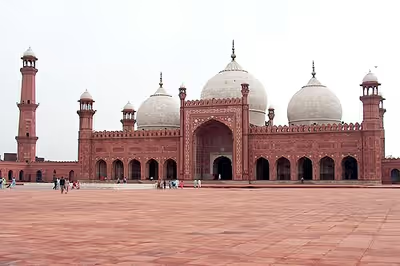
The mosque is an important religious as well as social institution in Pakistan. Many rituals and ceremonies are celebrated according to Islamic calendar.
Sunni
According to the CIA World Factbook and Oxford Centre for Islamic Studies, 96–97% of the total population of Pakistan is Muslim.
Pakistani Sunnis generally follow the Hanafi school of jurisprudence. Most of the madrasas in Pakistan are affiliated with the Barelvi and Deobandi movements that originated in British India. Approximately 65% of Pakistan's Islamic seminaries are affiliated with the Deobandis, compared to 25% associated with the Barelvis. Other regular Hanafi schools include the Jamaat-e-Islami's madrasas, Minhaj-ul-Quran madrasas and others which are neither Barelvi nor Deobandi. A minority of madrasas are affiliated with the Ahl-i Hadith.
The widespread educational infrastructure has enabled the Deobandi movement to play a pivotal role in shaping religious education and discourse across the country. The Deobandi movement is especially prominent in regions such as Khyber Pakhtunkhwa and Balochistan, where it forms the majority among Sunni Muslims. Its influence extends beyond education into political spheres, with parties like Jamiat Ulema-e-Islam (JUI) playing active roles in national politics. In contrast, the Barelvi movement, while representing a significant portion of Pakistan's Sunni population, has historically had less institutional influence. However, it has seen a resurgence in recent years, with increased political activism and the formation of parties like Tehreek-e-Labbaik Pakistan.
Islam to some extent syncretized with pre-Islamic influences, resulting in a religion with some traditions distinct from those of the Arab world. Two Sufis whose shrines receive much national attention are Ali Hajweri in Lahore (ca. 11th century) and Shahbaz Qalander in Sehwan, Sindh (ca. 12th century). Sufism, a mystical Islamic tradition, promoted by Fariduddin Ganjshakar in Pakpatan, has a long history and a large popular following in Pakistan. Popular Sufi culture is centered on Thursday night gatherings at shrines and annual festivals which feature Sufi music and dance. Contemporary Islamic fundamentalists criticize its popular character, which in their view, does not accurately reflect the teachings and practice of the Islamic prophet Muhammad and his companions. There have been terrorist attacks directed at Sufi shrines and festivals, 5 in 2010 that killed 64 people.
Ahmadiyya
According to the last Census in Pakistan, Ahmadis made up 0.07% of the population; however, the Ahmadiyya boycotted the census. Independent groups generally estimate the population to be somewhere between two and five million. In media reports, four million is the most commonly cited figure.
In 1974, the government of Pakistan amended the Constitution of Pakistan to define a Muslim according to Qu'ran 33:40, as a person who believes in finality of Muhammad under the Ordinance XX. According to Ordinance XX, Ahmadis cannot call themselves Muslim or "pose as Muslims" which is punishable by three years in prison. They believe in Muhammad as the final law-bearing prophet, but also believe Mirza Ghulam Ahmad to be a prophet, the prophecised Mehdi and second coming of Jesus. Consequently, they were declared non-Muslims by a parliamentary tribunal and are subject to persecution under Pakistani blasphemy laws.
Hinduism
Hinduism is the second largest religion affiliation in Pakistan after Islam. As of 2025, Pakistan has the fourth largest Hindu population in the world after India, Nepal and Bangladesh. According to the 2023 Census, the Hindu population was found to be 5,217,216 constituting 2.17%, slightly up from 2.14% in 2017 census. Hindus are geographically concentrated in the Sindh province. About 94% of Hindus live in Sindh and remaining 5% in Punjab and around 1% in Balochistan.
The Rig Veda, the oldest Hindu text, is believed to have been composed in the Punjab region in the Indian subcontinent around 1500 BCE and spread from there across South and South East Asia slowly developing and evolving into the various forms of the faith we see today. Many ancient Hindu temples are located throughout Pakistan. A significant Hindu pilgrimage site known as Hinglaj Mata takes place in southern Balochistan, where nearly 300,000 people visit during spring as a pilgrimage. Another major pilgrimage site is the Shri Ramdev Pir temple, whose annual Ramdevpir Mela in the temple is the second largest Hindu pilgrimage in Pakistan.
Cases collected by Global Human Rights Defence show that underage Hindu (and Christian) girls are often targeted by Muslims for forced conversion to Islam. According to the National Commission of Justice and Peace and the Pakistan Hindu Council (PHC) around 1,000 non-Muslim minority women are converted to Islam and then forcibly married off to their abductors or rapists.
Christianity
Christians (Urdu: مسيحى، عیسائی) make up 1.6% of Pakistan's population. The population is nearly split equally between Catholics and Protestants. The majority of the Pakistani Christian community consists of Punjabis speaking who converted during the British colonial era. There were waves of conversions to Christianity among the Chuhra and Chamar between the 1870s and 1930s in the Punjab Province and United Provinces of Agra and Oudh. Christians mainly live in the urban centres of Punjab. There is also a Roman Catholic community in Karachi which was established by Goan and Tamil migrants when Karachi's infrastructure was being developed between the two World Wars. A few Protestant groups conduct missions in Pakistan. The present Christian population in Pakistan is ranged between 2 and 3 million as per as recent (2020–21) year estimation by various institution and NGOs of Pakistan.
There are a number of church-run schools in Pakistan that admit students of all religions, including Forman Christian College, St. Patrick's Institute of Science & Technology and Saint Joseph's College for Women, Karachi.
Sikhism
In the 15th century, the Sikh faith was born in the Punjab region (of present day India and Pakistan) where Sikhism's founder Guru Nanak was born. Home to some of the world's most sacred gurdwaras, Sikhs have a become a crucial part in Pakistan's religious tourism with large numbers coming to the country particularly during festivals. Sikhism was included as a religious category in 2023, which showed the population to be 15,998. Other estimated put the number between 20,000 to 35,000. The National Database and Registration Authority (NADRA) which documents the voters there were 8,852 Sikh Voters in 2018.
Other religions
Baháʼí
The Baháʼí Faith in Pakistan was present when it was still under British colonial rule. The roots of the religion in the region go back to the first days of the Bábí religion in 1844, with Shaykh Sa'id Hindi who was from Multan. During Bahá'u'lláh's lifetime, as founder of the religion, he encouraged some of his followers to move to the area that is present day Pakistan.
The Baháʼís in Pakistan have the right to hold public meetings, establish academic centers, teach their faith, and elect their administrative councils. Bahá'í sources claim their population to be around 30,000. Shoba Das of Minority Rights Group International reported around 200 Baháʼís in Islamabad and between 2,000 and 3,000 Baháʼís in Pakistan, in 2013. One more PhD thesis says that "It is an assumption that the Bahá’ís do not want to declare their exact population, which is supposed to be more or less 3,000 in total". Most of these Bahá’ís have their roots in Iran.
Zoroastrianism
There are at least 4,000 Pakistani citizens practicing the Zoroastrian religion. The region of Balochistan is believed to have been a stronghold of Zoroastrianism before the advent of Islam. With the flight of Zoroastrians from Greater Iran into the Indian subcontinent, the Parsi communities were established. More recently, from the 15th century onwards, Zorastrians came to settle the coast of Sindh and have established thriving communities and commercial enterprises. At the time of independence of Pakistan in 1947, Karachi and Lahore were home to a thriving Parsi business community. Karachi had the most prominent population of Parsis in Pakistan, though their population is declining. Parsis have entered Pakistani public life as social workers, business folk, journalists and diplomats. The most prominent Parsis of Pakistan today include Ardeshir Cowasjee, Byram Dinshawji Avari, Jamsheed Marker, as well as Minocher Bhandara. The founding father of Pakistan, Muhammad Ali Jinnah, married Ratti Bai who belonged to a Parsi family before her conversion to Islam.
Kalash
The Kalash people practise a form of ancient Hinduism mixed with animism. Adherents of the Kalash religion number around 3,000 and inhabit three remote valleys in Chitral; Bumboret, Rumbur and Birir. Their religion has been compared to that of ancient Greece, but they are much closer to the Hindu traditions in other parts of the Indian subcontinent. It is more similar to the historical Vedic religion, than later forms of Hinduism.
Jainism
Several ancient Jain shrines are scattered across the country. Baba Dharam Dass was a holy man whose tomb is located near the bank of a creek called (Deoka or Deokay or Degh) near Chawinda Phatic, behind the agricultural main office in Pasrur, near the city of Sialkot in Punjab, Pakistan. Another prominent Jain monk of the region was Vijayanandsuri of Gujranwala, whose samadhi (memorial shrine) still stands in the city.
Buddhism
Buddhism has an ancient history in Pakistan; currently there is a small community of at least 1,500 Pakistani Buddhists in the country. The country is dotted with numerous ancient and disused Buddhist stupas along the entire breadth of the Indus River that courses through the heart of the country. Many Buddhist empires and city states existed, notably in Gandhara but also elsewhere in Taxila, Punjab and Sindh.
The number of Buddhist voters was 1,884 in 2017 and are mostly concentrated in Sindh and Punjab.
Judaism
Various estimates suggest that there were about 1,500 Jews living in Pakistan at the time of its independence on 14 August 1947, with the majority living in Karachi and a few living in Peshawar. However, almost all emigrated to Israel after 1948. There are a few disused synagogues in both cities; while one Karachi synagogue was torn down for the construction of a shopping mall. The one in Peshawar still exists, although the building is not being used for any religious purpose. There is a small Jewish community of Pakistani origin settled in Ramla, Israel.
One Pakistani, Faisal Khalid (a.k.a. Fishel Benkhald) of Karachi claims to be Pakistan's only Jew. He claimed that his mother is Jewish (making him Jewish by Jewish custom) but, his father is a Muslim. Pakistani authorities have issued him a passport that stated Judaism as his religion and have allowed him to travel to Israel.
Irreligion
Irreligion is present among a minority of mainly young people in Pakistan. There are people who do not profess any faith (such as atheists and agnostics) in Pakistan, but their numbers are not known. They are particularly in the affluent areas of the larger cities. Some were born in secular families while others in religious ones. According to the 1998 census, people who did not state their religion accounted for 0.5% of the population, but social pressure against claiming no religion was strong. A 2012 study by Gallup Pakistan found that people not affiliated to any religion account for 1% of the population. Many atheists in Pakistan have been lynched and imprisoned over unsubstantiated allegations of blasphemy. When the state initiated a full-fledged crackdown on atheism since 2017, it has become worse with secular bloggers being kidnapped and the government running advertisements urging people to identify blasphemers among them and the highest judges declaring such people to be terrorists.
Freedom of religion in Pakistan
A few aspects of secularism have also been adopted by Pakistani constitution from British colonial concept. In 2022, Freedom House rated Pakistan’s religious freedom as 1 out of 4, noting that the blasphemy laws are often exploited by religious vigilantes and also curtail the freedom of expression by Christians and Muslims, especially Ahmadi Muslims. Hindus have spoken of vulnerability to kidnapping and forced conversions. Pakistan, a Muslim-majority country of about 220 million, is often under fire for crimes against members of its religious minorities, including Christians, Ahmadi Shi’ite Muslims and wahabi Muslims and Hindus.