


Related on Lably
Through Islam, Muslims and Muhammad in Islam
Muslims believe the Quran was orally revealed by God to the final Islamic prophet Muhammad through the angel Gabriel incrementally over a period of some 23 years, beginning on the Laylat al-Qadr when Muhammad was 40 and concluding in 11 AH/632 CE, the year of his death. Muslims regard the Quran as Muhammad's most important miracle, a proof of his prophethood, and the culmination of a series of divine messages starting with those revealed to the first Islamic prophet Adam, including the holy books of the Torah, Psalms, and Gospel in Islam. The Quran is believed by Muslims to be God's own divine speech providing a complete code of conduct across all facets of life. This has led Muslim theologians to fiercely debate whether the Quran was "created or uncreated". According to tradition, several of Muhammad's companions served as scribes, recording the revelations. Shortly after Muhammad's death, the Quran was compiled on the order of the first caliph Abu Bakr (r. 632–634) by the companions, who had written down or memorized parts of it. Caliph Uthman (r. 644–656) established a standard version, now known as the Uthmanic codex, which is generally considered the archetype of the Quran known today. There are, however, canonical variant readings (qirāʾāt), transmitted through oral tradition, with minor variations in wording and nuance that may lead to subtle differences in meaning, while preserving the core message of the Quran. It is the subject of a modern field of academic research known as Quranic studies. Some argue that manuscript evidence, textual variants (such as the Sanaa manuscript), and historical sources suggest a more gradual and complex process of compilation and canonization.
The Quran describes itself as a guide for humanity (2:185). It alludes to significant narratives found in biblical and apocryphal texts. While it devotes considerable space to some of these narratives, it does not quote any paragraph from these sources directly, but summarizes and uses different versions of some in different sections. Islamic theorists tend to explain this situation as the Quran's focus on the moral lessons to be drawn from events. This allusive style and summarization entail many explanatory efforts (exegesis). To extrapolate the meaning of a particular Quranic verse, Muslims rely on tafsir, or commentary, often in conjunction with translations of the text. Furthermore, hadiths, which are valued in most Islamic schools of thought for their role in establishing Islamic laws and regulations, are oral traditions that were later written down and are believed to reflect the words and actions of Muhammad, serving as additional guidance alongside the Quran for most Muslims. During prayers, the Quran is recited only in Arabic. A person who has memorized the entire Quran is called a hafiz (female hafiza). Ideally, verses are recited with a special kind of prosody reserved for this purpose called tajwid. It is a tradition for some Muslims to recite the entire Quran during the tarawih prayers throughout the month of Ramadan.
Etymology and meaning
The word qur'ān appears about 70 times in the Qur'an itself, assuming various meanings. It is a verbal noun (maṣdar) of the Arabic verb qara'a (قرأ) meaning 'he read' or 'he recited'. The Syriac equivalent is qeryānā (ܩܪܝܢܐ), which refers to 'scripture reading' or 'lesson'. While some Western scholars consider the word to be derived from the Syriac, the majority of Muslim authorities hold the origin of the word is qara'a itself. Regardless, it had become an Arabic term by Muhammad's lifetime. An important meaning of the word is the 'act of reciting', as reflected in an early Quranic passage: "It is for Us to collect it and to recite it (qur'ānahu)."
In other verses, the word refers to 'an individual passage recited [by Muhammad]'. Its liturgical context is seen in a number of passages, for example: "So when al-qur'ān is recited, listen to it and keep silent." The word may also assume the meaning of a codified scripture when mentioned with other scriptures such as the Torah and Gospel.
The term also has closely related synonyms that are employed throughout the Quran. Each synonym possesses its own distinct meaning, but its use may converge with that of qur'ān in certain contexts. Such terms include kitāb ('book'), āyah ('sign'), and sūrah ('scripture'); the latter two terms also denote units of revelation. In the large majority of contexts, usually with a definite article (al-), the word is referred to as the waḥy ('revelation'), that which has been "sent down" (tanzīl) at intervals. Other related words include: dhikr ('remembrance'), used to refer to the Quran in the sense of a reminder and warning; and ḥikmah ('wisdom'), sometimes referring to the revelation or part of it.
The Quran describes itself as 'the discernment' (al-furqān), 'the mother book' (umm al-kitāb), 'the guide' (huda), 'the wisdom' (hikmah), 'the remembrance' (dhikr), and 'the revelation' (tanzīl; 'something sent down', signifying the descent of an object from a higher place to lower place). Another term is al-kitāb ('The Book'), though it is also used in the Arabic language for other scriptures, such as the Torah and the Gospels. The term mus'haf ('written work') is often used to refer to particular Quranic manuscripts but is also used in the Quran to identify earlier revealed books.
Sign in to keep reading
11 more chapters are free with a Lably account.
History
Prophetic era
Islamic tradition relates that Muhammad received his first revelation in 610 CE in the Cave of Hira on the Laylat al-Qadr during one of his isolated retreats to the mountains. Thereafter, he received revelations over a period of 23 years. The final verse of the Quran was revealed on the 18th of the Islamic month of Dhu al-Hijjah in the year 10 A.H., a date that roughly corresponds to February or March 632. The verse was revealed after Muhammad finished delivering his sermon at Ghadir Khumm.
Sahih al-Bukhari narrates Muhammad describing the revelations as, "Sometimes it is (wahy) like the ringing of a bell" and A'isha reported, "I saw the Prophet being inspired Divinely on a very cold day and noticed the sweat dropping from his forehead (as the Inspiration was over)." "A strong person had taught him". Also expressions like "grew clear to view when he was on the uppermost horizon. Then he drew nigh and came down till he was (distant) two bows' length or even nearer" in the Quran are also linked to the angel of revelation in traditional interpretations. The Islamic studies scholar Welch states in the Encyclopaedia of Islam that, these seizures would have been seen by those around him as convincing evidence for the superhuman origin of Muhammad's inspirations. However, Muhammad's critics accused him of being a possessed man, a soothsayer, or a magician since his experiences were similar to those claimed by such figures well known in ancient Arabia.
The revelations traditionally classified as "Meccan" constitute two-thirds of the Quran. It is stated that these revelations were transmitted orally during this period, and then recorded in the years leading up to the Hijrah, a period referred to as the Medinan period (622–632). The Meccan period is known for relying on an oral tradition —including narratives related to the Quran— that is generally considered to have undergone a degree of textual evolution alongside other religious narratives. The poetic style and frequently repetitive composition of the Quran as we know it today are seen as a consequence of the traditional oral communication method of this period. It is thought that the Qur'an began to be written down towards the end of the Meccan period. According to tradition, some of the Quraysh captives taken in the Battle of Badr were given the opportunity to be freed after teaching the Muslims the simple script of that time, and a group of Muslims became literate. Initially transmitted orally, the Qur'an began to be recorded on tablets, bones, and the broad, flat ends of palm tree leaves. Most of suras were in use amongst early Muslims since they are mentioned in numerous sayings by both Sunni and Shia sources, relating Muhammad's use of the Quran as a call to Islam, the making of prayer and the manner of recitation. However, the Quran did not exist in book form at the time of Muhammad's death in 632 at age 61–62. There is agreement among scholars that Muhammad himself did not write down the revelation because of the Quranic description on Muhammad as "ummi".
Compilation and preservation
Traditional views
According to tradition, after the death of Muhammad in 632, when many of his companions who had memorized the Qur'an were killed by Musaylima in the Battle of al-Yamama, the first caliph Abu Bakr (632-634) decided to compile the book into a single volume for its preservation and appointed Zayd ibn Thabit (d. 655) for this task, as he was "the person who wrote down the divine revelation for the Messenger of Allah." Zayd's difficulties in collecting the Quranic material from parchments, palm-leaf stalks, thin stones and from men who knew it by heart is recorded in narratives along with a group of friends, and created a draft of the entire book, which he then presented to Abu Bakr. Upon Abu Bakr's death in 644, the Mushaf was given to Muhammad's widow, Hafsa bint Umar, and remained with her until the third caliph, Uthman (reign 644-656), requested a standard copy from her.
Around the 650s, the spread of Islam beyond the Arabian Peninsula to Persia, the Levant, and North Africa, and the establishment of large military garrisons, necessitated the co-existence, integration, and communal worship of soldiers from different tribes. During this time, conflicts arose among the soldiers due to differing readings of the Quran, presented by Islamic scholars as the use of seven syllables (ahruf), and this was reported to Uthman, who requested a solution. Thus, in order to preserve the Holy text, he ordered a committee headed by Zayd to prepare a standard text known as the Uthmanic codex, and copies to sent to various city centers. It is also believed that other versions (or private codices) of the Qur'an were collected and destroyed on Uthman's orders. According to historian Michael Cook, early Muslim accounts of the collection and compilation of the Qur'an sometimes contradict themselves. Current version of the Quranic text is accepted by Muslim scholars -as the Qurayshi version- compiled by Abu Bakr, and codified by Uthman; the Quran, which is not a book structured according to the order of revelation received by Muhammad, has its present coherence and sequential order debated, with some claiming it was achieved through divine revelation during Muhammad's time, while others suggest it was accomplished through an ijtihad (legal reasoning) decision by Uthman's committee.
The mentioned ahruf (lit. ' letter'), persistently emphasized as being different from the Qira'at, which today refers to the different pronunciations of the Quranic rasm, are a debated and somewhat concealed topic. According to some accounts, when Uthman compiled his official codex, he based the writing on the Qurayshi dialect and eliminated other codices gathered from different regions, and therefore expected to have different local dialects. This suggests that the relevant accounts may actually point to a single issue encompassing different codices (variants). While ahruf, were initially scorned and criticized as man-made, five centuries later they were sanctified by being linked to a divine source. None of the variant copies of the Quran attributed to individuals such as Abdullah ibn Masud, Ubayy ibn Ka'b, and Abu Musa al-Ash'ari, some of whom are said to have lived as far back as the 11th century, exist today. Shia had more than 1,000 hadiths ascribed to the Shia Imams which indicate the distortion of the Quran and according to Etan Kohlberg, this belief about Quran was common among Shiites in the early centuries of Islam. Alleged distortions have been carried out to remove any references to the rights of Ali, the Imams and their supporters and the disapproval of enemies, such as Umayyads and Abbasids.
Today, the branch of study that delves deeply into the various readings, different narrations, and schools of readings of the Quran is referred to as "Ilm-al Qira'a", and according to some hadiths, dates back to the time of Muhammad. (See: ten canonical recitations) Today's shias recite the Quran according to the qira'at of Hafs on authority of 'Asim, which is the prevalent qira'at in the Islamic world and expresses that the Quran was gathered and compiled by Muhammad during his lifetime. The modern Qur'an contains numerous commands ("ql" meaning "say") which give it the image of a divine word addressed directly to Muhammad. Michael Cook offers an explanation of this phenomenon through qira'a; in the original texts (Rasm) there was no distinction between "say" or "he said". However, later texts standardized the expression "ql" (which can be read as both "he said" and "say") in these texts to be read as "say" in many places.
Lack of a critical edition of the Quran
Numerous researchers have observed that there has never been a critical text of the Quran, that is based on manuscript evidence, that checks for accuracy of transmission. The current text of the Qurʾan that is widely used relies on one traditional variant called the ʿUthmānic recension and the lack of rigorous analysis is seen as a deficiency compared to other texts like the Old and New Testament that have been well studied for a few centuries and properly reconstructed. The general consensus among experts is that reconstructions using the oldest manuscripts should be the basis of any claims to accuracy of Quranic preservation, not traditions. Critical editions are standard procedure in the reconstruction of any secular or religious text copied by hand to reliably recover a plausible original that is close to an author's intention with introductions and annotations for proper context.
Modern scholarship
Quranic studies is the academic study of the Quran. The field uses and applies a diverse set of disciplines and methods, such as philology, textual criticism, lexicography, codicology, literary criticism, comparative religion, and historical criticism. Studies on the Quran rarely went beyond textual criticism and have not produced a critical text that could form the basis for a scientific reconstruction of the Quranic text.
Until the early 1970s, non-Muslim Islamic scholars generally accepted the traditional narrative—excluding the divine source—in its entirety. These explanations did not satisfy a new generation of researchers; some Western scholars question the accuracy of the traditional accounts on whether the holy book existed in any form before the last decade of the seventh century (Patricia Crone and Michael Cook); and/or argue it is a "cocktail of texts", some of which may have been existent a hundred years before Muhammad, that evolved (Gerd R. Puin), or was redacted (J. Wansbrough), to form the Quran. After the creation of this standardized "canonical" text, the earlier texts were suppressed, and all existing manuscripts—despite their numerous variants—appear to date from a time after the creation of this text. According to some researchers like John Wansbrough and Yehuda D. Nevo, later tagged as the critical historians of Islam, the canonization of the Quran, through the unification of "various previous texts" into a single, unchanging standard text and the elimination of others, took place over a period of approximately 200 years. They argued that a common method within Islamic tradition was to legitimize a practice by attributing it to a past authority that enjoyed high popular acceptance. Although most of the different versions/readings of the Quranic text are no longer transmitted, some still are.
Development from oral recitations to a written text
Contemporary scholars hold diverse views on the formation, compilation, and development of the Quran from oral recitations to a written work. Scholars generally acknowledge that the existence of numerous collections of variants, some of which are significant (e.g. with different words), that survive even today, complicate the notion of a "traditional" Uthmanic text. The 1924 Cairo Arabic edition of the Quran is main version used today and follows the reading of Kufan asim b. Bahdala, while other Arabic variant versions are usually ignored. In North Africa (excluding Egypt), the Warsh version of the arabic Quran is used.
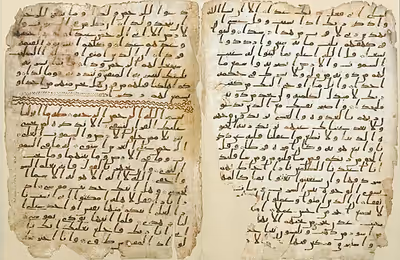
In 1972, in a mosque in the city of Sanaa, Yemen, manuscripts "consisting of 12,000 pieces" were discovered that were later proven to be the oldest Quranic text known to exist at the time. The Sanaa manuscripts contain palimpsests, manuscript pages from which the text has been washed off to make the parchment reusable again. However, the faint washed-off underlying text (scriptio inferior) is still barely visible. The German scholar Gerd R. Puin has been investigating these Quran fragments for years. His research team made 35,000 microfilm photographs of the manuscripts, which he dated to the early part of the 8th century. Puin has noted unconventional and different verse orderings, minor textual variations, and rare styles of orthography, and suggested that some of the parchments were palimpsests which had been reused. Puin believed that this implied an evolving text as opposed to a fixed one.
Among the earliest Quranic manuscripts, the Sana'a manuscript has revealed numerous remarkable textual variants, as well as between the subtext and the standard 1924 Cairo edition. Some accounts suggest the existence of at least four different Qurans with significant differences, written by Ubayy b. Ka'b, Abd Allah ibn Mas'ud, Abu Musa al-Ash'ari, and Miqdad b. al-Aswad, were commonly used in the early period and presented in tradition as "the companions of Muhammad." These "significant differences" between the texts demonstrate that a "synoptic problem" similar to the Gospels in Christianity, whereby different sources depend on other sources, also applies to the Quran. For example, the Quran displays combination of variants internally such as Surah 55:46–60 vs Surah 55:62-76 with repetitions placed in parallel from possibly two variants and also in Surah 26.176–90 & Surah 29.36–37 vs Surah 7:85–93 vs Surah 11:84–93. Textual critics state that based on the diversity of variants found in the manuscript evidence, the editing after Muhammad's death, the history of the transmission of the text showing destruction of variants (e.g. burning), early standardization attempts (e.g. 653–705 AD and 936 AD), along with other factors leads scholars to conclude that there "never was one original text of the Qur’an." The diversity of contents in the Quran has lead some scholars to suggest that the Quran possibly has multiple authors and/or editors.
In order understand the early Quranic development, a survey of non-Muslim sources from the earliest period of Islam was conducted and concluded that non-Muslims show no awareness, in their writings, of a unique Muslim scripture until the 8th century, meaning that the Quran was not available or fixed until around that time. Furthermore, both Muslim and non-Muslim sources indicate that sections of the Qur’an such as suras: the Cow, the Women, and the Family of Imran; were independently circulated as separate works in the 8th century. A recent example of purging was how a large number of pre-1924 Quran variants were destroyed by disposing of them in the river Nile in order to standardize the 1924 Cairo Arabic edition used widely today.
It is also possible that the content of the present-day Qur'an provides information about the geography and history in which the text was likely written. In Quranic studies, while the content of the Quran is seen to be geographically related to the Hejaz and non-Hejaz (Northern Arabian) regions, it is defined and classified in a historical context by fragments pointing to Syriac, Rabbinic, Arabian, Greek and Jewish Christian religious and ethnic origins. Guillaume Dye believes the Quran may be a composite text of traditions originating from many parts of Arabia, including but not limited to the Hejaz. As reported in the narrations, some expressions that are understood today as architectural works are used repeatedly in the Quran and shed light on the dates of writing of the relevant expressions which is known to continue even during the time of Hajjaj. The construction date of the Masjid al-Haram, which is mentioned 16 times in the Quran, is 78 AH, and the construction of the Masjid al-Aqsa coincides with the period of Abd al Malik or al Walid. Furthermore, with a natural external interpretation of the relevant verses, these structures should have been a night's walk from each other. Modern Islamic orthodoxy places these structures in cities like Mecca and Jerusalem, thousands of kilometers away from where Muhammad miraculously flew.Surah Al-Isra 17:1 (See also:Bakkah)
Contents
The Quranic content is concerned with basic Islamic beliefs including the existence of God and the resurrection. Narratives of the early prophets, ethical and legal subjects, historical events of Muhammad's time, charity and prayer also appear in the Quran. The Quranic verses contain general exhortations regarding right and wrong and historical events are related to outline general moral lessons. The style of the Quran has been called "allusive", with commentaries needed to explain what is being referred to—"events are referred to, but not narrated; disagreements are debated without being explained; people and places are mentioned, but rarely named." While tafsir in Islamic sciences expresses the effort to understand the implied and implicit expressions of the Quran, fiqh refers to the efforts to expand the meaning of expressions, especially in the verses related to the provisions, as well as understanding it.
Quranic studies state that, in the historical context, the content of the Quran is related to Rabbinic, Jewish-Christian, Syriac Christian and Hellenic literature, as well as pre-Islamic Arabia. Many places, subjects and mythological figures in the culture of Arabs and many nations in their historical neighborhoods, especially Judeo-Christian stories, are included in the Quran with small allusions, references or sometimes small narratives such as jannāt ʿadn, jahannam, Seven Sleepers, Queen of Sheba etc. The stories of Yusuf and Zulaikha, Moses, Family of Amram (parents of Mary according to the Quran) and mysterious hero Dhul-Qarnayn ("the man with two horns") who built a barrier against Gog and Magog that will remain until the end of time are more detailed and longer stories. Apart from semi-historical events and characters such as King Solomon and David, about Jewish history as well as the exodus of the Israelites from Egypt, tales of the hebrew prophets accepted in Islam, such as Creation, the Flood, struggle of Abraham with Nimrod, sacrifice of his son occupy a wide place in the Quran.
Some philosophers and scholars such as Mohammed Arkoun, who emphasize the mythological content of the Quran, are met with rejectionist attitudes in Islamic circles. In response to the fact that the people mentioned do not correspond to historically known figures, some modern commentators have suggested that these figures should be understood as representative figures portraying certain characters, rather than real ones. Furthermore, considering the findings of the revisionist school of Islamic studies, it is clear that the expression of certain narrative concepts in the Quran that refer to places, people, and events (such as Quraysh, Ababil, and Abu Lahab) in a single word or a few short sentences will require new interpretations and meanings that differ from the traditional narrative within this framework of understanding. (see:Quranic hermeneutics, Harut and Marut)
Creation and God
The central theme of the Quran is monotheism. God is depicted as living, eternal, omniscient and omnipotent (see, e.g., Quran 2:20, 2:29, 2:255). He is the creator of everything, of the heavens and the earth and what is between them (see, e.g., Quran 13:16, 2:253, 50:38, etc.). All human beings are equal in their utter dependence upon God, and their well-being depends upon their acknowledging that fact and living accordingly. The Quran uses cosmological and contingency arguments in various verses without referring to the terms to prove the existence of God; the universe is originated and therefore needs an originator, as whatever exists must have a sufficient cause for its existence. The design of the universe is frequently referred to as a point of contemplation: "It is He who has created seven heavens in harmony. You cannot see any fault in God's creation; then look again: Can you see any flaw?"
"The Qur'ān insists that Muhammad and his followers worship the same God as the Jews (29:46). The Qur'an's Allah is the same Creator God who covenanted with Abraham". Francis Edward Peters states that the Quran portrays Allah as both more powerful and more remote than Yahweh, and as a universal deity, unlike Yahweh who closely follows Israelites. However, Yahweh is never used for God in the Quran and Islamic texts, but, Rabb is an Arabic word to refers to God meaning Lord and the Quran cites in several places as in the Al-Fatiha; "All Praise and Gratitude is due to God, Lord of all the Universe".
Even though Muslims do not doubt about the existence and unity of God, they may have adopted different attitudes that have changed and developed throughout history regarding his nature (attributes), names and relationship with creation. In contrast with pre-Islamic Arabian polytheism, as stated by Gerhard Böwering, God in Islam does not have associates and companions, nor is there any kinship between God and jinn. Pre Islamic Arabs believed in a blind, powerful, unstoppable and insensible fate over which man had no control. This was replaced with the Islamic belief of a powerful yet benevolent and merciful God's control over man's life. In the early periods of Islam, the concept of God was established as a personal deity living in the heavens. This understanding developed over time under the influence of Islamic theology, acquiring a transcendent character. However, in contrast to this transcendent and absolute conception of God established among the elite, the public and Sufis maintained the traditional understanding on God. Also actions and attributes such as coming, going, sitting, satisfaction, anger and sadness etc. similar to humans used for this God in the Quran were considered mutashabihat—"no one knows its interpretation except God" (Quran 3:7)—by later scholars stating that God was free from resemblance to humans in any way. Mustafa Öztürk points out the following words of Ahmad Ibn Hanbal in this regard: "Whoever says that Allah is everywhere is a heretic, an infidel. He should be invited to repent, but if he does not, be killed." This understanding changes later and gives way to the understanding that "God cannot be assigned a place and He is everywhere."
Prophetic stories
In Islam, God speaks to people called prophets through a kind of revelation called wahy, or through angels. (42:51) nubuwwah (Arabic: نبوة 'prophethood') is seen as a duty imposed by God on individuals who have some characteristics such as intelligence, honesty, fortitude and justice: "Nothing is said to you that was not said to the messengers before you, that your lord has at his Command forgiveness as well as a most Grievous Penalty."
Islam regards Abraham as a link in the chain of prophets that begins with Adam and culminates in Muhammad via Ishmael and mentioned in 35 chapters of the Quran, more often than any other biblical personage apart from Moses. Muslims regard him as a hanif, an archetype of the perfect Muslim, and revered prophet and builder of the Kaaba in Mecca. The Quran consistently refers to Islam as 'the religion of Abraham' (millat Ibrahim). In Islam, Eid-al-Adha is celebrated to commemorate Abraham's attempt to sacrifice his son by surrendering in line with his dream, (As-Saaffat; 100–107) which he accepted as the will of God.
In Islam, Moses is a prominent prophet and messenger of God and the most frequently mentioned individual in the Quran, with his name being mentioned 136 times and his life being narrated and recounted more than that of any other prophet. Unlike the hundreds of references in the Quran to the stories of prophets such as Moses and Jesus, it provides very little information about Muhammad himself, his companions, or his contemporaries. The individuals to whom the expressions used in Quranic polemics belong and the contexts in which they were used are merely notes made in commentaries written in later centuries. An exception is his slave/adopted son Zayd, whose name is mentioned in the verses (Al-Aḥzāb;37) in the context of his -divorced- wife being taken into Muhammad's marriages. Probably the clearest biographical account of Muhammad in the Quran is the brief mention of his followers' settlement in Yathrib after their expulsion by the Quraysh, and of military encounters such as the Muslim victory at Badr.
Stories of the prophets in the Quran often revolve around a certain pattern, according to which a prophet is sent to a group of people, who then reject or attack him, and ultimately suffer extinction as God's punishment. However, the Quran, given its paraenetic character, does not offer a full narrative; but rather offers a parabolic reference to the doom of previous generations, assuming the audience is familiar with the told stories.
Ethico-religious concepts
While belief in God and obedience to the prophets are the main emphasis in the prophetic stories, there are also non-prophetic stories in the Quran that emphasize the importance of humility and having profound-inner knowledge (hikmah) besides trusting in God. This is the main theme in the stories of Khidr, Luqman and Dhul Qarnayn. According to the later ascriptions to these stories, it is possible for those with this knowledge and divine support to teach the prophets (Khidr-Moses story Quran 18:65–82) and employ jinn (Dhul Qarnayn). Those who "spend their wealth" on people who are in need because they devoted their lives to the way of Allah and whose situation is unknown because they are ashamed to ask, will be rewarded by Allah. (Al Baqara; 272-274) In the story of Qārūn, the person who avoids searching for the afterlife with his wealth and becomes arrogant will be punished, arrogance befits only God. (Al Mutakabbir) Characters of the stories can be closed-mythical, (Khidr) demi-mythologic or combined characters, and it can also be seen that they are Islamized. While some believe he was a prophet, some researchers equate Luqman with the Alcmaeon of Croton or Aesop.
Commanding ma'ruf and forbidding munkar (Ar. ٱلْأَمْرُ بِٱلْمَعْرُوفِ وَٱلنَّهْيُ عَنِ ٱلْمُنْكَرِ) is repeated or referred to in nearly 30 verses in different contexts in the Quran and is an important part of Islamist / jihadist indoctrination today, as well as Shiite teachings.
Although a common translation of the phrase is "Enjoining good and forbidding evil", the words used by Islamic philosophy determining good and evil in discourses are "husn" and "qubh". The word ma'ruf literally means "known" or what is approved because of its familiarity for a certain society and its antithesis munkar means what is disapproved because it is unknown and extraneous.
The Quran is one of the fundamental sources of Islamic law (sharia). Some formal religious practices receive significant attention in the Quran including the salat and fasting in the month of Ramadan. As for the manner in which the prayer is to be conducted, the Quran refers to prostration. The term chosen for charity, zakat, literally means purification implies that it is a self-purification. In fiqh, the term fard is used for clear imperative provisions based on the Quran. However, it is not possible to say that the relevant verses are understood in the same way by all segments of Islamic commentators; For example, Hanafis accept 5 daily prayers as fard. However, some religious groups such as Quranists and Shiites, who do not doubt that the Quran existing today is a religious source, infer from the same verses that it is clearly ordered to pray two or three times, not five times. About six verses address the way a woman should dress when in public; Some Muslim scholars consider this verse referring to the Hijab while others to clothings in general.
Research shows that the rituals in the Quran, along with laws such as qisas and tax (zakat), developed as an evolution of pre-Islamic Arabian rituals. Arabic words meaning pilgrimage (hajj), prayer (salāt) and charity (zakāt) can be seen in pre-Islamic Safaitic-Arabic inscriptions, and this continuity can be observed in many details, especially in hajj and umrah.
As a source of law and judgment
A small number of verses in the Quran are about general rules of governance, inheritance, marriage, crime and punishment. Although the Quran does not impose a specific legal-management system, it emphasizes custom in nearly 40 verses and commands justice. (An-Nahl; 90) The practices prescribed in the Quran are considered as reflections of contextual legal understandings, as can be clearly seen in some examples such as Qisas and Diya. The following statement in the Quran is thought to be the general rule of testimony in Islamic jurisprudence, except for crime and punishment - for example, debt, shopping, etc.; O believers! When you contract a loan for a fixed period of time, commit it to writing....with justice. Call upon two of your men to witness. If two men cannot be found, then one man and two women of your choice will witness so if one of the women forgets the other may remind her.[Quran 4:11]
As a different example, in the necklace story of Aisha, called Asbab al-Nuzul for surah An-Nur :11-20 four witnesses were required for the accusation of adultery. In addition, those who made accusations that did not meet the specified conditions would be punished with 80 lashes. The jurisprudence of later periods stipulates that witnesses must be men, covering all hadd crimes and people who did not have credibility and honesty in society (slaves, non-adl; sinners, infidels) could not testify against believers. In addition, the Islamic judiciary did not require proof of the issues defined as tazir. The statement in the Quran that determines the status of slaves in community is; Ma malakat aymanuhum meaning "those whom your right hands possess". The widespread use of slavery in the Islamic world continued until the last century, and the unrestricted sexual use of female slaves, with a few exceptions such as they couldn't be loaned out in traditional islamic jurisprudence while stated today often that sharia provides many rights to slaves and aims to eradicate slavery over time.
Sharia is a collection of laws and rules created by scholars' interpretations on the Quran and hadith collections, and has been developed over the centuries, changing according to different geographies and societies. Fiqh sects are schools of understanding that try to determine the actions that people should do or avoid based on the Quran and hadiths. The place of hadiths in legislation is controversial; for example, in the Hanafi sect, in order to claim that something is obligatory, that issue must be clearly expressed in the Quran. Some of these results may also indicate exaggeration of statements, generalizations taken out of context, and imperative broadening of scope. Of the few criminal cases listed as crimes in the Quran, only a few of them are punished by the classical books of sharia as determined by the verses of the Quran and are called hudud laws. How the verse Al-Ma'idah 33, which describes the crime of hirabah, should be understood is a matter of debate even today. The verse talks about the punishment of criminals by killing, hanging, having their hands and feet cut off on opposite sides, and being exiled from the earth, in response to an -abstract- crime such as "fighting against Allah and His Messenger". Expanding or narrowing the conditions and scope of this crime according to new situations and universal legal standards are issues that continue to be discussed today such as punishing in addition to rebellion against the legitimate government on "concrete sequential criminal acts" ie massacre, robbery and rape as preconditions. Mehmet Görmez draws a distinction between the concepts of shar'i (derived from Sharia) and mashru' (lit. approved by Sharia, legal); he states that not every ruling based on the sources of Sharia (nass) can be accepted as mashru' —a term he interprets as implying conformity with the principle of justice.
Although the constitutions of most Muslim-majority states contain references to sharia, its rules are largely preserved only in family law and criminal law in some. The Islamic revival of the late 20th century brought calls by Islamic movements for the full implementation of sharia, including corporal punishment such as stoning for adultery, through a variety of propaganda methods, from civic political activities to terrorism.
Eschatology
The doctrine of the last day and eschatology (the final fate of the universe) may be considered the second great doctrine of the Quran. It is estimated that approximately one-third of the Quran is eschatological, dealing with the afterlife in the next world and with the day of judgment at the end of time. The Quran does not assert a natural immortality of the human soul, since man's existence is dependent on the will of God: when he wills, he causes man to die; and when he wills, he raises him to life again in a bodily resurrection.
In the Quran belief in the afterlife is often referred in conjunction with belief in God: "Believe in God and the last day" emphasizing what is considered impossible is easy in the sight of God. A number of suras such as 44, 56, 75, 78, 81 and 101 are directly related to the afterlife and warn people to be prepared for the "imminent" day referred to in various ways. It is 'the Day of Judgment,' 'the Last Day,' 'the Day of Resurrection,' or simply 'the Hour.' Less frequently it is 'the Day of Distinction', 'the Day of the Gathering' or 'the Day of the Meeting'.
While most topics known as "signs of the apocalypse" in Islamic eschatology are based on non-Quranic sources, some references in the Quran were frequently understood as apocalyptic terms, such as fitna, Dabba, and Gog and Magog. At the time of the Mongol conquests, ibn Kathir identified the latter with the historical Turks and Mongols. The apocalyptic writings frequently feature extra-Quranic figures such as the Dajjāl (corresponding to Armilos and Anti-Christ) and the Mahdī. The Dajjāl is supposed to become a cause of misguidance and causes havoc on earth, but is ultimately stopped by either the Mahdī or ʿĪsā (Jesus) who returns to earth from heaven.
When the time of the apocalypse comes -which is told in a poetic form- the sun is rolled up, the stars fall down, seas are set on fire, mountains are moved people run away in fear and pregnant women miscarry.(At-Takwir 1-7) Then a square is set up and the king or lord of the day;(māliki yawmi-d-dīn) comes and shows his shin; the looks are fearful, those gathered in the square are invited to prostrate;(Al-Qalam 42-43) the question asked is why the innocent female children were killed.(At-Takwir 8-9)
Text and arrangement
The Quran consists of 114 chapters of varying lengths, known as a sūrah. Each sūrah consists of verses, known as āyāt, which originally means a 'sign' or 'evidence' sent by God. The number of verses differs from sūrah to sūrah. An individual verse may be just a few letters or several lines. The total number of verses in the most popular Hafs Quran is 6,236; however, the number varies if the bismillahs are counted separately. According to one estimate the Quran consists of 77,430 words, 18,994 unique words, 12,183 stems, 3,382 lemmas and 1,685 roots.
Chapters are classified as Meccan or Medinan, depending on whether the verses were revealed before or after the migration of Muhammad to the city of Medina on traditional account. However, a sūrah classified as Medinan may contain Meccan verses in it and vice versa. Sūrah names are derived from a name or a character in the text, or from the first letters or words of the sūrah. Chapters are not arranged in chronological order, rather the chapters appear to be arranged roughly in order of decreasing size. Each sūrah except the ninth starts with the Bismillah (بِسْمِ ٱللَّٰهِ ٱلرَّحْمَٰنِ ٱلرَّحِيمِ), an Arabic phrase meaning 'In the name of God.' There are, however, still 114 occurrences of the Bismillah in the Quran, due to its presence in Quran 27:30 as the opening of Solomon's letter to the Queen of Sheba.
The Muqattaʿat (Arabic: حروف مقطعات ḥurūf muqaṭṭaʿāt, 'disjoined letters, disconnected letters'; also 'mysterious letters') are combinations of between one and five Arabic letters figuring at the beginning of 29 out of the 114 chapters of the Quran just after the basmala. The letters are also known as fawātih (فواتح), or 'openers', as they form the opening verse of their respective suras. Four surahs are named for their muqatta'at: Ṭāʾ-Hāʾ, Yāʾ-Sīn, Ṣād, and Qāf. Various theories have been put forward; they were a secret communication language between Allah and Muhammad, abbreviations of various names or attributes of Allah, symbols of the versions of the Quran belonging to different companions, elements of a secret coding system, or expressions containing esoteric meanings. Some researchers associate them with hymns used in Syrian Christianity. The phrases must have been part of these hymns or abbreviations of frequently repeated introductory phrases. Some of them, such as Nun, were used in symbolic meanings.
In addition of the division into chapters, there are various ways of dividing Quran into parts of approximately equal length for convenience in reading. The 30 juz' (plural ajzāʼ) can be used to read through the entire Quran in a month. A juz' is sometimes further divided into two ḥizb (plural aḥzāb), and each hizb subdivided into four rubʻ al-ahzab. The Quran is also divided into seven approximately equal parts, manzil (plural manāzil), for it to be recited in a week. A different structure is provided by semantic units resembling paragraphs and comprising roughly ten āyāt each. Such a section is called a ruku.
Literary style
The Quran's message is conveyed with various literary structures and devices. In the original Arabic, the suras and verses employ phonetic and thematic structures that assist the audience's efforts to recall the message of the text. Muslims, such as Dr. Mustafa Khattab in his The Clear Quran assert, according to the Quran itself, that the Quranic content and style is inimitable.
The language of the Quran has been described as "rhymed prose" as it partakes of both poetry and prose; however, this description runs the risk of failing to convey the rhythmic quality of Quranic language, which is more poetic in some parts and more prose-like in others. Rhyme, while found throughout the Quran, is conspicuous in many of the earlier Meccan suras, in which relatively short verses throw the rhyming words into prominence. The effectiveness of such a form is evident for instance in Sura 81, and there can be no doubt that these passages impressed the conscience of the hearers. Frequently a change of rhyme from one set of verses to another signals a change in the subject of discussion. Later sections also preserve this form but the style is more expository.
Today, the Quranic text contains numerous expressions ('ql' meaning "say") that create the image of it as a direct divine word commanding Muhammad. Michael Cook has noted an aspect of this phenomenon. There was no distinction between "say" or "he said" in the original texts (Rasm). However, later texts standardized the "ql" expression (which can be read as both "he said" and "say") in these texts to be read as "say" in many places. (According to the current reading style, the word "Say" appears a total of 332 times in the Quran.)
The Quranic text seems to have no beginning, middle, or end, its nonlinear structure being akin to a web or net. The textual arrangement is sometimes considered to exhibit lack of continuity, absence of any chronological or thematic order and repetitiousness. Michael Sells, citing the work of the critic Norman O. Brown, acknowledges Brown's observation that the seeming disorganization of Quranic literary expression—its scattered or fragmented mode of composition in Sells's phrase—is in fact a literary device capable of delivering profound effects as if the intensity of the prophetic message were shattering the vehicle of human language in which it was being communicated. Sells also addresses the much-discussed repetitiveness of the Quran, seeing this, too, as a literary device. Another group of researchers explores the irregularities and repetitions mentioned in the Quranic text in a way that refutes the traditional claim that it was preserved by memorization alongside writing. According to them, an oral period shaped the Quran as a text and order, and mentioned repetitions and irregularities were remnants of this period.
A text is self-referential when it speaks about itself and makes reference to itself. According to Stefan Wild, the Quran demonstrates this metatextuality by explaining, classifying, interpreting and justifying the words to be transmitted. Self-referentiality is evident in those passages where the Quran refers to itself as revelation (tanzil), remembrance (dhikr), news (naba'), criterion (furqan) in a self-designating manner (explicitly asserting its Divinity, "And this is a blessed Remembrance that We have sent down; so are you now denying it?"), or in the frequent appearance of the "Say" tags, when Muhammad is commanded to speak (e.g., "Say: 'God's guidance is the true guidance'", "Say: 'Would you then dispute with us concerning God?'"). According to Wild the Quran is highly self-referential. The feature is more evident in early Meccan suras.
Inimitability
In Islam, 'i'jāz (Arabic: اَلْإِعْجَازُ), "inimitability challenge" of the Quran in sense of feṣāḥa and belagha (both eloquence and rhetoric) is the doctrine which holds that the Quran has a miraculous quality, both in content and in form, that no human speech can match. According to this, the Quran is a miracle and its inimitability is the proof granted to Muhammad in authentication of his prophetic status. The literary quality of the Quran has been praised by Muslim scholars and by many non-Muslim scholars. The doctrine of the miraculousness of the Quran is further emphasized by Muhammad's illiteracy since the unlettered prophet could not have been suspected of composing the Quran.
The Quran is widely regarded as the finest work in Arabic literature. The emergence of the Quran was an oral and aural poetic experience; the aesthetic experience of reciting and hearing the Quran is often regarded as one of the main reasons behind conversion to Islam in the early days. Pre-Islamic Arabic poetry was an element of challenge, propaganda and warfare, and those who incapacitated their opponents from doing the same in feṣāḥa and Belagha socially honored, as could be seen on Mu'allaqat poets. The etymology of the word "shā'ir; (poet)" connotes the meaning of a man of inspirational knowledge, of unseen powers. `To the early Arabs poetry was ṣihr ḥalāl and the poet was a genius who had supernatural communications with the jinn or spirits, the muses who inspired him.' Although pre-Islamic Arabs gave poets status associated with suprahuman beings, soothsayers and prophecies were seen as persons of lower status. Contrary to later hurufic and recent scientific prophecy claims, traditional miracle statements about the Quran hadn't focused on prophecies, with a few exceptions like the Byzantine victory over the Persians in wars that continued for hundreds of years with mutual victories and defeats.
The first works about the 'i'jāz of the Quran began to appear in the 9th century in the Mu'tazila circles, which emphasized only its literary aspect, and were adopted by other religious groups. According to grammarian Al-Rummani the eloquence contained in the Quran consisted of tashbīh, istiʿāra, taǧānus, mubālaġa, concision, clarity of speech (bayān), and talāʾum. He also added other features developed by himself; the free variation of themes (taṣrīf al-maʿānī), the implication content (taḍmīn) of the expressions and the rhyming closures (fawāṣil). The most famous works on the doctrine of inimitability are two medieval books by the grammarian Al Jurjani (d. 1078 CE), Dala'il al-i'jaz ('the Arguments of Inimitability') and Asraral-balagha ('the Secrets of Eloquence'). Al Jurjani believed that Quran's eloquence must be a certain special quality in the manner of its stylistic arrangement and composition or a certain special way of joining words. Angelika Neuwirth lists the factors that led to the emergence of the doctrine of 'i'jāz: The necessity of explaining some challenging verses in the Quran; In the context of the emergence of the theory of "proofs of prophecy" (dâ'il an-nubuwwa) in Islamic theology, proving that the Quran is a work worthy of the emphasized superior place of Muhammad in the history of the prophets, thus gaining polemical superiority over Jews and Christians; Preservation of Arab national pride in the face of confrontation with the Iranian Shu'ubiyya movement, etc. Orientalist scholars Theodor Nöldeke, Friedrich Schwally and John Wansbrough, pointing out linguistic defects, held similar opinions on the Quranic text as careless and imperfect.
Significance in Islam
Quran says, "We have sent down the Quran in truth, and with the truth it has come down" and frequently asserts in its text that it is divinely ordained. The Quran speaks of a written pre-text that records God's speech before it is sent down, the "preserved tablet" that is the basis of the belief in fate also, and Muslims believe that the Quran was sent down or started to be sent down on the Laylat al-Qadr.
Revered by pious Muslims as "the holy of holies", whose sound moves some to "tears and ecstasy", it is the physical symbol of the faith, the text often used as a charm on occasions of birth, death, and marriage. Traditionally, before starting to read the Quran, ablution is performed, one seeks refuge in Allah from the accursed Satan, and the reading begins by mentioning the names of Allah, Rahman and Rahim together known as basmala. Consequently,
It must never rest beneath other books, but always on top of them, one must never drink or smoke when it is being read aloud, and it must be listened to in silence. It is a talisman against disease and disaster.
According to Islam, the Quran is the word of God (Kalām Allāh). Its nature and whether it was created became a matter of fierce debate among religious scholars; and with the involvement of the political authority in the discussions, some Muslim religious scholars who stood against the political stance faced religious persecution during the caliph al-Ma'mun period and the following years.
Muslims believe that the present Quranic text corresponds to that revealed to Muhammad, and according to their interpretation of Quran 15:9, it is protected from corruption ("Indeed, it is We who sent down the Quran and indeed, We will be its guardians"). Muslims consider the Quran to be a sign of the prophethood of Muhammad and the truth of the religion. For this reason, in traditional Islamic societies, great importance was given to children memorizing the Quran, and those who memorized the entire Quran were honored with the title of hafiz. Even today, "millions and millions of people refer to the Koran daily to explain their actions and to justify their aspirations" or see it as the source of scientific knowledge, though this has been criticized as pseudoscientific.
Muslims believe the Quran to be God's literal words, a complete code of life, the final revelation to humanity, a work of divine guidance revealed to Muhammad through the angel Gabriel. On the other hand it is believed in Muslim community that full understanding of it can only be possible with the depths obtained in the basic and religious sciences that the ulema (imams in shia) might access, as "heirs of the prophets". For this reason, direct reading of the Quran or applications based on its literal translations are considered problematic except for some groups such as Quranists thinking that the Quran is a complete and clear book; and tafsir / fiqh are brought fore to correct understandings in it. With a classical approach, scholars will discuss verses of the Quran in context called asbab al-nuzul in islamic literature, as well as language and linguistics; will pass it through filters such as muhkam and mutashabih, nasıkh and abrogated; will open the closed expressions and try to guide the believers. There is no standardization in Quran translations, and interpretations range from traditional scholastic, to literalist-salafist understandings to Esoteric-Sufist, to modern and secular exegesis according to the personal scientific depth and tendencies of scholars.
In worship
Surah Al-Fatiha, the first chapter of the Quran, is recited in full in every rakat of salah and on other occasions. This sura, which consists of seven verses, is the most often recited surah of the Quran:
بِسْمِ ٱللَّهِ ٱلرَّحْمَٰنِ ٱلرَّحِيمِ
ٱلْحَمْدُ لِلَّهِ رَبِّ ٱلْعَٰلَمِينَ
ٱلرَّحْمَٰنِ ٱلرَّحِيمِ
مَٰلِكِ يَوْمِ ٱلدِّينِ
إِيَّاكَ نَعْبُدُ وَإِيَّاكَ نَسْتَعِينُ
ٱهْدِنَا ٱلصِّرَٰطَ ٱلْمُسْتَقِيمَ
صِرَٰطَ ٱلَّذِينَ أَنْعَمْتَ عَلَيْهِمْ غَيْرِ ٱلْمَغْضُوبِ عَلَيْهِمْ وَلَا ٱلضَّآلِّينَ
— Quran 1:1-7 Translation:
In the Name of Allah the Entirely Merciful, the Especially Merciful.
[All] praise is [due] to Allah, Lord of the worlds —
The Entirely Merciful, the Especially Merciful,
Sovereign of the Day of Recompense.
It is You we worship and You we ask for help
Guide us to the straight path—
The path of those upon whom You have bestowed favor, not of those who have evoked [Your] anger or of those who are astray.
— Sahih International English translation
Other sections of the Quran of choice are also read in daily prayers. Sura Al-Ikhlāṣ is second in frequency of Quran recitation, for according to many early authorities, Muhammad said that Ikhlāṣ is equivalent to one-third of the whole Quran.
قُلۡ هُوَ ٱللَّهُ أَحَدٌ
ٱللَّهُ ٱلصَّمَدُ
لَمۡ یَلِدۡ وَلَمۡ یُولَدۡ
وَلَمۡ یَكُن لَّهُۥ كُفُوًا أَحَدُۢ
— Surah Al-Ikhlāṣ 112:1-4 Translation:
Say, ˹O Prophet,˺ "He is God—One ˹and Indivisible˺;
God—the Sustainer ˹needed by all˺.
He has never had offspring, nor was He born.
And there is none comparable to Him."
— The Clear Quran English translation
Respect for the written text of the Quran is an important element of religious faith by many Muslims, and the Quran is treated with reverence. Based on tradition and a literal interpretation of Quran 56:79 ("none shall touch but those who are clean"), some Muslims believe that they must perform a ritual cleansing with water (wudu or ghusl) before touching a copy of the Quran, although this view is not universal.
Worn-out and old copies of the Quran are wrapped in a cloth and stored indefinitely in a safe place, buried in a mosque or a Muslim cemetery, or burned and the ashes buried or scattered over water. While praying, the Quran is only recited in Arabic.
In Islam, most intellectual disciplines, including Islamic theology, philosophy, mysticism and jurisprudence, have been concerned with the Quran or have their foundation in its teachings. Muslims believe that the preaching or reading of the Quran is rewarded with divine rewards variously called ajr, thawab, or hasanat.
In Islamic art
The Quran also inspired Islamic arts and specifically the so-called Quranic arts of calligraphy and illumination. The Quran is never decorated with figurative images, but many Qurans have been highly decorated with decorative patterns in the margins of the page, or between the lines or at the start of suras. Islamic verses appear in many other media, on buildings and on objects of all sizes, such as mosque lamps, metal work, pottery and single pages of calligraphy for muraqqas or albums.
Interpretation
Tafsir (Arabic: تفسير, romanized: tafsīr ; English: explanation) refers to an exegesis, or commentary, of the Quran. An author of a tafsir is a mufassir (Arabic: مُفسّر; plural: Arabic: مفسّرون, romanized: mufassirūn). A Quranic tafsir attempts to provide elucidation, explanation, interpretation, context or commentary for clear understanding and conviction of God's will in Islam. In the classical approach, the exegesis of the Qur'an is built on the 7th verse of Al Imran-7;
"He is the one who has sent down to you the Book. In it are verses that are sound (muhkamat), which are the foundation of the Book, and others that are assimilated (mutashabihat; resembling one another)." In classical approach verses that speak of Allah's "hand," "throne" (arsh), or His "sitting on throne" (istiwa) are considered mutashabih. These expressions are not believed to refer to a physical organ or action but are seen as metaphorical expressions symbolizing Allah's power, knowledge, or majesty.
Principally, a tafsir deals with the issues of linguistics, jurisprudence, and theology. In terms of perspective and approach, tafsir can be broadly divided into two main categories, namely tafsir bi-al-ma'thur (lit. received tafsir), which is transmitted from the early days of Islam through the Islamic prophet Muhammad and his companions, and tafsir bi-al-ra'y (lit. tafsir by opinion), which is arrived through personal reflection or independent rational thinking.
Knowledge of context / Asbab al-Nuzul; a scholar must understand the reasons and circumstances of a revelation in order to interpret the text correctly. If a verse is isolated without knowing the context, it can be misinterpreted.
Quranic hermeneutics, and hermeneutics in general, refers to efforts to understand the Quran and Islamic texts through a more objective and secular approach, using universal criteria and moving beyond traditionally imposed forms. The Syro-Aramaic Reading of the Koran offers a new and compelling approach to understanding the implications of the Quran, based on linguistic and geographical-cultural knowledge that also coincides with the findings of historical research of the revisionist school.
There are different characteristics and traditions for each of the tafsirs representing respective schools and doctrines, such as Sunni Islam, Shia Islam, and Sufism. There are also general distinctions between classic tafsirs compiled by authoritative figures of Muslim scholarship during the formative ages of Islam, and modern tafsir which seeks to address a wider audience, including the common people.
Exoteric and Esoteric interpretations (ta'wil)
Commentaries dealing with the zahir ('outward aspects') of the text are called tafsir, (explanation) and hermeneutic and esoteric commentaries dealing with the batin are called ta'wil ('interpretation'). Commentators with an esoteric slant believe that the ultimate meaning of the Quran is known only to God. Esoteric or Sufi interpretation relates Quranic verses to the inner or esoteric (batin) and metaphysical dimensions of existence and consciousness. According to Sands, esoteric interpretations are more suggestive than declarative, and are allusions (isharat) rather than explanations (tafsir). They indicate possibilities as much as they demonstrate the insights of writers.
Shias and Sunnis as well as some Muslim philosophers believe the meaning of the Quran is not restricted to the literal aspect. In contrast, Quranic literalism, followed by Salafis and Zahiris, is the belief that the Quran should only be taken at its apparent meaning. Henry Corbin narrates a hadith that goes back to Muhammad:
The Quran possesses an external appearance and a hidden depth, an exoteric meaning and an esoteric meaning. This esoteric meaning in turn conceals an esoteric meaning. So it goes on for seven esoteric meanings.
According to esoteric interpreters, the inner meaning of the Quran does not eradicate or invalidate its outward meaning. Rather, it is like the soul, which gives life to the body. Corbin considers the Quran to play a part in Islamic philosophy, because Gnosiology itself goes hand in hand with prophetology.
Translations
Translating the Quran has always been problematic and difficult. Many argue that the Quranic text cannot be reproduced in another language or form. An Arabic word may have a range of meanings depending on the context, making an accurate translation difficult. Moreover, one of the biggest difficulties in understanding the Quran for those who do not know its language in the face of shifts in linguistic usage over the centuries is semantic translations (meanings) that include the translator's contributions to the relevant text instead of literal ones. Although the author's contributions are often bracketed and shown separately, the author's individual tendencies may also come to the fore in making sense of the main text. These studies contain reflections and even distortions caused by the region, sect, education, ideology and knowledge of the people who made them, and efforts to reach the real content are drowned in the details of volumes of commentaries. These distortions can manifest themselves in many areas of belief and practices such as hijab. In fact, every new interpretation and translation of the Quran inherently involves a new semantic restructuring of it.
Islamic tradition also holds that translations were made for Negus of Abyssinia and Byzantine Emperor Heraclius, as both received letters by Muhammad containing verses from the Quran. In early centuries, the permissibility of translations was not an issue, but whether one could use translations in prayer. The Quran has been translated into most African, Asian, and European languages. The first translator of the Quran was Salman the Persian, who translated surat al-Fatiha into Persian during the seventh century. Another translation of the Quran was completed in 884 in Alwar (Sindh, India, now Pakistan) by the orders of Abdullah bin Umar bin Abdul Aziz on the request of the Hindu Raja Mehruk.
The first fully attested complete translations of the Quran were done between the 10th and 12th centuries in Persian. The Samanid king, Mansur I (961–976), ordered a group of scholars from Khorasan to translate the Tafsir al-Tabari, originally in Arabic, into Persian. Later in the 11th century, one of the students of Abu Mansur Abdullah al-Ansari wrote a complete tafsir of the Quran in Persian. In the 12th century, Najm al-Din Abu Hafs al-Nasafi translated the Quran into Persian. The manuscripts of all three books have survived and have been published several times. In 1936, translations in 102 languages were known. In 2010, the Hürriyet Daily News and Economic Review reported that the Quran was presented in 112 languages at the 18th International Quran Exhibition in Tehran.
Robert of Ketton's 1143 translation of the Quran for Peter the Venerable, Lex Mahumet pseudoprophete, was the first into a Western language (Latin). Alexander Ross offered the first English version in 1649, from the French translation of L'Alcoran de Mahomet (1647) by Andre du Ryer. In 1734, George Sale produced the first scholarly translation of the Quran into English; another was produced by Richard Bell in 1937, and yet another by Arthur John Arberry in 1955. While all these translators were non-Muslims, there have been numerous translations by Muslims: popular modern English translations by Muslims include The Oxford World Classics translation by Muhammad Abdel Haleem, The Clear Quran by Mustafa Khattab, Sahih International's translation, among various others. As with translations of the Bible, the English translators have sometimes favored archaic English words and constructions over their more modern or conventional equivalents; for example, two widely read translators, Abdullah Yusuf Ali and Marmaduke Pickthall, use the plural and singular ye and thou instead of the more common you.
The oldest Gurmukhi translation of the Quran has been found in village Lande of Moga district of Indian Punjab which was printed in 1911.
Recitation
Rules of recitation
The proper recitation of the Quran is the subject of a separate discipline named tajwid which determines in detail how the Quran should be recited, how each individual syllable is to be pronounced, the need to pay attention to the places where there should be a pause, to elisions, where the pronunciation should be long or short, where letters should be sounded together and where they should be kept separate, etc. It may be said that this discipline studies the laws and methods of the proper recitation of the Quran and covers three main areas: the proper pronunciation of consonants and vowels (the articulation of the Quranic phonemes), the rules of pause in recitation and of resumption of recitation, and the musical and melodious features of recitation.
In order to avoid incorrect pronunciation, reciters follow a program of training with a qualified teacher. The two most popular texts used as references for tajwid rules are Matn al-Jazariyyah by Ibn al-Jazari and Tuhfat al-Atfal by Sulayman al-Jamzuri.
The recitations of a few Egyptian reciters, like El Minshawy, Al-Hussary, Abdul Basit, Mustafa Ismail, were highly influential in the development of current styles of recitation. Southeast Asia is well known for world-class recitation, evidenced in the popularity of the woman reciters such as Maria Ulfah of Jakarta. Today, crowds fill auditoriums for public Quran recitation competitions.
There are generally two types of recitation (based on pace of recitation):
- Murattal is a recitation at moderate pace, used for study and practice.
- Mujawwad refers to a slower recitation that deploys heightened technical artistry and melodic modulation, as in public performances by trained experts. It is directed to and dependent upon an audience for the mujawwad reciter seeks to involve the listeners.
Variant readings
The variant readings of the Quran are one type of textual variant. According to Melchert (2008), the majority of disagreements have to do with vowels to supply, most of them in turn not conceivably reflecting dialectal differences and about one in eight disagreements has to do with whether to place dots above or below the line. Nasser categorizes variant readings into various subtypes, including internal vowels, long vowels, gemination (shaddah), assimilation and alternation.
The first Quranic manuscripts lacked marks, enabling multiple possible recitations to be conveyed by the same written text. The 10th-century Muslim scholar from Baghdad, Ibn Mujāhid, is famous for establishing seven acceptable textual readings of the Quran. He studied various readings and their trustworthiness and chose seven 8th-century readers from the cities of Mecca, Medina, Kufa, Basra and Damascus. Ibn Mujahid did not explain why he chose seven readers, rather than six or ten, but this may be related to a prophetic tradition (Muhammad's saying) reporting that the Quran had been revealed in seven ahruf. Today, the most popular readings are those transmitted by Ḥafṣ (d. 796) and Warsh (d. 812) which are according to two of Ibn Mujahid's reciters, Aasim ibn Abi al-Najud (Kufa, d. 745) and Nafiʽ al-Madani (Medina, d. 785), respectively. The influential standard Quran of Cairo uses an elaborate system of modified vowel-signs and a set of additional symbols for minute details and is based on ʻAsim's recitation, the 8th-century recitation of Kufa. This edition has become the standard for modern printings of the Quran. Occasionally, an early Quran shows compatibility with a particular reading. A Syrian manuscript from the 8th century is shown to have been written according to the reading of Ibn Amir ad-Dimashqi. Another study suggests that this manuscript bears the vocalization of himsi region.
According to Ibn Taymiyyah vocalization markers indicating specific vowel sounds (tashkeel) were introduced into the text of the Quran during the lifetimes of the last Sahabah.
Writing and printing
Writing
Before printing was widely adopted in the 19th century, the Quran was transmitted in manuscripts made by calligraphers and copyists. The earliest manuscripts were written in Ḥijāzī-typescript. The Hijazi style manuscripts nevertheless confirm that transmission of the Quran in writing began at an early stage. Probably in the ninth century, scripts began to feature thicker strokes, which are traditionally known as Kufic scripts. Toward the end of the ninth century, new scripts began to appear in copies of the Quran and replace earlier scripts. The reason for discontinuation in the use of the earlier style was that it took too long to produce and the demand for copies was increasing. Copyists would therefore choose simpler writing styles. Beginning in the 11th century, the styles of writing employed were primarily the naskh, muhaqqaq, rayḥānī and, on rarer occasions, the thuluth script. Naskh was in very widespread use. In North Africa and Iberia, the Maghribī style was popular. More distinct is the Bihari script which was used solely in the north of India. Nastaʻlīq style was also rarely used in Persian world.
In the beginning, the Quran was not written with dots or tashkeel. These features were added to the text during the lifetimes of the last of the Sahabah. Since it would have been too costly for most Muslims to purchase a manuscript, copies of the Quran were held in mosques in order to make them accessible to people. These copies frequently took the form of a series of 30 parts or juzʼ. In terms of productivity, the Ottoman copyists provide the best example. This was in response to widespread demand, unpopularity of printing methods and for aesthetic reasons.
Whilst the majority of Islamic scribes were men, some women also worked as scholars and copyists; one such woman who made a copy of this text was the Moroccan jurist, Amina, bint al-Hajj ʿAbd al-Latif.
Printing
Woodblock printing of extracts from the Quran is on record as early as the 10th century. This technique was known as tarsh and it reached a high degree of complexity, printing letters only one milimeter in height, a remarkable technical achievement. Different scripts like Kufic, Naskh and Maghrebi were used, along with several colors like red, yellow and green. These printed quotations of the Quran were mainly used for protection talismans and amulets, but it was also used in the 13th century for printed hajj certificates. However, after 1444 the technique vanished for unknown reasons.
Arabic movable type printing was ordered by Pope Julius II (r. 1503–1512) for distribution among Middle Eastern Christians. The first complete Quran printed with movable type was produced in Venice in 1537–1538 for the Ottoman market by Paganino Paganini and Alessandro Paganini. But this Quran was not used as it contained a large number of errors. Two more editions include the Hinckelmann edition published by the pastor Abraham Hinckelmann in Hamburg in 1694, and the edition by the Italian priest Ludovico Maracci in Padua in 1698 with Latin translation and commentary.
Printed copies of the Quran during this period met with strong opposition from Muslim legal scholars: printing anything in Arabic was prohibited in the Ottoman empire between 1483 and 1726—initially, even on penalty of death. The Ottoman ban on printing in Arabic script was lifted in 1726 for non-religious texts only upon the request of Ibrahim Muteferrika, who printed his first book in 1729. Except for books in Hebrew and European languages, which were unrestricted, very few books, and no religious texts, were printed in the Ottoman Empire for another century.
In 1786, Catherine the Great of Russia, sponsored a printing press for "Tatar and Turkish orthography" in Saint Petersburg, with one Mullah Osman Ismail responsible for producing the Arabic types. A Quran was printed with this press in 1787, reprinted in 1790 and 1793 in Saint Petersburg, and in 1803 in Kazan. The first edition printed in Iran appeared in Tehran (1828), a translation in Turkish was printed in Cairo in 1842, and the first officially sanctioned Ottoman edition was finally printed in Constantinople between 1875 and 1877 as a two-volume set, during the First Constitutional Era.
Gustav Flügel published an edition of the Quran in 1834 in Leipzig, which remained authoritative in Europe for close to a century, until Cairo's Al-Azhar University published an edition of the Quran in 1924. This edition was the result of a long preparation, as it standardized Quranic orthography, and it remains the basis of later editions.
Criticism
Common criticisms of the Quran concern its questionable origins, imperfect textual and oral transmission, imperfect preservation, pre-existing sources that the Quran relies upon, internal inconsistency, and ethical teachings.
No critical text of the Quran, based on manuscript analysis, has ever been made and this is considered problematic since all other ancient and even sacred literature have been studied for accuracy. Textual critics state that based on the diversity found in the manuscript evidence, the editing after Muhammad's death, early purges of variants, early standardization attempts (e.g. 653–705 AD and 936 AD), along with other factors leads to the view that there "never was one original text of the Qur’ān." Scholars argue that the earliest Muslims had a confusing understanding of Muhammad's message and that the emergence of multiple conflicting traditions exhibit many attempts to make sense of the chaos of composition, including examples of dependence on Christian and Jewish texts.
The Quran's oral formation and written transmission, before and after Muhammad, has been questioned on the grounds of variants in manuscripts, the existence of numerous early contradictory narratives of how the Quran was composed, and early sources themselves discussing actual variants from even the followers of Muhammad. Sunni and Shia sects of Islam have competing and contradictory narratives of origins of the Quran which cannot be reconciled. Early sources by non-Muslims indicate that there was no Quran at the time of Muhammad since early Christian and Jewish sources on Islam show no awareness of a unique Muslim scripture during Muhammad's lifetime.
Regarding the claim of divine origin, critics refer to pre-existing sources, not only taken from the Bible, supposed to be older revelations of God, but also from heretic, Apocryphic and talmudic sources, such as the Syriac Infancy Gospel and Gospel of James. The Quran acknowledges that accusations of borrowing popular ancient fables were being made against Muhammad.
Relationship with other literature
Some non-Muslim groups such as the Baháʼí Faith and Druze view the Quran as holy. In the Baháʼí Faith, the Quran is accepted as authentic revelation from God along with the revelations of the other world religions, Islam being viewed as a stage within the divine process of progressive revelation. Bahá'u'lláh, the Prophet-Founder of the Baháʼí Faith, wrote about the Quran. Unitarian Universalists may also seek inspiration from the Quran. It has been suggested that the Quran has some narrative similarities to the Diatessaron, Protoevangelium of James, Infancy Gospel of Thomas, Gospel of Pseudo-Matthew and the Arabic Infancy Gospel. One scholar has suggested that the Diatessaron, as a gospel harmony, may have led to the conception that the Christian Gospel is one text.
Relationship with Jewish and Christian texts
The Quran attributes its relationship with former books (the Torah, or Tawrāh and the Gospel, or ʾInjīl) to their unique origin, saying all of them have been revealed by Allah. The Quran explicitly names the Torah, Gospel and Psalms as distinct entities (Surah 3:3-4, Surah 4:163, Surah 5:44-46) as well as references to "the ancient scriptures, the scriptures of Abraham and Moses" (Surah 87:18–19; Surah 53:36–37). Many today believe it asserts that Jews and Christians have corrupted it through falsification and alteration (Taḥrīf). However, others state that the Quran shows deep reverence for these scriptures as preserved both essentially as we have them today and at the time of the prophet; and that many major interpreters of the Quran (tafsir) did as well, with any issues being over interpretation instead of textual corruption. A study of Muslim views of the Bible in the first four centuries observed that positive views of preservation of previous scriptures is prevalent in the Quran itself, even in the few verses expressing a negative view, and among early commentators due to the belief that Muhammad was in the previous scriptures. Analysis of early commentaries (tafsir) on the Quranic understanding of tampering of previous scriptures indicate that at the beginning even the words commentators used to describe tampering did not imply or mean textual corruption, as Muhammad was understood to be in the Torah, at least. Biblical scholars note that the manuscript evidence of the New Testament verifies that it was the same as in the time of Muhammad and before, so a dilemma between the revelations by the same deity emerges.
According to Christoph Luxenberg (in The Syro-Aramaic Reading of the Koran) the Quran's language was similar to the Syriac language. The Quran recounts stories of many of the people and events recounted in Jewish and Christian sacred books (Tanakh, Bible) and devotional literature (Apocrypha, Midrash), although it differs in many details. Adam, Enoch, Noah, Eber, Shelah, Abraham, Lot, Ishmael, Isaac, Jacob, Joseph, Job, Jethro, David, Solomon, Elijah, Elisha, Jonah, Aaron, Moses, Zechariah, John the Baptist and Jesus are mentioned in the Quran as prophets of God (see Prophets of Islam). In fact, Moses is mentioned more in the Quran than any other individual. Jesus is mentioned more often in the Quran than Muhammad (by name—Muhammad is often alluded to as "The Prophet" or "The Apostle"), while Mary is mentioned in the Quran more than in the New Testament.
The Quran is highly saturated in biblical traditions yet, it is unlikely that Muhammad or his audience had access to written copies of the Bible and other Jewish and Christian literature since direct quotes are quite rare. Instead the Quran often paraphrases, alludes to, and echoes these biblical narratives showing evidence of limited engagement with written texts, whether Biblical, extra-Biblical, or post-Biblical. Most of these biblical traditions reached Muhammad and his followers in oral form. The Quran does not just borrow biblical stories, but changes and elaborates on some of them, often reflecting engagement with Christian versions of stories than other groups.
Relationship with Arab writing
After the Quran, and the general rise of Islam, the Arabic alphabet developed rapidly into an art form. The Arabic grammarian Sibawayh wrote one of the earliest books on Arabic grammar, referred to as "Al-Kitab", which relied heavily on the language in the Quran. Wadad Kadi, Professor of Near Eastern Languages and Civilizations at University of Chicago, and Mustansir Mir, Professor of Islamic studies at Youngstown State University, state that the Quran exerted a particular influence on Arabic literature's diction, themes, metaphors, motifs and symbols and added new expressions and new meanings to old, pre-Islamic words that would become ubiquitous.