


Related on Lably
Sunni Islam
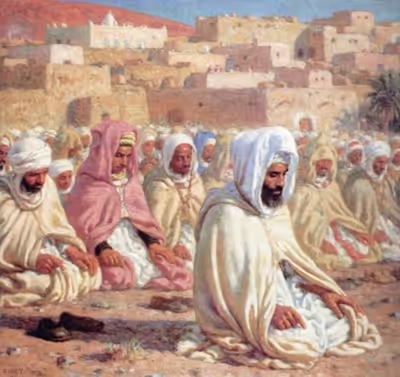
Sunni Islam does not conceive of the role of imams in the same sense as Shia Islam: an important distinction often overlooked by non-Muslims. In everyday terms, an imam for Sunni Muslims is the person charged with leading formal Islamic prayers (Fard) even in locations besides the mosque—whenever prayer is performed in a group of two or more. The imam leads the worship and the congregation copies his actions. Friday sermons are most often given by an appointed imam. All mosques have an imam to lead the congregational prayers—even though it may sometimes just be a member from the gathered congregation rather than an officially appointed, salaried person. Women cannot be imams when men are present but are allowed to be when no men are present. An imam should be chosen, according to multiple ahadith, based on his knowledge of the Qur'an and Sunnah and his moral character.
Title of scholarly authority
Another well-known use of the term is as an honorary title for a recognized religious scholarly authority in Islam. It is especially used for a jurist (faqih) and often for the founders of the four Sunni madhhabs or schools of jurisprudence (fiqh), as well as an authority on Quranic exegesis (tafsir), such as Al-Tabari or Ibn Kathir.
It may also refer to the Muhaddithūn or scholars who created the analytical sciences related to Hadith; due to their scholarly authority, the term may also refer to the heads of Muhammad's family in their generational times.
The position of Imams in Turkey
Imams are appointed by the state to work at mosques and they are required to be graduates of an İmam Hatip high school or have a university degree in theology. This is an official position regulated by the Presidency of Religious Affairs in Turkey and only men are appointed to this position, whilst female officials under the same state organisation work as preachers and Qur'an course tutors, religious services experts, etc. These officials are supposed to belong to the Hanafi school of the Sunni sect.
A central figure in an Islamic movement is also called an imam, like Imam Nawawi in Syria.
Sign in to keep reading
3 more chapters are free with a Lably account.
Shia Islam
In Shia Islam, an imam is not only presented as the man of God par excellence, but as participating fully in the names, attributes, and acts that theology usually reserves for God alone. Imams have a meaning more central to belief, referring to leaders of the community. Twelver and Ismaili Shi'a believe that these imams are chosen by God to be perfect examples for the faithful and to lead all humanity in all aspects of life. They also believe that all the imams chosen are free from committing any sin, impeccability which is called ismah. These leaders must be followed since they are appointed by God.
Twelver
Here follows a list of the Twelvers Shia imams:
Fatimah, also Fatimah al-Zahraa, daughter of Muhammed (615–632), is also considered infallible but not an Imam. Shia Muslims believe that the last Imam, the 12th Imam Mahdi will emerge on the Day of Resurrection (Qiyamah). The title was also used by the Zaidi Shia imams of Yemen, who eventually founded the Mutawakkilite Kingdom of Yemen (1918–1970).
Ismaili
- See Imamah (Ismaili doctrine) and List of Ismaili imams for Ismaili imams.
Zaidi
- See details under Zaidiyyah, Islamic history of Yemen and imams of Yemen.
Imams as secular rulers
At times, imams have held both secular and religious authority. This was the case in Oman among the Kharijite or Ibadi sects. At times, the imams were elected. At other times the position was inherited, as with the Yaruba dynasty from 1624 and 1742. See List of rulers of Oman, the Rustamid dynasty: 776–909, Nabhani dynasty: 1154–1624, the Yaruba dynasty: 1624–1742, the Al Said: 1744–present for further information. The Imamate of Futa Jallon (1727–1896) was a Fulani state in West Africa where secular power alternated between two lines of hereditary imams, or almami. In the Zaidi Shiite sect, imams were secular as well as spiritual leaders who held power in Yemen for more than a thousand years. In 897, a Zaidi ruler, al-Hadi ila'l-Haqq Yahya, founded a line of such imams, a theocratic form of government which survived until the second half of the 20th century (See details under Zaidiyyah, History of Yemen, Imams of Yemen).
Ruhollah Khomeini is officially referred to as imam in Iran. Several Iranian places and institutions are named "Imam Khomeini", including a city, an international airport, a hospital, and a university.
General references
- Martin, Richard C. (2004). "Imam". Encyclopaedia of Islam and the Muslim World. Vol. 1: Encyclopedia of Islam and the Muslim World: A–L. MacMillan. ISBN 0-02-865604-0.
- Momen, Moojan (1985). An Introduction to Shi'i Islam: The History and Doctrines of Twelve. Yale University Press. ISBN 0-300-03531-4.