

Thermochemistry
Branch of thermodynamics
- 3 min read
- 4 chapters

Related on Lably
Through Chemical reaction, Melting and Boiling
Endothermic reactions absorb heat, while exothermic reactions release heat. Thermochemistry coalesces the concepts of thermodynamics with the concept of energy in the form of chemical bonds. The subject commonly includes calculations of such quantities as heat capacity, heat of combustion, heat of formation, enthalpy, entropy, and free energy.
Thermochemistry is one part of the broader field of chemical thermodynamics, which deals with the exchange of all forms of energy between system and surroundings, including not only heat but also various forms of work, as well the exchange of matter. When all forms of energy are considered, the concepts of exothermic and endothermic reactions are generalized to exergonic reactions and endergonic reactions.
History
Thermochemistry rests on two generalizations. Stated in modern terms, they are as follows:
- Lavoisier and Laplace's law (1780): The energy change accompanying any transformation is equal and opposite to energy change accompanying the reverse process.
- Hess' law of constant heat summation (1840): The energy change accompanying any transformation is the same whether the process occurs in one step or many.
These statements preceded the first law of thermodynamics (1845) and helped in its formulation.
Thermochemistry also involves the measurement of the latent heat of phase transitions. Joseph Black had already introduced the concept of latent heat in 1761, based on the observation that heating ice at its melting point did not raise the temperature but instead caused some ice to melt.
Gustav Kirchhoff showed in 1858 that the variation of the heat of reaction is given by the difference in heat capacity between products and reactants: dΔH / dT = ΔCp. Integration of this equation permits the evaluation of the heat of reaction at one temperature from measurements at another temperature.
Sign in to keep reading
3 more chapters are free with a Lably account.
Calorimetry
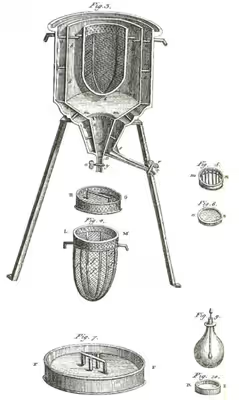
The measurement of heat changes is performed using calorimetry, usually an enclosed chamber within which the change to be examined occurs. The temperature of the chamber is monitored either using a thermometer or thermocouple, and the temperature plotted against time to give a graph from which fundamental quantities can be calculated. Modern calorimeters are frequently supplied with automatic devices to provide a quick read-out of information, one example being the differential scanning calorimeter.
Systems
Several thermodynamic definitions are very useful in thermochemistry. A system is the specific portion of the universe that is being studied. Everything outside the system is considered the surroundings or environment. A system may be:
- a (completely) isolated system which can exchange neither energy nor matter with the surroundings, such as an insulated bomb calorimeter
- a thermally isolated system which can exchange mechanical work but not heat or matter, such as an insulated closed piston or balloon
- a mechanically isolated system which can exchange heat but not mechanical work or matter, such as an uninsulated bomb calorimeter
- a closed system which can exchange energy but not matter, such as an uninsulated closed piston or balloon
- an open system which can exchange both matter and energy with the surroundings, such as a pot of boiling water
Processes
A system undergoes a process when one or more of its properties changes. A process relates to the change of state. An isothermal (same-temperature) process occurs when temperature of the system remains constant. An isobaric (same-pressure) process occurs when the pressure of the system remains constant. A process is adiabatic when no heat exchange occurs.