

Twelve Olympians
Major deities of the Greek pantheon
- 4 min read
- 4 chapters

Related on Lably
Through Apollo
Besides the twelve Olympians, there were many other cultic groupings of twelve gods.
Olympians
The Olympians are a race of deities, primarily consisting of a third and fourth generation of immortal beings, worshipped as the principal gods of the Greek pantheon and so named because of their residency atop Mount Olympus. They gained their supremacy in a ten-year-long war of gods, in which Zeus led his siblings to victory over the previous generation of ruling immortal beings, the Titans, children of the primordial deities Gaia and Uranus. They were a family of gods, the most important consisting of the first generation of Olympians, offspring of the Titans Cronus and Rhea: Zeus, Poseidon, Hera, Demeter and Hestia, along with the principal offspring of Zeus: Aphrodite, Athena, Artemis, Apollo, Ares, Hephaestus, Hermes and Dionysus. Although Hades was a major deity in the Greek pantheon and was the brother of Zeus and the other first generation of Olympians, his realm was far away from Olympus in the underworld, and thus he was not usually considered to be one of the Olympians. Olympic gods can be contrasted to chthonic gods including Hades and his wife Persephone, by mode of sacrifice, the latter receiving sacrifices in a bothros (βόθρος, "pit") or megaron (μέγαρον, "sunken chamber") rather than at an altar.
The canonical number of Olympian gods was twelve, but besides the (thirteen) principal Olympians listed above, there were many other residents of Olympus, who thus might be considered to be Olympians. Heracles became a resident of Olympus after his apotheosis and married another Olympian resident Hebe. According to Diodorus Siculus, some said that Heracles was offered a place among the twelve, but refused as it would mean one of the original twelve being "cast out". In the Iliad, the goddess Themis, who is listed among the twelve Titans, dwells on Olympus alongside the other gods, making her a Titan and an Olympian at the same time. According to Hesiod, the children of Styx—Zelus (Envy), Nike (Victory), Kratos (Strength), and Bia (Force)—"have no house apart from Zeus, nor any dwelling nor path except that wherein God leads them, but they dwell always with Zeus". Some others who might be considered Olympians include the Horae, the Graces, the Muses, Eileithyia, Iris, Dione, and Ganymede.
Sign in to keep reading
3 more chapters are free with a Lably account.
Twelve gods
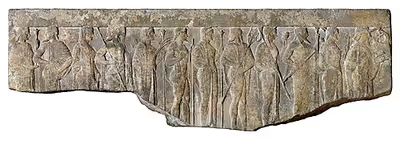
Throughout ancient Greece, there were many cultic groupings of twelve gods, with varying members. The earliest evidence of Greek religious practice involving twelve gods (Greek: δωδεκάθεον, dōdekátheon, from δώδεκα dōdeka, "twelve", and θεοί theoi, "gods") comes no earlier than the late sixth century BC. According to Thucydides, an altar of the twelve gods was established in the agora of Athens by the archon Pisistratus (son of Hippias and the grandson of the tyrant Pisistratus), around 522 BC. The altar became the central point from which distances from Athens were measured and a place of supplication and refuge.
Olympia apparently also had an early tradition of twelve gods. The Homeric Hymn to Hermes (c. 500 BC) has the god Hermes divide a sacrifice of two cows he has stolen from Apollo into twelve parts, on the banks of the river Alpheus (presumably at Olympia):
Next glad-hearted Hermes dragged the rich meats he had prepared and put them on a smooth, flat stone, and divided them into twelve portions distributed by lot, making each portion wholly honorable.
Pindar, in an ode written to be sung at Olympia c. 480 BC, has Heracles sacrificing, alongside the Alpheus, to the "twelve ruling gods":
[Heracles] enclosed the Altis all around and marked it off in the open, and he made the encircling area a resting-place for feasting, honoring the stream of the Alpheus along with the twelve ruling gods.
Another of Pindar's Olympian odes mentions "six double altars". Herodorus of Heraclea (c. 400 BC) also has Heracles founding a shrine at Olympia, with six pairs of gods, each pair sharing a single altar.
Many other places had cults of the twelve gods, including Delos, Chalcedon, Magnesia on the Maeander, and Leontinoi in Sicily. As with the twelve Olympians, although the number of gods was fixed at twelve, the membership varied. While the majority of the gods included as members of these other cults of twelve gods were Olympians, non-Olympians were also sometimes included. For example, Herodorus of Heraclea identified the six pairs of gods at Olympia as: Zeus and Poseidon, Hera and Athena, Hermes and Apollo, the Graces and Dionysus, Artemis and Alpheus, and Cronus and Rhea. Thus, while this list includes the eight Olympians: Zeus, Poseidon, Hera, Athena, Hermes, Apollo, Artemis, and Dionysus, it also contains three clear non-Olympians: the Titan parents of the first generation of Olympians, Cronus and Rhea, and the river god Alpheus, with the status of the Graces (here apparently counted as one god) being unclear.
Plato connected "twelve gods" with the twelve months and implies that he considered Pluto (or Hades) one of the twelve in proposing that the final month be devoted to him and the spirits of the dead.
The Roman poet Ennius gives the Roman equivalents (the Dii Consentes) as six male-female complements, preserving the place of Vesta (Greek Hestia), who played a crucial role in Roman religion as a state goddess maintained by the Vestals.
List
There is no single canonical list of the twelve Olympian gods. The thirteen Greek gods and goddesses, along with their Roman counterparts, most commonly considered to be one of the twelve Olympians are listed below.