

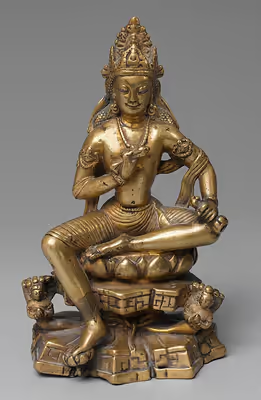

Explore on Lably
ToursExplore Lably’s 3D toursIn Chinese Buddhism and the Japanese Shingon tradition, Vajrasattva is the esoteric aspect of the bodhisattva Samantabhadra and is commonly associated with the student practitioner who, through the master's teachings, attains an ever-enriching, subtle and rarefied grounding in their esoteric practice. In the East Asian esoteric Buddhist Diamond Realm Mandala, Vajrasattva sits to the East near Akshobhya Buddha.
In some esoteric lineages, Nagarjuna was said to have met Vajrasattva in an iron tower in South India, and was taught tantra, thus transmitting the esoteric teachings to more historical figures. In Tibetan Buddhism, Vajrasattva is associated with the sambhogakāya and with purification practice.
Vajrasattva appears in various Buddhist texts, including in the esoteric Vairocanābhisaṃbodhi Sūtra and in the Vajraśekhara Sūtra. Vajrasattva also appears as a major character in the Ghanavyūha sūtra. In the Nyingma canon, Vajrasattva also appears in various Dzogchen texts, such as the Kulayarāja Tantra and The Mirror of the Heart of Vajrasattva.
Vajrasattva's mantra is oṃ Vajrasattva hūṃ (Sanskrit: ॐ वज्रसत्त्व हूँ; Chinese: 唵 斡資囉 薩答 啊 吽 / 嗡 班扎 薩埵 吽; Pinyin: ǎn wòzīluō sàdá a hōng / wēng bānzhā sàduǒ hōng).
Meaning of name
Vajrasattva's name translates to Diamond Being (Sattva roughly translates to hero/being/saint) or Thunderbolt Being. The vajra, a symbol of insight, is associated with Esoteric Buddhism.
Sign in to keep reading
4 more chapters are free with a Lably account.
Newar Buddhism
Vajrasattva is an important figure in the tantric Buddhism of the Newar People of the Kathmandu Valley. He represents the ideal guru, and he is frequently invoked in the guru maṇḍala, the foundational ritual for all other Newar Buddhist rituals and the daily pūjā for Newar priests (vajrācāryas). The śatākṣara (100 syllable prayer to Vajrasattva) is memorized by many practicing Newar Buddhist priests.
East Asian Buddhism
In Chinese Buddhism and Shingon, Vajrasattva is traditionally viewed as the second patriarch of Esoteric Buddhism, the first being Vairocana Buddha. Kukai, in Record of the Dharma Transmission, relates a story based on Amoghavajra's account, of Nagarjuna having met Vajrasattva in an iron tower in southern India. Vajrasattva initiated Nagarjuna into the abhiseka ritual and entrusted him with the esoteric teachings he had learned from Vairocana Buddha, as depicted in the Mahavairocana Sutra. Kukai does not elaborate further on Vajrasattva or his origins.
Elsewhere, Vajrasattva is an important figure in two esoteric Buddhist sutras, the Mahavairocana Sutra and the Vajrasekhara Sutra. In the first chapter of the Mahavairocana Sutra, Vajrasattva leads a host of beings who visit Vairocana Buddha to learn the Dharma. Vajrasattva inquires about the cause, goal and foundation of all-embracing wisdom, which leads to a philosophical discourse delivered by the Buddha. The audience cannot comprehend the teaching, so the Buddha demonstrates through the use of mandala. Vajrasattva then questions why rituals and objects are needed, if the truth is beyond form. Vairocana Buddha replies to Vajrasattva that these are expedient means, whose function is to bring practitioners to awakening more readily, and so on. In Shingon Buddhist rituals for initiation, the kechien kanjō, the initiate re-enacts the role of Vajrasattva and recites mantra and dialogue from the sutras above. The Mahācārya enacts the role of Mahavairocana Buddha, bestowing wisdom upon the student.
In certain esoteric Chinese Buddhist rituals, such as the Yujia Yankou rite (Chinese: 瑜伽燄口; pinyin: Yújiā Yànkǒu), Vajrasattva's Hundred Syllable Mantra is commonly recited as part of the liturgy, while the performing monastic uses ritual vajras and ghantas to expel demons from the ritual platform. Besides these rituals, in different other rituals such as repentance rites, some monastics have also been known to utilize the mantra oṃ Vajrasattva hūṃ (Chinese: 嗡 班扎薩埵 吽; pinyin: Wēng bānzhāsàduǒ hōng).
Tibetan Buddhism
In Tibetan Buddhism the Vajrasattva root tantra is Dorje Gyan, or "Vajra Ornament". Vajrasattva practices are common to all of the five schools of Tibetan Buddhism and are used both to purify obscurations so that the Vajrayana student can progress beyond Ngondro practices to the various yoga practices of tantra and also to purify any broken samaya vows after initiation. As such, Vajrasattva practice is an essential element of Tibetan Buddhist practice.
In addition to personal practice, the Vajrasattva mantra is regarded as having the ability to purify karma, bring peace, and cause enlightened activity in general. Following the September 11, 2001 attacks on the United States, The Dzogchen Ponlop Rinpoche announced a project, Prayer 4 Peace, to accumulate one billion six syllable Vajrasattva recitations from practitioners around the world. The six syllable mantra (oṁ Vajrasattva Hūṁ), is a less formal version of the one hundred syllable mantra on which it is based but contains the essential spiritual points of the longer mantra, according to lama and tulku Jamgon Kongtrul.
Dzogchen
"The Mirror of the Heart of Vajrasattva" (Tibetan: རྡོ་རྗེ་སེམས་དཔའ་སྙིང་གི་མེ་ལོང, Wylie: rdo rje sems dpa' snying gi me long) is one of the Seventeen Tantras of Dzogchen Upadesha.
Samantabhadra discourses to Vajrasattva and in turn Vajrasattva asks questions of Samantabhadra in clarification in the Kulayaraja Tantra (Wylie: kun byed rgyal po, THL: künjé gyalpo) or "The All-Creating King Tantra", the main tantra of the Mind Series of Dzogchen.
Consorts
Vajrasattva is often depicted with various consorts: the peaceful one being Vajragarvi, aka Vajrasatvātmikā (Tib. Dorje Nyema), Dharmadhatvishvari, Ghantapani ("Bell Bearer"), the wrathful one Diptacakra, Vajratopa, Vajrabhrikuti, and others.
Hundred Syllable Mantra
An important mantra associated with Vajrasattva is the Hundred Syllable Mantra. This mantra appears in the Sarvatathāgata-tattvasaṃgraha. The earliest appearance of the mantra is in a collection of mantras (T.866) translated into Chinese by Vajrabodhi (c. 671–741) in 723 CE called A Summary of Recitations Taken from the Sarvatathāgatatattvasaṃgrahasūtra (金剛頂瑜伽中略出念誦經).
The mantra is the following:
In Chinese Buddhism
In Chinese Buddhism, the "Vajrasattva Hundred Syllable Mantra" (Chinese: 金剛薩埵百字明咒; pinyin: Jīngāngsàduǒ bǎizì zhòu) is recited and practiced by monastics during esoteric rituals that have tantric elements. One example is the Yujia Yankou rite (Chinese: 瑜伽焰口; pinyin: Yújiā Yànkou; lit “Yoga Flaming Mouth”), which is commonly conducted as a part of regular temple services in order to facilitate the spiritual nourishment and liberation of hungry ghosts as well as to prolong the lifespans of the living and avert disasters.
In Tibetan Buddhism
In Tibetan Vajrayana Buddhist practice, Vajrasattva is used in the Ngondro, or preliminary practices, in order to purify the mind's defilements, prior to undertaking more advanced tantric techniques. The yik gya, the "Hundred Syllable Mantra" (Tibetan: ཡིག་བརྒྱ་, Wylie: yig brgya) supplication of Vajrasattva, approaches universality in the various elementary Ngondro sadhana for sadhakas of all Mantrayana and Sarma schools bar the Bonpo. The pronunciation and orthography differ between lineages.
The evocation of the Hundred Syllable Vajrasattva Mantra in the Vajrayana lineage of Jigme Lingpa's (1729–1798) ngondro from the Longchen Nyingtig displays Sanskrit-Tibetan hybridization. Such textual and dialectical diglossia (Sanskrit: dvaibhāṣika) is evident from the earliest transmission of tantra into the region, where the original Sanskrit phonemes and lexical items are often orthographically rendered in the Tibetan, rather than the comparable indigenous terms (Davidson, 2002). Though Jigme Lingpa did not compose the Hundred Syllable Mantra, his scribal style bears a marked similarity to it as evidenced by his biographies (Gyatso, 1998). Jigme Lingpa as pandit, which in the Himalayan context denotes an indigenous Tibetan versed in Sanskrit, often wrote in a hybridized Sanskrit-Tibetan diglossia.