


Related on Lably
Through Forest, Grassland and Dietary fiber
The species occurs in a variety of habitats, such as woodlands, savannas, forests, grasslands, shrublands, and wetlands. It is a ruminant and grazer that primarily feeds on 6.5 to 15 kg (14 to 33 lb) of grass and dietary fiber per day. It forms herds ranging in size from a few individuals to over a thousand members. A typical herd consists of adult females and their young, and a few to no adult males that temporarily join herds for mating opportunities. The pecking order among males ensures that dominant individuals hold exclusive mating rights to females in heat. After a 340-day gestation period, females give birth to a single calf; weaning occurs between 10 and 18 months. Due to its power and large size, the African buffalo has few natural predators, though calves are much more vulnerable.
Since the 19th century, its geographic distribution has greatly reduced due to human factors such as poaching, climate change, agriculture, and disease outbreaks. Despite this, conservation efforts have managed to increase populations in some parts of its range. As of 2019, it is listed as Near Threatened on the IUCN Red List, with an estimated population of 398,000 to 401,000 mature individuals.
Taxonomy
The African buffalo was first described by Anders Sparrman in 1779. Due to its pronounced polymorphism, there has been much discussion about its taxonomic status. The IUCN Red List currently lists four subspecies: the Cape buffalo (S.c. caffer), the African forest buffalo (S.c. nanus), the West African buffalo (S.c. brachyceros), and Central African buffalo (S.c. aequinoctialis). A study on maternally inherited mitochondrial DNA reveals two genetic clusters of African buffalo. One cluster consists of a single subspecies, the Cape buffalo from East and Southern Africa, while the other comprises the other three subspecies from West and Central Africa. These results were corroborated by a study on both paternally inherited Y-chromosomes and materially inherited mitochondrial DNA.
Spatial patterns based on microsatellites show that the Cape buffalo cluster, as well as the West and Central African subspecies, underwent slow, continuous genetic changes in relation to an environmental gradient. Based on these patterns, it is believed that savanna buffalo populations (the Cape, West, and Central African buffaloes) were once part of a large metapopulation. In the Central African Republic, the forest buffalo shows similar clinal patterns, but with double the genetic changes accumulated. Low population density and restricted gene flow are likely causes for these differences.
It has been proposed that if genetic evidence is used as an extra criterion for determining subspecies, only three would be recognized: the Cape buffalo (S.c. caffer), African forest buffalo (S.c. nanus), and northern savanna buffalo (S.c. umarii). In 2014, a study suggested that the forest, and West and Central African buffaloes be classified as a single subspecies due to their phylogenetic similarities.
Evolution
Syncerus and Bubalus (Asian buffaloes) split from a common ancestor around 6—9.8 million years ago, according to genetic evidence. S. acoelotus was the earliest known species of Syncerus and was equal in size to the Cape buffalo but with smaller horns. Currently, the African buffalo is the only extant species of the genus, emerging 500 thousand to 1 million years ago. It spread across sub-Saharan Africa during glacial and interpluvial periods as conditions allowed for savanna expansion. Around 130–300 thousand years ago, drastic environmental changes isolated populations into savanna refugia, leading to the formation of two genetic clusters. During the late to middle Pleistocene, the species again dispersed from Central Africa, with one cluster spreading across West Africa, while the other reached East and southern Africa. Genetic evidence indicates that the forest buffalo arose before the Cape buffalo.
Sign in to keep reading
5 more chapters are free with a Lably account.
Habitat
Historically, the African buffalo ranged throughout most of sub-Saharan Africa in habitats with yearly rainfalls above 250 mm. Since the 19th century, geographic distribution has greatly reduced due to human factors such as poaching, climate change, agriculture, and disease outbreaks. Most savanna buffalo populations are restricted to protected areas and nearby hunting zones. The Cape buffalo occurs across East and Southern Africa from Ethiopia southwards to South Africa and westwards to Namibia. Both the West and Central African buffaloes are found within the Sudano-Sahelian zone, with the former ranging from Senegal in the west to the Central African Republic in the east, whereas the latter is distributed north to Chad, south to the Democratic Republic of Congo, and east to Ethiopia. Two separate populations of forest buffalo reside in West and Central Africa, respectively.
The African buffalo can be found in a variety of habitats, such as woodlands, savannas, forests, grasslands, shrublands, and wetlands. It prefers semi-arid environments with a permanent water source not beyond 20–40 km (12–25 mi). In East and Southern Africa, buffalo populations prefer woodlands, while those in West and Central Africa are found in an array of habitats, including shrub savannas and Sudanian woodlands. The forest buffalo is primarily found in forest-savanna mosaics in elevations of up to 4,000 m (13,000 ft).
Description
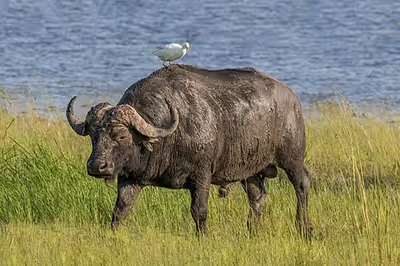
The African buffalo is a large bovid characterized by its stocky build with a broad head and torso, thick, muscular neck, stubby legs, and curved hooves that grow larger in the forelegs than the hindlegs. It is rusty to black in color and has a dark, hairy tuft at the end of the tail. The sagged, often scarred ears are outlined with long hairs, and the broad muzzle has a wet nose and wide eyes.
Both sexes have large horns; however, males possess a fusion of bone called a boss between the bases of their horns. The boss is most pronounced in male Cape buffaloes. Females of this subspecies have smaller horns with hairy skin between them, and like their male counterparts, their horns curve laterally. In forest buffaloes, the horns possess no boss, can reach 65 cm (26 in) long, and point horizontally backwards. Male Cape, and Western and Central African buffaloes have larger horn spans that can grow between 56 cm (22 in) and 165 cm (65 in) across.
The African buffalo is among the most polymorphic of African mammals, as subspecies vary considerably in size, color, and horn shape. The largest subspecies, the Cape buffalo, has a head-to-body length of 210 to 300 cm (83 to 118 in) and a shoulder height of 140 to 160 cm (55 to 63 in). Males weigh 650 to 900 kg (1,430 to 1,980 lb), whereas females reach a maximum of 500 kg (1,100 lb). At 100 to 130 cm (39 to 51 in) tall at the shoulder, 170 to 220 cm (67 to 87 in) in body length and 265 to 320 kg (584 to 705 lb) in weight, the forest buffalo is the smallest subspecies. The tail length, though differing across subspecies, is 55 to 120 cm (22 to 47 in).
Behavior and ecology
Social behavior
The African buffalo is a social animal that congregates in groups called herds comprising adult females, calves, adolescents, and a few to no adult males. The number of individuals in a herd is highly variable and depends on the subspecies and region. In southern and eastern African floodplains, the Cape buffalo is known to form the largest herds of any subspecies, as numbers tend to exceed a thousand. In contrast, only 3–25 animals make up the average forest buffalo herd. For West and Central African buffaloes, typical herd size ranges from 45 to 150 individuals.
Female African buffaloes remain with the herd for life and, in some subspecies, maintain a close bond with their mother post-weaning. On the other hand, aside from the forest buffalo, young males become less and less dependent on their mothers and separate from the herd to temporarily join bachelor groups at age four to five. After a few years, they join a herd to compete for mating opportunities. Once their physical condition deteriorates, males again leave for bachelor groups so as to recover and regain strength by excessively grazing in areas inaccessible to herds. In the forest buffalo, males make up the minority of the stable herd and travel with the group throughout the year.
Mixed herds of savanna buffaloes are fission-fusion societies, where members briefly separate and form subgroups, then unify once more. Separation seems to occur more during the wet season, when there is a resource surplus. Sometimes, separation may be due to large herd size. Stable membership and the preference for a certain home range over long periods of time have been observed in both mixed herds and bachelor groups. A few bulls and some females lead the herd when moving between feeding grounds. Decisions on where to eat or drink are not made by these individuals but rather through a process called 'voting.' After a lengthy resting session, right before dusk, adult females will stand up, raise their heads, and point in a particular direction, then again rest. If multiple voting females point in the same direction, consensus is strong. However, in cases of weak consensus, the herd will separate and rejoin days later.
There is a pecking order among male buffaloes. Dominant individuals display a threat posture by lifting the head up and pointing the nose down, which accentuates the frame. Subordinate males respond by lowering the head and positioning the nose between a dominant bull's hindlegs; they often bellow throughout the interaction. In most cases, bulls observe each other from a distance and avoid direct interaction. Fights only occur when two bulls are evenly matched, and such encounters could lead to serious injuries or death.
The African buffalo is mostly silent but can make sounds such as grunts, bellows, snorts, and coughs. When injured by predators, a bull may emit a loud bellow to signal for help. Coughs and snorts are usually made when running or when a predator is spotted, though no alarm call exists.
Habitat use and activity patterns
African buffalo herds have home ranges that vary from as small as 4.6 km2 (1.8 sq mi) to as large as 350 km2 (140 sq mi). Forest buffaloes have the smallest home range of any subspecies, and space use depends on the season, with herds prioritizing forests in the dry season and marshes in the wet season. In savanna populations, herds occurring in areas where resources are widely distributed have the largest home ranges and often migrate seasonally. Conversely, bachelor groups have small home ranges of only 0.5 to 4.0 km2 (0.19 to 1.54 sq mi). The home range of mixed herds in some ecosystems has been observed increasing in the wet season due to the influx of resources across the land and decreasing in the dry season because of the limitation of water, which restrains herds into small areas. Furthermore, in ecosystems with permanent water access, home ranges expand in the dry season when herds disperse in search of ideal foraging grounds.
The African buffalo spends about 17 to 19 hours a day feeding and ruminating. It is highly dependent on water, requiring 45 L (9.9 imp gal; 12 U.S. gal) every 48 hours. Feeding generally occurs from dawn to mid-morning hours and from late-evening to mid-night hours. The total feeding time during the night is comparable to the feeding time during the day, and across seasons, feeding time is greater in the dry than in the wet season. In most populations, activity appears to occur during both day and night. A study conducted in West Africa in 2011 found buffaloes to spend equal amounts of day and night hours performing daily activities, especially during crepuscular hours.
Savanna buffalo populations average 4 to 6 km (2.5 to 3.7 mi) of distance traveled per day. On the contrary, forest buffaloes only travel 0.5 to 1.5 km (0.31 to 0.93 mi) per day, according to a study in Dzanga-Ndoki National Park, Central African Republic. During the late afternoon, when temperatures are at their highest, forest and mostly male savanna buffaloes wallow to keep cool, though the former wallow more in the dry season. For thermoregulation purposes, members of mixed herds in savanna populations typically seek shade from the searing midday heat.
Diet
The African buffalo is a ruminant that primarily feeds on grass and dietary fiber. Per day, it consumes 6.5 to 15 kg (14 to 33 lb) of grass, about 2.2% of its body weight. In some cases, it is known to live off grass that most other grazers either cannot reach or chew. However, it is unable to shorten grass as much as other herbivores and instead clears the landscape for short-grass grazers, thus filling the ecological niche of an ecosystem engineer. Its preferred foraging grounds include floodplains and forest glades, as they offer large pastures and grass leaves of at least 10 cm (3.9 in) tall.
The Cape buffalo subspecies prefers grass such as panicgrass, Guinea grass, and fonio, and during the dry season when food is scarce and of poor nutritional quality, species such as Leersia hexandra, Setaria sphacelata, and Cyperus laevigatus become important food sources. In West and Central African buffaloes, perennial grass, beard grass, foxtail, and flatsedges are the preferred grass genera. During the dry season, as grass lignifies, the savanna population partially adopts browsing herbivory and also consumes shrubs and tree leaves. Studies on forest buffalo feeding ecology suggest that it mainly feeds on graminoids, arrowroot, day flowers, and cryptogams.
Reproduction
Most Cape buffalo calves are born during the wet season, except in more mesic areas. Data on forest buffalo reproduction is limited, though observations indicate that births can occur during both the dry and wet seasons. A female enters heat for 5 to 6 days in an 18- to 23-day cycle. Males assess a female's readiness to mate by sniffing chemicals in her urine. Usually, dominant males mate with most of the females in heat. After a gestation of 340 days, females typically give birth within the herd to a single calf, weighing 30 kg (66 lb). Calves nurse from the hindquarters, which allows the mother to move with the herd while continuing to suckle her young. As calves get older, they spend less time suckling, from around 10 minutes at one month to 5 minutes by six months; weaning occurs between 10 and 18 months. Females begin breeding by age five, which is two years after they start to ovulate, while males typically breed by at least age seven, despite being sexually mature at five to six. Lifespan is about 12 years in the wild.
Mortality factors
Adult African buffaloes have few natural predators, owing to their aggressive temperament and large size. Calves, however, are much more vulnerable to predation and require constant parental protection. The lion (Panthera leo) is the major predator of Cape buffalo. A pride typically takes advantage of thick vegetation to sneak up on a herd or bachelor group and isolate an individual. If successful, pride members attack the rear to bring the buffalo down and then subdue it with a suffocation bite to the nose as opposed to the neck, which is too thick to break. In other cases, the Cape buffalo drives off or even kills lions. It is especially successful at fending off lions in thick bushes, where it faces them head-on while positioning its rear in the thickets. In open areas, large herds may offer protection from lion predation. Spotted hyenas (Crocuta crocuta) and leopards (Panthera pardus) are minor predators of the Cape buffalo that mostly target calves. On rare occasions, the forest buffalo has been known to fall prey to the leopard. Possible anti-predator behaviors of this subspecies include communal resting and movement, as well as stampeding characterized by a female taking the lead and a male lagging slightly behind.
Like all ungulates, the African buffalo is susceptible to rinderpest, a disease caused by Morbillivirus. Transmission occurs when respiratory droplets or feces from an affected animal come into close contact with a healthy one. Severe diarrhea and dehydration are associated symptoms that often lead to death. The African buffalo serves as a maintenance host for Mycobacterium bovis, a bacteria that causes bovine tuberculosis. Other infections include brucellosis, anthrax, haemorrhagic septicaemia, foot-and-mouth disease, theileriosis, trypanosomiasis, rabies, tick-borne diseases, and African insect-borne diseases.
Conservation
As of 2019, the African buffalo is listed as Near Threatened on the IUCN Red List. There are currently 398,000 to 401,000 mature individuals left in the wild. Human activities such as poaching, expansion of settlements, agriculture, habitat destruction, and wars pose serious threats to the species. The use of the African buffalo for bushmeat is widespread and could lead to local population declines or complete eradication. Other threats include droughts and disease outbreaks.
The West African buffalo persists in a handful of strongholds in countries like Ivory Coast, Senegal, Burkina Faso, Benin, Cameroon, and Niger. Populations are scattered, and geographic distribution has reduced. In a 2023 investigation, West African buffalo populations in these strongholds were shown to have either increased or remained stable, except in Cameroon, where populations experienced a decline. Strongholds for the Central African buffalo include Garamba National Park in the Democratic Republic of Congo and Zakouma National Park in Chad. The forest buffalo endures in Nigeria, Ghana, Ivory Coast, Guinea-Bissau, Benin, Sierra Leone, Guinea, and Liberia, while maintaining strongholds in the Democratic Republic of Congo, Central African Republic, Uganda, Gabon, Cameroon, and Equatorial Guinea. In 2021, an estimated 240,000 Cape buffaloes resided in Tanzania, the most of any country. Between 1998 and 2023, a substantial population increase was observed in South Africa, Mozambique, Namibia, and Uganda. Tanzania and Zimbabwe were the only countries where noticeable dents occurred.
The increased presence of livestock and cash crops in West and Central African protected areas threatens the species. Effective conservation in this region relies heavily on the governance and management decisions that are made. However, due to widespread poverty, corruption, and poor governance, many protected areas in West and Central Africa are underfunded. This is only made worse when considering that Central Africa has the most protected areas of any region relative to its size. In spite of this, buffalo populations in some protected areas have increased as a result of targeted conservation efforts. Additionally, human-wildlife conflict has been mitigated through the use of hunting programs as a source of revenue for rural communities and wildlife agencies alike. Many African countries have slowly incorporated trophy hunting into conservation policies.
State-owned protected areas, private property, and communal land are the main land management systems used across Africa to conserve African buffalo populations. Since 1996, numerous breeding programs in South Africa have been initiated to help re-populate areas where the Cape buffalo once thrived. Breeding programs later transitioned to commercial systems, with around 26,000 privately owned individuals living on about 2,700 reserves and ranches in 2013. The management of a local community's resource coupled with private rewilding efforts, financed through the maintenance of large cultivated marginal lands, is a proposed conservation strategy to increase and maintain biodiversity, as well as create wealth and jobs for the community. The African buffalo, an attraction to tourists and hunters, is vital to such plans.
Relations with humans
Hunting
Prior to colonialism, the African buffalo served as an important source of protein for African societies like the Valley Bisa of Zimbabwe, who regarded buffalo meat as integral to their identity and fate. In Ethiopia and Zambia, the African buffalo is sometimes poached to increase one's social ranking, and among western hunters it is considered a major animal for trophy hunting due to its aggression and power. Out of 37 range countries, the African buffalo can be legally hunted in 16 of them as of 2022. Attacks on humans have been reported and can cause serious injuries or death.
In the late 19th century, a rinderpest outbreak killed 95% of African buffaloes, and targeted hunting by European settlers led to further population declines. By the early 20th century, the African buffalo received protection from uncontrolled hunting. During the same period, safaris and hunting for sport became more popular throughout Africa. Starting in East Africa and expanding after World War II, hunting safaris became increasingly structured as a business and were dictated by law, but following the 1970s permanent and temporary hunting bans in Kenya and Tanzania, respectively, other African regions experienced a rise in hunting safaris.
In human culture
Humans and African buffaloes have co-existed for thousands of years. Across African communities, the African buffalo contributes to human culture, and rock paintings depicting the African buffalo have been dated to as far back as the Middle Stone Age. The local African people generally describe the species as being a dangerous and powerful animal that defends itself viciously.
In southern and West Africa, the African buffalo is widely used as a totemic symbol of strength, courage, and potent spirituality. Horizontal masks depicting the African buffalo have been observed in West African tribes. Many of these masks represent a cross between animal, human, and spirit and are mainly used for dancing and rituals during male initiation ceremonies. In North Africa, a Berber legend has it that an African buffalo and a heifer appeared as the earliest creatures on earth, with the former giving rise to wild animals and the latter to all cattle.
Many African cultures forbid people from invading a buffalo's space or using its body parts. Some groups of pygmy in Cameroon give buffaloes a wide berth due to the widely accepted belief of buffaloes harboring dangerous spirits, whereas southern African ethnic groups do so out of totemism. On the contrary, shamans and traditional healers routinely use buffalo body parts to cure ailments and disease, improve one's sexual life, and fight off bad spirits.
The African buffalo has been used as an icon in numerous social domains, including sports, military units, merchandise, and shipping. The Buffalo bicycle is an African buffalo icon that is 'built for big loads on tough roads in Africa,' a slogan highlighting its size and strength.