


Related on Lably
Through Aluminium, Oxygen and Chemical formula
Corundum is hard, alumina ceramics are electrical insulators, and aluminium oxide is amphoteric, reacting with both acids and bases. Industrial alumina is extracted from bauxite by the Bayer process, and most alumina is used as feedstock for aluminium production in the Hall–Héroult process.
Other important uses include refractory and engineering ceramics, abrasives and polishing materials, catalysts and catalyst supports, adsorbents, electronic and optical materials, protective coatings and effect pigments, and components of glasses and polymer composites. Different applications use different forms of aluminium oxide, ranging from dense α-alumina ceramics and single-crystal sapphire to high-surface-area transition aluminas and thin aluminium-oxide films.
Natural occurrence
Corundum is the most common naturally occurring crystalline form of aluminium oxide. Rubies and sapphires are gem-quality varieties of corundum whose colours arise from trace impurities. Traces of chromium give rubies their deep red colour and are also responsible for their laser properties. Sapphires occur in a range of colours produced by other trace impurities, including iron and titanium. An extremely rare delta form occurs naturally as the mineral deltalumite.
Sign in to keep reading
6 more chapters are free with a Lably account.
History
In the 1750s, Andreas Sigismund Marggraf characterised the "earth" precipitated from alum as distinct from lime; the precipitate was aluminium hydroxide. Louis-Bernard Guyton de Morveau used the French name alumine in 1782. In 1789, Antoine Lavoisier suggested that such undecomposed "earths" might be oxides of metals that had not yet been isolated.
Alumina was extracted from bauxite at Salindres from 1860 using a process developed by Henri Sainte-Claire Deville and his collaborators. The expansion of electrolytic aluminium production following the development of the Hall–Héroult process in 1886 increased demand for purified alumina. Karl Josef Bayer later applied for patents covering two key steps: seeded precipitation of aluminium hydroxide in 1887 and pressure digestion of bauxite in 1892. Together, these developments formed the basis of the Bayer process.
Around the turn of the twentieth century, electric furnaces made commercial production of fused-alumina abrasives possible. In 1902, Auguste Verneuil announced his flame-fusion method for growing synthetic ruby, followed by a detailed account in 1904. The process enabled commercial production of single-crystal corundum.
Commercial production and use of high-alumina ceramics expanded in the late 1920s and early 1930s; early applications included spark-plug insulators and laboratory equipment. Producing high-alumina spark-plug insulators required improvements in high-temperature furnaces and forming methods.
Properties
Physical and mechanical properties
Corundum (α-Al2O3) is hard and is used as an abrasive and in cutting tools.
Dense α-alumina ceramics are stiff but brittle, and their strength depends on defects, microstructure and test conditions. For sintered α-alumina with at least 99.5% purity, at least 98% of theoretical density and a nominal grain size of 5 μm, a representative Young's modulus is about 400 GPa at room temperature.
The thermal conductivity of alumina ceramics depends on temperature and material composition. For the same sintered α-alumina specification, the evaluated thermal conductivity at 20 °C is 33 ± 2 W·m−1·K−1. The stated uncertainty is an estimated combined standard uncertainty.
Electrical and optical properties
Alumina ceramics are electrical insulators. Their electrical resistivity decreases with increasing temperature. For high-purity sintered alumina, the relative permittivity is about 10 at room temperature and at microwave frequencies around 9 GHz. Dielectric loss is particularly sensitive to impurities and microstructure.
Vacuum-ultraviolet measurements of single-crystal α-alumina indicate an optical band gap of about 8.8 eV at room temperature. Optical-quality sapphire transmits light from the ultraviolet through the visible into the infrared. It is birefringent, so its refractive behaviour depends on polarisation and propagation direction. In polycrystalline alumina, pores and differently oriented birefringent grains scatter light; sufficiently dense, fine-grained ceramics can nevertheless be transparent.
Chemical behaviour
Aluminium oxide is amphoteric and reacts with both acids and bases. In aqueous solution, dissolution of γ-alumina under acidic and alkaline conditions can be represented by the following simplified net ionic equations:
Here Al3+(aq) represents hydrated aluminium(III) ions, while [Al(OH)4]− is the tetrahydroxoaluminate ion. The dissolved species present depend on the solution conditions.
α-Alumina is conventionally classified as insoluble in water. Nevertheless, alumina can undergo dissolution and hydration, depending on the material and on conditions such as pH and temperature. In long-duration experiments, γ-alumina suspended in water has been observed to transform progressively into the aluminium hydroxide bayerite.
The surface of γ-alumina contains hydroxyl groups, and water can adsorb either molecularly or by dissociating to form additional hydroxyls. Heating can remove some of these groups and alter their distribution. Coordinatively unsaturated surface aluminium centres act as Lewis acids, while oxygen and hydroxyl groups can provide basic sites. These surface properties influence adsorption and interactions with supported catalytic species. Surface chemistry also depends on hydration and on which crystal faces are exposed, some of which can reconstruct; detailed assignments of individual surface sites therefore depend on the structural model and experimental method used.
Surface films and passivation
When exposed to oxygen or dry air at room temperature, aluminium forms a thin, amorphous oxide film that passivates the surface and inhibits corrosion. The film is a few nanometres thick and grows with exposure time.
Anodising increases the thickness of this oxide layer and allows its morphology to be controlled through the choice of electrolyte and processing conditions. The resulting films are commonly amorphous and may be either barrier-type or porous.
Aluminium oxide also contributes to the corrosion resistance of some aluminium-containing alloys. For example, protective layers formed on cast nickel–aluminium bronze in synthetic seawater have been found to contain aluminium oxide and copper oxide.
Plasma electrolytic oxidation can produce coatings containing crystalline α- and γ-alumina as well as amorphous material. These coatings are often harder than conventional anodised coatings, although their phase composition and properties depend on processing conditions and coating microstructure.
Structure
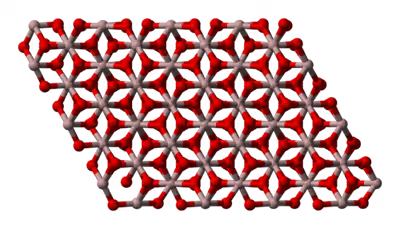
At ambient conditions, α-Al2O3, which has the corundum structure, is the thermodynamically stable form of bulk crystalline aluminium oxide. The oxygen ions form a nearly hexagonal close-packed array, with aluminium ions occupying two-thirds of the octahedral interstices. Each aluminium ion is coordinated by six oxygen ions in a distorted octahedron. Corundum belongs to the trigonal crystal system and has a rhombohedral Bravais lattice, with space group R3c (No. 167). Its rhombohedral primitive cell contains two formula units of Al2O3, while the conventional cell in the hexagonal setting contains six.
The Al–O bonds in corundum have a strong ionic component together with some covalent character.
Aluminium oxide also occurs in several metastable crystalline forms, commonly called transition aluminas. These include the cubic γ and η phases, the monoclinic λ, θ, θ′ and θ″ phases; the hexagonal χ phase; the orthorhombic κ and δ phases; and the tetragonal δ′ phase. The exact structural assignment of some transition aluminas, particularly γ-, δ- and χ-alumina, depends on how the material was prepared and on the structural model used. γ-Al2O3 has important technical applications, including use as a catalyst and catalyst support. The historical name β-alumina refers instead to a sodium-containing aluminate, commonly represented by the ideal formula NaAl11O17, and not to a polymorph of pure Al2O3.
Transition aluminas can form when aluminium hydroxides or oxyhydroxides are heated and lose water; the phases produced depend on the precursor structure, crystallinity, impurities and thermal history. Boehmite commonly yields γ-alumina, followed on further heating by δ- and θ-alumina and ultimately α-alumina, with several phases able to coexist during the transformation. Diaspore forms corundum without passing through this γ-, δ- and θ-alumina sequence. Gibbsite can transform through χ- and κ-alumina, or form boehmite and subsequently γ-alumina. Under rapid heating conditions relevant to Bayer-process calcination, a route from χ- to γ-alumina can also be favoured.
Diffraction-based modelling of liquid aluminium oxide near its melting point indicates that roughly two-thirds of the aluminium atoms are coordinated to four oxygen atoms and about one-third to five, with small fractions having three or six oxygen neighbours. The exact proportions depend on the Al–O distance cutoff used to define coordination. In these models, around 80% of oxygen atoms are shared among three or more Al–O polyhedra. Most polyhedra are connected by shared corners, with fewer edge-sharing connections and only a very small fraction of face-sharing connections.
The average coordination of aluminium in the liquid is lower than the sixfold coordination found in crystalline α-Al2O3. Liquid alumina has a reported density of 2.93 g/cm3 at its melting temperature of 2327 K.
Diffraction-based models indicate that, as liquid alumina cools and becomes supercooled, the fractions of five- and six-coordinate aluminium increase at the expense of four-coordinate aluminium. This shifts the liquid towards the higher average coordination inferred for the amorphous alumina samples studied.
Production
Bauxite, the principal ore of aluminium, consists mainly of aluminium hydroxide and oxyhydroxide minerals, including gibbsite (Al(OH)3), boehmite (γ-AlO(OH)) and diaspore (α-AlO(OH)). It also contains iron oxides and hydroxides, quartz and clay minerals. Bauxite deposits commonly occur in laterites.
Alumina is extracted from bauxite by the Bayer process. During digestion, hot aqueous sodium hydroxide dissolves the aluminium-bearing minerals to form a sodium aluminate solution, known as the liquor. The simplified net ionic reactions can be written in terms of the tetrahydroxoaluminate ion:
The remaining bauxite residue, which contains iron- and titanium-bearing minerals and other solids, is separated by settling and filtration. Reactive silica, including silica in kaolinite, can dissolve during digestion and then precipitate as sodium aluminosilicate desilication products, which are removed with the residue.
The clarified liquor is cooled and seeded with gibbsite crystals to promote precipitation of aluminium hydroxide. The net precipitation reaction regenerates hydroxide ions, allowing the alkaline liquor to be recycled:
The precipitated gibbsite is then filtered, washed and calcined to form alumina:
Industrial flash calciners typically operate at about 1000–1100 °C.
Smelter-grade alumina is typically a mixture of transition aluminas and α-alumina, with proportions depending on the calcination conditions. Its phase composition affects how it dissolves in the molten electrolyte used for aluminium production. Surface area and pore structure are also important when the alumina is used for dry scrubbing of hydrogen fluoride from smelter gases.
Lime–soda sintering
The lime–soda sintering process is an alternative or supplementary route for some high-silica bauxites. The ore is heated with sodium carbonate and limestone, forming soluble sodium aluminate while binding silica in calcium silicates. The sintered material is then leached with water or an alkaline liquor, and the insoluble residue is removed. Aluminium hydroxide is precipitated from the aluminate liquor by carbonation and subsequently calcined to alumina.
Applications
Most alumina is used as feedstock for aluminium production in the Hall–Héroult process. Alumina for smelting is distinguished from grades used in nonmetallurgical applications such as refractories, ceramics and abrasives.
Refractories and engineering ceramics
Alumina ceramics are used in refractory materials and wear-resistant engineering components. Alumina–silica refactories are used for furnace linings and thermal insulation. Electrical applications of alumina ceramics include spark-plug insulators.
High-purity alumina ceramics and alumina–zirconia composites are used as bearing components in hip replacements, including femoral heads and acetabular liners.
Alumina ceramics are also used in armour systems, including ceramic plates bonded to fibre or polymer backings.
Alumina and alumina–mullite fibres are used to reinforce ceramic matrix composites for high-temperature structural applications.
Abrasives and polishing
Manufactured alumina abrasives, including fused aluminium oxide, are used in bonded abrasive tools, coated abrasives such as sandpaper, and polishing compounds. Fine fused-alumina powders are used for precision surface finishing.
Catalysis and adsorption
Transition aluminas, including γ-alumina, are used as catalysts, while high-surface-area aluminas are used as catalyst supports. Activated alumina is used as a catalyst in the Claus process, which converts hydrogen sulfide to elemental sulfur. Both γ- and θ-alumina catalyse the dehydration of ethanol to ethylene.
Activated alumina is also used as an adsorbent, including for removing water from gas streams in chromatography.
Electronic and optical materials
Single-crystal sapphire (α-Al2O3) is used as an insulating substrate in silicon on sapphire integrated circuits. Ultrathin aluminium-oxide films, including amorphous AlOx, are used as tunnel barriers in superconducting devices. Aluminium-oxide films, including those deposited by atomic layer deposition, are also used as dielectric layers in capacitors.
Translucent polycrystalline alumina is used for the discharge tubes of some high-pressure sodium-vapour lamps. Carbon-doped aluminium oxide is used in optically stimulated luminescence dosimeters.
Coatings and pigments
Anodising forms aluminium-oxide coatings on aluminium for decorative and protective purposes, including improved wear resistance. Plasma electrolytic oxidation likewise produces oxide coatings used to protect surfaces against sliding and abrasive wear.
Alumina effect pigments consist of α-alumina flakes coated with layers of titanium dioxide or iron(III) oxide, producing lustrous and sparkling effects.
Glass and fillers
Aluminium oxide is a component of aluminosilicate glasses, including compositions used for display substrates and chemically strengthened cover glasses.
Alumina powders are used as fillers in polymers, including thermally conductive and electrically insulating composites. In cosmetics, alumina is used as an abrasive, absorbent and opacifying ingredient.
Regulation
In 1990, the United States Environmental Protection Agency removed non-fibrous forms of aluminium oxide from the chemicals subject to reporting under section 313 of the Emergency Planning and Community Right-to-Know Act, with effect from the 1989 reporting year. Fibrous forms remain on the Toxics Release Inventory chemical list.