

Mother goddess
Goddess representing motherhood or fertility
- 10 min read
- 7 chapters

Related on Lably
Through Mother, Cosmology and Creation myth
Excavations at Çatalhöyük
Between 1961 and 1965 James Mellaart led a series of excavations at Çatalhöyük, north of the Taurus Mountains in a fertile agricultural region of South-Anatolia. Striking were the many statues found here, which Mellaart suggested represented a Great goddess, who headed the pantheon of an essentially matriarchal culture. A seated female figure, flanked by what Mellaart describes as lionesses, was found in a grain-bin; she may have intended to protect the harvest and grain. He considered the sites as shrines, with especially the Seated Woman of Çatalhöyük capturing the imagination. There was also a large number of sexless figurines, which Mellaart regarded as typical for a society dominated by women. He wrote that "emphasis on sex in art is invariably connected with male impulse and desire." The idea that there could have been a matriarchy and a cult of the mother goddess was supported by archaeologist Marija Gimbutas. This gave rise to a modern cult of the Mother Goddess with annual pilgrimages being organized at Çatalhöyük.
Since 1993, excavations were resumed, now headed by Ian Hodder with Lynn Meskell as head of the Stanford Figurines Project that examined the figurines of Çatalhöyük. This team came to different conclusions than Gimbutas and Mellaart. Only a few of the figurines were identified as female and these figurines were found not so much in sacred spaces, but seemed to have been discarded randomly, sometimes in garbage heaps. This rendered a cult of the mother goddess in this location as unlikely.
Sign in to keep reading
6 more chapters are free with a Lably account.
African religions
In Egyptian mythology, sky goddess Nut is sometimes called "Mother" because she bore stars and Sun god. Nut was thought to draw the dead into her star-filled sky, and refresh them with food and wine.
In Kongo religion, the Sky Mother, Nzambici, was the female counterpart of the Sky Father and Solar god, Nzambi Mpungu. Originally, they were seen as one spirit with one half male and the other half female. After the introduction of Christianity to Central Africa, the description of Nzambi changed to Creator God and Nzambici to his wife, "God the essence, the god on earth, the great princess, the mother of all the animals, and the mystery of the Earth."
Hinduism
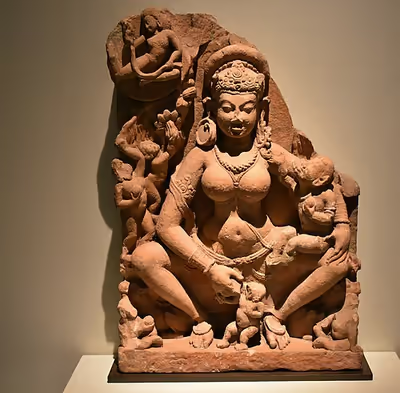
Traditional Hindu mythology features matriarchal power in a central role, reflected in the powerful presence of the Mother goddess, who is diversely called Annapurna, Durga, Parvati, Mahadevi, Shakti, Kali or Mahakali. As Annapurna, she is the provisioner of food and nurturance; as Durga she destroys asuric or demonic elements that cannot be dealt by male gods; as Kali, in her dark mode, she is the erratic, fickle, chastening mother, associated with death and destruction as well as grace and rejuvenation. As Shakti or Mahadevi, known by the common name "Devi" (from the Sanskrit root "to shine"), she is the life-giving, generative power of the universe.
In Hinduism, Saraswati, Lakshmi, Radha, Parvati, Durga and other goddesses represents both the feminine aspect and the shakti (power) of the supreme being known as the Brahman. The divine mother goddess, manifests herself in various forms, representing the universal creative force. She becomes Mother Nature (Mula Prakriti), who gives birth to all life forms and nourishes them through her body. Ultimately she re-absorbs all life forms back into herself, or "devours" them to sustain herself as the power of death feeding on life to produce new life. She also gives rise to Maya (the illusory world) and to prakriti, the force that galvanizes the divine ground of existence into self-projection as the cosmos.
The Shakti sect is strongly associated with Samkhya, and Tantra Hindu philosophies and ultimately, is monist. The primordial feminine creative-preservative-destructive energy, Shakti, is considered to be the motive force behind all action and existence in the phenomenal cosmos. The cosmos itself is purusha, the unchanging, infinite, immanent, and transcendent reality that is the divine ground of all being, the "world soul". This masculine potential is actualized by feminine dynamism, embodied in multitudinous goddesses who are ultimately all manifestations of the one great mother. Shakti, herself, can free the individual from demons of ego, ignorance, and desire that bind the soul in maya (illusion). Practitioners of the Tantric tradition focus on Shakti to free themselves from the cycle of karma.
The worship of the mother deity can be traced back to early Vedic culture. The Rigveda calls the divine female power Mahimata (R.V. 1.164.33) which means "great mother".
Christianity
The Council of Ephesus in 431 AD affirmed Mary as Theotokos (Greek: "God-bearer"), establishing her title as Mother of God in Christian theology. The council emphasized that, because Jesus Christ is both fully divine and fully human, Mary is the mother of the incarnate Word.
Mary occupies a central role in Christian devotion, particularly within the Catholic and Orthodox churches. While Protestants generally reject Marian devotion, Catholic and Orthodox theology maintains that veneration of Mary differs from worship of God, reserving adoration (latria) for the Trinity alone.
The earliest known prayer directed to Mary, the Sub Tuum Praesidium, dates to approximately the 3rd century and seeks her intercession and protection. The Hail Mary, originating in the 11th century, became a central element of the Rosary. Shrines and devotions such as Our Lady of Guadalupe, Our Lady of the Rosary, and Our Lady of Good Counsel are observed in diverse cultural contexts.
According to Catholic and Orthodox teaching, Mary’s life concluded with her body taken up into heaven (the Assumption in Western Christianity & the Dormition in Eastern Christianity). She is regarded as the foremost saint, who is believed by some Christians to continue intervening & interceding in the world through reported Marian apparitions.
Mary has not been described in Christian theology as a goddess or divine in her own right. Scholastic theology and Mariology consistently describe her as a created being, subordinate to and distinct from the Triune God.
In pre-Islamic Arabia, Collyridians were an unorthodox Christian denomination who reportedly worshipped Virgin Mary, by making burnt offerings of dough to her. Ancient Christians viewed the Collyridians as heretics, holding that Mary was only to be honoured, and not to be worshipped like the God-man of Christianity.
Latter Day Saint movement
In the Latter Day Saint movement, particularly the Church of Jesus Christ of Latter-day Saints, many adherents believe in a Heavenly Mother as the wife of God the Father. They are collectively referred to as Heavenly Parents. The theology varies, however, according to the Latter Day Saint denomination. Some believe in multiple Heavenly Mothers married to one Heavenly Father in a polygynous relationship.
Shakers
For Shakers, Holy Mother Wisdom "will come forth and be revealed in her true order; and will be known, even as the Eternal Father is known" (Divine Book of Holy and Eternal Wisdom; Part VI; Chapter 2; Verse 22).
New religious movements
In Theosophy, the Earth goddess is called the "Planetary Logos of Earth".
The Mother Goddess, or Great Goddess, is a composite of various feminine deities from past and present world cultures, worshiped by modern Wicca and others broadly known as Neopagans. She is considered sometimes identified as a Triple Goddess, who takes the form of Maiden, Mother, and Crone archetypes. She is described as Mother Earth, Mother Nature, or the Creatress of all life. She is associated with the full moon and stars, the Earth, and the sea. In Wicca, the Earth Goddess is sometimes called Gaia. The name of the mother goddess varies depending on the Wiccan tradition. English historian Ronald Hutton, however, has forcefully stated that any use of the term "Mother-Goddess" can be accounted for, and disregarded, as the scholars and mythographers' own projection of the Virgin Mary onto the evidence and source data. More recently Hutton was criticized in a review for ignoring the evidence of numerous goddesses identified as either mothers or both virgin and mother in pre-Christian antiquity, in addition to providing no evidence or secondary citations with which to substantiate his own position.
Carl Gustav Jung suggested that the archetypal mother was a part of the collective unconscious of all humans; various adherents of Jung, most notably Erich Neumann and Ernst Whitmont, have argued that such an archetype underpins many of its own mythologies and may even precede the image of the paternal "father". Such speculations help explain the universality of such mother goddess imagery around the world.
In the Baháʼí Faith, Baha'u'llah uses the Mother as an attribute of Himself, the manifestation of God and the one "well-grounded in all knowledge": "And when He Who is well-grounded in all knowledge, He Who is the Mother, the Soul, the Secret, and the Essence thereof, revealeth that which is the least contrary to their desire, they bitterly oppose Him and shamelessly deny Him". Baha'u'llah further writes that "Every single letter proceeding out of the mouth of God is indeed a Mother Letter, and every word uttered by Him Who is the Well Spring of Divine Revelation is a Mother Word, and His Tablet a Mother Tablet."
Zahng Gil-jah is a South Korean woman, by the World Mission Society Church of God believed to be "God the Mother" (Korean: 어머니 하나님; RR: Eomeoni Hananim; Korean pronunciation: ). Church members may also call her "New Jerusalem Mother”, "Mother Jerusalem", or "Heavenly Mother".
Prehistoric matriarchy debate
There is difference of opinion between the academic and the popular conception of the term Mother goddess. The popular view is mainly driven by the Goddess movement and reads that primitive societies initially were matriarchal, worshipping a sovereign, nurturing, motherly earth goddess. This was based upon the nineteenth-century ideas of unilineal evolution of Johann Jakob Bachofen. According to the academic view, however, both Bachofen and the modern Goddess theories are a projection of contemporary world views on ancient myths, rather than attempting to understand the mentalité of that time. Often this is accompanied by a desire for a lost civilization from a bygone era that would have been just, peaceful, and wise. However, it is highly unlikely that such a civilization ever existed.
For a long time, feminist authors claimed that these peaceful, matriarchal agrarian societies were exterminated or subjugated by nomadic, patriarchal warrior tribes. An important contribution to this was that of archaeologist Marija Gimbutas. Her work in this field has been questioned. Among feminist archaeologists this vision is nowadays also considered highly controversial.
Since the 1960s, especially in popular culture, the alleged worship of the mother goddess and the social position that women in prehistoric societies supposedly assumed, were linked. This made the debate a political one. According to the goddess movement, the current male-dominated society should return to the egalitarian matriarchy of earlier times. That this form of society ever existed was supposedly supported by many figurines that were found. The Upper Paleolithic Venus figurines have been sometimes explained as depictions of an Earth Goddess similar to Gaia.
In academic circles, this prehistoric matriarchy is considered unlikely. Firstly, worshiping a mother goddess does not necessarily mean that women ruled society. In addition, the figurines can also portray ordinary women or goddesses, and it is unclear whether there really ever was a mother goddess.
List of mother goddesses
Africa
Bakongo
- Mamba Muntu
- Nzambici
Egyptian
Guanche
- Chaxiraxi
West Africa
- Asase Yaa (Akan)
- Mami Wata (Regional)
- Nana Buluku (Dahomey)
- Yemòó (Yoruba)
- Yemọja (Yoruba)
East and Central Asia
Chinese
Myanmar (Burma)
- Popa Medaw
- Ma Ngwe Taung
- Medaw Shwezaga
Japanese
- Izanami
- Amaterasu
Korean
- Samsin Halmeoni
Turkic
West Asia
Anatolian
Mesopotamian
Semitic
South Asia
Buddhism
Hinduism
- Durga
- Bhagavati
- Kali
- Kamakhya
- Karumariamman
- Khodiyar
- Tripura Sundari (also known as Rajarajeshwari)
- Lakshmi
- Mariamman
- Maisamma
- Matrikas
- Parvati
- Radha
- Rukmini
- Saraswathi
- Shakti
- Sita
Jainism
- Ambika
Meitei
- Leimarel Sidabi
- Loktak Ima
- Yumjao Leima
Southeast Asia
Vietnamese
- Mẫu Thượng Thiên
- Mẫu Thượng Ngàn
- Mẫu Thoải
- Mẫu Địa
- Thiên Y A Na
Sundanese
- Sunan Ambu
Europe
Albanian
- Dheu
- Nëna e Diellit
Baltic
- Mahte
Celtic
- Aveta (Gallo-Roman)
- Danu (Irish)
- Dea Matrona (Gaulish)
- Dôn (Welsh)
- Ernmas (Irish)
- Mór Muman (Irish)
Finnic
- Maaemä (Finnish and Estonian)
Germanic
Greek
Roman
Slavic
- Mat Zemlya
- Mokosh
- Živa
Oceania
Australian Aboriginal
- Eingana
- Kunapipi
Polynesian
- Atua-anua (Rapa Nui)
- Ika-Roa (Maori)
- Varima-te-takere (Cook Islands)
Americas
Aztec
- Coatlicue
- Cihuacōātl
- Toci
Chamacoco
- Eschetewuarha
Inca
- Mama Killa
- Mama Ocllo
- Pachamama
Muisca
- Bachué
Taíno
- Atabey
Modern Religions
Mormonism
- Heavenly Mother
Thelema
- Babalon
- Nuit
Neopaganism
- Triple Goddess