

Persepolis
Ceremonial capital of the Achaemenid Empire
- 21 min read
- 8 chapters

Learn it on Lably
The earliest remains of Persepolis date back to 515 BC. The city, acting as a major centre of the empire, housed a palace complex and citadel designed to serve as the focal point for governance and ceremonial activities. It exemplifies the Achaemenid style of architecture. The complex was taken by the army of Alexander the Great in 330 BC, and soon after, its palaces were destroyed by fire. According to one account, Alexander deliberately set fire to Persepolis to avenge the destruction of Athens by the Persians; according to another, the fire was started at the urging of Thaïs, a courtesan, during a feast when Alexander was intoxicated.
The exact function of Persepolis remains unclear. It was not one of the largest cities in ancient Iran, let alone the rest of the empire, but appears to have been a grand ceremonial complex that was only occupied seasonally. The complex was raised high on a walled platform, with five "palaces" or halls of varying size, and grand entrances. It is still not entirely clear where the king's private quarters actually were. Until recently, most archaeologists held that it was primarily used for celebrating Nowruz, the Persian New Year, held at the spring equinox, which is still an important annual festivity in Iran. The Iranian nobility and the tributary parts of the empire came to present gifts to the king, as represented in the stairway reliefs. It is also unclear what permanent structures there were outside the palace complex; due to these factors, Persepolis is more often referred to as a complex rather than a "city" in the usual sense.
The exploration of Persepolis from the early 17th century led to the modern rediscovery of cuneiform writing and, from detailed studies of the trilingual Achaemenid royal inscriptions found on the ruins, the initial decipherment of cuneiform in the early 19th century.
Name
Persepolis is derived from the Greek Περσέπολις, Persepolis, a compound of Pérsēs (Πέρσης) and pólis (πόλις), together meaning "the Persian city" or "the city of the Persians".
To the ancient Persians, the city was known as Pārsa (Old Persian: 𐎱𐎠𐎼𐎿), which is also the name of the region of Persis, the homeland of the Persians. Trilingual inscriptions in Old Persian, Elamite and Babylonian on the site's gate, together with other textual evidence, show that the palace complex built by Darius the Great bore the same name as the surrounding land. The name also appears in the Elamite administrative tablets found at the site, which record payments to workmen in Pārsa and its suburbs. In modern Persian, the ancient name is rendered as Pārseh (پارسه).
An inscription left in 311 AD by Sasanian Prince Shapur Sakanshah, the son of Hormizd II, refers to the site as Sad-stūn, meaning "Hundred Pillars".
Early Muslim geographers, including al-Masudi, Istakhri, al-Muqaddasi and Ibn Hawqal, described the ruins but attributed them to the legendary world-king Jamshid, whom they identified with the biblical Solomon. As a result, the site was also called Malʿab Solaymān or Masjed Solaymān. Others attributed it to the legendary queen Homāy; Hamza al-Isfahani called it Hezār Sotun ("Thousand Columns").
Because medieval Persians attributed the site to Jamshid, it has been referred to as Takht-e Jamshid (Persian: تخت جمشید, Taxt-e Jamšīd; ), literally "Throne of Jamshid". This remains the most common modern Persian name for the site, although there is no evidence that Jamshid had any connection with it. Another name given to the site in the medieval period was Čehel Menār (Persian: چهل منار, "Forty Minarets"), transcribed as Chilminara in De Silva Figueroa and as Chilminar in early English sources. The Spanish traveller De Silva Figueroa, who visited in the early 17th century, appears to have been the first to recognise that the site known locally as Chehel Menār or Takht-e Jamshid was the Persepolis of the ancient Greek authors.
Sign in to keep reading
7 more chapters are free with a Lably account.
History
Construction
There are some indications that the site of Persepolis was already a government centre under Cyrus the Great and his son Cambyses II, but no archaeological traces of this older phase have been found. It was Darius I who created Persepolis as the splendid seat of the government of the Achaemenid Empire and as its centre for receptions and festivals. The earliest remains date back to 515 BC, and inscriptions on the buildings support the view that the terrace and the first palaces were built by Darius. Under his successors Xerxes I and Artaxerxes I the complex was extended in several building phases, and further buildings were added in the 4th century BC.
With Darius I, the sceptre passed to a new branch of the royal house. The administrative capitals of the empire were Susa, Babylon and Ecbatana. This may be why the Greeks were not acquainted with the city until Alexander the Great took and plundered it.
Darius I's construction of Persepolis was carried out parallel to that of the Palace of Susa. According to Gene R. Garthwaite, the Susa Palace served as Darius' model for Persepolis. Darius I ordered the construction of the Apadana and the Council Hall (Tripylon or the "Triple Gate"), as well as the main imperial Treasury and its surroundings. These were completed during the reign of his son, Xerxes I. Further construction of the buildings on the terrace continued until the downfall of the Achaemenid Empire.
Grey limestone was the main building material used at Persepolis. The uneven plan of the terrace, including the foundation, acted like a castle, whose angled walls enabled its defenders to target any section of the external front.
The workers who built Persepolis were paid for their labour. The Elamite administrative tablets found at the site record the issue of silver and foodstuffs to workmen of the royal economy in Persepolis and its suburbs, most frequently Cappadocians, Lydians, Carians, Thracians, Ionians, Sogdians, Bactrians, Babylonians and Egyptians.
Conquest by Alexander the Great
After his victory over Darius III at the Battle of Gaugamela in 331 BC, Alexander the Great took Susa, which surrendered without resistance, and then marched towards Persepolis. In the winter of 331/330 BC he forced the Persian Gates, a pass through the Zagros Mountains, where Ariobarzanes of Persis had held off his army for some time. Some sources indicate that a local guide showed the Macedonians a path that allowed them to outflank the defenders, in a reversal of Thermopylae. Ariobarzanes was killed either during the battle or during the retreat.
During his advance, Alexander received a letter from Tiridates, the guardian of the royal treasury at Persepolis. Tiridates warned him that Persians loyal to Darius III were on their way to fortify the city, and offered to surrender it to him if he arrived first. Alexander accepted, crossed the Araxes river (the modern Kur) by forced march and took the city. On his way, according to Diodorus, he was met by some 800 Greek artisans who had been captured by the Persians. Most were elderly and had been mutilated, with a hand or foot cut off, so that they could still practise their crafts but not easily escape. Alexander provided them with clothing and provisions. Diodorus does not cite this as a reason for the destruction of Persepolis, but it is possible that Alexander began to see the city in a more negative light after this encounter.
Alexander took possession of the royal treasury, in which the state revenues had been accumulated since the time of Cyrus the Great. According to Diodorus, it contained gold and silver worth 120,000 talents. He kept part of it to meet the costs of the war and had the rest loaded onto mules and other pack animals and taken to Ecbatana. According to Plutarch, the treasure was carried away on 20,000 mules and 5,000 camels. The surrender of the treasury did not save the city: Alexander gave Persepolis, except for the palaces, over to his soldiers to plunder.
Destruction
Alexander remained at Persepolis for several months. In the spring of 330 BC, before leaving the city, a fire destroyed the palaces. The fire consumed the complex so completely that only the columns, parts of the walls, stairways and doorways of the great palaces and halls remained. It has been suggested that the fire started in the Hadish, the palace of Xerxes I, and spread to the rest of the terrace.
The ancient authors disagree on how the fire began:
- According to Arrian, Alexander deliberately set fire to the palaces as revenge for the Persian destruction of Athens and the burning of its temples during the second Persian invasion of Greece in 480 BC, even though his general Parmenion advised him against it.
- According to Diodorus Siculus, Quintus Curtius Rufus and Plutarch, the fire was started during a drunken celebration at the suggestion of Thaïs, an Athenian courtesan and later the mistress of Ptolemy I Soter. In these accounts, she or Alexander himself threw the first torch.
The two accounts need not exclude each other: the fire may have been both a symbolic act of revenge and the outcome of a feast. It may also have had the political purpose of destroying an iconic symbol of the Persian monarchy that might otherwise have become a focus of Persian resistance.
The Book of Arda Wiraz, a Zoroastrian work composed in the 3rd or 4th century AD, describes Persepolis' archives as containing "all the Avesta and Zend, written upon prepared cow-skins, and with gold ink", which were destroyed. In his Chronology of the Ancient Nations, the Iranian scholar Biruni notes the unavailability of certain native Iranian historiographical sources in the post-Achaemenid era, especially during the Parthian Empire. He adds: "[Alexander] burned the whole of Persepolis as revenge to the Persians, because it seems the Persian King Xerxes had burnt the Greek City of Athens around 150 years ago. People say that, even at the present time, the traces of fire are visible in some places."
The fire may, however, have helped to preserve the Persepolis Administrative Archives. According to archaeological evidence, the partial burning of Persepolis did not damage the Persepolis Fortification Archive tablets, but may have caused the collapse of the upper part of the northern fortification wall, which buried and protected the tablets until their recovery by archaeologists of the Oriental Institute.
After the fall of the Achaemenid Empire
In 316 BC, Persepolis was still the capital of Persis as a province of the Macedonian empire. The city must have gradually declined in the course of time. The lower city at the foot of the terrace might have survived for longer, but the ruins of the Achaemenids remained as a witness to its ancient glory.
The nearby Estakhr gained prominence as a separate city shortly after the decline of Persepolis, and much of Persepolis' rubble appears to have been used for its construction. At the time of the Muslim conquest of Persia, Estakhr offered a desperate resistance. It was still a place of considerable importance in the first century of Islam, although its greatness was soon eclipsed by the new metropolis of Shiraz. In the 10th century Estakhr dwindled to insignificance, and during the following centuries it gradually declined until it ceased to exist as a city.
Geography
Persepolis is near the small river Pulvar, which flows into the Kur River. The site includes a 125,000 m2 (1,350,000 sq ft) terrace, partly artificially constructed and partly cut out of a mountain, with its east side leaning on Rahmat Mountain. The terrace measures close to 450 m in length and 300 m in width.
Archaeological research
Early travellers
Odoric of Pordenone may have passed through Persepolis on his way to China in 1320, although he mentioned only a great, ruined city called "Comerum". In 1474, Giosafat Barbaro visited the ruins of Persepolis, which he incorrectly thought were of Jewish origin. Hakluyt's Voyages included a general account of the ruins of Persepolis attributed to an English merchant who visited Iran in 1568. António de Gouveia from Portugal wrote about cuneiform inscriptions following his visit in 1602. His report on the ruins of Persepolis was published as part of his Relaçam in 1611.
In 1618, García de Silva Figueroa, King Philip III of Spain's ambassador to the court of Abbas I, the Safavid monarch, was the first Western traveller to identify the site known in Iran as "Chehel Minar" with the Persepolis of the Classical authors.
Pietro Della Valle visited Persepolis in 1621 and noticed that only 25 of the 72 original columns were still standing, due to either vandalism or natural processes. The Dutch traveller Cornelis de Bruijn visited Persepolis in 1704.
The French travellers Eugène Flandin and Pascal Coste were among the first to provide not only a literary description of the structure of Persepolis, but also some of the best and earliest visual depictions of it. In their publication Voyage en Perse de MM. Eugène Flandin, peintre, et Pascal Coste, architecte, the authors provided some 350 illustrations of Persepolis. In the 19th century a variety of amateur digging occurred at the site, in some cases on a large scale.
Scientific excavations
French influence and interest in Persia's archaeological findings continued after the accession of Reza Shah, when André Godard became the first director of the archaeological service of Iran. The first scientific excavations at Persepolis were carried out by Ernst Herzfeld and Erich Schmidt on behalf of the Oriental Institute of the University of Chicago. They conducted excavations for eight seasons, beginning in 1930, which also included other nearby sites.
Herzfeld believed that the reasons behind the construction of Persepolis were the need for a majestic atmosphere, a symbol for the empire, and a place to celebrate special events, especially Nowruz. For historical reasons, Persepolis was built where the Achaemenid dynasty was founded, although it was not the centre of the empire at that time.
Excavations of plaque fragments hint at a scene with a contest between Herakles and Apollo, dubbed A Greek painting at Persepolis.
Administrative archives
Between 1933 and 1934, the excavations of the Oriental Institute discovered the administrative archives of Persepolis, consisting of the Persepolis Fortification Archive and the Persepolis Treasury Archive. The Fortification tablets, some 25,000 to 30,000 in number and written mostly in Elamite, deal with economic transactions until 493 BC; the smaller Treasury archive of 139 tablets records payments in silver between 492 and 458 BC. A damaged tablet from the Fortification Archive, dating to around 500 BC, records the distribution of at least 600 quarts of an unidentified commodity among five villages, providing rare evidence that Old Persian was also used for everyday administration.
Architecture
Persepolitan architecture is noted for its use of the Persian column, which was probably based on earlier wooden columns.
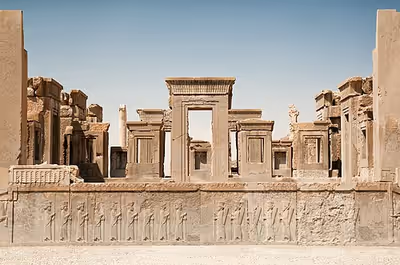
The buildings at Persepolis include three general groupings: military quarters, the treasury, and the reception halls and occasional houses for the King. Noted structures include the Great Stairway, the Gate of All Nations, the Apadana, the Hall of a Hundred Columns, the Tripylon Hall and the Tachara, the Hadish Palace, the Palace of Artaxerxes III, the Imperial Treasury, the Royal Stables, and the Chariot House.
Tol-e Ajori
In 2011 a joint Italian-Iranian team discovered a monumental gateway that strongly resembles the Ishtar Gate in Babylon at the site of Tol-e Ajori, 3 kilometres west of Persepolis. The gate, which has been dated to the Achaemenid period, measures 40 by 30 metres and features glazed brick decoration produced in the same manner and with the same motifs as the glazed bricks used to adorn the Ishtar Gate and the rest of the ceremonial procession in Babylon. However, the structure does not fit neatly into the architectural style used for the rest of the Persepolis area. Excavations yielded fragments of inscriptions in both Elamite and Babylonian, but the gate does not seem to have included an Old Persian inscription. Based on these differences, the excavators concluded that the gate probably predates the construction of Persepolis under Darius I, and was built sometime between the conquest of Babylon in 539 and the start of construction at Persepolis in 518 BC.
Remains
Entrance staircase
Northern StaircaseStaircaseEasternTomb of Artaxerxes IIITowersGateGate of All NationsProcessional WayUnfinished gateApadanaHundred columnsTripylonTacharaHadishTreasuryQueen Palace
and MuseumBarracks of 32 columnsJ PalaceG PalaceD Palace
Ruins of a number of colossal buildings exist on the terrace. They are built mainly of grey limestone. Several of the buildings were never finished.
Behind the compound at Persepolis, there are three sepulchres hewn out of the rock in the hillside.
The Gate of All Nations
The Gate of All Nations, referring to subjects of the empire, consisted of a grand hall that was a square of approximately 25 m (82 ft) in length, with four columns and its entrance on the Western Wall.
The Apadana Palace
Darius I built the greatest palace at Persepolis on the western side of the platform. This palace was called the Apadana. The King of Kings used it for official audiences.
Foundation tablets of gold and silver were found in two deposition boxes in the foundations of the Palace. They contained an inscription by Darius in Old Persian cuneiform, which describes the extent of his Empire in broad geographical terms, and is known as the DPh inscription:
Darius the great king, king of kings, king of countries, son of Hystaspes, an Achaemenid. King Darius says: This is the kingdom which I hold, from the Sacae who are beyond Sogdia, to Kush, and from Sind (Old Persian: 𐏃𐎡𐎭𐎢𐎺, romanized: Hidauv, locative of Hiduš, i.e. "Indus valley") to Lydia (Old Persian: Spardâ) – [this is] what Ahuramazda, the greatest of gods, bestowed upon me. May Ahuramazda protect me and my royal house!
— DPh inscription of Darius I in the foundations of the Apadana Palace
The reliefs on the staircases allow one to observe the people from across the empire in their traditional dress, and even the king himself, "down to the smallest detail".
Apadana Palace coin hoard
The Apadana hoard is a hoard of coins that were discovered under the stone boxes containing the foundation tablets of the Apadana Palace in Persepolis. The coins were discovered in excavations in 1933 by Erich Schmidt, in two deposits, each under one of the two deposition boxes. The deposition of this hoard is dated to c. 515 BC. The coins consisted of eight gold lightweight Croeseids, a tetradrachm of Abdera, a stater of Aegina and three double-sigloi from Cyprus. The Croeseids were found in very fresh condition, confirming that they had been recently minted under Achaemenid rule. The deposit did not include any Darics and Sigloi, which strongly suggests that these coins typical of Achaemenid coinage only started to be minted later, after the foundation of the Apadana Palace.
The Throne Hall
Next to the Apadana, the second largest building of the terrace is the Throne Hall or the Imperial Army's Hall of Honour (also called the Hundred-Columns Palace). This 70 m2 × 70 m2 (750 sq ft × 750 sq ft) hall was begun by Xerxes I and completed by his son Artaxerxes I by the end of the fifth century BC. Its eight stone doorways are decorated on the south and north with reliefs of throne scenes and on the east and west with scenes depicting the king in combat with monsters. Two colossal stone bulls flank the northern portico. The head of one of the bulls now resides in the Oriental Institute in Chicago and a column base from one of the columns in the British Museum.
At the beginning of the reign of Xerxes I, the Throne Hall was used mainly for receptions for military commanders and representatives of all the subject nations of the empire.
The Tachara Palace
The Tachara was the exclusive palace of Darius the Great at Persepolis. Only a small portion of the palace was finished under his rule; it was completed after the death of Darius in 486 BC by his son and successor, Xerxes, whose inscriptions call it a taçara ("palace"). It was later used by Artaxerxes I. The Tachara was one of the few structures that escaped destruction in the fire of 330 BC; for this reason it is today the most intact building at Persepolis. It is also the oldest structure on the terrace. The Tachara stands back to back with the Apadana and is oriented southward.
The Hadish Palace
The Hadish Palace of Xerxes is one of the palaces at Persepolis. It is located east of Palace H (of Artaxerxes I). The palace occupies the highest level of the terrace and stands on the living rock. The inscriptions of the palace attest that the building was built by order of Xerxes. It covers an area of 2,550 square metres (40 × 55 metres). A double staircase on the west leads to the courtyard of the Tachara, and another staircase on the northeast connects to the courtyard of the Council Hall.
Other palaces and structures
The Council Hall (Tripylon), Palaces D, G and H, storerooms, stables and quarters, the unfinished gateway and a few miscellaneous structures are located near the south-east corner of the terrace, at the foot of the mountain.
Tombs
It is commonly accepted that Cyrus the Great was buried in the Tomb of Cyrus in Pasargadae, which is mentioned by Ctesias as his own city. If it is true that the body of Cambyses II was brought home "to the Persians", his burial place must be somewhere near that of his father. Ctesias assumes that it was the custom for a king to prepare his own tomb during his lifetime. Hence, the kings buried at Naqsh-e Rostam are probably Darius I, Xerxes I, Artaxerxes I and Darius II. According to Ctesias, Darius I's tomb was in a cliff face that could be reached only with an apparatus of ropes. Xerxes II, who reigned for a very short time, could scarcely have obtained so splendid a monument, and still less could the usurper Sogdianus. The two completed tombs behind the compound at Persepolis would then belong to Artaxerxes II and Artaxerxes III. The owner of the unfinished tomb, about a kilometre away from the terrace, is debated.
Inscriptions and ancient accounts
There are a total of 11 existing royal inscriptions at Persepolis, attributed to Darius the Great, Xerxes, Artaxerxes II and Artaxerxes III.
The main ancient accounts of the capture and burning of Persepolis are those of Diodorus Siculus (17.69–72), Quintus Curtius Rufus (5.5–7), Plutarch (Life of Alexander 37–38) and Arrian (Anabasis 3.18). Diodorus describes Persepolis as the richest city under the sun, which Alexander gave over to his soldiers to plunder, all but the palaces:
Persepolis was the capital of the Persian kingdom. Alexander described it to the Macedonians as the most hateful of the cities of Asia, and gave it over to his soldiers to plunder, all but the palaces.
— Diodorus Siculus, 17.70.1
Diodorus and Curtius then describe the feast at which Thaïs urged the burning of the palace:
One of these, Thais by name, herself also drunken, declared that the king would win most favor among all the Greeks, if he should order the palace of the Persians to be set on fire; that this was expected by those whose cities the barbarians had destroyed. [...] The king was the first to throw a firebrand upon the palace, then the guests and the servants and courtesans. The palace had been built largely of cedar, which quickly took fire and spread the conflagration widely.
— Quintus Curtius Rufus, 5.7.3–5
The earliest known source for the role of Thaïs is the historian Cleitarchus, who was quoted by Athenaeus:
And did not Alexander the Great have with him Thais, the Athenian hetaira? Cleitarchus speaks of her as having been the cause for the burning of the palace at Persepolis. After Alexander's death, this same Thais was married to Ptolemy, the first king of Egypt.
Modern events
2,500-year celebration
In 1971, Persepolis was the main staging ground for the 2,500-year celebration of the Persian Empire under the reign of Mohammad Reza Pahlavi, the second and last Shah of the Pahlavi dynasty. It included delegations from foreign nations in an attempt to advance the Iranian culture and history.
Concerts
In a groundbreaking cultural event, Iranian vocalist Alireza Ghorbani performed the first-ever concert at Persepolis from 29 June to 1 July 2024, and received an overwhelmingly enthusiastic response from attendees. Another historic event took place on 6 September 2025, when Persepolis hosted the 100th anniversary of the Armenian Philharmonic Orchestra. Over 1,500 people attended. With ambassadors from 23 countries and envoys from the UN, it was the first-ever international public concert at Persepolis, a cultural milestone for Iran–Armenia relations, and the site's second international event since the 2,500-year celebration of 1971.
Nowruz celebrations
Every year during Nowruz, a large number of people come to Persepolis to celebrate the new year. In 2024, 10,000 people were at Persepolis when Nowruz began.
Cultural events
Various events are held at Persepolis every year, including a Shahnameh reading festival and other cultural events.
Conservation issues
The site is threatened by lichens that have grown on the surface of the monuments, some of which have eroded intricate carvings and motifs. Some of the lichens are estimated to be around 1,700 years old, and their spread has been attributed to industrialisation, acid rain and the extreme desert climate.
The controversy of the Sivand Dam
Construction of the Sivand Dam, named after the nearby town of Sivand, began on 19 September 2006. Despite 10 years of planning, Iran's Cultural Heritage Organization was not aware of the broad areas of flooding during much of this time, and there is growing concern about the effects the dam will have on the surrounding areas of Persepolis. Activists expressed concern that the dam's placement between the ruins of Pasargadae and Persepolis will flood both. Engineers involved with the construction deny this claim, stating that it is impossible because both sites sit well above the planned waterline. Of the two sites, Pasargadae is considered the more threatened.
Museums outside Iran with objects from Persepolis
One bas-relief from Persepolis is in the Fitzwilliam Museum in Cambridge, England. The largest collection of reliefs is at the British Museum, sourced from multiple British travellers who worked in Iran in the 19th century. The Persepolis bull at the Oriental Institute in Chicago is one of the university's most prized treasures, part of the division of finds from the excavations of the 1930s. New York City's Metropolitan Museum and the Detroit Institute of Arts house objects from Persepolis, as does the Museum of Archaeology and Anthropology of the University of Pennsylvania. The Museum of Fine Arts of Lyon and the Louvre in Paris hold objects from Persepolis as well. A bas-relief of a soldier that had been looted from the excavations in 1935–36 and later purchased by the Montreal Museum of Fine Arts was repatriated to Iran in 2018, after being offered for sale in London and New York.
Foreign visitors' graffiti at Persepolis
Some European travellers throughout history have left graffiti on the walls of Persepolis during their visits.