


Related on Lably
Through Chera dynasty, Sangam literature and Chola Empire
The region was ruled by the Cheras during the Sangam period between the 1st and the 4th centuries CE. It was under the rule of early Pandyas medieval Cholas, Later Cholas and the Vijayanagara Empire till the 15th century followed by the Nayaks who introduced the Palayakkarar system. In the later part of the 18th century, the it came under the Kingdom of Mysore and later the British Raj as a part of Madras Presidency. The region played a prominent role in the Poligar Wars.
After Indian independence in 1947, Tiruppur became part of Coimbatore district. It was established as the capital of the newly formed Tiruppur district in 2009. Tiruppur is a part of Tiruppur Lok Sabha constituency that elects its member of parliament. The town was predominantly an agricultural, but with the advent of textile boom in the 20th century and rapid industrialization has seen Tiruppur become a major textile and knitwear hub. As of 2021–22, Tiruppur exported garments worth 480 billion USD, contributing to nearly 54% of the all the textile exports from India.
Etymology
The name "Tiruppur" might have its origin from the Indian epic Mahabharata wherein cattle stolen from Pandavas were returned by Arjuna. It is a combination of two Tamil words, "Thiruppu" meaning "to turn" and "oor" meaning "a place" meaning "place where they were returned".
Sign in to keep reading
11 more chapters are free with a Lably account.
History
Tiruppur formed a part of the Kongu Nadu region ruled by the Cheras during Sangam period. The region was part of a prominent Roman trade route that connected east and west coasts of India. The medieval Cholas conquered the Kongu Nadu in the tenth century CE and Chola stone carvings mention Kanchi Maanadhi (Noyyal River) and the fertile sand that it deposited on its banks.
The region came under the rule of the Vijayanagara Empire by the 15th century and later Palayakkarars, the chieftains of Madurai Nayaks ruled the region. In the later part of the 18th century, the region came under the Kingdom of Mysore, following a series of wars with the Madurai Nayak Dynasty. After the defeat of Tipu Sultan in the Anglo-Mysore Wars, the British East India Company annexed the region into the Madras Presidency in 1799.
Tiruppur was an agricultural town with irrigated farms and the farmers became small owners of various textile related units during the 1970s. The boom in the textile industry led to an inter woven network of the small scale units leading to growth of the city into a major textile hub. Tiruppur became a municipal corporation in 2008 and became the headquarters of a separate Tiruppur district was carved out from parts of Coimbatore district and Erode district in 2009.
Geography
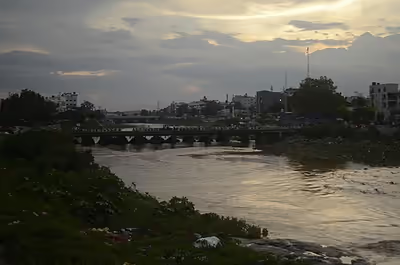
Tiruppur is located at 11°06′27″N 77°20′23″E / 11.1075°N 77.3398°E on the banks of the Noyyal River. It has an average elevation of 295 metres (967 feet) and covers an area of 159.6 km2 (61.6 sq mi).
Climate
The climate in Tiruppur is hot semi-arid (Köppen BSh) with the mean maximum and minimum temperatures varying between 35 and 22 °C (95.0 and 71.6 °F). The summer occurs during the months March, April and May when the weather is hot and dry. The maximum temperature during the summer months will be around 35 °C (95 °F) and the minimum temperature will be around 29 °C (84.2 °F). The monsoon months are the months of June, July and August. These months are mainly characterised by mild showers and a reduced temperature. The post monsoon or winter months are September, October, November, December and January. These months generally have a cooler climate with temperatures rarely rise beyond a maximum of around 29 °C (84.2 °F). The minimum temperature during this season will be around 24 °C (75.2 °F).
Due to the presence of the Palghat gap, the city receives some rainfall from the south-west monsoon from June to August. After a humid September, the north-east monsoon brings rains from October which lasts till early December. The average annual rainfall is around 700 mm (28 in) with the north-east and the south-west monsoons contributing 47% and 28%, respectively, to the total. The soil is predominantly black, which is suitable for cotton cultivation, but Tiruppur district also has some red loamy soil. Tiruppur falls under the Class III/IV seismic zone, having experienced a 6.0 Richter scale earthquake in 1900.
Demographics
According to 2011 census, Tiruppur had a population of 444,352 with a sex-ratio of 955 females for every 1,000 males, above the national average of 929. The A total of 48,802 were under the age of six, constituting 24,818 males and 23,984 females. Scheduled Castes and Scheduled Tribes accounted for 5.47% and 0.06% of the population, respectively. The average literacy was 78.17%, compared to the national average of 72.99%. The city had a total of 124,617 households and a work force of 207,358. The area of Tiruppur was expanded in 2011 and the population was estimated as 877,778 in 2015.
As per the religious census of 2011, Tiruppur (M Corp.) had 86.05% Hindus, 10.36% Muslims, 3.33% Christians, 0.03% Sikhs, 0.01% Buddhists, 0.07% Jains, 0.14% following other religions and 0.01% following no religion or did not indicate any religious preference.
At per the 2011 census, 83.61% of the population in the erstwhile Tiruppur Municipal Corporation spoke Tamil, 6.65% Telugu, 3.35% Kannada, 2.31% Malayalam, 2.06% Urdu and 1.21% Hindi as their first language.
Administration and politics
Tiruppur is administered by Tiruppur Municipal Corporation headed by a mayor. The municipality was established in 1917 and was upgraded to a municipal corporation in 2008. The city is divided into 60 wards. Each ward is represented by a councillor who is elected by direct election and the mayor of Tiruppur is elected by councillors. The executive wing of the corporation is headed by a corporation commissioner and maintains basic services like water supply, sewage and roads. Law and order is maintained by Tiruppur police headed by a police commissioner who is equivalent to the rank of IGP (Inspector General Of Police). The city police has seven police stations, three traffic police stations and over 1,000 personnel. The Tiruppur District Court is the ultimate judicial authority in the district.
Tiruppur has two assembly constituencies Tiruppur North and Tiruppur South. Tiruppur is part of Tiruppur Lok Sabha constituency which was created during the delimination in 2008 consisting parts of erstwhile Coimbatore, Gobichettipalayam and Palani constituencies.
Economy
The economy of Tiruppur is primarily based on the textile industry. There are over 10,000 garment manufacturing industries in Tiruppur, employing over 600,000 people. As of 2021-22, Tiruppur exported garments worth 4.5 billion USD. The city is known as the knitwear capital of India due to its cotton knitwear export. Special industrial parks like the Tiruppur Export Knitwear Industrial complex supporting 189 sheds and the Nethaji Apparel Park housing 53 companies have been established to support the textile industry. Some of the world's largest companies including Nike, Adidas and Reebok import textiles and clothing from Tiruppur. According to Hurun India rich list, Tiruppur was amongst the top 20 cities in India in the number of billionaires in 2023.
Transport
Road
The following major highways serve Tiruppur:
Tiruppur has three major bus stations: Central (Old bus stand), North (New bus stand) and South (Kovilvazhi bus stand). Tiruppur is connected by moffusil bus services run by TNSTC to all major towns across Tamil Nadu and prominent cities in Kerala, Karnataka and Andhra Pradesh.
Rail
Tiruppur railway station is the major rail head serving the city. It falls on the electrified Erode - Coimbatore broad gauge (5 ft 6 in (1,676 mm)) line and is well connected by trains to destinations across India. Also most of the trains stops for only 2 mins which makes the cargo handling not at all possible.
Air
The nearest airport is Coimbatore International Airport (45 km) with regular flights to domestic destinations and select international destinations including Sharjah and Singapore.
Public utility services
While Tiruppur itself has only a few engineering colleges, but is located in proximity to the major educational hub of Coimbatore. There are 7 government hospitals at the taluk level with a total number of 896 beds and a total of 43 primary health centers in the rural areas Electricity supply is regulated and distributed by Tamil Nadu Electricity Board (TNEB) as the city along with its suburbs forms Tiruppur Electricity Distribution Circle. A Chief Distribution engineer is stationed at the regional headquarters. Water supply and other public utility services are provided by the corporation.
Environmental issues
Tiruppur, like any other industrial town, faces its share of environmental pollution complaints. Farmers in Tiruppur and its hinterland have faced issues due to the discharge of industrial effluents into Noyyal and other water bodies. Untreated effluents, mostly containing dyes and chemicals in high concentration are let off clandestinely once again in large quantities through storm water drains into water bodies or into open areas mostly during the early morning hours or during rain. In 2015, the Madras High Court directed that zero liquid discharge (ZLD) should be strictly followed by the knitwear industries during the effluent treatment process. Failure to implement this order, led to a court ordered closure of dyeing units and bleaching units. Tirupur Exporters Association made a representation to the Government of Tamil Nadu about loss of revenue and jobs due to the closure of dyeing units. As per a report by CRISIL in February 2011, ensuring Zero Liquid Discharge (ZLD), will affect the operational costs of dyeing and bleaching units, increasing it by 7% to 10%. Eventually, by complying with the court order, Tiruppur became the first textile cluster in India to achieve zero liquid discharge in its units.
Places of interest
Old temples in Tiruppur were built during the reign of Cholas and Pandyas. Temples in the area include Sukreeswarar Temple, Avinashilingeshwarar temple, Sivanmalai and Konganagiri. Other places of interest include Thirumoorthy Hills, Amaravathi Dam, Nanjarayan Tank Bird Sanctuary and Tiruppur Kumaran memorial.
Notable people
- T. S. Avinashilingam, lawyer and politician
- Tiruppur Kumaran, freedom fighter
- C. P. Radhakrishnan, 15th Vice President of India
- T. A. Ramalingam, lawyer and politician
- Best Ramasamy, entrepreneur and politician