


Related on Lably
Through Rotational symmetry, Ampere and Voltage
The design for the USB‑C connector was initially developed in 2012 by members of the USB Implementers Forum, with Intel, HP Inc., and Texas Instruments being distinguished on the design document, though Apple Inc. and Microsoft among others also contributed. The Type‑C Specification 1.0 was published by the USB Implementers Forum (USB-IF) on August 11, 2014. In 2016 it was adopted by the International Electrotechnical Commission as "IEC 62680-1-3".
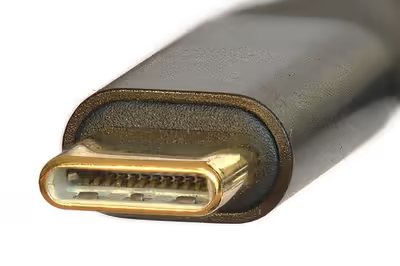
The USB Type‑C connector has 24 pins and is reversible. The designation C distinguishes it from the various USB connectors it replaced, all termed either Type‑A or Type‑B. Whereas earlier USB cables had a host end A and a peripheral device end B, a USB‑C cable connects either way; and for interoperation with older equipment, there are cables with a Type‑C plug at one end and either a Type‑A (host) or a Type‑B (peripheral device) plug at the other.
The designation C refers only to the connector's physical configuration, or form factor, not to be confused with the connector's specific capabilities and performance, such as Thunderbolt 3, DisplayPort 2.0, USB 3.2 Gen 2×2. While USB‑C is the single modern connector for all USB protocols, there are valid uses of the connector that do not involve any USB protocol. Based on the protocols supported by all, host, intermediate devices (hubs), and peripheral devices, a USB‑C connection normally provides much higher data rates, and often more electrical power, than anything using the superseded connectors.
A device with a Type‑C connector does not necessarily implement any USB transfer protocol, USB Power Delivery, or any of the Alternate Modes: the Type‑C connector is common to several technologies while mandating only a few of them.
USB 3.2, released in September 2017, fully replaced the USB 3.1 (and therefore also USB 3.0) specifications. It preserves the former USB 3.1 SuperSpeed and SuperSpeedPlus architectures and protocols, though introduces two additional operational modes by newly applying a two-lane configuration with signalling rates of 5 Gbit/s (resulting speed of USB 10Gbps with two lanes; raw data rate: 1.212 GB/s) and 10 Gbit/s (USB 20Gbps speed; raw data rate: 2.422 GB/s). They are only applicable with Full-Featured USB‑C cables and connectors and hosts, hubs, and peripheral devices that use them.
USB4 specification, released in 2019, is the first USB protocol standard that is applicable exclusively via USB‑C.
Ease of use
The USB‑C standard simplifies usage by specifying cables having identical plugs on both ends; orientation is moot. Also, the plugs are flat but can be inserted in either orientation.
Symmetry
- Mechanically, the USB‑C receptacles have two-fold rotational symmetry because a plug may be inserted into a receptacle in either of two orientations. The ends are also mechanically interchangeable, because both end have the same type of plug.
- Electrically, USB‑C plugs are not symmetric, as can be seen in the tables of pin layouts. Also, the two ends of the USB‑C are electrically different, as can be seen in the table of cable wiring.
- Logically, the plugs are completely symmetrical. The illusion of symmetry results from how devices respond to the cable. Software makes the plugs and cables behave as though they are symmetric. According to the specifications, "Determination of this host-to-device relationship is accomplished through a Configuration Channel (CC) that is connected through the cable."
Universal application
The USB‑C standard attempts to eliminate the need to have different cables for other communication technologies, such as Thunderbolt, PCIe, HDMI, DisplayPort and more. Over the past decade since 2014, many companies including Samsung Electronics, Apple Inc. and Transsion have adopted the USB‑C standard into their products. USB‑C cables can contain circuit boards and processors giving them much more capability than simple circuit connections.
Sign in to keep reading
6 more chapters are free with a Lably account.
Overview
USB‑C cables interconnect hosts and peripheral devices, replacing various other electrical cables and connectors, including all earlier (legacy) USB connectors, HDMI connectors, DisplayPort ports, and 3.5 mm audio jacks.
Name
USB Type‑C and USB‑C are trademarks of the USB Implementers Forum.
Connectors
The 24-pin double-sided connector is slightly larger than the non-SuperSpeed, USB 2.0 Micro connectors, with a USB‑C receptacle opening measuring 8.34 mm × 2.56 mm, 6.20 mm deep.
Cables
Type‑C cables can be split among various categories and subcategories. The first one is USB 2.0 vs Full-Featured. USB 2.0 Type‑C cables have very limited wires and are only good for USB 2.0 communications and power delivery. They are also called charging cables colloquially. Conversely, Full-Featured cables need to have all wires populated and in general support Alternate Modes and are further distinguished by their speed rating.
Full-Featured cables exist in different speed grades. Their technical names, the operation mode, use the "Gen A" notation, each higher number increasing capabilities in terms of bit rates. The marketing names are based on the theoretically highest bit rate a connection should fulfill – but in reality never can –, namely "USB 5Gbps", "USB 10Gbps", "USB 20Gbps", "USB 40Gbps", and so on. The Full-Featured cables, can support at least USB 3.x, USB Power Delivery and DisplayPort.
A Gen 1 (signalling rate of 5 Gbit/s) cable supports that rate on every one of its two lanes (2*2 twisted data wire pairs). So it can be used to establish a USB 3.2 Gen 1x2 operation mode with nominally 10 Gbit/s (2*5 Gbit/s) between two USB 3.2, or USB4 or newer capable hosts connected by a Fully-Featured USB-C cable.
According the specification USB4 and USB4 2.0, the implementation of the USB 3.2 Gen 2x2 operation mode, resulting in nominally 20 Gbit/s, is only optional; indeed most USB4 controllers do not implement it. In other words, the "USB 20Gbps" will only be achieved by a USB4 or more modern version of an operation mode, such as USB4 Gen 2x2, with USB4 capable devices and Fully-Featured USB-C cables (and intermediate hubs) of a rate of "USB 20Gbps" (I.e. all 4 twisted data wire pairs are wired) or higher between a host and a peripheral device.
The USB Implementers Forum certifies valid cables so they can be marked accordingly with the official logos and users can distinguish them from non-compliant products. There have been simplifications in the logos. Previous logos and names also referenced specific USB protocols like SuperSpeed for the USB 3 family of connections or USB4 directly. The current official names and logos have removed those references as most full-featured cables can be used for USB4 connections as well as USB 3 connections.
In order to achieve longer cable lengths, cable variants with active electronics to amplify the signals also exist. The Type‑C standard mostly mandates these active cables to behave similarly to passive cables with vast backwards compatibility, but they are not mandated to support all possible features and typically have no forward compatibility to future standards. Optical cables are even allowed to further reduce the backwards compatibility. For example, an active cable may not be able to use all high speed wire-pairs in the same direction (as used for DisplayPort connections), but only in the symmetric combinations expected by classic USB connections. Passive cables have no such limitations.
Power delivery
Every USB‑C cable must support at least 3 amps of current and up to 20 volts for up to 60 watts of power according to the USB PD specification. Cables were also allowed to support up to 5 A while retaining the 20 V limit, allowing up to 100 W of power; however, the 20 V limit for 5 A cables has been deprecated in favor of 48 V. The combination of higher voltage support and 5 A current support is called Extended Power Range (EPR) and allows for up to 240 W (48 V, 5 A) of power according to the USB PD specification.
E-Marker
All Type‑C cables except the minimal combination of USB 2.0 and only 3 A must contain E-Marker chips that identify the cable and its capabilities via the USB CC protocol. This identification data includes information about product/vendor, cable connectors, USB signalling protocol (USB 2.0, USB 3.x, etc), passive/active construction, use of VCONN power, available VBUS voltages and currents, latency, RX/TX directionality, SOP controller mode, and hardware/firmware version. It also can include further vendor-defined messages (VDM) that detail support for Alt Modes or vendor-specific functionality outside of the USB standards.
Hosts and peripheral devices
For any two pieces of equipment connecting over USB, one is a host (with a downstream-facing port, DFP) and the other is a peripheral device (with an upstream-facing port, UFP). Some products, such as mobile phones, can take either role, whichever is opposite that of the connected equipment. Such equipment is said to have Dual-Role-Data (DRD) capability, which was known as USB On-The-Go in the previous specification. With USB‑C, when two such devices are connected, the roles are first randomly assigned, but a swap can be commanded from either end, although there are optional path and role detection methods that would allow equipment to select a preference for a specific role. Furthermore, Dual-Role equipment that implements USB Power Delivery may swap data and power roles independently using the Data Role Swap or Power Role Swap processes. This allows for charge-through hub or docking station applications such as a portable computer acting as a host to connect to peripherals but being powered by the dock, or a computer being powered by a display, through a single USB‑C cable.
USB‑C devices may optionally provide or consume bus power currents of 1.5 A and 3.0 A (at 5 V) in addition to baseline bus power provision; power sources can either advertise increased USB current through the configuration channel or implement the full USB Power Delivery specification using both the BMC-coded configuration line and the legacy BFSK-coded VBUS line.
All older USB connectors (all Type‑A and Type‑B) are designated legacy. Connecting legacy and modern, USB‑C equipment requires either a legacy cable assembly (a cable with any Type‑A or Type‑B plug on one end and a Type‑C plug on the other) or, in very specific cases, a legacy adapter assembly.
An older device can connect to a modern (USB‑C) host by using a legacy cable, with a Standard-B, Mini-B, or Micro-B plug on the device end and a USB‑C plug on the other. Similarly, a modern device can connect to a legacy host by using a legacy cable with a USB‑C plug on the device end and a Standard-A plug on the host end. Legacy adapters with USB‑C receptacles are "not defined or allowed" by the specification because they can create "many invalid and potentially unsafe" cable combinations (being any cable assembly with two A ends or two B ends). However, exactly two types of USB adapters with Type‑C plugs are defined: An adapter with a Standard‑A receptacle (for connecting a legacy device to a modern host, and supporting up to 10 Gbit/s), and one with a Micro‑B receptacle (for connecting a modern device to a legacy host or power supply, and supporting up to USB 2.0).
Non-USB modes
Liquid Corrosion Mitigation Mode
This is an optional mode that aims to reduces the risk of corrosion within the Type-C port by driving voltages down as close as possible to 0V.
Debug Accessory Mode
This mode can be used for both high-level and low-level debugging purposes. For embedded devices this can be used to allow access to e.g. JTAG Test Access Port without having to open the casing of the device. It is designed for both usage within LAB as well as within production environments. Basic debug requirements are defined as a standard feature and should therefore be present on all compliant devices. A vendor may add additional debug features as required. The spec demands the assurance by the vendor that an explicit user authorization and the actual vendor specific implementation do not compromise system security and user privacy. Also noteworthy is that detecting the orientation of the cable is considered optional for this mode. Meaning it may only work when the cable is plugged in one way but not when it is plugged in upside down.
To enter this mode the device needs to detect both CC pins being terminated using pull-up or pull-down resistors each (either both pins using pull-up or both using pull-down resistors). Because this mode uses both CC Pins a receptacle to receptacle connection using compliant Type-C to Type-C cables cannot be detected. This is because the spec does not allow USB-C cables to connect both CC wires through and demands CC2 aka VCONN to be isolated instead. Therefore either a non-compliant cable that connects this pin anyway, a captive cable (that is one where one side is either hard-wired or has a proprietary connector), or a directly attaching device (aka something that connects without a cable) is needed.
Alternate modes
An Alternate Mode dedicates some of the physical wires in a USB‑C cable for direct device-to-host transmission using non-USB data protocols, such as DisplayPort or Thunderbolt. The four high-speed lanes, two side-band pins, and (for dock, detachable device and permanent-cable applications only) five additional pins can be used for Alternate Mode transmission. The modes are configured using vendor-defined messages (VDM) through the configuration channel.
Analog Audio Adapter Accessory Mode (deprecated)
Deprecated in October 2024, with the Type‑C Cable and Connector Specification version 2.3, to allow for the new Liquid Corrosion Mitigation Mode, this mode allowed a device with a Type‑C port to drive analog headsets directly through an audio adapter with a 3.5 mm jack, providing three analog audio channels (left and right output and a monaural microphone input). Unlike superficially similar Lightning adapters, which handle all analog conversion and audio amplification internally, the adapters that used this Accessory Mode contained no electronics and required that the host device have all the additional components to handle analog audio – digital-to-analog converters and amplifiers for audio output and an analog-to-digital converter to handle the analog microphone signal. Such an adapter could optionally include a USB‑C charge-through port to allow 500 mA device charging. The engineering specification states that an analog headset shall not use a USB‑C plug instead of a 3.5 mm plug. In other words, a headset with a USB‑C plug must always support digital audio (but optionally could support the Accessory Mode).
Analog signals used the USB 2.0 differential pair contacts (Dp and Dn for right and left) and the two side-band use contacts for microphone and ground. The presence of the audio accessory was signaled through the configuration channel and VCONN.
With the deprecation of Analog Audio mode, the Type-C specification strongly recommends using USB Audio Device Class 4.0 while also recommending version 2.0.
Specifications
USB Type‑C cable and connector specifications
The USB Type‑C specification 1.0 was published by the USB Implementers Forum (USB-IF) and was finalized in August 2014.
It defines requirements for cables and connectors.
- Rev 1.1 was published 2015-04-03.
- Rev 1.2 was published 2016-03-25.
- Rev 1.3 was published 2017-07-14.
- Rev 1.4 was published 2019-03-29.
- Rev 2.0 was published 2019-08-29.
- Rev 2.1 was published 2021-05-25 (USB PD Extended Power Range: 240 W as 48 V × 5 A).
- Rev 2.2 was published 2022-10-18, primarily for enabling USB 80Gbps (USB4 Version 2.0 specification) over USB Type‑C connectors and cables.
- Rev 2.3 was published 2023-10-31.
- Rev 2.4 was published 2024-10-21.
Adoption as IEC specification:
- IEC 62680-1-3:2016 (2016-08-17, edition 1.0) "Universal serial bus interfaces for data and power – Part 1-3: Universal Serial Bus interfaces – Common components – USB Type‑C cable and connector specification"
- IEC 62680-1-3:2017 (2017-09-25, edition 2.0) "Universal serial bus interfaces for data and power – Part 1-3: Common components – USB Type‑C Cable and Connector Specification"
- IEC 62680-1-3:2018 (2018-05-24, edition 3.0) "Universal serial bus interfaces for data and power – Part 1-3: Common components – USB Type‑C Cable and Connector Specification"
Receptacles
The receptacle features four power and four ground pins, two differential pairs (connected together on devices) for legacy USB 2.0 high-speed data, four shielded differential pairs for Enhanced SuperSpeed data (two transmit and two receive pairs), two Sideband Use (SBU) pins, and two Configuration Channel (CC) pins.
Plugs
The plug has only one USB 2.0 high-speed differential pair, and one of the CC pins (CC2) is replaced by VCONN, to power optional electronics in the cable, and the other is used to actually carry the Configuration Channel (CC) signals. These signals are used to determine the orientation of the cable, as well as to carry USB Power Delivery communications.
Cables
Although plugs have 24 pins, cables commonly have only 18 wires. In the following table, the "No." column shows the wire number as assigned within the spec. It is allowed to use multiple wires instead of a single wire. The spec does not demand having two GND and VBUS wires even though it allocated a wire number for them. Note that within the plugs all of the VBUS wires must be joined together. The same is true for all of the GND wires (including shielding).
Related USB-IF specifications
- USB Type‑C Locking Connector Specification
- The USB Type‑C Locking Connector Specification was published 2016-03-09. It defines the mechanical requirements for USB‑C plug connectors and the guidelines for the USB‑C receptacle mounting configuration to provide a standardized screw lock mechanism for USB‑C connectors and cables.
- USB Type‑C Port Controller Interface Specification
- The USB Type‑C Port Controller Interface Specification was published 2017-10-01. It defines a common interface from a USB‑C Port Manager to a simple USB‑C Port Controller.
- USB Type‑C Authentication Specification
- Adopted as IEC specification: IEC 62680-1-4:2018 (2018-04-10) "Universal Serial Bus interfaces for data and power – Part 1-4: Common components – USB Type-C Authentication Specification"
- USB 2.0 Billboard Device Class Specification
- USB 2.0 Billboard Device Class is defined to communicate the details of supported Alternate Modes to the computer host OS. It provides user readable strings with product description and user support information. Billboard messages can be used to identify incompatible connections made by users. They optionally appear to negotiate multiple Alternate Modes and must appear when negotiation fails between the host (source) and device (sink).
- USB Audio Device Class 3.0 Specification
- USB Audio Device Class 3.0 defines powered digital audio headsets with a USB‑C plug. The standard supports the transfer of both digital and analog audio signals over the USB port.
- USB Power Delivery Specification
- While it is not necessary for USB‑C compliant devices to implement USB Power Delivery, for USB‑C DRP/DRD (Dual-Role-Power/Data) ports, USB Power Delivery introduces commands for altering a port's power or data role after the roles have been established when a connection is made.
- USB 3.2 Specification
- USB 3.2, released in September 2017, replaces the USB 3.1 specification. It preserves existing USB 3.1 SuperSpeed and SuperSpeed+ data modes and introduces two new SuperSpeed+ transfer modes over the USB‑C connector using two-lane operation, doubling the signalling rates to 10 and 20 Gbit/s (raw data rate 1 and ~2.4 GB/s).
- USB4 Specification
- The USB4 specification released in 2019 is the first USB data transfer specification to be exclusively applicable by the Type‑C connector.
Alternate Mode partner specifications
As of 2018, five system-defined Alternate Mode partner specifications exist. Additionally, vendors may support proprietary modes for use in dock solutions. Alternate Modes are optional; Type‑C features and devices are not required to support any specific Alternate Mode, nor are they required to support USB (though some standards using Alternate Modes, such as Thunderbolt, require that all compatible ports support USB communications as well). The USB Implementers Forum is working with its Alternate Mode partners to make sure that ports are properly labelled with respective logos.
Other protocols, like Ethernet, have been proposed, although Thunderbolt 3 and later are also capable of 10 Gigabit Ethernet networking.
All Thunderbolt 3 controllers support both Thunderbolt Alternate Mode and DisplayPort Alternate Mode. Because Thunderbolt can encapsulate DisplayPort data, every Thunderbolt controller can either output DisplayPort signals directly over DisplayPort Alternative Mode or encapsulated within Thunderbolt in Thunderbolt Alternate Mode. Low-cost peripherals mostly connect via DisplayPort Alternate Mode while some docking stations tunnel DisplayPort over Thunderbolt.
DisplayPort Alternate Mode does not support DisplayPort Dual-Mode (DP++), which allows DisplayPort sources to output HDMI-compatible signals. As a result, USB Type‑C-to-HDMI adapters or cables which use DisplayPort Alternate Mode must incorporate active conversion circuitry. DisplayPort Alternate Mode 2.0: DisplayPort 2.0 can run directly over USB‑C alongside USB4. DisplayPort 2.0 can support 8K resolution at 60 Hz with HDR10 color and can use up to 80 Gbps, which is double the amount available to USB data.
As of 2023, there were no known USB type-C to HDMI adapters using HDMI Alternate Mode, according to the HDMI Licensing Association.
The USB SuperSpeed protocol is similar to DisplayPort and PCIe/Thunderbolt, in using packetized data transmitted over differential LVDS lanes with embedded clock using comparable bit rates, so these Alternate Modes are easier to implement in the chipset.
Alternate Mode hosts and peripheral devices can be connected with either regular Full-Featured Type‑C cables, or with converter cables or adapters:
- USB 3.1 Type‑C to Type‑C Full-Featured cable
- DisplayPort, Mobile High-Definition Link (MHL), HDMI and Thunderbolt (20 Gbit/s, or 40 Gbit/s with cable length up to 0.5 m) Alternate Mode Type‑C ports can be interconnected with standard passive Full-Featured USB Type‑C cables. These cables are only marked with standard "trident" SuperSpeed USB logo (for Gen 1 mode only) or the SuperSpeed+ USB 10 Gbit/s logo on both ends. Cable length should be 2.0 m or less for Gen 1 and 1.0 m or less for Gen 2.
- Thunderbolt Type‑C to Type‑C active cable
- Thunderbolt 3 (40 Gbit/s) Alternate Mode with cables longer than 0.8 m requires active Type‑C cables that are certified and electronically marked for high-speed Thunderbolt 3 transmission, similarly to high-power 5 A cables. These cables are marked with a Thunderbolt logo on both ends. They do not support USB 3 backwards compatibility, only USB 2 or Thunderbolt. Cables can be marked for both Thunderbolt and 5 A power delivery at the same time.
Active cables and adapters contain powered electronics to allow for longer cables or to perform protocol conversion. The adapters for video Alternate Modes may allow conversion from native video stream to other video interface standards (e.g., DisplayPort, HDMI, VGA or DVI).
Using Full-Featured Type‑C cables for Alternate Mode connections provides some benefits. Alternate Mode does not employ USB 2.0 lanes and the configuration channel lane, so USB 2.0 and USB Power Delivery protocols are always available. In addition, DisplayPort and MHL Alternate Modes can transmit on one, two, or four SuperSpeed lanes, so two of the remaining lanes may be used to simultaneously transmit USB 3.1 data.
USB‑C receptacle pin usage in different modes
The diagrams below depict the pins of a USB‑C receptacle in different use cases.
USB 2.0/1.1
A simple USB 2.0/1.1 device mates using one pair of D+/D− pins. Hence, the source (host) does not require any connection management circuitry, but it lacks the same physical connector so therefore USB‑C is not backward compatible. VBUS and GND provide 5 V up to 500 mA of current.
However, to connect a USB 2.0/1.1 device to a USB‑C host, use of pull-down resistors Rd on the CC pins is required, as the source (host) will not supply VBUS until a connection is detected through the CC pins.
This means many USB‑A–to–USB‑C cables will only work in the A to C direction (connecting to a USB‑C devices, e.g. for charging) as they do not include the termination resistors needed to work in the C to A direction (from a USB‑C host). Adapters or cables from USB‑C to a USB‑A receptacle usually do work as they include the required termination resistor.
USB Power Delivery
The USB Power Delivery specification uses one of CC1 or CC2 pins for power negotiation between source device and sink device, up to 20 V at 5 A. It is transparent to any data transmission mode, and can therefore be used together with any of them as long as the CC pins are intact.
An extension to the specification has added 28 V, 36 V and 48 V to support up to 240 W of power for laptops, monitors, hard disks and other peripherals.
USB 3.2
In the USB 3.2 mode, two or four high speed links are used in TX/RX pairs to provide 5, 10, or 20 Gbit/s (only by USB 3.2 x2 two-lane operations) signalling rates respectively. One of the CC pins is used to negotiate the mode.
VBUS and GND provide 5 V up to 900 mA, in accordance with the USB 3.1 specification. A specific USB‑C mode may also be entered, where 5 V at nominal either 1.5 A or 3 A is provided. A third alternative is to establish a USB Power Delivery (USB‑PD) contract.
In single-lane mode, only the differential pairs closest to the CC pin are used for data transmission. For dual-lane data transfers, all four differential pairs are in use.
The D+/D− link for USB 2.0/1.1 is typically not used when a USB 3.x connection is active, but devices like hubs open simultaneous 2.0 and 3.x uplinks in order to allow operation of both types of devices connected to it. Other devices may have the ability to fall back to 2.0, in case the 3.x connection fails. For this, it is important that SS and HS lanes are correctly aligned so that i.e. operating system messages indicating overcurrent conditions report the correct shared USB plug.
Alternate Modes
In Alternate Modes one of up to four high speed links are used in whatever direction is needed. SBU1, SBU2 provide an additional lower speed link. If two high speed links remain unused, then a USB 3.2 link can be established concurrently to the Alternate Mode. One of the CC pins is used to perform all the negotiation. An additional low band bidirectional channel (other than SBU) may share that CC pin as well. USB 2.0 is also available through D+/D− pins.
In regard to power, the devices are supposed to negotiate a Power Delivery contract before an Alternate Mode is entered.
Debug Accessory Mode
The external device test system (DTS) signals to the target system (TS) to enter debug accessory mode via CC1 and CC2 both being pulled down with an Rd resistor value or pulled up as Rp resistor value from the test plug (Rp and Rd defined in Type‑C specification).
After entering debug accessory mode, optional orientation detection via the CC1 and CC2 is done via setting CC1 as a pullup of Rd resistance and CC2 pulled to ground via Ra resistance (from the test system Type‑C plug). While optional, orientation detection is required if USB Power Delivery communication is to remain functional.
In this mode, all digital circuits are disconnected from the connector, and the 14 bold pins can be used to expose debug related signals (e.g. JTAG interface). USB IF requires for certification that security and privacy consideration and precaution has been taken and that the user has actually requested that debug test mode be performed.
If a reversible Type‑C cable is required but Power Delivery support is not, the test plug will need to be arranged as below, with CC1 and CC2 both being pulled down with an Rd resistor value or pulled up as Rp resistor value from the test plug:
This mirroring of test signals will only provide 7 test signals for debug usage instead of 14, but with the benefit of minimizing extra parts count for orientation detection.
Audio Adapter Accessory Mode
In this mode, all digital circuits are disconnected from the connector, and certain pins become reassigned for analog outputs or inputs. The mode, if supported, is entered when both CC pins are shorted to GND. D− and D+ become audio output left L and right R, respectively. The SBU pins become a microphone pin MIC, and the analog ground AGND, the latter being a return path for both outputs and the microphone. Nevertheless, the MIC and AGND pins must have automatic swap capability, for two reasons: firstly, the USB‑C plug may be inserted either side; secondly, there is no agreement, which TRRS rings shall be GND and MIC, so devices equipped with a headphone jack with microphone input must be able to perform this swap anyway.
This mode also allows concurrent charging of a device exposing the analog audio interface (through VBUS and GND), however only at 5 V and 500 mA, as CC pins are unavailable for any negotiation.
Plug insertions detection is performed by the TRRS plug's physical plug detection switch. On plug insertions, this will pull down both CC and VCONN in the plug (CC1 and CC2 in the receptacle). This resistance must be less than 800 ohms which is the minimum "Ra" resistance specified in the USB Type‑C specification). This is essentially a direct connection to USB digital ground.
Software support
- Android from version 6.0 "Marshmallow" onwards works with USB 3.1 and USB‑C.
- ChromeOS, starting with the Chromebook Pixel 2015, supports USB 3.1, USB‑C, Alternate Modes, Power Delivery, and USB Dual-Role support.
- FreeBSD released the Extensible Host Controller Interface, supporting USB 3.0, with release 8.2
- iOS first supported USB‑C with version 12.1-12.4.1 on iPad Pro (3rd generation). Support returned with version 17.0 or later with iPhone 15 or later.
- iPadOS supports USB‑C on iPad Pro (3rd generation) or later, iPad Air (4th generation) or later, iPad Mini (6th generation) or later, and iPad (10th generation) or later.
- NetBSD began supporting USB 3.0 with release 7.2
- Linux has supported USB 3.0 since kernel version 2.6.31 and USB version 3.1 since kernel version 4.6.
- OpenBSD began supporting USB 3.0 in version 5.7
- macOS supports USB‑C with USB 3.1, USB‑C, Alternate Modes, and Power Delivery on OS X Yosemite 10.10.2 or later on MacBook (Early 2015) or later, MacBook Air (2018) or later, MacBook Pro (2016) or later, Mac mini (2018) or later, iMac (2017) or later, iMac Pro, Mac Studio, and Mac Pro (2019) or later.
- Windows 8.1 added USB‑C and billboard support in an update.
- Windows 10 and Windows 10 Mobile support USB 3.1, USB‑C, Alternate Modes, Billboard Device Class, Power Delivery and USB Dual-Role.
Hardware support
USB‑C devices
An increasing number of motherboards, notebooks, tablet computers, smartphones, hard disk drives, USB hubs and other devices released from 2014 onwards include the USB‑C receptacles. However, the initial adoption of USB‑C was limited by the high cost of USB‑C cables and the wide use of Micro-USB chargers.
Video output
A USB‑C multiport adapter converts the device's native video stream to DisplayPort/HDMI/VGA, allowing it to be displayed on an external display, such as a television set or computer monitor.
It is also used on USB‑C docks designed to connect a device to a power source, external display, USB hub, and optional extra (such as a network port) with a single cable. These functions are sometimes implemented directly into the display instead of a separate dock, meaning a user connects their device to the display via USB‑C with no other connections required.
Compatibility issues
Power issues with cables
Many cables claiming to support USB‑C are actually not compliant to the standard. These cables can, potentially, damage a device. There are reported cases of laptops being destroyed due to the use of non-compliant cables.
Some non-compliant cables with a USB‑C connector on one end and a legacy USB‑A plug or Micro-B receptacle (receptacles also usually being invalid on cables, but see known exceptions in the sections on Hosts and peripheral devices and Audio adapter accessory mode above) on the other end fail to be, or incorrectly terminate the Configuration Channel (CC) with a 10 kΩ pull-up to VBUS instead of the specification-mandated 56 kΩ pull-up, causing a device connected to the cable to incorrectly determine the amount of power it is permitted to draw from the cable. Cables with this issue may not work properly with certain products, including Apple and Google products, and may even damage power sources such as chargers, hubs, or PC USB ports.
A defective USB‑C cable or power source can cause a USB‑C device to see an incorrect and different "declared" voltage than what the source will actually deliver. This may result in an overvoltage on the VBUS pin.
Also due to the fine pitch of the USB‑C receptacle, the VBUS pin from the cable may contact with the CC pin of the USB‑C receptacle resulting in a short-to-VBUS electrical issue due to the fact that the VBUS pin is rated up to 20 V while the CC pins are rated up to 5.5 V.
To overcome these issues, USB Type‑C port protection must be used between a USB‑C connector and a USB‑C Power Delivery controller.
Compatibility with audio adapters
The USB‑C port can be used to connect wired accessories such as headphones.
There are two modes of audio output from devices: digital and analog. There are primarily two types of USB‑C audio adapters: active, e.g. those with digital-to-analog converters (DACs), and passive, without electronics.
When an active set of USB‑C headphones or adapter is used, digital audio is sent through the USB‑C port. The conversion by the DAC and amplifier is done inside of the headphones or adapter, instead of on the phone. The sound quality is dependent on the headphones/adapter's DAC. Active adapters with a built-in DAC have near-universal support for devices that output digital and analog audio, adhering to the Audio Device Class 3.0 and Audio Adapter Accessory Mode specifications.
Examples of such active adapters include external USB sound cards and DACs that do not require special drivers, and USB‑C to 3.5 mm headphone jack adapters by Apple, Google, Essential, Razer, HTC, and Samsung.
On the other hand, when a passive adapter is used, digital-to-analog conversion is done on the host device and analog audio is sent through the USB‑C port. The sound quality is dependent on the phone's onboard DAC. Passive adapters are only compatible with devices that output analog audio, adhering to the Audio Adapter Accessory Mode specification.
Compatibility with other fast-charging technology
In 2016, Benson Leung, an engineer at Google, pointed out that Quick Charge 2.0 and 3.0 technologies developed by Qualcomm are not compatible with the USB‑C standard. Qualcomm responded that it is possible to make fast-charge solutions fit the voltage demands of USB‑C and that there are no reports of problems; however, it did not address the standard compliance issue at that time. Later in the year, Qualcomm released Quick Charge 4, which it claimed was – as an advancement over previous generations – "USB Type‑C and USB PD compliant".
Regulations for compatibility
In 2021, the European Commission proposed the use of USB‑C as a universal charger. On 4 October 2022, the European Parliament voted in favor of the new law, Radio Equipment Directive 2022/2380, with 602 votes in favor, 13 against and 8 abstentions. The regulation requires that all new mobile phones, tablets, cameras, headphones, headsets, handheld video game consoles, portable speakers, e-readers, keyboards, mice, portable navigation systems, and earbuds sold in the European Union and supporting wired charging, would have to be equipped with a USB‑C port and charge with a standard USB‑C cable by the end of 2024. Additionally, if these devices support fast charging, they must support USB Power Delivery. These regulations will extend to laptops by early 2026. To comply with these regulations, Apple Inc. replaced its proprietary Lightning connector with USB‑C beginning with the iPhone 15 and AirPods Pro second generation, released in 2023.
In late December 2024, new EU regulations took effect, mandating USB‑C charging ports for all small and medium-sized electronic devices sold in the EU, with laptops following on 28 April 2026. These rules were aimed at reducing waste and saving €250 million annually for consumers. Apple, which initially opposed the changes, had since adopted USB‑C for its products. Additionally, consumers can opt not to receive a new charger with their device.
Security
Authentication
USB Type‑C Authentication is an extension to the USB‑C protocol which can add security to the protocol.