

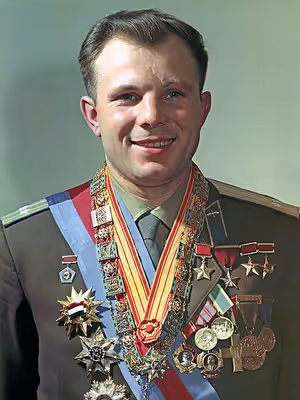
Yuri Gagarin
Soviet cosmonaut (1934–1968)
- 19 min read
- 7 chapters

Related on Lably
Through Outer space, Soviet Union and Russians
Born in the village of Klushino in the Russian SFSR, Gagarin was a foundryman at a steel plant in Lyubertsy in his youth. He later joined the Soviet Air Forces as a pilot and was stationed at the Luostari Air Base, near the Norway–Soviet Union border, before his selection for the Soviet space programme alongside five other cosmonauts. Following his spaceflight, Gagarin became the deputy training director of the Cosmonaut Training Centre, which was later named after him. He was also elected as a deputy of the Soviet of the Union in 1962 and then to the Soviet of Nationalities, the lower and upper chambers of the Supreme Soviet respectively.
Vostok 1 was Gagarin's only spaceflight, but he served as the backup crew to Soyuz 1, which ended in a fatal crash, killing his friend and fellow cosmonaut Vladimir Komarov. Fearful that a high-level national hero might be killed, Soviet officials banned Gagarin from participating in further spaceflights. After completing training at the Zhukovsky Air Force Engineering Academy in February 1968, he was again allowed to fly regular aircraft. However, Gagarin died five weeks later, when the MiG-15 that he was piloting with flight instructor Vladimir Seryogin crashed near the town of Kirzhach.
Early life
Gagarin was born on 9 March 1934 in the village of Klushino, in the Western Oblast of the Russian SFSR, near Gzhatsk (renamed Gagarin in 1968 after his death). His parents, ethnic Russian, worked on a sovkhoz—Aleksey Ivanovich Gagarin as a carpenter and Anna Timofeyevna Gagarina as a dairy farmer. Yuri was the third of four children. His elder brother Valentin was born in 1924, and by the time Yuri was born he was already helping with the cattle on the farm. His sister Zoya, born in 1927, helped take care of "Yura" and their youngest brother Boris, born in 1936.
Like millions of Soviet citizens, his family suffered during the German occupation during World War II. During the German advance on Moscow, retreating Red Army soldiers seized the collective farm's livestock. The Nazis captured Klushino on 18 October 1941. On their first day in the village, they burned down the school, ending Yuri's first year of education. The Germans also burned down 27 houses in the village and forced the residents, including the Gagarins, to work the farms to feed the occupying soldiers. Those who refused were beaten or sent to the concentration camp set up at Gzhatsk.
A Nazi officer took over the Gagarin residence. On the land behind their house, the family was allowed to build a mud hut measuring approximately 3 by 3 metres (10 by 10 ft), where they spent 21 months until the end of the occupation. During this period, Yuri became a saboteur, especially after one of the German soldiers (called "the Devil" by the children) tried to hang his younger brother Boris on an apple tree using the boy's scarf. In retaliation, Yuri sabotaged the soldier's work; he poured soil into the tank batteries gathered to be recharged and randomly mixed the different chemical supplies intended for the task. In early 1943, his two elder siblings were deported by the Germans to Poland for slave labour. They escaped and were found by Soviet soldiers who conscripted them into helping with the war effort. They did not return home until 1945, after the war.
The rest of the Gagarin family believed the two elder children were dead. Yuri's father was overcome with "grief and hunger" and often sickly; he was beaten for refusing to work for the German occupiers. He spent the remainder of the war at a hospital as a patient and later as an orderly. Yuri's mother was hospitalized during the same period, after a soldier gashed her leg with a scythe. Aleksey helped the Red Army find mines buried in the roads by the fleeing Germans following their rout out of Klushino on 9 March 1943.
Sign in to keep reading
6 more chapters are free with a Lably account.
Education and early career
In 1946, the family moved to Gzhatsk, where Gagarin continued his education. Yuri and Boris were enrolled at a crude school built in the town and run by a young woman who volunteered to be the teacher. They learned to read using a discarded Soviet military manual. A former Soviet airman later joined the school to teach maths and science, Yuri's favourite subjects. Yuri was also part of a group of children who built model aeroplanes. He was fascinated with aircraft from a young age and his interest in aeroplanes was energised after a Yakovlev fighter plane crash-landed in Klushino during the war.
In 1950, aged 16, Gagarin began an apprenticeship as a foundryman at a steel plant in Lyubertsy, near Moscow, and enrolled at a local "young workers" school for seventh-grade evening classes. After graduating in 1951 from both the seventh grade and the vocational school with honours in mouldmaking and foundry work, he was selected for further training at the Industrial Technical School in Saratov, where he studied tractors. While in Saratov, Gagarin volunteered at a local flying club for weekend training as a Soviet air cadet, where he trained to fly a biplane, and later a Yakovlev Yak-18. He earned extra money as a part-time dock labourer on the River Volga.
Soviet Air Force service
In 1955, Gagarin was accepted to the First Chkalov Higher Air Force Pilots School in Orenburg. He initially began training on the Yak-18 already familiar to him and later graduated to training on the MiG-15 in February 1956. Gagarin twice struggled to land the two-seater trainer aircraft and risked dismissal from pilot training. However, the commander of the regiment decided to give him another chance at landing. Gagarin's flight instructor gave him a cushion to sit on, which improved his view from the cockpit, and he landed successfully. Having completed his evaluation in a trainer aircraft, Gagarin began flying solo in 1957.
On 5 November 1957, Gagarin was commissioned a lieutenant in the Soviet Air Forces, having accumulated 166 hours and 47 minutes of flight time. He graduated from flight school the next day and was posted to the Luostari Air Base, close to the Norwegian border in Murmansk Oblast, for a two-year assignment with the Northern Fleet. He was assigned to the 769th Fighter Aviation Regiment of the 122nd Fighter Aviation Division flying Mikoyan-Gurevich MiG-15bis aircraft. By October 1959, he had flown a total of 265 hours.
On 7 July 1959, he was rated Military Pilot 3rd Class. After expressing interest in space exploration following the launch of Luna 3 on 6 October 1959, his recommendation to the Soviet space programme was endorsed and forwarded by Lieutenant Colonel Babushkin. By this point, he had accumulated 265 hours of flight time. Gagarin was promoted to the rank of senior lieutenant on 6 November 1959, three weeks after he was interviewed by a medical commission for qualification to the space programme.
Soviet space programme
Selection and training
Gagarin's selection for the Vostok programme was overseen by the Central Flight Medical Commission led by Major General Konstantin Fyodorovich Borodin of the Soviet Army Medical Service. He underwent physical and psychological testing conducted at Central Aviation Scientific-Research Hospital, in Moscow, commanded by Colonel A.S. Usanov, a member of the commission. The commission also included Colonel Yevgeniy Anatoliyevich Karpov, who later commanded the training centre, Colonel Vladimir Ivanovich Yazdovskiy, the head physician for Gagarin's flight, and Major-General Aleksandr Nikolayevich Babiychuk, a physician flag officer on the Soviet Air Force General Staff to the Commander in Chief of the Air Force. The commission limited its selection to pilots between 25 and 30 years old. The chief engineer of the programme Sergei Korolev also specified that candidates, to fit in the limited space in the Vostok capsule, should weigh less than 72 kg (159 lb) and be no taller than 1.70 metres (5 ft 7 in); Gagarin was 1.57 metres (5 ft 2 in) tall.
From a pool of 154 qualified pilots short-listed by their Air Force units, the military physicians chose 29 cosmonaut candidates, of whom 20 were approved by the Credential Committee of the Soviet government. The first twelve, including Gagarin, were approved on 7 March 1960 and eight more were added in a series of subsequent orders issued until June.
Gagarin began training at the Khodynka Airfield in central Moscow on 15 March 1960. The training regimen involved vigorous and repetitive physical exercises, which Alexei Leonov, a member of the initial group of twelve, described as akin to training for the Olympic Games. In April 1960, they began parachute training in Saratov Oblast and each man completed about 40 to 50 jumps from both low and high altitudes, over both land and water.
Gagarin was a candidate favored by his peers; when they were asked to vote anonymously for a candidate besides themselves they would like to be the first to fly, all but three chose Gagarin. One of these candidates, Yevgeny Khrunov, believed that Gagarin was very focused and was demanding of himself and others when necessary. On 30 May 1960, Gagarin was further selected for an accelerated training group, known as the Vanguard Six or Sochi Six, from which the first cosmonauts of the Vostok programme would be chosen. The other members of the group were Anatoly Kartashov, Andriyan Nikolayev, Pavel Popovich, Gherman Titov, and Valentin Varlamov. However, Kartashov and Varlamov were injured and replaced by Khrunov and Grigory Nelyubov.
As several of the candidates selected for the programme including Gagarin did not have higher education degrees, they were enrolled in a correspondence course programme at the Zhukovsky Air Force Engineering Academy. Gagarin enrolled in September 1960 and did not earn his specialist diploma until early 1968. Gagarin was also subjected to experiments that were designed to test physical and psychological endurance, including oxygen starvation tests in which the cosmonauts were locked in an isolation chamber and the air was slowly pumped out. He also trained for the upcoming flight by experiencing g-forces in a centrifuge. Psychological tests included placing the candidates in an anechoic chamber in complete isolation; Gagarin was in the chamber from 26 July to 5 August. In August 1960, a Soviet Air Force doctor evaluated his personality as follows:
Modest; gets embarrassed when his humour gets a little too racy; high degree of intellectual development evident in Yuriy; fantastic memory; distinguishes himself from his colleagues by his sharp and far-ranging sense of attention to his surroundings; a well-developed imagination; quick reactions; persevering, prepares himself painstakingly for his activities and training exercises, handles celestial mechanics and mathematical formulae with ease as well as excels in higher mathematics; does not feel constrained when he has to defend his point of view if he considers himself right; appears that he understands life better than a lot of his friends.
The Vanguard Six were given the title of pilot-cosmonaut in January 1961 and underwent a two-day examination conducted by a special interdepartmental commission led by Lieutenant-General Nikolai Kamanin, the overseer of the Vostok programme. The commission was tasked with ranking the candidates based on their mission readiness for the first human Vostok mission. On 17 January, they were tested in a simulator at the M. M. Gromov Flight-Research Institute on a full-size mockup of the Vostok capsule. Gagarin, Nikolayev, Popovich, and Titov all received excellent marks on the first day of testing, in which they were required to describe the various phases of the mission followed by questions from the commission. On the second day, they were given a written examination, following which the special commission ranked Gagarin as the best candidate. He and the next two highest-ranked cosmonauts, Titov and Nelyubov, were sent to Tyuratam for final preparations. Gagarin and Titov were selected to train in the flight-ready spacecraft on 7 April. Historian Asif Azam Siddiqi writes of the final selection:
In the end, at the State Commission meeting on April 8, Kamanin stood up and formally nominated Gagarin as the primary pilot and Titov as his backup. Without much discussion, the commission approved the proposal and moved on to other last-minute logistical issues. It was assumed that in the event Gagarin developed health problems prior to liftoff, Titov would take his place, with Nelyubov acting as his backup.
Vostok 1
On 12 April 1961, at 6:07 am UTC, the Vostok 3KA-3 (Vostok 1) spacecraft was launched from Baikonur Cosmodrome. Aboard was Gagarin, the first human to travel into space, using the call sign Kedr (Кедр, Siberian pine or cedar). The radio communication between the launch control room and Gagarin included the following dialogue at the moment of rocket launch:
Korolev: Preliminary stage ... intermediate... main... LIFT-OFF! We wish you a good flight. Everything's all right.
Gagarin: Off we go! Goodbye, until [we meet] soon, dear friends.
Gagarin's farewell to Korolev using the informal phrase Poyekhali! (Поехали!, 'Off we go!') later became a popular expression in the Eastern Bloc that was used to refer to the beginning of the Space Age. The five first-stage engines fired until the first separation event, when the four side boosters fell away, leaving the core engine. The core stage then separated while the rocket was in a suborbital trajectory, and the upper stage carried it to orbit. Once the upper stage finished firing, it separated from the spacecraft, which orbited for 108 minutes before returning to Earth in Kazakhstan. Gagarin became the first human to orbit the Earth.
"The feeling of weightlessness was somewhat unfamiliar compared with Earth conditions. Here, you feel as if you were hanging in a horizontal position in straps. You feel as if you are suspended", Gagarin wrote in his post-flight report. He also wrote in his autobiography released the same year that he sang the tune "The Motherland Hears, The Motherland Knows" ("Родина слышит, Родина знает") during re-entry. Gagarin was recognised as a qualified Military Pilot 1st Class and promoted to the rank of major in a special order given during his flight.
At about 7,000 metres (23,000 ft), Gagarin ejected from the descending capsule as planned and landed using a parachute. There were concerns that Gagarin's orbital spaceflight records for duration, altitude, and lifted mass would not be recognized by the Fédération Aéronautique Internationale (FAI), the world governing body for setting standards and keeping records in the field, which at the time required that the pilot land with the craft. Gagarin and Soviet officials initially refused to admit that he had not landed with his spacecraft, an omission which became apparent after Titov's flight on Vostok 2 four months later. Gagarin's spaceflight records were nonetheless certified and reaffirmed by the FAI, which revised its rules, and acknowledged that the crucial steps of the safe launch, orbit, and return of the pilot had been accomplished. Gagarin is internationally recognised as the first human in space and the first to orbit the Earth. Among the technical gear he wore to space, he kept the time from the Sturmanskie watch on his wrist.
After the Vostok 1 flight
Gagarin's flight was a triumph for the Soviet space programme and he became a national hero of the Soviet Union and the Eastern Bloc, as well as a worldwide celebrity. Newspapers around the globe published his biography and details of his flight. He was escorted in a long motorcade of high-ranking officials through the streets of Moscow to the Kremlin where, in a lavish ceremony, Nikita Khrushchev awarded him the title Hero of the Soviet Union. Other cities in the Soviet Union also held mass demonstrations, the scale of which was second only to the World War II Victory Parades.
Gagarin gained a reputation as an adept public figure and was noted for his charismatic smile. On 15 April 1961, accompanied by officials from the Soviet Academy of Sciences, he answered questions at a press conference in Moscow reportedly attended by 1,000 reporters. Gagarin visited the United Kingdom three months after the Vostok 1 mission, going to London and Manchester. While in Manchester, despite heavy rain, he refused an umbrella, insisted that the roof of the convertible car he was riding in remain open, and stood so the cheering crowds could see him. Gagarin toured widely abroad, accepting the invitation of about 30 countries in the years following his flight. In just the first four months, he also went to Poland, Brazil, Bulgaria, Canada, Cuba, Czechoslovakia, Finland, Hungary, and Iceland. Because of his popularity, US President John F. Kennedy barred Gagarin from visiting the United States.
In 1962, Gagarin began serving as a deputy to the Soviet of the Union, and was elected to the Central Committee of the Young Communist League. He later returned to Star City, the cosmonaut facility, where he spent several years working on designs for a reusable spacecraft. He became a lieutenant colonel of the Soviet Air Forces on 12 June 1962 and received the rank of colonel on 6 November 1963. On 20 December, Gagarin became Deputy Training Director of the cosmonaut training facility. Soviet officials, including Kamanin, tried to keep Gagarin away from any flights, being worried about losing their hero in an accident noting that he was "too dear to mankind to risk his life for the sake of an ordinary space flight". Kamanin was also concerned by Gagarin's drinking and believed the sudden rise to fame had taken its toll on the cosmonaut. While acquaintances say Gagarin had been a "sensible drinker", his touring schedule placed him in social situations in which he was increasingly expected to drink alcohol.
Two years later, he was re-elected as a deputy of the Soviet Union but this time to the Soviet of Nationalities, the upper chamber of the legislature. The following year, he began to re-qualify as a fighter pilot and was a backup pilot for his friend Vladimir Komarov on the Soyuz 1 flight after five years without piloting duty. Kamanin had opposed Gagarin's reassignment to cosmonaut training; Gagarin had gained weight and his flying skills had deteriorated. Despite this, he remained a strong contender for Soyuz 1 until he was replaced by Komarov in April 1966 and reassigned to Soyuz 3.
The Soyuz 1 launch was rushed due to implicit political pressures and despite Gagarin's protests that additional safety precautions were necessary. Gagarin accompanied Komarov to the rocket before launch and relayed instructions to Komarov from ground control following multiple system failures aboard the spacecraft. Despite their best efforts, Soyuz 1 crash-landed after its parachutes failed to open, killing Komarov instantly. After the Soyuz 1 crash, Gagarin was permanently banned from training for and participating in further spaceflights. He was also grounded from flying aircraft solo, a demotion he worked hard to lift. He was temporarily relieved of duties to focus on academics with the promise that he would be able to resume flight training. On 17 February 1968, Gagarin successfully defended his aerospace engineering thesis on the subject of spaceplane aerodynamic configuration and graduated cum laude from the Zhukovsky Air Force Engineering Academy.
Personal life
In 1957, while a cadet in flight school, Gagarin met Valentina Goryacheva at the May Day celebrations at the Red Square in Moscow. She was a medical technician who had graduated from Orenburg Medical School. They were married on 7 November of the same year, the same day Gagarin graduated from his flight school. Valentina and Yuri had two daughters. Yelena Yurievna Gagarina, born 1959, is an art historian who has worked as the director general of the Moscow Kremlin Museums since 2001; and Galina Yurievna Gagarina, born 1961, is a professor of economics and the department chair at Plekhanov Russian University of Economics in Moscow. , In September 1961 he was seen with an injury on his eyebrow that has been the source of many rumours. The Kamanin diaries, for example, describe an incident where he was allegedly caught inside a nurse's room and jumped out of the window to avoid being seen. However, the official statement provided was that he fell while playing with his daughter.
In his youth, Gagarin was a keen sportsman and played ice hockey as a goalkeeper. He was also a basketball fan and coached the Saratov Industrial Technical School team, as well as being a referee.
Some Soviet sources have said that Gagarin commented during his space flight, "I don't see any god up here.", though no such words appear in the verbatim record of his conversations with Earth stations during the spaceflight. In a 2006 interview, Gagarin's friend Colonel Valentin Petrov stated that Gagarin never said these words and that the quote originated from Khrushchev's speech at the plenum of the Central Committee of the CPSU about the state's anti-religion campaign, saying "Gagarin flew into space, but didn't see any god there". Petrov also said Gagarin had been baptised into the Russian Orthodox Church as a child, and a 2011 Foma magazine article quoted the rector of the Orthodox Church in Star City saying, "Gagarin baptized his elder daughter Yelena shortly before his space flight; and his family used to celebrate Christmas and Easter and keep icons in the house". Nevertheless, Gagarin's officially sanctioned autobiography, released by the USSR's state publishing house in 1961, includes a passage that upholds the official Soviet position on religious belief: "The manned space flight was a crushing blow to the churchmen. In the streams of letters that were addressed to me, I was pleased to read confessions in which believers, impressed by the achievements of science, renounced God, agreed that there is no god and everything connected with his name is fiction and nonsense".
Death
On 27 March 1968, while on a routine training flight from Chkalovsky air base, Gagarin and flight instructor Vladimir Seryogin died when their MiG-15UTI crashed near the town of Kirzhach. The bodies of Gagarin and Seryogin were cremated and their ashes interred in the walls of the Kremlin. Wrapped in secrecy, the cause of the crash that killed Gagarin is uncertain and became the subject of speculation, including several conspiracy theories. At least three investigations into the crash were conducted separately by the Air Force, official government commissions, and the KGB. According to a biography of Gagarin by Jamie Doran and Piers Bizony, Starman: The Truth Behind the Legend of Yuri Gagarin, the KGB worked "not just alongside the Air Force and the official commission members but against them."
The KGB's report, declassified in March 2003, claimed that the actions of airbase personnel contributed to the crash. The report states that an air-traffic controller provided Gagarin with outdated weather information and that by the time of his flight, conditions had deteriorated significantly. The ground crew also left the external fuel tanks attached to the aircraft. Gagarin's planned flight activities needed clear weather and no outboard tanks. The investigation concluded Gagarin's aircraft entered a spin, either due to a bird strike or because of a sudden move to avoid another aircraft. Because of the out-of-date weather report, the crew believed their altitude was higher than it was and could not react properly to bring the MiG-15 out of its spin. Another theory, advanced in 2005 by the original crash investigator, hypothesizes that a cabin air vent was accidentally left open by the crew or the previous pilot, leading to oxygen deprivation and leaving the crew incapable of controlling the aircraft. A similar theory, published in Air & Space/Smithsonian magazine, is that the crew detected the open vent and followed procedure by executing a rapid dive to a lower altitude. This dive caused them to lose consciousness and crash.
On 12 April 2007, the Kremlin vetoed a new investigation into the death of Gagarin. Government officials said they saw no reason to begin a new investigation. In April 2011, documents from a 1968 commission set up by the Central Committee of the Communist Party to investigate the accident were declassified. The documents revealed that the commission's original conclusion was that Gagarin or Seryogin had manoeuvred sharply, either to avoid a weather balloon or to avoid "entry into the upper limit of the first layer of cloud cover", leading the jet into a "super-critical flight regime and to its stalling in complex meteorological conditions".
Alexei Leonov, who was also a member of a state commission established to investigate Gagarin's death, was conducting parachute training sessions that day and heard "two loud booms in the distance". He believes that a Sukhoi Su-15 was flying below its minimum altitude and, "without realizing it because of the terrible weather conditions, he passed within 10 or 20 meters (33 or 66 ft) of Yuri and Seregin's plane while breaking the sound barrier". The resulting turbulence would have sent the MiG-15UTI into an uncontrolled spin. Leonov said the first boom he heard was that of the jet breaking the sound barrier and the second was Gagarin's plane crashing.