


Related on Lably
Through Buddhism, Compassion and Ishvara
In East Asian Buddhism, Avalokiteśvara is known as 觀世音, or more commonly simply as 觀音 (simplified Chinese: 观音; pinyin: Guānyīn; Cantonese Jyutping: Gun1-jam1; Japanese: 観音; rōmaji: Kannon; Korean: 관음; romaja: Gwaneum; Vietnamese: Quan Âm). In the traditional cultures of these Asian countries, there is a female form of Avalokiteśvara depicted as a divine mother in a white robe, called White-Robed Avalokiteśvara or Southern Sea Avalokiteśvara. This female form of Avalokiteśvara is worshiped widely in East Asian religions including Taoism and Chinese folk religion.
Avalokiteśvara is also known for his popular mantra, Oṃ maṇi padme hūṃ, which is the most popular mantra in Tibetan Buddhism.
Etymology
The name Avalokiteśvara combines the verbal prefix ava "down", lokita, a past participle of the verb lok "to look, notice, behold, observe", here used in an active sense, and finally īśvara, "lord", "ruler", "sovereign", or "master". In accordance with sandhi (Sanskrit rules of sound combination), a+īśvara becomes eśvara. Combined, the parts mean "lord who gazed down (at the world)". The word loka ("world") is absent from the name, but the phrase is implied. It does appear in the Cambodian form of the name, Lokesvarak.
The earliest translation of the name Avalokiteśvara into Chinese by authors such as Xuanzang was as Guānzìzài (Chinese: 觀自在; pinyin: Guān zìzài), not the form used in East Asian Buddhism today, which is Guanyin (Chinese: 觀音; pinyin: Guānyīn). It was initially thought that early translators, lacking fluency in Sanskrit, mistook Avalokiteśvara for Avalokitasvara ("who looked down upon sound", i.e., the cries of sentient beings who need help) and thus mistranslated Avalokiteśvara as Guānyīn. It is now understood that Avalokitasvara was the original form and is also the origin of Guanyin "perceiving sound, cries". This translation was favored by the tendency of some Chinese translators, notably Kumārajīva, to use the variant Guānshìyīn Chinese: 觀世音; pinyin: Guānshìyīn "who perceives the world's lamentations"—wherein lok was read as simultaneously meaning both "to look" and "world" (Sanskrit loka; Chinese: 世; pinyin: shì). The original form of Guanyin's name appears in Sanskrit fragments from the fifth century.
The original meaning of the name fits the Buddhist understanding of the role of a bodhisattva. The reinterpretation presenting him as an īśvara shows a strong influence of Hinduism, as the term īśvara was usually connected to the Hindu notion of Vishnu (in Vaishnavism) or Shiva (in Shaivism) as the Supreme Lord, Creator, and Ruler of the world. Some attributes of such a god were transmitted to the bodhisattva, but the mainstream of those who venerated Avalokiteśvara upheld the Buddhist rejection of the doctrine of any creator god.
In Sanskrit, Avalokiteśvara is also referred to as Lokeśvara ("Lord of the World"). In Tibetan, Avalokiteśvara is Chenrézig (Tibetan: སྤྱན་རས་གཟིགས་). The etymology of the Tibetan name Chenrézik is spyan "eye", ras "continuity", and gzig "to look". This gives the meaning of one who always looks upon all beings (with the eye of compassion).
Sign in to keep reading
5 more chapters are free with a Lably account.
Origin
Mahayana account
These are found in Chapter 25 of the Lotus Sutra: The Universal Gate of Bodhisattva Avalokiteśvara (Chinese: 觀世音菩薩普門品; pinyin: Guānshìyīn púsà pǔ mén pǐn). This chapter is devoted to Avalokiteśvara, describing him as a compassionate bodhisattva who hears the cries of sentient beings and who works tirelessly to help those who call upon his name. A total of 33 different manifestations of Avalokiteśvara are described, including female manifestations, all to suit the minds of various beings. The chapter consists of both a prose and a verse section. This earliest source often circulates separately as its own sutra, called the Avalokiteśvara Sūtra (Chinese: 觀世音經; pinyin: Guānshìyīn jīng), and is commonly recited or chanted at Buddhist temples in East Asia.
When the Chinese monk Faxian traveled to Mathura in India around 400 CE, he wrote about monks presenting offerings to Avalokiteśvara. When Xuanzang traveled to India in the 7th century, he provided eyewitness accounts of Avalokiteśvara statues being venerated by devotees from all walks of life, from kings to monks to laypeople.
In Chinese Buddhism and East Asia, Tangmi practices for the 18-armed form of Avalokiteśvara called Cundī are very popular. The popularity of Cundī is attested by the three extant translations of the Cundī Dhāraṇī Sūtra from Sanskrit to Chinese, made from the end of the seventh century to the beginning of the eighth century. In late imperial China, these early esoteric traditions still thrived in Buddhist communities. Robert Gimello has also observed that in these communities, the esoteric practices of Cundī were extremely popular among both the populace and the elite.
In the Tiantai school, six forms of Avalokiteśvara are defined. Each of the bodhisattva's six qualities is said to break the hindrances in one of the six realms of existence: hell-beings, pretas, animals, humans, asuras, and devas.
According to Nīlakaṇṭha Dhāraṇī Sūtra, Gautama Buddha told his disciple Ānanda that Avalokiteśvara had become a Buddha countless eons ago, with the name Samyaka Dharma-Vidya Tathāgata meaning "Tathāgata who clearly understands the right Dharma". Out of great compassion, he wants to help all other Bodhisattvas to achieve the highest Awakenment, and bring happiness and peacefulness to all sentient beings, therefore he appears as a Bodhisattva, taking the name Avalokiteshvara and often abides in the Sahā world.
Another Mahayana Sutra, Tathagata's Unimaginable State Sutra, reaffirms that Avalokiteśvara is actually a Buddha. In the Sutra it is written that when Sakyamuni Buddha attained the highest Awakenment, countless Buddhas from other worlds, appearing as Bodhisattvas, came to our world to congratulate him and assist his Dharma-teaching work, and Avalokiteśvara was one of those Buddhas who appeared as Bodhisattvas.
In Mahayana Buddhism, Avalokiteśvara is one of the Four Great Bodhisattvas (四大菩薩) who are Mañjuśrī, Samantabhadra, Avalokiteśvara, and Kṣitigarbha. Avalokiteśvara is also a close assistant of Amitabha Buddha, helping Amitabha Buddha to preach the Dharma of the Pure Land.
Theravāda account
Veneration of Avalokiteśvara Bodhisattva has continued to the present day in Sri Lanka.
In times past, both Tantrayana and Mahayana have been found in some of the Theravada countries, but today the Buddhism of Sri Lanka (formerly Ceylon), Myanmar (formerly Burma), Thailand, Laos, and Cambodia is almost exclusively Theravada, based on the Pali Canon. The only Mahayana deity that has entered the worship of ordinary Buddhists in Theravada Buddhism is Bodhisattva Avalokitesvara. In Sri Lanka, he is known as Natha-deva and is believed by the majority to be the Buddha yet to come, Bodhisattva Maitreya. The figure of Avalokitesvara is usually found in the shrine room near the Buddha image.
In more recent times, some western-educated Theravādins have attempted to identify Nātha with Maitreya Bodhisattva; however, traditions and basic iconography (including an image of Amitābha Buddha on the front of the crown) identify Nātha as Avalokiteśvara. Andrew Skilton writes:
... It is clear from sculptural evidence alone that the Mahāyāna was fairly widespread throughout Sri Lanka, although the modern account of the history of Buddhism on the island presents an unbroken and pure lineage of Theravāda. (One can only assume that similar trends were transmitted to other parts of Southeast Asia with Sri Lankan ordination lineages.) Relics of an extensive cult of Avalokiteśvara can be seen in the present-day figure of Nātha.
Avalokiteśvara is popularly worshipped in Myanmar, where he is called Lokanat or lokabyuharnat, and Thailand, where he is called Lokesvara. The bodhisattva goes by many other names. In Indochina and Thailand, he is Lokesvara, "The Lord of the World". In Tibet, he is Chenrezig, also spelled Spyan-ras gzigs, "With a Pitying Look". In China, the bodhisattva takes a female form and is called Guanyin (also spelled Kwan Yin, Kuanyin, or Kwun Yum), "Hearing the Sounds of the World". In Japan, Guanyin is Kannon or Kanzeon; in Korea, Gwaneum; and in Vietnam, Quan Am.
Modern scholarship
Avalokiteśvara is worshipped as Nātha in Sri Lanka. The Tamil Buddhist tradition developed in Chola literature, such as Buddamitra's Virasoliyam, states that the Vedic sage Agastya learned Tamil from Avalokiteśvara. The earlier Chinese traveler Xuanzang recorded a temple dedicated to Avalokitesvara in the south Indian Mount Potalaka, a Sanskritization of Pothigai, where Tamil Hindu tradition places Agastya as having learned the Tamil language from Shiva. Avalokitesvara worship gained popularity with the growth of the Abhayagiri vihāra's Tamraparniyan Mahayana sect.
Western scholars have not reached a consensus on the origin of the reverence for Avalokiteśvara. Some have suggested that Avalokiteśvara, along with many other supernatural beings in Buddhism, was a borrowing or absorption by Mahayana Buddhism of one or more deities from Hinduism, in particular Shiva or Vishnu. This seems to be based on the name Avalokiteśvara.
On the basis of Buddhist scriptures, ancient Tamil literary sources, and field surveys, Japanese scholar Shu Hikosaka proposes the hypothesis that ancient Mount Potalaka, the residence of Avalokiteśvara described in the Gaṇḍavyūha Sūtra and Xuanzang's Great Tang Records on the Western Regions, is Mount Potigai in Ambasamudram, Tirunelveli, at the Tamil Nadu-Kerala border. Shu also said that Mount Potalaka has been a sacred place for the people of South India since time immemorial. It is the traditional residence of Siddhar Agastya at Agastya Mala. With the spread of Buddhism in the region beginning at the time of the great king Aśoka in the third century BCE, it became a holy place also for Buddhists, who gradually became dominant as a number of their hermits settled there. The local people, though, mainly remained followers of the Tamil animist religion. The mixed Tamil-Buddhist cult culminated in the formation of the figure of Avalokiteśvara.
The name Lokeśvara should not be confused with that of Lokeśvararāja, the Buddha under whom Dharmakara became a monk and made forty-eight vows before becoming Amitābha.
Avalokiteśvara's six armed manifestation as Cintāmaṇicakra is also widely venerated in East Asia. The Cintāmaṇicakra Dharani (Chinese: 如意寶輪王陀羅尼; pinyin: Rúyì Bǎolún Wáng Tuóluóní) is another popular dharani associated with the bodhisattva.
Manifestations
Avalokiteśvara has an extraordinarily large number of forms, emanations or manifestations, including wisdom goddesses (vidyās) directly associated with him in images and texts.
Furthermore, at least two separate female Buddhist deities, Cundī and Tara also later came to be associated with Avalokiteśvara (and were even seen as manifestations of him).
According to Śūraṅgama Sūtra, Avalokiteśvara Bodhisattva had achieved perfect mastery of Buddhist Dharma and hence can manifest countless forms with different numbers of heads, arms and eyes.
Commonly seen forms
Some of the more commonly mentioned forms include:
Some other forms
Thousand-armed Avalokiteśvara
One prominent Buddhist story tells of Avalokiteśvara vowing never to rest until he had freed all sentient beings from saṃsāra. Despite strenuous effort, he realizes that many unhappy beings were yet to be saved. After struggling to comprehend the needs of so many, his head splits into eleven pieces. Amitābha, seeing his plight, gives him eleven heads with which to hear the cries of the suffering. Upon hearing these cries and comprehending them, Avalokiteśvara tries to reach out to all those who needed aid, but found that his two arms shattered into pieces. Once more, Amitābha comes to his aid and invests him with a thousand arms with which to aid the suffering multitudes.
This manifestation of Avalokiteśvara is known as Sahrasasbhuja Avalokiteśvara ("Thousand-armed Avalokiteśvara), and is among the bodhisattva's most popular iconographic forms across China, Japan and Korea.
Avalokiteśvara as a cosmic maheśvara ("Great Lord of Creation")
According to various Mahayana sources, numerous Hindu deities are considered to be emanations of Avalokiteshvara. For example, in the Kāraṇḍavyūhasūtra (4th–5th century CE), Great universal deities called Vishnu, Shiva, Brahma and Saraswati are all said to have emerged from Avalokiteshvara bodhisattva's body. The passage states:
Āditya and Candra came from his eyes, Maheśvara came from his forehead, Brahmā came from his shoulders, Nārāyaṇa came from his heart, Devi Sarasvatī came from his canines, Vāyu came from his mouth, Dharaṇī came from his feet, and Varuṇa came from his stomach.
In a similar manner, Hindu deities like Nīlakaṇṭha and Harihara are cited in the Nīlakaṇṭha Dhāraṇī, possibly as forms of Avalokiteshvara or as associated bodhisattvas (the text is not clear, though traditionally these have been interpreted as various names or forms of Avalokiteshvara).
Alexander Studholme writes that these sources are influenced by Puranic Hinduism, and its concepts of an Īśvara ("lord") and Maheśvara ("great lord"), both of which are terms that refer to a transcendent and all pervasive being. The name Maheśvara is also applied to Avalokiteshvara three times in the Kāraṇḍavyūhasūtra, and some passages he is described as a cosmic man, similar to how the Puranas depict Vishnu or Shiva. However, this Buddhist myth only focuses on how Avalokiteshvara gives birth to all the gods (devas), and he is not depicted as a true Creator God (who creates the cosmos, like the Hindu Īśvara), instead he is depicted as a great cosmic being that manifests in myriad ways as a skillful means to guide living beings to Buddhahood.
Mantras and Dharanis
There are various mantras and dharanis associated with Avalokiteśvara.
Mani mantra
In Tibetan Buddhism, the central mantra is the six-syllable mantra Oṃ maṇi padme hūṃ (Sanskrit: ॐ मणि पद्मे हूँ, also called the Mani mantra. Due to his association with this mantra, one form of Avalokiteśvara is called Ṣaḍākṣarī ("Lord of the Six Syllables") in Sanskrit. The Mani mantra is also popular in East Asian Mahayana, such as Chinese Buddhism. There are also different variations of the mani mantra, the most common which is Oṃ maṇi padme hūṃ hrīḥ. Hrīḥ is the seed syllable of the Lotus Buddha family and the Buddha Amitabha.
Recitation of this mantra while using prayer beads is the most popular religious practice in Tibetan Buddhism. Another popular religious practice associated with om mani padme hum is the spinning of prayer wheels clockwise, which contains numerous repetitions of this mantra and effectively benefits everyone within the vicinity of the practitioner.
The connection between this famous mantra and Avalokiteśvara is documented for the first time in the Kāraṇḍavyūhasūtra. This text is dated to around the late 4th century CE to the early 5th century CE. In this sūtra, a bodhisattva is told by the Buddha that recitation of this mantra while focusing on the sound can lead to the attainment of eight hundred samādhis.
Ārolik mantra
Another mantra for Avalokiteśvara commonly recited in East Asian Buddhism is "three and a half syllables" (ardhacaturthākṣara) heart-mantra: "oṃ ārolik svāha" (or sometimes just Ārolik or oṁ ārolik), which is found (in many forms and variations like ārolika, arulika, etc.) in numerous pre-tenth-century Indian texts, including the 7th century Chinese translation of the Dhāraṇīsaṁgraha, the Susiddhikarasūtra, the Mañjuśriyamūlakalpa, and the Guhyasamājatantra.
In Chinese Buddhism, this mantra is known as "Avalokiteśvara's mantra for eradicating karmic obstructions" (Chinese: 觀世音菩薩滅業障真言, pinyin: Guānshìyīn púsà miè yèzhàng zhēnyán) and is typically recited everyday as part of the standard liturgy during the daily Mengshan Shishi ritual (Chinese: 蒙山施食; pinyin: Méngshān shīshí; lit. 'Mengshan food-bestowal') carried out in all Chinese Buddhist monasteries. In Shingon Buddhism, this mantra is the main mantra for Avalokiteśvara, and it is also considered to be the main mantra of the Lotus Buddha family.
One text (Taisho Tripitaka no. 1031) describes a visualization practice done after reciting oṁ ārolik svāhā seven times which includes meditating on the meanings of the four letters of ārolik which are:
- a: all dharmas are originally unborn (ādyanutpanna);
- ra: all dharmas are dissociated from defilement (rajas);
- la: characteristics (lakṣaṇa) are inapprehensible in all dharmas;
- ka: all dharmas are without action (kārya).
The Ārolik mantra has also been found engraved on a few sculptures found in north India. One of these begins with "ārolik oṁ hrīḥ". Another one of these found in Bihar also included other mantras, including ye dharma hetu, followed by "namo ratnatrayāya namo Āryāvalokiteśvarāya bodhisatvāya mahāsatvāya mahākāruṇikāya Ārolok Oṁ hriḥ hriḥ".
Another longer mantra appears in a translation by Amoghavajra (T. 1033, 20: 9b1–7):
namoratnatrayāya | nama āryāvalokiteśvarāya bodhisattvāya mahāsattvāya mahākāruṇikāya | tadyathā padmapāṇi sara sara ehy ehi bhagavann āryāvalokiteśvara ārolik |
In Chinese, oṃ ārolik svāha is pronounced Ǎn ālǔlēi jì suōpóhē (唵 阿嚕勒繼 娑婆訶). In Korean, it is pronounced Om aroreuk Ge Sabaha (옴 아로늑계 사바하). In Japanese, it is pronounced On arori kya sowa ka (おん あろりきゃ そわか). In the Siddham script it is written as 𑖄𑖼 𑖁𑖨𑖺𑖩𑖰𑖎𑖿 𑖭𑖿𑖪𑖯𑖮𑖯𑗃.
Dharanis
The Kāraṇḍavyūha Sūtra also features the first appearance of the dhāraṇī of Cundī, which occurs at the end of the sūtra text. After the bodhisattva finally attains samādhi with the mantra "oṃ maṇipadme hūṃ", he is able to observe 77 koṭīs of fully enlightened buddhas replying to him in one voice with the Cundī Dhāraṇī: namaḥ saptānāṃ samyaksaṃbuddha koṭīnāṃ tadyathā, oṃ cale cule cunde svāhā.
The Nīlakaṇṭha Dhāraṇī is an 82-syllable dhāraṇī for Avalokiteśvara also known as the Great Compassion Mantra. It is very popular in East Asian Buddhism. Another popular Avalokiteśvara dharani in East Asian Buddhism is Eleven-Faced Avalokitesvara Heart Dharani. This dharani is associated with Avalokiteśvara's eleven face form, known as Ekādaśamukha, one of the six forms of Guanyin.
East Asian chants and phrases
In East Asian Buddhism, the most popular form of Avalokiteśvara is the feminine white robed Guanyin. A common phrase which is widely chanted and recited by East Asian Buddhists is:
There are also longer chants, usually termed "White Robe Avalokitesvara" (Baiyin Guanyin) sutras (jing) or mantras (zhou). The most well known is the "Divine White-robed Avalokiteśvara Mantra" (c. 11th century). This longer mantra is as follows:
Another popular dharani of Guanyin is associated with her power over children and childbirth. This is called the "Dharani Sutra of White-Robed Guanyin's Heart of Five Seals".
In Japanese Buddhism, a popular longer chant to Kannon or Kanzeon (Guanyin) is the jikku kan'on gyō (十句觀音經), the "10 Verse Kannon Sutra". It is the following:
Tibetan Buddhist beliefs
Avalokiteśvara is an important deity in Tibetan Buddhism. He is regarded in the Vajrayana teachings as a Buddha.
In Tibetan Buddhism, Tãrã came into existence from a single tear shed by Avalokiteśvara. When the tear fell to the ground it created a lake, and a lotus opening in the lake revealed Tara. In another version of this story, Tara emerges from the heart of Avalokiteśvara. In either version, it is Avalokiteśvara's outpouring of compassion which manifests Tãrã as a being.
Certain living tulku lineages, including the Dalai Lamas and the Karmapas, are considered by many Tibetan Buddhists to also be manifestations of Avalokiteśvara.
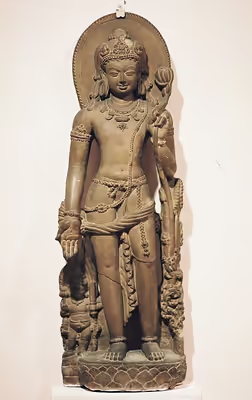
Iconography
Deer-skin (tinasara)
In Tibetan iconography, Avalokiteśvara (Chenrezig) is occasionally depicted wearing a deer-skin—tinasara or krishnasara कृष्णसार (kṛṣṇasāra) in Sanskrit, and ཀྲཱིཤྣ་སཱ་ར (krī-shna-sā-ra) or ཁྲི་སྙན་སཱ་ར། in Tibetan—draped over his left shoulder. This attribute serves as a layered symbol of renunciation, deep compassion, and yogic practice. Historically, Indian ascetics used deer-skins as meditation seats or garments to support austere retreat and concentration.
The iconographic tradition may trace back to the Ruru Jātaka (Jātaka tale No. 482), also known as the 'Golden Deer' story, in which the bodhisattva was once born as a splendid golden deer endowed with compassion and the ability to speak human languages. He saved a man from drowning and, when the king later hunted him, he offered himself to protect his followers. His act of selflessness moved the king to prohibit hunting throughout the realm—thus embodying compassion that transforms society.
This convergence of yogic renunciation, mythic compassion, and visual representation makes the tinasara a powerful emblem in Chenrezig's devotional art.