


Explore on Lably
ToursExplore Lably’s 3D toursMalagasy is the westernmost Austronesian language, brought to Madagascar with the settlement of Austronesian speakers from the Sunda Islands (about 7,300 kilometres or 4,500 miles away) around the 5th century AD or perhaps between the 7th and 13th centuries. The Malagasy language is one of the Barito languages and is most closely related to the Maʼanyan language, still spoken on Borneo. Malagasy also includes numerous Malay loanwords from the time of the early Austronesian settlement and trading between Madagascar and the Sunda Islands. After c. 1000 AD, Malagasy incorporated numerous Bantu and Arabic loanwords brought over by traders and new settlers.
Malagasy is spoken by around 25 million people in Madagascar and the Comoros. Most people in Madagascar speak it as a first language, as do some people of Malagasy descent elsewhere. Malagasy is divided in dozen dialects between three main dialect groups: Northern Malagasic, Central-Eastern Malagasic and Southern Malagasic. The central plateau of the island, where the capital Antananarivo and the old heartland of the Merina Kingdom is located, speaks the Merina dialect. The Merina dialect is the basis of Standard Malagasy, which is used by the government and media in Madagascar. Standard Malagasy is one of two official languages of Madagascar alongside French, in the 2010 constitution of the Fourth Republic of Madagascar.
Malagasy is written in the Latin script, which was introduced by Western missionaries in the early 19th century. Previously, the Sorabe script was used, a local development of the Arabic script.
Classification
The Malagasy language is the westernmost (Hesperonesian) member of the Austronesian language family, a grouping that is closely related to the Western Indonesian languages.
Similarities between Malagasy and Eastern Sumatran (Malay) had been observed since the 17th century and Malagasy's relation with other Austronesian languages had already been noted by early scholars, such as the Dutch scholar Adriaan Reland in 1708.
Among all Austronesian languages, Dahl (1951) demonstrated that Malagasy and Maʼanyan Dayak – an East Barito language natively spoken in Central Kalimantan (Indonesia) on the island of Kalimantan – were particularly closely related. Furthermore, there appears to be a Bantu influence or substratum in Malagasy phonotactics (Dahl 1988). There are some Sanskrit loanwords in Malagasy, which are said to have been borrowed via Javanese (mainly).
Adelaar (1995) suggested that the vocabulary of Malagasy also contains many words that are of South Sulawesi-origin (especially Makassar) . Further evidence for this suggestion was presented by Blench (2018).
However, the diversity of Malagasy dialects does not correspond to the genetic diversity of the populations. For example, the Merina, who often show a relatively high proportion of Austronesian ancestry (more than 50–60% according to several studies), nevertheless use certain words of African origin such as mamba 'crocodile' or osy 'goat'. Conversely, several coastal populations, whose proportion of Asian ancestry is generally lower (around 30–40%), do not always use these terms and instead retain Austronesian words absent from the Merina vocabulary, such as voay or bengy.
Sign in to keep reading
11 more chapters are free with a Lably account.
Etymology
Malagasy is the demonym of Madagascar, from which it is taken to refer to the people of Madagascar in addition to their language.
History
Madagascar was first settled by Austronesian peoples from Maritime Southeast Asia from the Sunda Islands (Malay archipelago). As for their route, one possibility is that the Indonesian Austronesian came directly across the Indian Ocean from Java to Madagascar. It is likely that they went through the Maldives, where evidence of old Indonesian boat design and fishing technology persists until the present. The migrations continued along the first millennium, as confirmed by linguistic researchers who showed the close relationship between the Malagasy language and Old Malay and Old Javanese languages of this period. The Malagasy language originates from the Southeast Barito languages, and the Ma'anyan language is its closest relative, with numerous Malay and Javanese loanwords. It is known that Ma'anyan people were brought as labourers and slaves by Malay and Javanese people in their trading fleets, which reached Madagascar by c. 50–500 AD. Later, c. 1000, the original Austronesian settlers mixed with Bantus and Arabs, amongst others. There is evidence that the predecessors of the Malagasy dialects first arrived in the southern stretch of the east coast of Madagascar. Adelaar (2017) proposes that a distinct Malagasy speech community had already been established in South Borneo before the early Malagasy speakers migrated to East Africa.
Malagasy has a tradition of oratory arts and poetic histories and legends. The most well-known is the national epic, Ibonia, about a Malagasy folk hero of the same name.
Geographic distribution
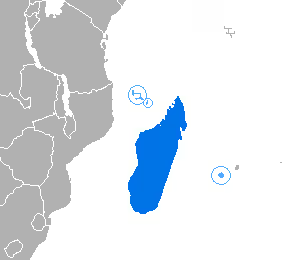
Malagasy is the principal language spoken on the island of Madagascar. It is also spoken by Malagasy communities on neighboring Indian Ocean islands such as Réunion, Mayotte and Mauritius. Expatriate Malagasy communities speaking the language also exist in Europe and North America.
Legal status
The Merina dialect of Malagasy is considered the national language of Madagascar. It is one of two official languages alongside French in the 2010 constitution put in place the Fourth Republic. Previously, under the 2007 constitution, Malagasy was one of three official languages alongside French and English. Malagasy is the language of instruction in all public schools through grade five for all subjects, and remains the language of instruction through high school for the subjects of history and Malagasy language.
Dialects
In his 1658 work Histoire de la grande isle Madagascar, Étienne de Flacourt provided one of the earliest known attempts to classify the Malagasy language into dialectal regions. He divided Malagasy into two main dialect groups: northern and southern. He noted significant lexical differences between them — for instance, the word ampela was used in the south to mean 'woman' or 'girl', while vaiavy was used in the north. Similarly, baba was a northern term for 'father', whereas ray was used in the south.
Flacourt also observed phonological variations. He noted similarities between the Tanosy and Antemoro dialects, especially their shared use of the [] sound in words like fotsy 'white'. In contrast, in the Masikoro and Mahafaly dialects, the [] sound is often replaced by [], producing foty for the same meaning.
Malagasy dialects can be divided into northern, central-eastern, and southern groups. Northern dialects (Kibushi, Northern Sakalava, Antakarana, Tsimihety, Northern Betsimisaraka) are heavily influenced by Swahili and French. Northern Malagasy speakers pronounce the vowel o like the English vowel in "cold," orthographically written ô. Examples include vôalôhagny ('first'), nôsy ('island'), talôha ('before'), mitôndra ('to carry'), vôlagna ('moon; month'), and sôla ('bald').
Non-Northern Malagasy speakers pronounce the same vowel o like the English "oo" in "food", as in voalohany, nosy, mitondra, volana, and sola.
Southern Malagasy dialects, including Tandroy, Southern Sakalava, Tanosy, and Bara, reflect conservative phonology and can phonetically resemble Polynesian languages. They also use a progressive or ascending numeral system, where the smaller unit is added after the base (e.g., folo raik'amby → literally '10 + 1'), in contrast with other Malagasy dialects that use a retrograde or descending system (e.g., iraika ambin'ny folo → literally '1 over 10').
For example, the word linta ('leech') corresponds to Malay lintah, taly ('rope') corresponds to Malay tali, and limy ('five') corresponds to Malay lima, whereas in other dialects it appears as dinta, tady, and dimy.
Central-Eastern subgroup which contains Antesaka, Sahafatra, Southern Betsimisaraka and Plateau dialects like Antefasy, Antambahoaka, Vakinankaratra, Sihanaka, Merina (basis of Standard Malagasy) constitutes an intermediate group, with a structure and vocabulary largely close to standard Malagasy, and with influence sometimes coming from either the northern or southern branches.
Although considered a single ethnic group, the Sakalava speak at least two distinct dialects. The Southern Sakalava dialect is more closely related to Masikoro, while the Northern Sakalava dialect shares linguistic features with the Tsimihety dialect. The Betsimisaraka also demonstrate internal dialectal variation: the Northern Betsimisaraka dialect is closer to Tsimihety, whereas the Southern variant is more similar to Antambahoaka.
Tree list of Malagasy dialects
- Proto-Malagasy
- Central-Eastern Malagasic
- Plateaux Malagasy
- Merina-Vakinankaratra
- Merina
- Standard Malagasy
- Inner City Merina
- Vakinankaratra
- Marofotsy
- Merina
- Betsileo
- Bezanozano
- Sihanaka
- Antemoro-Antefasy
- Sahavoay
- Antemoro
- Antefasy
- Zafisoro
- Antambahoaka
- Tanala
- Merina-Vakinankaratra
- Sahafatra-Antesaka
- Antemanambondro
- Sahafatra
- Antesaka
- Southern Betsimisaraka
- Plateaux Malagasy
- Southern Malagasic
- Vezo-Sakalava
- Southern Sakalava
- Vezo
- Masikoro
- Mikea
- Tandroy
- Karimbola
- Mahafaly
- Bara
- Antanosy
- Vezo-Sakalava
- Northern Malagasic
- Northern Sakalava
- Kibushi
- Kibushi Kimaore
- Kibushi Kiantalaotsy
- Kibushi
- Sakalava Anjoaty
- Antakarana
- Tsimihety
- Northern Betsimisaraka
- Northern Sakalava
- Central-Eastern Malagasic
Inspired by Gabriel Ferrand's book Essai de phonétique comparée du malais et des dialectes malgaches, published in 1909, Glottolog divides Malagasy into two principal dialect zones: Eastern (including Merina) and Western (including Sakalava), with an isogloss running roughly down the central spine of the island. In this model, the southern region is classified as Western, while the central plateau and much of the north (excluding the far northern tip) are considered Eastern.
This binary classification is now widely viewed as outdated. It overlooks crucial grammatical, phonological, and lexical distinctions among Malagasy dialects. For example, Northern Betsimisaraka shares features with Northern Sakalava, placing it closer to western varieties, while Southern Betsimisaraka remains a typically eastern dialect. Similarly, dialects such as Tanosy, although traditionally grouped in the east, show structural and etymological affinities with western dialects like Bara and Southern Sakalava.
Ethnologue identifies 12 major varieties of Malagasy and treats them as separate languages. It distinguishes between dialects such as Northern and Southern Betsimisaraka, and between Northern and Southern Sakalava, which is a step toward acknowledging internal diversity. However, it still fails to represent the full diversity of the dialect continuum in Madagascar. In reality, more than more than 20 dialects are spoken, many of which are entirely absent from Glottolog and Ethnologue. Dialects such as Sakalava Anjoaty, Karimbola, and Sahavoay are completely neglected.
The following is the classification of Malagasy dialects according to Ethnologue:
The Eastern dialects are:
- Northern Betsimisaraka Malagasy (1,270,000 speakers) – spoken by the Betsimisaraka on the northeastern coast of the island
- Southern Betsimisaraka Malagasy (2,000,000 speakers) – spoken by the Betsimisaraka in the North of the region Vatovavy Fito Vinany.
- Plateau (Merina) Malagasy (10,893,000 speakers) – spoken in the centre of the island.
- Tanosy Malagasy (639,000 speakers) – spoken by the Antanosy people in the south of the island.
- Tesaka Malagasy (1,130,000 speakers) – spoken by the Antaisaka people in the southeast of the island.
The Western dialects are:
- Antankarana Malagasy (156,000 speakers) – spoken by the Antankarana in the northern tip of the island.
- Bara Malagasy (724,000 speakers) – spoken by the Bara people in the south of the island
- Masikoro Malagasy (550,000 speakers) – spoken by the Masikoro in the southwest of the island.
- Sakalava Malagasy (1,210,000 speakers) – spoken by the Sakalava people on the western coast of the island.
- Tandroy-Mahafaly Malagasy (1,300,000 speakers) – spoken by the Antandroy and the Mahafaly people on the southern tip of the island
- Tsimihety Malagasy (1,615,000 speakers) – spoken by the Tsimihety people.
Additionally, the Bushi dialect (41,700 speakers) is spoken on the French overseas territory of Mayotte, which is part of the Comoro island chain situated northwest of Madagascar.
Writing system
The language has a written literature going back presumably to the 15th century. When the French established Fort-Dauphin in the 17th century, they found an Arabico-Malagasy script in use, known as Sorabe ("large writings"). This Arabic-derived Sorabe alphabet was mainly used for astrological and magical texts. The oldest known manuscript in that script is a short Malagasy-Dutch vocabulary from the early 17th century, which was first published in 1908 by Gabriel Ferrand though the script must have been introduced into the southeast area of Madagascar in the 15th century.
The first bilingual renderings of religious texts are those by Étienne de Flacourt, who also published the first dictionary of the language. Radama I, the first literate representative of the Merina monarchy, though extensively versed in the Arabico-Malagasy tradition, opted in 1823 for a Latin system derived by David Jones and invited the Protestant London Missionary Society to establish schools and churches. The first book to be printed in Malagasy using Latin characters was the Bible, which was translated into Malagasy in 1835 by British Protestant missionaries working in the highlands area of Madagascar.
The current Malagasy alphabet consists of 21 letters: a, b, d, e, f, g, h, i, j, k, l, m, n, o, p, r, s, t, v, y, z. The orthography maps rather straightforwardly to the phonemic inventory. The letters i and y both represent the sound (y is used word-finally, and i elsewhere), while o is pronounced (except in the northern dialects, where it corresponds to ). The affricates and are written tr and dr, respectively, while and are written ts and j. The letter h is often silent. All other letters have essentially their IPA values. The letters c, q, u, w and x are not part of the Malagasy alphabet, but are used in some foreign loanwords.
Mp and occasionally nt may begin a word, but they are pronounced .
@ is used informally as a short form for amin'ny, which is a preposition followed by the definite form, meaning for instance 'with the'.
Diacritics
Diacritics are not obligatory in standard Malagasy, except in the case where its absence leads to an ambiguity: tanàna 'city' must have the diacritic to discriminate itself from tanana 'hand'. They may however be used in the following ways:
- ◌̀ (grave accent) shows the stressed syllable in a word. It is frequently used for disambiguation. For instance in tanàna 'city' and tanana 'hand', where the word that is an exception to the usual pronunciation rules (tanàna) gets an accent. Using the accent on the word that follows the pronunciation rules (tànana) is less common, mainly in dictionaries. (This is very similar to the usage of the grave accent in Italian.)
- ◌́ (acute accent) may be used in
- very old dictionaries, along with grave accent
- dialects such as Bara
- French (Tuléar) and French-spelled (Antsirabé) names. Malagasy versions are Toliara or Toliary and Antsirabe.
- ◌̂ (circumflex) is used as follows:
- ô shows that the letter is pronounced and not , in Malagasified foreign words (hôpitaly) and dialects (Tôlan̈aro). In standard Malagasy, ao or oa (as in mivoaka) is used instead.
- sometimes the single-letter words a and e are written â and ê but it does not change the pronunciation
- ◌̈ (diaeresis) is used with n̈ in dialects for a velar nasal . Examples are place names such as Tôlan̈aro, Antsiran̈ana, Iharan̈a, Anantson̈o. This can be seen in maps from FTM, the national institute of geodesy and cartography.
- ◌̃ (tilde) is used in ñ sometimes, perhaps when the writer cannot produce an n̈ (although ng is also used in such cases). In Ellis' Bara dialect dictionary, it is used for velar nasal as well as palatal nasal .
Phonology
Vowels
After a stressed syllable, as at the end of most words and in the final two syllables of some, are reduced to . ( is spelled ⟨y⟩ in such cases, though in monosyllabic words like ny and vy, ⟨y⟩ is pronounced as a full .) Final , and sometimes final syllables, are devoiced at the end of an utterance. and are never reduced or devoiced. The large number of reduced vowels, and their effect on neighbouring consonants, give Malagasy a phonological quality not unlike that of Portuguese.
is marginal in Merina dialect, found in interjections and loan words, though it is also found in place names from other dialectical areas. are diphthongs in careful speech, or in more casual speech. , whichever way it is pronounced, affects following as does.
Consonants
The alveolars are slightly palatalized. vary between and , and are especially likely to be the latter when followed by unstressed , thus French malgache 'Malagasy'. The velars are palatalized after (e.g. alika 'dog'). is frequently elided in casual speech.
The reported postalveolar trilled affricates are sometimes simple stops, , but they often have a rhotic release, . It is not clear if they are actually trilled, or are simply non-sibilant affricates . However, in another Austronesian language with a claimed trilled affricate, Fijian, trilling occurs but is rare, and the primary distinguishing feature is that it is postalveolar. The Malagasy sounds are frequently transcribed [ ], and that is the convention used in this article.
In reduplication, compounding, possessive and verbal constructions, as well as after nasals, fricatives and liquids, 'spirants' become stops, as follows:
Stress
Here, stressed syllables are indicated by grave diacritics ⟨à⟩, although these diacritics are normally not used.
Words are generally accented on the penultimate syllable, unless the word ends in ka, tra and often na, in which case they are stressed on the antepenultimate syllable. Secondary stresses exist in even-numbered syllables from the last stressed syllable, when the word has more than four syllables (fàmantàranàndro "watch, clock"). Neither prefixation nor suffixation affect the placement of stress.
In many dialects, unstressed vowels (except ) are devoiced, and in some cases almost completely elided; thus fanòrona is pronounced .
Tonogenesis
According to Penelope Howe in 2019, Central Malagasy is undergoing tonogenesis, with syllables containing voiced consonants are "fully devoiced" and acquire a low tone ( → ), while those containing unvoiced consonants acquire a high tone ( → ). However, this development appears to not occur in posttonic syllables, and she called it "pitch accent" instead.
Phonotactics
Grammar
Word order
Malagasy has a verb–object–subject (VOS) word order:
Mamaky
reads
boky
book
ny
the
mpianatra
student
"The student reads the book"
Nividy
bought
ronono
milk
ho
for
an'ny
the
zaza
child
ny
the
vehivavy
woman
"The woman bought milk for the child"
Within phrases, Malagasy order is typical of head-initial languages: Malagasy has prepositions rather than postpositions (ho an'ny zaza 'for the child'). Determiners precede the noun, while quantifiers, modifying adjective phrases, and relative clauses follow the noun (ny boky 'the book(s)', ny boky mena 'the red book(s)', ny boky rehetra 'all the book(s)', ny boky novakin'ny mpianatra 'the book(s) read by the student(s)').
Somewhat unusually, demonstrative determiners are repeated both before and after the noun: ity boky ity 'this book' (lit. 'this book this').
Verbs
Verbs have syntactically three productive "voice" forms according to the thematic role they play in the sentence: the basic "agent focus" forms of the majority of Malagasy verbs, the derived "patient focus" forms used in "passive" constructions, and the derived "goal focus" forms used in constructions with focus on instrumentality. Thus, all the following sentences mean "I wash my hands with soap".
- (1) Manasa ny tanako amin'ny savony aho. (lit. 'I am washing my hands with soap.')
- (2) Sasako amin'ny savony ny tanako. (lit. 'My hands are washed with soap by me.')
- (3) Anasako ny tanako ny savony. (lit. 'It is with soap that my hands are washed by me.')
However, focus is determined in each case by the sentence initial verb form and the sentence final (noun) argument: manasa 'wash' and aho 'I' in (1), sasako 'wash' and ny tanako 'my hands' in (2), anasako 'wash' and ny savony 'soap' in (3). There is no equivalent to the English preposition with in (3).
Verbs inflect for past, present, and future tense, where tense is marked by prefixes (e.g. mividy 'buy', nividy 'bought', hividy 'will buy').
Nouns and pronouns
Malagasy has no grammatical gender, and nouns do not inflect for number. However, pronouns and demonstratives have distinct singular and plural forms (cf. io boky io 'that book', ireto boky ireto 'these books').
There is a complex series of demonstrative pronouns, depending on the speaker's familiarity with the referent.
The following set of pronouns are the pronouns found in Standard Malagasy. Note: the nominative first person singular pronoun is divided between a long and short form; the long form occurs before a verb (focalized or topicalized subjects) and the short form after a verb. The genitive first and second person pronouns are also divided between long and short forms; the long form occurs if the root ends with anything but [na], [ka*] or [tra]; if the stem ends with [na], the long form also occurs but [na] is deleted; and if the stem ends with [ka*] or [tra], the final vowel of the root is deleted and the short form occurs.
Deixis
Malagasy has a complex system of deixis (these, those, here, there, etc.), with seven degrees of distance as well as evidentiality across all seven. The evidential dimension is prototypically visible vs. non-visible referents; however, the non-visible forms may be used for visible referents which are only vaguely identified or have unclear boundaries, whereas the visible forms are used for non-visible referents when these are topical to the conversation.
Notes:
- Diacritics in deixis are not mandatory in Malagasy.
- Deixis marked by a * are rarely used.
Vocabulary
Malagasy shares much of its basic vocabulary with the Ma'anyan language, a language from the region of the Barito River in southern Borneo. The Malagasy language also includes some borrowings from Sanskrit, Arabic and Bantu languages (especially the Sabaki branch, from which most notably Swahili derives), and more recently from French and English.
Malagasy contains many words that derive from Malay which have completely different original definitions unlike those of its close relative Ma'anyan:
Lexicography
The first dictionary of the language is Étienne de Flacourt's Dictionnaire de la langue de Madagascar published in 1658 though earlier glossaries written in Arabico-Malagasy script exist. A later Vocabulaire Anglais-Malagasy was published in 1729. An 892-page Malagasy–English dictionary was published by James Richardson of the London Missionary Society in 1885, available as a reprint; however, this dictionary includes archaic terminology and definitions. Whereas later works have been of lesser size, several have been updated to reflect the evolution and progress of the language, including a more modern, bilingual frequency dictionary based on a corpus of over 5 million Malagasy words.
- Winterton, M. et al.: Malagasy–English, English–Malagasy Dictionary / Diksionera Malagasy–Anglisy, Anglisy–Malagasy. Raleigh, North Carolina. USA: Lulu Press 2011, 548 p.
- Richardson: A New Malagasy–English Dictionary. Farnborough, England: Gregg Press 1967, 892 p. ISBN 0-576-11607-6 (Original edition, Antananarivo: The London Missionary Society, 1885).
- Diksionera Malagasy–Englisy. Antananarivo: Trano Printy Loterana 1973, 103 p.
- An Elementary English–Malagasy Dictionary. Antananarivo: Trano Printy Loterana 1969, 118 p.
- English–Malagasy Phrase Book. Antananarivo: Editions Madprint 1973, 199 p. (Les Guides de Poche de Madagasikara.)
- Paginton, K: English–Malagasy Vocabulary. Antananarivo: Trano Printy Loterana 1970, 192 p.
- Bergenholtz, H. et al.: Rakibolana Malagasy–Alemana. Antananarivo: Leximal/Moers: aragon. 1991.
- Bergenholtz, H. et al.: Rakibolana Alemana–Malagasy. Antananarivo: Tsipika/Moers: aragon. 1994.
- Rakibolana Malagasy. Fianarantsoa: Régis RAJEMISOA – RAOLISON 1995, 1061 p.
Sample text
Article 1 of the Universal Declaration of Human Rights in Malagasy:
Teraka afaka sy mitovy zo sy fahamendrehana ny olombelona rehetra. Samy manan-tsaina sy fieritreretana ka tokony hifampitondra am- pirahalahiana.
Article 1 of the Universal Declaration of Human Rights in English:
All human beings are born free and equal in dignity and rights. They are endowed with reason and conscience and should act towards one another in a spirit of brotherhood.