

Ramkhamhaeng
King of Sukhothai from 1279 to 1298
- 7 min read
- 5 chapters

Related on Lably
Through Ahom people
He is credited with the creation of the Thai alphabet and with firmly establishing Theravada Buddhism as the state religion of the kingdom.
Birth and name
Ramkhamhaeng (sometimes written Ram Khamhaeng) was a son of Pho Khun Bang Klang Hao, who ruled as Pho Khun Si Inthrathit, and his queen, Sueang. Folk legend, however, claims that his real parents were an ogress named Kangli and a fisherman. He had two brothers and two sisters. The eldest brother died while very young. The second, Ban Mueang, became king following their father's death and was succeeded by Ramkhamhaeng on his death.
At the age of 19, he took part in his father's successful campaign to capture the city of Sukhothai. Coedès described the city as formerly a vassal of the Khmer Empire, and on his account the victory established Sukhothai as an independent kingdom. Owing to his courage in battle, he was reportedly granted the title "Phra Ram Khamhaeng" ("Rama the Bold"). The Ram Khamhaeng Inscription gives a different occasion. At nineteen he fought Khun Sam Chon, ruler of Mueang Chot, who had attacked Tak, and he took the name Ram Khamhaeng from his victory on elephant-back. Following his father's death, his elder brother Ban Mueang ascended the throne and appointed Ramkhamhaeng as ruler of Si Satchanalai. Chusak Satienpattanodom reads the descent of the town differently. On his account Si Satchanalai remained with Pha Mueang's line until 1283, when Ramkhamhaeng annexed it after Pha Mueang's death and restored it as the second seat of the kingdom. He takes the date from the preface of the Chindamani, a manual of the 17th century.
The Royal Institute of Thailand has speculated that Ramkhamhaeng's birth name was "Ram", from Rama, the hero of the Hindu epic Ramayana, since his name following coronation was recorded as "Pho Khun Ramarat" (Thai: พ่อขุนรามราช). At the time, it was customary to name a grandson after his grandfather. According to both the 11th Stone Inscription and the Ayutthaya Chronicles compiled by Prasoet Aksoranit, Ramkhamhaeng had a grandson named "Phraya Ram", whose two grandsons in turn were named "Phraya Ban Mueang" and "Phraya Ram".
The title Maharat (Thai: มหาราช) is the Thai equivalent of "the Great King".
Sign in to keep reading
4 more chapters are free with a Lably account.
Accession
Tri Amattayakun (Thai: ตรี อมาตยกุล), a Thai historian, suggests that Ramkhamhaeng should have acceded to the throne in 1279, the year he planted a sugar palm tree in Sukhothai. Prasert na Nagara of the Royal Institute speculates that this was a tradition of Tai Ahom monarchs. They planted banyan or sugar palm trees on their coronation day in the hope that their reign would achieve the same stature as the tree.
The most significant event at the beginning of his reign was the elopement of one of his daughters, Thai: แม่นางสร้อยดาว, RTGS: Mae-nang Soidao, "Lady Soidao" May Hnin Thwe-Da, with the captain of the palace guards, a commoner. The commoner would found the Burmese Hanthawaddy kingdom and commission compilation of the Code of Wareru, which would provide a basis for the law of Thailand used in Siam until 1908, and in Burma to the present.
Reign
Ramkhamhaeng sent embassies to Yuan China from 1282 to 1323 and imported the techniques to make the ceramics now known as Sangkhalok ceramic ware. He had close relationships with the rulers of nearby city-states, especially Ngammueang, the ruler of neighboring Phayao kingdom (whose wife, according to legend, he seduced), and King Mangrai of Chiang Mai. His campaign against Cambodia left the Khmer country "utterly devastated".
According to Thai history, Ramkhamhaeng is credited with creating the Thai alphabet (Lai Nangsue Thai) from a combination of the Khmer, Sanskrit, Pali, and Grantha alphabets.
It is speculated that Ramkhamhaeng's kingdom reached Lampang, Phrae and Nan in the north and Phitsanulok and Vientiane in the east. It is said to have reached the Nakhon Si Thammarat Kingdom in the south, the Mon kingdoms of what is now Myanmar in the west, and the Bay of Bengal in the northwest. The Thais also expanded south towards the Malay Peninsula. The History of Yuan records that, "since the people of Sien and of Ma- li-yü-erh have long been killing each other and are all in submission at this moment", an imperial order told the people of Sien to "do no harm to the Ma-li-yii-erh and hold to your promise". However, in the mandala political model, kingdoms such as Sukhothai lacked distinct borders, instead being centered on the strength of the capital itself. Claims of Ramkhamhaeng's large kingdom were intended to assert Siamese dominance over mainland Southeast Asia.
Chris Baker and Pasuk Phongpaichit, who render his name Ramaraja, read his inscription as the record of a warrior career. In it he describes raiding towns and villages in his youth and carrying off elephants, people, silver and gold, and later raiding over a wide area and helping other chiefs establish themselves. The same inscription advertises Sukhothai as a place where anyone may trade in elephants, horses, silver or gold. It then turns from the warrior exploits to the Buddhist furnishings of the city, its viharas, its gilded and colossal images and its senior monks.
Death
According to the Chinese History of Yuan, King Ramkhamhaeng died in 1298 and was succeeded by his son, Loe Thai, though George Cœdès says it is "more probable" it was "shortly before 1318". Legend holds that Khamhaeng perished in the rapids of the rivers of Sawankhalok. Another source says he was slain by a Malay warrior princess named Adruja Wijayamala Singha during a battle between Thai and Malay armies. The battle belonged to a campaign to conquer Malay lands that make up a third of modern Thailand today.
Legacy
Ram Khamhaeng Inscription
Much of the traditional biographical information comes from the inscription on the Ramkhamhaeng stele, composed in 1292, and contains vague facts about the king. It is now found in the Bangkok National Museum. The formal name of the stele is the "King Ramkhamhaeng Inscription". It was added to the Memory of the World Register in 2003 by UNESCO.
The stele's claim that Ramkhamhaeng devised Tai letters has been read narrowly. Hans Penth argued that Tai had been written in South Indian, Grantha, Mōn and Khmer alphabets for as much as two centuries earlier, and David K. Wyatt notes that the text speaks of "these Tai letters", claiming only one particular form. What was devised was the writing of vowels on the line and the dropping of tone marks. Wyatt also uses the length of Ramkhamhaeng's reign, which ran into the 1290s, to argue that his father Si Inthrathit cannot have taken Sukhothai as early as 1220 and probably did so about 1243. He also cites the Annals of the North tradition that Ramkhamhaeng studied at Lopburi in 1254 under the same teacher as Ngam Mueang of Phayao. He takes it as a caution against reading later political identities backwards, since Lopburi would on a modern reading have been enemy country.
Sangkhalok ceramic ware
Ramkhamhaeng is credited with bringing the skills of ceramic making from China and laying the foundation of a strong ceramic ware industry in the Sukhothai Kingdom. Sukhothai for centuries was the major exporter of the ceramics known as "Sangkhalok ware" (Thai: เครื่องสังคโลก) to countries such as Japan, the Philippines, Indonesia, and even to China. The industry was one of the main revenue generators during his reign and long afterward. Phiset Jiajanphong attributes the transfer to a later ruler. He identifies the Phra Ruang who travelled to China and brought back potters as Chao Nakhon In of Suphannabhum, who ruled Ayutthaya as Intharacha from 1409. On that reading the sangkhalok kilns of Sukhothai and Si Satchanalai worked from the technology he obtained, a century after Ramkhamhaeng's death. Vajiravudh had put the transfer earlier still. He held that Ramkhamhaeng took the Chinese style of bowls and dishes and adapted it into sangkhalok during a journey to China in 1300, in the reign of the Yuan emperor Chengzong. Saipan Puriwanchana traces that account to the chronicle motif in which Phra Ruang travels to China, brings back potters and becomes the Chinese emperor's son-in-law.
Banknote
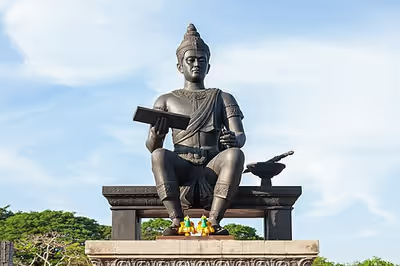
The reverse of the 20 Baht note (series 16), issued in 2013, depicts images of the royal statue of Ramkhamhaeng seated on the Manangkhasila Asana Throne and commemorates the invention of the Thai script by the king.
Honour
Ramkhamhaeng University, the first Thai university with an open-door policy and with campuses throughout the country was named after Ramkhamhaeng. The name was proposed in parliament by Khlaeo Norapati as a memorial to the king who granted the Thai letters.
Video games
King Ramkhamhaeng is a playable ruler for the Siamese in Sid Meier's Civilization V.