

History of Thailand
- 69 min read
- 13 chapters
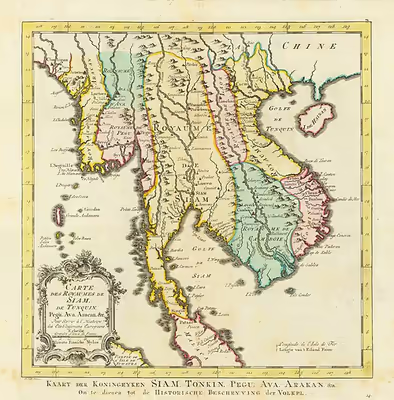

Explore on Lably
ToursExplore Lably’s 3D toursIn Northern Thailand, the oldest region, the main ethnic group, the Tai-Yuan, founded kingdoms of their own, the semi-legendary Singhanavati (691 BCE–638 CE) and then Ngoenyang (638–1292). Sukhothai was taken in 1238 and became the capital of the Sukhothai Kingdom (1238–1438), which by the 13th century had replaced the Mon kingdoms in Central Thailand; how far the town had stood under Angkorian authority before that, and how the events of 1238 should be read, are both disputed. Suphannabhum princes separated Lavo from the Khmer Empire. Under Ramkhamhaeng the Thai script was created in 1283, the arts flourished, Thai institutions took shape, and the people called themselves Thai as those free of foreign rule. In 1351 the Suphannabhum city-state, modern Suphan Buri, and Lavo, modern Lop Buri, merged into the Ayutthaya Kingdom on the Chao Phraya River, joining Tai-Yuan of the north with Monic people of the basin. Duarte Fernandes reached Ayutthaya in 1511, the first European to do so. Its government was at first bilingual in Thai and Khmer, but Thai became the lingua franca after the Fall of Angkor in 1431 and the conquest of Sukhothai in 1438.
Siam and Burma fought 26 wars between the 16th and the early 19th century. Ayutthaya fell when its capital was sacked in the Burmese–Siamese War (1765–1767). Taksin drove out the Burmese, reunified the five warring regional states and founded the short-lived Thonburi Kingdom in 1767. He was deposed by his commander Chao Phraya Chakri, who founded the Rattanakosin Kingdom (1782–1932); at its greatest extent in 1805–1812 it took in 25 polities, among them modern Cambodia, Laos, northern Malaysia and eastern Burma. King Mongkut (Rama IV) took up Western innovations and began the modernization of the country. Thailand was the only state in Southeast Asia to stay independent through the European colonization of 1511 to 1984. Several things account for it: the centralizing reforms of Chulalongkorn, a policy that balanced British against French interests, the king's visits to Europe in 1897 and 1907, large territorial concessions to French Indochina, and the wish of both powers to keep Siam as a buffer state between their colonies. An edict of 1874 began the reforms that abolished slavery in 1905.
Siam allied with the United Kingdom in 1917 and joined the Allies of World War I. The Siamese revolution of 1932 ended absolute monarchy and made Prajadhipok (Rama VII) a constitutional king, and in 1939 the country was renamed Thailand, "Land of the Free". The Franco-Thai War of 1940–1941 gained disputed territory in Cambodia and Laos from French Indochina. Thailand was neutral at the start of World War II but joined the Axis after the Japanese invasion of Thailand on 8 December 1941, annexing disputed territory in Burma (Saharat Thai Doem) and Malaya (Sirat Malai); it gave these up after the war, with all wartime claims, in return for admission to the United Nations and American aid. In the 70-year reign of Bhumibol Adulyadej the country had 10 coups with military governments and 17 constitutions. From 1962 it allowed the United States the use of bases in the Vietnam War and sent troops to South Vietnam, and the Thai government defeated the insurgency begun by the CPT in 1965 by 1973. Thailand was a founding member of ASEAN in 1967. The 1970s peasant revolts in Thailand, to reduce farmers' debt and secure fair rice prices, brought the Land Rent Control Act (LRCA) of December 1974. Growth was rapid from 1993 to 1997, until the 1997 Asian financial crisis brought bankruptcies and unemployment, followed by recovery in 1998 and 1999. The Senate was first elected in 2000. The Sappaya-Sapasathan, the world's largest parliamentary building, opened on 1 May 2021.
Etymology
The name Siam (Thai: สยาม RTGS: Sayam) may have originated from Pali (suvaṇṇabhūmi, "land of gold"), Sanskrit श्याम (śyāma, "dark"), or Mon ရာမည (rhmañña, "stranger"), with likely the same root as Shan and Ahom. The Thai country name has mostly been Mueang Thai. Chinese records of the 13th and 14th centuries call the polities of the lower Chao Phraya Xiān (暹). After Xiān and Luó hú (Lavo) were joined in 1349 the compound Xiānluó hú (暹羅斛) appears, later shortened to Xiānluó (暹羅). That form is still the Mandarin name for Siam. Yoneo Ishii argued that Xiān named several port polities of the Bay of Bangkok rather than a single place.
An earlier form, syam, occurs in a mid-11th-century Cham inscription and in 13th-century Khmer inscriptions, and Theodore Pigeaud identified the syangka of the Old Javanese Deśawarṇana with it. The country's designation as Siam by Westerners likely came from the Portuguese. Portuguese chronicles noted that Borommatrailokkanat, king of Ayutthaya, sent an expedition to the Malacca Sultanate, at the southern tip of the Malay Peninsula, in 1455. Following their conquest of Malacca in 1511, the Portuguese sent a diplomatic mission to the Ayutthaya Kingdom. A century after the Portuguese mission, on 15 August 1612, The Globe, an East India Company merchantman bearing a letter from King James I, arrived in "the Road of Syam". "By the end of the 19th century, Siam had become so enshrined in geographical nomenclature that it was believed that by this name and no other would it continue to be known and styled." The country was renamed to Thailand (Thai: ประเทศไทย RTGS: Prathet Thai) which means “Land of the Free” in 1939. Thailand has been nicknamed the "Emerald Kingdom", the "Land of the White Elephant", the "Rice bowl of Asia", and the "Land of Smiles". The elephant is a Thai national symbol and treasure. Thailand's geographic shape resembles an elephant's head with a long trunk.
Sign in to keep reading
12 more chapters are free with a Lably account.
Prehistory
Mainland Southeast Asia was home to various indigenous communities for up to 100,000 years. The discovery of Homo erectus fossils such as Lampang man is an example of archaic hominids. The remains were first discovered during excavations in Lampang Province. The finds have been dated from roughly 1,000,000–500,000 years ago in the Pleistocene. Stone artefacts dating to 40,000 years ago have been recovered from, e.g., Tham Lod rockshelter in Mae Hong Son and Lang Rongrien Rockshelter in Krabi, peninsular Thailand. The archaeological data between 18,000 and 3,000 years ago primarily derive from cave and rock shelter sites, and are associated with Hoabinhian foragers.
Bronze Age
There are many sites in present-day Thailand dating to the Bronze (1500–500 BCE) and Iron Ages (500 BCE–500 CE). Areas comprising what is now Thailand participated in the Maritime Jade Road, as ascertained by archeological research. The trading network existed for 3,000 years, between 2000 BC and 1000 AD. The site of Ban Chiang (around Udon Thani Province) currently ranks as the earliest known of copper and bronze production in Southeast Asia and has been dated to around 2,000 years BCE. Baker and Pasuk place the appearance of bronze at about 1250 to 1000 BCE, while noting that others argue for 2000 to 1800 BCE. Around 1500 BCE, there was independent human cultural, social, and technological evolution in the Ban Chiang area which later spread widely over the region.
The early date rests on determinations that are themselves disputed. Sing C. Chew sets a long chronology, which puts the first bronze at about 2000 BCE, against a short one of about 1200 to 1000 BCE. Joyce White and Elizabeth Hamilton trace the technology to metalworkers of the Seima-Turbino tradition moving from the Altai through Sichuan and Yunnan, a route that avoids the Central Plain of China. Charles Higham and his colleagues bring it instead down the Yangtze to Lingnan and on to northern Vietnam and northeastern Thailand in the later second millennium BCE. They date the Ban Non Wat burials to between 1259 and 1056 cal BCE and the regional sequence to about 1600–540 BCE, and object that the older determinations come from disturbed deposits. Chew endorses neither and quotes their own remark that such models must remain in flux.
Archaeobotany has been used to test the direction of the earliest exchange. Cristina Castillo and her colleagues identified the rice grown and eaten in Thailand between about 1050 and 420 BCE as japonica rather than indica. The peninsular sites with the earliest Indian contact yielded no japonica in their Bronze Age levels, and indica appears only from the first centuries CE. Chew reads this as evidence that the exchange behind early cultivation ran to China.
Ancient history
Initial states
The oldest known records of a political entity in Indochina are attributed to Funan, located in the Mekong Delta and comprising territories inside modern-day Thailand. Chinese annals confirm Funan's existence as early as the first century CE. Archaeological documentation implies an extensive human settlement history since the fourth century BCE.
The region was inhabited by a number of indigenous Austroasiatic-speaking and Malayo-Sumbawan-speaking civilisations. By the first millennium the region was inhabited by the primary groups: the Austroasiatic Lawa in the north, Mon in the center, Khmer in the east and the Austronesian Malay in Langkasuka of the Malay Peninsula. However, literary and concrete sources about Thailand before the 13th century are scarce, and most of the knowledge about this period is gleaned from archaeological evidence. Similar to other regions in Southeast Asia, Thailand was heavily influenced by the cultures and religions of India and Sri Lanka, starting with the Funan Kingdom, around the first century, until the Khmer Empire. These kingdoms were composed of Dvaravati, Srivijaya, and the Khmer Empire. E. A. Voretzsch believes that Buddhism must have been flowing into Thailand from India at the time of the Indian emperor Ashoka of the Maurya Empire and into the first millennium. Later, Thailand was influenced by the south Indian Pallava dynasty and north Indian Gupta Empire.
How far that influence amounted to Indian settlement is disputed. Chew treats Indianization as an inherited habit of mind rather than a finding, and prefers hybridization, an exchange weighted to neither side; he quotes Higham's judgement that the colonialist and Indianisation models are no longer tenable. At Khao Sam Kaeo, Bérénice Bellina found no concentration of production waste and no other Indian material indicating a resident Indian group. Geochemical work by Robert Theunissen, Peter Grave and Grahame Bailey placed most Thai agate and carnelian beads outside India, and concluded that carnelian was worked in Southeast Asia from early in the Iron Age. Miriam Stark dates the material evidence itself. Objects of South Asian provenance appear in parts of mainland Southeast Asia by about the turn of the era. They include gold leaf with Indic iconography, crystal amulets in the form of lingam and yoni, and bas-relief sculpture. Stark reads them as the entry of Saivism and Buddhism. The sites with the strongest evidence of Indian contact are later than about 500 CE.
In the northeast the social ranks of the early historic period have been traced back to Iron Age forerunners. Charles Higham argues that an agricultural revolution in the Mun valley underwrote a rapid rise of social elites, with ploughing and permanent, perhaps irrigated, rice fields in place by the fifth century CE. He gives iron working and the control of salt as further factors, and posits that these local leaders became the poñ named in pre-Angkorian inscriptions.
Central Thailand
The Chao Phraya Basin (now Central Thailand) was home of the Mon people's Dvaravati culture, which prevailed from the seventh century to the tenth century. Samuel Beal discovered the polity among the Chinese writings on Southeast Asia as "Duoluobodi". During the early 20th century, archaeological excavations led by George Coedès found Nakhon Pathom Province to be a centre of Dvaravati culture. The two most important sites were Nakorn Pathom and U Thong (in modern Suphan Buri Province). The inscriptions of Dvaravati were in Sanskrit and Mon using the script derived from the Pallava alphabet of the South Indian Pallava dynasty, a type now more often called Late Southern Brahmi.
It is believed that the Dvaravati borrowed Theravada Buddhism through its contacts with Sri Lanka, while the ruling class participated in Hindu rites. Dvaravati art, including the Buddha sculptures and stupas, showed strong similarities to those of the Gupta Empire of India. The eastern parts of the Chao Phraya valley were subjected to a more Khmer and Hindu influence as the inscriptions are found in Khmer and Sanskrit. David K. Wyatt cautions against reading the languages as populations: an inscription in Old Mon indicates a westward cultural orientation rather than a Mon people, and the plain was in his account multiethnic throughout. He also holds that Buddhism reached the region from the Mōn country of coastal Burma rather than directly from Sri Lanka or India.
Dvaravati was a network of city-states paying tribute to more powerful ones according to the mandala political model. Dvaravati culture expanded into Isan as well as south as far as the Kra Isthmus. The Chinese annals of the Tang period record a group of inland polities in the Mun–Chi and middle Mekong valleys over the same period, among them Wen Dan, Zhān Bó and Qiān Zhī Fú, which Hoshino reads as federated politically and economically along an overland route from Champa to the Menam basin and as differing culturally from the coastal region Dvaravati dominated. Dvaravati culture lost its influence around the tenth century when they submitted to the more unified Lavo-Khmer polity. Baker and Pasuk question that reading. The plain has yielded none of the temple-endowment inscriptions characteristic of Angkorian provinces, and Jayavarman VII's hospital foundations reach no further west than Prachin Buri, which they take to show cultural influence rather than administration.
A survey of the upper Mun points the other way. Caitlin Evans, Nigel Chang and Naho Shimizu find that the valley between the first and ninth centuries did not sustain large unified polities of the kind forming in central Thailand and in Zhenla. Settlements grew and consolidated in the Late Iron Age, but they see little evidence of the reorganisation that multi-tiered rule on Indic models would require. Communities kept a village and kinship focus well into the historic period. On their reading the population took up Buddhism and Brahmanism by about the sixth or seventh century but came under no single polity until the ninth or tenth, a change they ascribe to Angkorian expansion to the northwest.
The name Dvaravati rests on a small body of evidence. Medallions inscribed with the Sanskrit phrase śrīdvāravatīśvarapuṇya, "merit of the lord of glorious Dvaravati", were first found at Nakhon Pathom and at about ten other sites on the plain. A traveller from Annam took the robe at To-lo-po-ti early in the 7th century, and Xuanzang and Yijing recorded a country of that name lying between Sri Ksetra and Isanapura without going there. Three tribute missions reached the Tang court under the name, in 638, 640 and 649.
Art historians afterwards made Dvaravati the label for a body of styles and for the period in which they flourished, and stretched so far the name carried its political sense with it. Chris Baker and Pasuk Phongpaichit hold that the styles travelled with trade rather than with political authority. Between the 6th and 12th centuries some forty moated towns grew up across the plain, most of them beside rivers, sharing religious practice, art styles and the use of Mon for inscriptions, but showing no sign of political integration beyond, perhaps, local confederations.
Two long-standing elements of the picture have since been revised. Recent research has the sea receding earlier than once thought, the coastline settling near its present position by 500 CE, which unsettles the view that the lower gulf lay under water in the first millennium and that many Dvaravati sites then stood on the coast. The vocabulary of sectarian affiliation is also a modern coinage, Theravada among its terms. Images of Avalokiteśvara and Prajñāpāramitā that present usage would class as Mahāyāna stand alongside the Buddha subduing Māra, and Yijing found the two approaches practised in a mixed way.
Around the tenth century, the city-states of Dvaravati merged into the mandalas of: Lavo (modern Lopburi) and Suvarnabhumi (modern Suphan Buri). A legend in the Northern Chronicles has a king of Tambralinga invade and take Lavo in 903 and install a Malay prince on its throne. The prince married a Khmer princess who had fled an Angkorian dynastic bloodbath, and their son contested the Khmer throne and became Suryavarman I (1006–1050), a connection through which Lavo is said to have come under Khmer domination. Suryavarman I also expanded into the Khorat Plateau (later styled "Isan"), constructing many temples.
Suryavarman left no male heir and Lavo became independent again. Civil war followed the death of King Narai of Lavo, and Suryavarman II used the opening to invade and install his son on the throne. These episodes are read as having Khmerised the town, which passed from a Theravadin Mon Dvaravati city to a Hindu Khmer one and became the entrepôt of Khmer culture in the Chao Phraya basin. Baker and Pasuk read the relationship differently, holding that Angkorian control of Lavo from the 10th to the 13th centuries is asserted rather than demonstrated and that the tie was probably always flexible. A bas-relief at Angkor Wat shows a Lavo army among the contingents in an Angkorian procession, and a Tai contingent within the Lavo army, a century before the foundation of the Sukhothai Kingdom.
Northern Thailand
According to the Cāmadevivaṃsa, the city of Hariphunchai (modern Lamphun) was founded by hermits. Camadevi, a princess of the Lavo Kingdom, was invited to rule the city around 700. Hariphunchai may be a later (10th century) offshoot of the Lavo Kingdom or instead related to the Thaton Kingdom.
Hariphunchai was the centre of Theravada in the north. The kingdom flourished during the reign of King Attayawong who built Wat Phra That Hariphunchai in 1108. The kingdom had strong relations with the Mon Kingdom of Thaton. During the 11th century, Hariphunchai waged lengthy wars with the Tai Ngoenyang Kingdom of Chiang Saen. Weakened by Tai invasions, Hariphunchai eventually fell in 1293 to Mangrai, king of Lan Na, the successor state of the Ngoenyang Kingdom.
Southern Thailand
Malay civilisations dominated the area below the Kra Isthmus. Early Malay kingdoms are described as tributaries to Funan by second-century Chinese sources, though most of them proved to be tribal organisations instead of full-fledged kingdoms. From the sixth century on, two major mandalas partially ruled Southern Thailand, the Kanduli and Langkasuka. Kanduli centred on what is now Surat Thani Province and Langkasuka in Pattani Province.
Southern Thailand was the centre of Hinduism and Mahayana Buddhism. The 7th century Tang monk Yijing stopped at Langkasuka to study Pali grammar and Mahayana during his journey to India. At that time, the kingdoms of Southern Thailand quickly fell under the influences of the Malay kingdom of Srivijaya from Sumatra. The Tamil King Rajendra Chola I of the Chola dynasty invaded Tambralinga in the 11th century.
The isthmus owed its early importance to the sailing routes. Cargo from India and Sri Lanka was landed on the western side and carried over to ports on the Gulf of Siam, a portage of four or five days; the passage through the Straits of Malacca took about six weeks and came into general use only from the fourth century CE. Tin, which India lacked, and gold went the other way, a traffic Kenneth R. Hall connected to Vespasian's ban on the export of Roman gold. Khao Sam Kaeo on the eastern side and Phu Khao Thong on the western have been read by Bellina and her colleagues as port polities comparable to the later Malacca, Banten and Pasai.
Arrival of the Tai
The Tai people originated from South China. There are theories that the migrants primarily came from Guangxi. A large number of Tai people known as the Zhuang still live in Guangxi today. The Tai people are also closely related to the Dai people of Yunnan. Around 700 AD, Tai people who did not come under Chinese influence settled in what is now Điện Biên Phủ in modern Vietnam according to the Khun Borom legend. Based on layers of Chinese loanwords in proto-Southwestern Tai and other historical evidence, Pittayawat Pittayaporn (2014) proposed that this migration must have taken place sometime between the eighth–10th centuries. Tatsuo Hoshino argues for an earlier movement along a different route, placing Tai-speaking groups attested in northern Champa, in what are now Nghệ An and Thanh Hóa, in the central Mekong valleys during the 5th and 6th centuries, and taking Haudricourt's third century as the earliest possible date for a westward movement of tonal Tai out of Chinese-controlled Vietnam; Hiram Woodward regards the linguistic side of that argument as tendentious.
Tai speaking tribes migrated southwestward along the rivers and over the lower passes into Southeast Asia, perhaps prompted by the Chinese expansion and suppression. Chinese historical texts record that, in 722, 400,000 'Lao' rose in revolt behind a leader who declared himself the king of Nanyue in Guangdong. After the 722 revolt, some 60,000 were beheaded. In 726, after the suppression of a rebellion by a 'Lao' leader in the present-day Guangxi, over 30,000 rebels were captured and beheaded. In 756, another revolt attracted 200,000 followers and lasted four years. In the 860s, many local people in what is now North Vietnam sided with attackers from Nanchao, and in the aftermath, some 30,000 of them were beheaded. In the 1040s, a powerful matriarch-shamaness by the name of A Nong, her chiefly husband, and their son, Nong Zhigao, raised a revolt, took Nanning, besieged Guangzhou for 57 days, and slew the commanders of five Chinese armies sent against them before they were defeated, and many of their leaders were killed. As a result of these three bloody centuries, the Tai began to migrate southwestward. Baker and Pasuk stress that this was not one mass migration but many small groups moving over decades. The Tai people settled in the Northern and Central regions. They adopted the Dvaravati culture and assimilated with the indigenous peoples in the 8th-10th century. They continuously spoke Kra–Dai languages which evolved into Thai with the writing system by King Ramkhamhaeng in 1283.
Early polities
Northern city-states
In the Simhanavati legend a Tai chief of that name drives out the native Wa people and founds Chiang Saen around 800 CE. For the first time, the Tai people made contact with the Theravadin Buddhist kingdoms of Southeast Asia. Through Hariphunchai, the Tais of Chiang Saen embraced Theravada Buddhism and Sanskrit royal names. Wat Phrathat Doi Tong, constructed around 850, signified the piety of Tai people on the Theravada Buddhism. Around 900, major wars were fought between Chiang Saen and Hariphunchai. Mon forces captured Chiang Saen and its king fled. In 937, Prince Prom the Great took Chiang Saen back from the Mon and inflicted severe defeats on Hariphunchai.
Around 1000 CE, Chiang Saen was destroyed by an earthquake with many inhabitants killed. A council was established to govern the kingdom for a while, and then a local Wa man known as Lavachakkaraj was elected king of the new city of Chiang Saen or Ngoenyang. The Lavachakkaraj dynasty would rule over the region for about 500 years.
Overpopulation might have encouraged the Tais to seek their fortune further southwards. By 1100 CE, the Tai had established themselves as Po Khuns (ruling fathers) at Phayao, Nan, Phrae, Song Kwae, Sawankhalok, and Chakangrao on the upper Chao Phraya River. These southern Tai princes stood within the orbit of the Lavo Kingdom, and some are described as subordinate to it.
Xiān and the port polities
Suphannabhum was an important Siamese city-state founded circa 1150. It was located in Central Thailand, present-day Suphan Buri. The Suphannabhum Kingdom became a tributary state of the Sukhothai Kingdom from 1283–1298.
Chinese records of the late 13th and 14th centuries call the polities of the lower Chao Phraya Xiān (暹). Yoneo Ishii argued that the name covered several port polities of the Bay of Bangkok rather than one place, and that in the Chinese classification of tributary countries a name written in Chinese characters need not denote a single locality. Baker and Pasuk make the same reservation, reading Xiān as Ayodhya from the late 13th century while allowing that the Chinese may first have applied the name elsewhere.
The earliest notices of the name are Vietnamese. The Đại Việt sử ký toàn thư records that in 1149 merchant ships from Xiān and two other countries reached Hǎidōng and were granted a trading post at Vân Đồn. In the Chinese record the name first appears in 1282 or 1283, when an official fleeing the Mongol army took refuge there. It sent its first mission in 1292, its ruler presented a gold plate at court in 1295, and further missions followed in 1299, 1300, 1314, 1319 and 1323; over the same span Lavo sent four missions between 1289 and 1299 and Phetchaburi one in 1294. Suphan Buri appears later as Su-men-bang, whose prince, described as heir to the king of Siam, sent missions between the 1370s and 1398. Baker and Pasuk count four towns of the lower plain — Lavo, Suphan Buri, Ayodhya and Phetchaburi — that had each dealt with China in its own name before the union.
Which polity the name denotes has been disputed. The identification of Xiān with Sukhothai began with a translator of the Chinese annals and spread through Cœdès; Yamamoto Tatsurō challenged it in 1989 from the Guangzhou gazetteer of 1297–1307, in which Sukhothai stands as the object of a verb meaning to control and Xiān as its subject, so that the two cannot name one place. Xiān and Luó hú (Lavo) were joined in 1349, after which the records treat the pair as Xiānluó hú.
Sukhothai period (1238–1438)
Multiple Thai city-states gradually became independent of the weakened Khmer Empire. Sukhothai was established as a strong sovereign kingdom by Si Inthrathit in 1238 CE. How that event should be read has changed. In the older account the Khmer-titled ruler displaced at Sukhothai commanded a Khmer garrison, and his defeat was the liberation of the city from Khmer suzerainty. Baker and Pasuk argue that the ethnic framing and the idea of liberation were imported from a later era, and read the episode as a victory by one local lord associated with Angkor over another holding a Khmer title, the victor having himself received a title, a regalia sword and a princess in marriage from the ruler at Angkor. A political feature which "classic" Thai historians call "father governs children" existed at this time. Everybody could bring their problems to the king directly, as there was a bell in front of the palace for this purpose. The inception of a unified Thai identity evolved during the reign of King Ramkhamhaeng (1279-1298). Tradition and legend states the Thai script was created by Ramkhamhaeng. The architecture of Sukhothai (stone buildings and statues) were based on techniques and styles provided by the former Mon kingdoms. The kingdom expanded northward to the Lao cities of Lan Chang (Luang Prabang) and Vien Chan (Vientiane) in the Mekong valley. Sukhothai also conquered the Malay Peninsula until Nakhon Sri Thammarat. Baker and Pasuk read the passage naming Ligor as a dependency on the fourth face of the Ram Khamhaeng Inscription, and the corresponding clause of the Ayutthaya Palace Law, as later insertions in both texts. However, after his death in 1365, Sukhothai fell into decline and became subject to the emerging Ayutthaya Kingdom in the lower Chao Phraya River area. The 13th century had mass migration waves of Tai people who fled from the Mongol armies in China.
The scheme that makes Sukhothai the first period of Thai history was set out by Prince Damrong in 1914, as the succession Sukhothai, Ayutthaya, Thonburi and Rattanakosin. For the period before Ayutthaya he worked from the Sukhothai inscriptions and from the Chinese annals translated for him by Khun Chenchin'aksorn, and it was the translator who identified 暹國 in those annals as Sukhothai. Coedès accepted the identification, and it spread through his The Indianized States of Southeast Asia. Yamamoto Tatsuro challenged it in 1989 from the Dade Nanhai-zhi, which has Xiān controlling Sukhothai and so cannot be naming it. Yoneo Ishii accordingly held that Sukhothai's history needs an approach free of the unilinear scheme, and that Ayodhya before 1351 should be read as a trading centre of the post-Srivijayan order rather than a continuation of Sukhothai. Baker and Pasuk also identify the Xiān of the Chinese records with Ayodhya, on the grounds that the court listed Xiān among maritime kingdoms and that the same gazetteer has Xiān controlling Sukhothai. They further reject the account in which Ayutthaya conquered or absorbed Sukhothai, holding that it applies a model of sovereignty foreign to the region, and set in its place the marriages by which three Ayutthayan kings each took a daughter of Li Thai.
Lan Na emerged as a city-state in the same period as Sukhothai. The Lan Na kingdom was founded by King Mangrai in the late 13th century. Mangrai established the capital city Chiang Mai in Northern Thailand. Evidently, Lan Na coexisted and became closely allied with Sukhothai. Ayutthaya Kingdom expanded its influence from the Chao Phraya Basin and finally subdued Sukhothai. Fierce battles between Lan Na and Ayutthaya occurred constantly and Chiang Mai was eventually subjugated as a vassal of Ayutthaya.
Lan Na's independent history ended in 1558 when it fell to Burmese control. Local leaders rose up against the Burmese with the help of the rising Thonburi Kingdom of King Taksin. The "Northern City-States" became autonomous vassals of Thonburi in 1774–1775. The Lan Na dynasty ended when the region was formally incorporated by the Rattanakosin Kingdom around 1874.
Ayutthaya period (1351–1767)
Ayutthaya was founded as a port city on a small island at the confluence of the Chao Phraya, the Pa Sak, and the Lopburi river. Baker and Pasuk hold that only the Lopburi ran beside the site at the time, the other two having reached it later. The name Ayutthaya is derived from the legendary Indian city Ayodhya in Sanskrit texts. Due to its strategic and defensible location, Ayutthaya quickly became powerful, politically, and economically.
The Kingdom of Ayutthaya was established in 1351 by King Uthong (r. 1351–1369) when he centralized power and integrated the Lavo Kingdom, Suphannaphum, and Ayutthaya City. Baker and Pasuk count four towns of the lower plain that had each sent missions to China in its own name before the union, adding Phetchaburi to those three. The joining of Xiān and Luó hú (Lavo) is recorded in the Chinese sources under 1349, two years before the chronicle date, and the combined polity is named Xiānluó hú (暹羅斛) thereafter. The notices of that year run both ways, one having Xiān submit to Luó hú and another having Xiān bring Luó hú to submission, a discrepancy Baker and Pasuk attribute to copying error. King Uthong's most important contributions to Thai history were: the establishment and promotion of Theravada Buddhism as the official religion to differentiate his kingdom from the neighbouring Hindu Khmer Empire of Angkor, and the compilation of the Dharmaśāstra, a legal code based on Hindu sources and traditional Thai custom. The Dharmaśāstra remained a tool of Thai law until the late 19th century.
Sakdina system
The Sakdina (Thai: ศักดินา) system of social hierarchy was established at the beginning of the Ayutthaya Kingdom. It assigned a numerical rank (rai) to each person depending on their status. This determined their position in society. There were 6 classes in society: the king, royal family, nobility, monks, commoners and slaves. The king was an absolute monarch and owned all the land. The king granted control of the land to his subjects. The nobility had important leading roles. The learned Buddhist monks were above commoners. The lowest class were various slaves. The numbers represented the number of rai of land a person was entitled to own. In practice it indicated the number of people under control. The sakdina system was used for around 600 years till the early era of the Rattanakosin Kingdom.
European contact and commercial expansion
In 1511 Duke Afonso de Albuquerque sent Duarte Fernandes as envoy to the Ayutthaya Kingdom, known to Europeans as the "Kingdom of Siam". Fernandes was the first European to arrive formally in Siam and to establish diplomatic relations. Contact with the West in the 16th century opened lucrative trade routes and brought economic growth. Ayutthaya became one of the most prosperous cities in Southeast Asia. According to George Modelski, Ayutthaya is estimated to have been the largest city in the world in 1700 CE, with a population around one million. International trade flourished; the Dutch and Portuguese merchants were among the most active western foreigners in the kingdom together with the Chinese and Malayans. Luzones merchants and warriors from Luzon, the Philippines were also present. Philippines-Thailand relations already had precursors in that, Thailand often exported ceramics to several Filipino states as evidenced that when the Magellan expedition landed at the Cebu Rajahnate, they noted a Thai embassy to the king, Rajah Humabon. When the Spanish colonized the Philippines via Latin America, Spaniards and Mexicans joined the Filipinos in trading at Thailand.
The Ayutthaya Period is known as the golden age of Thai literature, art and trade with the eastern and western world. The Ayutthaya period was also considered as "a golden age of medicine in Thailand" due to major progress in the field of medicine at that time.
Burmese wars
Starting in the middle of the 16th century, the kingdom came under repeated attacks by the Taungoo Dynasty of Burma. The Burmese–Siamese War (1547–49) began with a Burmese invasion and a failed siege of Ayutthaya. A second siege (1563–64) led by King Bayinnaung forced King Maha Chakkraphat to surrender in 1564. The royal family was taken to Bago, Burma, with the king's second son Mahinthrathirat installed as a vassal king. In 1568, Mahinthrathirat revolted when his father managed to return from Bago as a Buddhist monk. The ensuing third siege captured Ayutthaya in 1569 and Bayinnaung made Mahathammarachathirat his vassal king.
After Bayinnaung's death in 1581, Uparaja Naresuan proclaimed Ayutthaya's independence in 1584. The Thai fought off repeated Burmese invasions (1584–1593), capped by an elephant duel between King Naresuan and Burmese heir-apparent Mingyi Swa in 1593 during the fourth siege of Ayutthaya in which Naresuan famously slew Mingyi Swa. The Burmese–Siamese War (1594–1605) was a Thai attack on Burma, resulting in the capture of the Tanintharyi Region as far as Mottama in 1595 and Lan Na in 1602. Naresuan even invaded mainland Burma as far as Taungoo in 1600, but was driven back.
Ayutthaya expanded its sphere of influence over a considerable area, ranging from the Islamic states on the Malay Peninsula, the Andaman seaports of present-day India, the Angkor kingdom of Cambodia, to states in northern Thailand. In the 18th century, the power of the Ayutthaya Kingdom gradually declined as fighting between princes and officials plagued its politics. Outlying principalities became more and more independent, ignoring the capital's orders and decrees.
In the 18th century, the last phase of the kingdom arrived. The Bamar people, who had taken control of Lan Na and had also unified their kingdom under the powerful Konbaung Dynasty, launched several blows against Ayutthaya in the 1750s and 1760s. Finally, in 1767, after several months of siege, the Burmese broke through Ayutthaya's outer and inner walls, sacked the city, and burned it down. The royal family fled the city and Ayutthaya's last king, Ekkathat, died of starvation ten days later while in hiding.
Thonburi period (1767–1782)
Reunification by Taksin
In 1767, after more than 400 years, the Kingdom of Ayutthaya was brought down by invading Burmese armies, its capital destroyed and its territory split. Recovery was rapid despite the defeat and occupation, and resistance to Burmese rule was led by the noble military commander Taksin. He went first to Chonburi and then to Rayong, where he raised a small army, and took Chanthaburi by surprise attack on 15 June 1767. His army grew quickly, and within a year he had defeated the Burmese occupation force and re-established a Siamese state with its capital at Thonburi on the west bank of the Chao Phraya, 20 km from the Gulf of Thailand. In 1767 he was crowned as King Taksin (now officially known as "Taksin the Great").
After the sack of Ayutthaya the country fell apart for want of a central authority. Besides Taksin, who had raised his force in the southeastern provinces, four other claimants and warlords held spheres of their own. Prince Thepphiphit, a son of King Boromakot whose diversionary action against the Burmese in 1766 had failed, set himself up as ruler of Phimai, holding the eastern provinces including Nakhon Ratchasima or Khorat. The Governor of Phitsanulok, whose first name was Ruang, had proclaimed himself independent, with the territory under his control extending to the province of Nakhon Sawan. A Buddhist monk named Ruan made himself a prince at Sawangburi, known as Fang in Uttaradit Province, and appointed fellow monks as army commanders. He had studied at Ayutthaya so well that King Boromakot had made him chief monk of Sawangburi. In the southern provinces as far north as Chumphon, a Pra Palad, acting governor of Nakhon Si Thammarat, declared himself independent and took princely rank.
With his power established at Thonburi, Taksin set out to reunify the kingdom and crush his regional rivals. Repulsed for a time by the governor of Phitsanulok, he turned on the weakest first, subduing and executing Prince Thepphiphit of Phimai in 1768. Chao Narasuriyawongse, one of Taksin's nephews, replaced Thepphiphit as governor. The last to challenge him was the Prince of Sawangburi, Chao Pra Fang, who had annexed Phitsanulok on the death of its governor. Taksin led the expedition against him in person and took the town, but the prince disappeared. In dealing with the Prince of Nakhon Si Thammarat, who was taken prisoner by the loyal Governor of Pattani, the king not only pardoned him but also favoured him with a residence at Thonburi.
Chinese mass immigration to Siam began in the Thonburi period, and Chinese labour made trade, agriculture and the crafts flourish, though the first Chinese rebellions had to be suppressed. Taksin is said to have suffered mental breakdowns in his later years, under stress and other causes. After a coup d'état removing Taksin from power, stability was restored by Chaophraya Chakri (later King Rama I). Taksin was sentenced to death on Wednesday, 10 April 1782.
Rattanakosin period (1782–1932)
Restoration under Rama I
A noble of Mon descent, General Chakri succeeded Taksin in 1782 as Rama I (Phra Phutthayotfa), the first king of the Chakri dynasty. In the same year he founded a new capital city across the Chao Phraya River in an area known as Rattanakosin Island. (While settlements on both banks were commonly called Bangkok, both the Burney Treaty of 1826 and the Roberts Treaty of 1833 refer to the capital as the City of Sia-Yut'hia.) In the 1790s, Burma was defeated and driven out of Siam, as it was then called. Lan Na also became free of Burmese occupation, but was reduced to the Kingdom of Chiang Mai. The king of the new dynasty was installed as a tributary ruler of the Chakri monarch.
Chakri and his family had probably planned his accession during Taksin's reign. After his coronation he had Taksin's followers systematically killed, in the manner usual among usurpers in Thai history.
The dynasty moved the capital from Thonburi to Rattanakosin Island in today's Bangkok, until then a small settlement with a fort, but well placed on the eastern shore of the Chao Phraya river and known to foreign traders as the 'key to Siam'. Work began on the Grand Palace and on Wat Phra Kaew, which holds the Emerald Buddha, the king intending to carry the splendour of Ayutthaya to the new capital, where he crowned himself in 1785.
Foreign policy under Rama I still turned on the Burmese threat. In 1786 the new Burmese king Bodawpaya sent nine armies against Siam in a surprise attack through the Three Pagoda Pass, in what became known as the "Nine Armies' Wars", and the Siamese won. In 1805 Lanna (North Thailand) was largely brought under control of Bangkok. Rama I also attempted unsuccessfully to conquer the important trading ports of Tenasserim.
Cambodia was in effect administered as a province of Siam while its rival Vietnam dealt with internal troubles, and Siamese influence there was contested again only when the emperor Gia Long came to the throne. Vietnam accordingly mattered more in this reign than the European colonial powers, with whom relations were still slight.
Rama I codified the country's laws in the 1,700-page Three Seals Law, which remained valid in its basic traits until the beginning of the twentieth century.
A Grand Council collected and reformulated the Buddhist canon, the Pāli Canon. The court promoted the arts and the building of palaces and temples in the capital, literature and theatre produced works such as the 3,000-page Ramakian epic, and texts were translated into Thai from Chinese, Mon, Javanese, Persian and Indian languages.
Rama I continued Ayutthayan tradition in many respects, but his state was more centralized than its predecessors. He put more weight on reason in the relation between monarch and subject, and was the first Thai king to justify his decisions before the highest officials.
Rama II and Rama III (1809–1851)
King Rama II (Phra Phutthaloetla) was the son of Rama I. His accession was accompanied by a plot in which 40 people were killed. Calm at home and abroad under him and his successor Rama III (Phra Nangklao) rested mainly on conceding conflicts and keeping good relations with influential clans.
Under Rama II the kingdom saw a cultural revival in the arts and literature after the wars of his predecessor's reign. Poets employed by Rama II included Sunthorn Phu the drunken writer (Phra Aphai Mani) and Narin Dhibet (Nirat Narin).
Foreign relations turned at first on the neighbouring states, with the European colonial powers in the background. Vietnam gained supremacy in Cambodia and Laos, which Rama II at first accepted. When a rebellion broke out in Vietnam in 1833–34 Rama III tried to subdue the Vietnamese by force, at a costly defeat for the Siamese troops. In the 1840s the Khmer expelled the Vietnamese themselves, and Siamese influence in Cambodia grew. At the same time, Siam kept sending tribute to China.
Siam came up against British colonial interests when it conquered the sultanate of Kedah on the Malay Peninsula in 1821, Kedah lying within the British sphere. After hard negotiations with the British envoy John Crawfurd the following year, Siam had to recognise the pre-conquest position. Trade and missionary activity resumed cautiously in the same period. In particular, British traders such as Robert Hunter ("discoverer" of the conjoined brothers Chang and Eng, the original "Siamese twins") or James Hayes, but also missionaries from Europe and the United States like Jacob Tomlin, Karl Gützlaff, Dan Beach Bradley and Jean-Baptiste Pallegoix became active in Siam. An agreement with the British emissary Henry Burney in 1825 recognised British colonial possessions on the Malay Peninsula and made commercial concessions, owing not least to rapid British success in the First Anglo-Burmese War.
In Anouvong's Rebellion of 1827 the troops of the tributary king Anouvong of the Kingdom of Vientiane advanced on Bangkok and were destroyed, which strengthened Siam's position in Laos. The Lao-population of the areas west of the Mekong were relocated to Thai provinces in Isan.
Under Rama II and Rama III, culture, dance, poetry and above all the theatre reached a climax. The temple Wat Pho was built by Rama III, known as the first university of the country.
Rama III's reign divided the aristocracy over foreign policy. A small group favoured taking up Western technology and other achievements, against conservative circles that wanted greater isolation; from the reigns of Rama II and Rama III the conservative religious circles largely kept to that isolationism.
The death of Rama III in 1851 marked the end of the old traditional Siamese monarchy; the profound changes already in sight were carried out by his two successors.
Modernization under Rama IV and Rama V (1851–1910)
King Mongkut (Rama IV) came to the Siamese throne under severe threat from the neighbouring states, Britain and France having already advanced into territories that had belonged to the Siamese sphere of influence. He and his successor Chulalongkorn (Rama V) sought to strengthen the country's defence forces by modernisation and to absorb Western science and technology, and so to avoid colonisation.
Both were the first monarchs with a Western formation. Mongkut had lived 26 years as a wandering monk and then as abbot of Wat Bowonniwet Vihara. Skilled in the traditional culture and Buddhist sciences of Siam, he had also studied modern Western science through European missionaries and his correspondence with Western leaders and the Pope, and was the first Siamese monarch to speak English.
Encroachment by the British Empire in Burma to the west and by the French in Indochina to the east in the 1880s alarmed the Siamese elite. The British-educated Prince Prisdang and eleven other senior dignitaries proposed to King Chulalongkorn that Siamese institutions be strengthened on the European model, some of the reforms answering a need to keep up with European conventions of liberal statecraft and justice and so maintain legitimacy. Prisdang suggested that the following reforms should be carried out:
- Change the absolute monarchy to a constitutional monarchy,
- Establish a cabinet system or ministerial government,
- Distribute power to the heads of departments,
- Promulgate a law of royal succession,
- Change the payment system for the bureaucracy from the commission system to a salary system,
- Promote equality under the law,
- Reform the legal system on the Western model,
- Promote freedom of speech, and
- Establish a merit system for the bureaucracy.
The majority of these reforms were implemented decades after Chulalongkorn's death.
In 1855 John Bowring, the British governor in Hong Kong, appeared on a warship at the mouth of the Chao Phraya River. With Britain's achievements in neighbouring Burma before him, King Mongkut signed the "Bowring Treaty", which abolished the royal monopoly of foreign trade and import duties and granted Britain a most favourable clause. It integrated Siam into the world economy and cost the royal house its most important sources of income. Similar treaties followed with all the Western powers, with Prussia in 1862 and Austria-Hungary in 1869, and the Prussian emissary Count Friedrich Albrecht zu Eulenburg left a much-respected travel report on Siam. The diplomacy of survival Siam had long cultivated abroad reached its climax in this period.
Integration into the world economy made Siam a market for Western industrial goods and a field for Western capital. Exports of agricultural and mineral raw materials began, rice, pewter and teakwood making up 90 per cent of the export turnover. King Mongkut promoted the extension of farmland by tax incentives, while canals, roads and later railways, and the influx of Chinese immigrants, opened new regions to agriculture. Subsistence farming in the Lower Menam Valley gave way to farming for money.
Mongkut's son, King Chulalongkorn (Rama V), ascended to the throne in 1868. He was the first Siamese king with a full Western education, taught by a British governess, Anna Leonowens, whose place in Siamese history has been fictionalised as The King and I. The conservative regent Somdet Chaophraya Sri Suriwongse dominated the early reign, but the king took control soon after coming of age in 1873. He created a Privy Council and a Council of State, a formal court system and budget office. He announced that slavery would be gradually abolished and debt-bondage restricted.
Western colonialism and cession of protectorates
Mongkut and Chulalongkorn both saw France and Great Britain extend their colonies in Southeast Asia and encircle Siam. The British took India, Burma and Malaya in the west; the French took South Vietnam and Vietnam in the east and claimed to be "protecting" Cambodia. Siam lost its extraterritorial rights in these areas to the new conquerors.
A Kra Isthmus Canal, planned by entrepreneurs led by the engineer Ferdinand de Lesseps, was never built, the British having conquered Konbaung-ruled Burma in the Third Anglo-Burmese War of 1885. In the Paknam incident of 13 July 1893 French gunboats entered the Chao Phraya towards Bangkok and were fired on from a Siamese coastal fort, which brought on the Franco-Siamese crisis. Siam was compelled that year to sign a treaty annexing Laos, east of the Mekong, to French Indochina, and to give up all influence over its former vassal state. In 1887, the Indo-Chinese Union was founded. In 1896, British and French concluded a treaty which made a border between their colonies, with Siam defined as a buffer state.
After the crisis of 1893 King Chulalongkorn recognised the threat from the western colonial powers and pressed on with reform of the administration, army, economy and society. It carried Siam from a feudal structure of personal domination and dependency, in which outlying areas were bound only indirectly to the king, to a centrally governed national state with established borders and modern political institutions.
By 1892, The Kingdom of Siam controlled the Siamese Shan States, Laos, western Cambodia and Southern Thailand. Siam was bordered to the north by the Northern Shan States which included Kachin. On the western border was Burma. On the eastern border was Cambodia, French Cochinchina and Tonkin.
The Entente Cordiale of 8 April 1904 ended Anglo-French rivalry over Siam and marked out zones of influence: the eastern territories, next to French Indochina, French, and the western, next to Burmese Tenasserim, British. Britain recognised a French sphere of influence east of the River Menam's basin and France a British one west of it, and both disclaimed any idea of annexing Siamese territory.
The Anglo-Siamese Treaty of 1909 defined the modern border between Siam and British Malaya. By it Siam gave up to Great Britain its claims over Kelantan, Terengganu, Kedah and Perlis, formerly part of the semi-independent Malay sultanates of Pattani and Kedah. A series of treaties with France fixed the country's current eastern border with Laos and Cambodia.
In 1904, 1907 and 1909, there were new border corrections in favour of France and Great Britain. When King Chulalongkorn died in 1910, Siam had achieved the borders of today's Thailand. In 1910 he was peacefully succeeded by his son Vajiravudh, who reigned as Rama VI. Educated at Royal Military Academy Sandhurst and University of Oxford, he was an anglicised Edwardian gentleman. One of Siam's problems was the widening gap between the Westernised royal family and upper aristocracy and the rest of the country, and Western education reached the rest of the bureaucracy and the army only 20 years later.
Nation formation under Vajiravudh and Prajadhipok (1910–1932)
The successor of King Chulalongkorn was King Rama VI in October 1910, better known as Vajiravudh. He had studied law and history at the University of Oxford as the Siamese crown prince in Great Britain. After his ascension to the throne, he forgave important officials for his devoted friends, who were not part of the nobility, and even less qualified than their predecessors, an action which had hitherto been unprecedented in Siam. In his reign (1910–1925) many changes were made, which brought Siam closer to modern countries. For example, the Gregorian Calendar was introduced, all the citizens of his country had to accept Family names, women were encouraged to wear skirts and long hair fringements and a citizenship law, Principle of the "Ius sanguinis" was adopted. In 1917 the Chulalongkorn University was founded and school education was introduced for all 7 to 14-year-olds.
King Vajiravudh was a favour of literature, theatre, he translated many foreign literatures into Thai. He created the spiritual foundation for a kind of Thai nationalism, a phenomenon unknown in Siam. He was based on the unity of nation, Buddhism, and kingship, and demanded loyalty from his subjects to all these three institutions. King Vajiravudh also took refuge in an irrational and contradictory anti-Sinicism. As a result of the mass immigration, in contrast to previous immigration waves from China, women and entire families had also come into the country, which meant that the Chinese were less assimilated and retained their cultural independence. In an article published by King Vajiravudh under a pseudonym, he described the Chinese minority as Jews of the East.
King Vajiravudh also created some new social associations, for example, the Wild Tiger Corps (1911), a kind of Scout movement.
In 1912, a Palace revolt, plotted by young military officers, tried unsuccessfully to overthrow and replace the king. Their goals were to change the system of government, overthrowing the ancien régime and replacing it with a modern, Westernised constitutional system, and perhaps to replace Rama VI with a prince more sympathetic to their beliefs., but the king went against the conspirators, and sentenced many of them to long prison sentences. The members of the conspiracy consisted of military and the navy, the status of the monarchy, had become challenged.
World War I
In 1917 Siam declared war on Germany and Austria-Hungary, mainly to gain favour with the British and the French. Siam's token participation in World War I secured it a seat at the Versailles Peace Conference, and Foreign Minister Devawongse used this opportunity to argue for the repeal of the 19th-century unequal treaties and the restoration of full Siamese sovereignty. The United States obliged in 1920, while France and Britain followed in 1925. This victory gained the king some popularity, but it was soon undercut by discontent over other issues, such as his extravagance, which became more noticeable when a sharp postwar recession hit Siam in 1919. There was also the fact that the king had no son. He obviously preferred the company of men to women (a matter which of itself did not much concern Siamese opinion, but which did undermine the stability of the monarchy due to the absence of heirs).
Thus when Rama VI died suddenly in 1925, aged only 44, the monarchy was already in a weakened state. He was succeeded by his younger brother Prajadhipok.
By 1925–1926, Siamese extraterritorial rights were restored a period of five years thereafter.
Early years of constitutional monarchy (1932–1945)
Revolution and difficult compromise
A small circle from the rising bourgeoisie of former students (all of whom had completed their studies in Europe – mostly Paris), supported by some military men, seized power from the absolute monarchy on 24 June 1932 in an almost nonviolent revolution. This was also called the "Siamese Revolution". The group, which called themselves Khana Ratsadon or sponsors, gathered officers, intellectuals and bureaucrats, who represented the idea of the refusal of the absolute monarchy.
The Khana Ratsadon installed a constitutional monarchy with Prajadhipok as king at the top – a corresponding constitution was proclaimed on 10 December of the year. On the same day, the experienced and rather conservative lawyer Phraya Manopakorn Nititada, was appointed as first Siamese Prime Minister. By selecting a non-party head of government, the Khana Ratsadon wanted to avoid the suspicion that the coup had only been carried out in order to come to power itself. However, the overthrow of the monarchy did not lead to free elections, and political unions were forbidden. Bureaucracy and the military shared the power in the National Assembly. The constitution was annexed to the monarchist ideology ("nation, religion, king") as a fourth pillar.
In the following period it became clear how heterogeneous the group of Khana Ratsadon was, and it fell into several rival wings, especially those of the high officers, the younger officers and the civilians. From the liberal and civilian wing, Pridi Phanomyong sought a profound transformation of the country's social and economic system. To this end, he presented an economic plan in January 1933, which became known as a "Yellow Cover Dossier" (Thai: สมุดปกเหลือง). Among other things, he proposed the nationalisation of farmland, industrialization through public companies, universal healthcare and pension insurance. The King, the rather conservative Prime Minister Phraya Manopakorn, and the high-ranking officers in the Khana Ratsadon around Phraya Songsuradet and even Pridi's friend and co-worker Prayun Phamonmontri, opposed the plan.
Fearing that Pridi's liberal wing, who had the majority in the National Assembly, would decide to take action, Phraya Manopakorn dissolved the parliament in April, imposed an emergency, and rescinded the constitution, which had not yet been a year old. He imposed a law against Communist activities, which was directed not so much against the almost insignificant Communist Party of Thailand, but rather against the alleged Communist projects of Pridi. However, the younger officers of the Khana Ratsadon resisted and countered the actions of Phraya Manopakorn in another coup d'état only one year later, in June 1933, resulting in the appointment of Phraya Phahon as Siam's second prime minister.
Khana Ratsadon's rise
After the fall of Phraya Manopakorn, Phraya Phahon became the new Prime Minister. Pridi Phanomyong was expelled from the charge of communism, but his economic plan was largely ignored. Only a few of his ideas, such as the expansion of primary schools and industrialisation with state enterprises, were gradually implemented. In 1933, Pridis founded the Thammasat University in Bangkok, which with its liberal self-image has remained a symbol of freedom and democracy. At the same time, the nationalist group led by Phibunsongkhram strengthened in the People's Party, oriented to the totalitarian ideas of Italy, Germany, Japan, but also the "young Turks" (Kemal Atatürk).
The many unsettled constitutional roles of the crown and the dissatisfaction with Khana Ratsadon, especially Pridi's post in the new government, culminated in October 1933 in a reactionary Boworadet Rebellion staged by royalist factions. The royalists were led by Prince Boworadet, Prajadhipok's minister of defence. His forces who mobilised from provincial garrisons captured the Don Muang Aerodrome and led Siam into small-scale civil War. After heavy fighting in the outskirts of Bangkok, the royalists were finally defeated and Prince Boworadet left for exile in French Indochina.
After the Boworadet rebellion and some other disagreements with Khana Khana Ratsadon thereafter, King Prajadhipok abdicated the throne and exiled himself. He was replaced as king by his nine-year-old nephew Prince Ananda Mahidol (King Rama VIII), who at that time was attending school in Lausanne, Switzerland. Plaek Phibunsongkhram's popularity increased from his role in leading anti-rebellion forces.
During this time, Pridi played an important role in modernising Thai public administration: completed Thai legal codes, created the local government system.
Dictatorship of Phibunsongkhram
When Phibulsonggram succeeded Phraya Phahon as Prime Minister in September 1938, the military and civilian wings of Khana Ratsadon diverged even further, and military domination became more overt. Phibunsongkhram began moving the government towards militarism, and totalitarianism, as well as building a personality cult around himself.
The defeat of France in the Battle of France was the catalyst for the Thai leadership to begin an attack on French Indochina. This began with smaller conflicts in 1940 and resulted in the Franco-Thai War in 1941. It suffered a heavy defeat in the sea battle of Ko Chang, but it dominated on land and in the air. The Empire of Japan, already the dominant power in the Southeast Asian region, took over the role of mediator. The negotiations ended the conflict with Thai territorial gains in the French colonies of Laos and Cambodia.
By 1942, he had issued a series of cultural decrees ("ratthaniyom") or Thai cultural mandates, which reflected the desire for social modernisation, but also an authoritarian and exaggerated nationalist spirit. During this period, the ultranationalist movements backed by his government and aligned with his ideology, including Khana Lueat Thai, also began emerging. First, in 1939, he changed the country's name of Siam to Thailand (Prathet Thai) (Thai: ประเทศไทย). This is based on the idea of a "Thai race", a Pan-Thai nationalism whose program is the integration of the Shan, the Lao and other Tai peoples, such as those in Vietnam, Burma and South China, into a "Great Kingdom of Thailand" (Thai: มหาอาณาจักรไทย). Other decrees urged the citizens to embrace Western-style modernisation.
World War II
After the Franco-Thai war ended, the Thai government declared neutrality. When the Japanese invaded on 8 December 1941, hours after the attack on Pearl Harbor, Japan demanded the right to move troops across Thailand to the Malayan frontier. Phibun accepted after brief resistance, and the government signed a military alliance with Japan that December. Japanese armies used the country as a base for their invasions of Burma and Malaya. Hesitancy, however, gave way to enthusiasm after the Japanese rolled their way through Malaya in a "Bicycle Blitzkrieg" with surprisingly little resistance. The following month, Phibun declared war on Britain and the United States. South Africa and New Zealand declared war on Thailand on the same day. Australia followed soon after. All who opposed the Japanese alliance were dismissed from his government. Pridi Phanomyong became acting regent for the absent King Ananda Mahidol, and Direk Jayanama, the foreign minister who had urged continued resistance, was later sent to Tokyo as ambassador. The United States considered Thailand to be a puppet of Japan and refused to declare war. When the allies were victorious, the United States blocked British efforts to impose a punitive peace.
The Thais and Japanese agreed that Shan State and Kayah State were to be under Thai control. On 10 May 1942, the Thai Phayap Army entered Burma's eastern Shan State, the Thai Burma Area Army entered Kayah State and some parts of central Burma. Three infantry divisions and one of cavalry, led by armoured reconnaissance groups and supported by the air force, engaged the retreating Chinese 93rd Division and took the main objective, Kengtung, on 27 May. Further offensives in June and November drove the Chinese into Yunnan. The area containing the Shan States and Kayah State was annexed by Thailand in 1942. They would be ceded back to Burma in 1945.
The Seri Thai (Free Thai Movement), an underground resistance against Japan, was founded by Seni Pramoj, the Thai ambassador in Washington. Run inside Thailand from the office of the regent Pridi, it operated freely, often with support from the government and from members of the royal family such as Prince Chula Chakrabongse. As Japan neared defeat and Seri Thai grew in strength, the National Assembly forced Phibun out, ending his six years as military commander-in-chief. Two failed schemes of his own helped force the resignation: moving the capital from Bangkok to a remote jungle site near Phetchabun in north-central Thailand, and building a "Buddhist city" near Saraburi. Announced in severe economic difficulty, they turned many government officers against him.
At the war's end Phibun was tried at Allied insistence for war crimes, chiefly collaboration with the Axis powers, but was acquitted under intense public pressure. Public opinion still favoured him as having done his best to protect Thai interests, and in particular as having used the Japanese alliance to expand Thai territory in Malaya and Burma.
Allied occupation of Thailand
After Japan's defeat in 1945, British, Indian troops, and US observers landed in September, and during their brief occupation of parts of the country disarmed the Japanese troops. After repatriating them, the British left in March 1946.
In early September the leading elements of Major General Geoffrey Charles Evans's 7th Indian Infantry Division landed, accompanied by Edwina Mountbatten. Later that month Seni Pramoj returned from Washington to succeed Tawee as prime minister. It was the first time in over a decade that the government had been controlled by civilians. But the ensuing factional scramble for power in late 1945 created political divisions in the ranks of the civilian leaders that destroyed their potential for making a common stand against the resurgent political force of the military in the post-war years.
Following the signature by Thailand of the Washington Accord of 1946, the territories that had been annexed after the Franco-Thai War, which included Phibunsongkhram Province, Nakhon Champassak Province, Phra Tabong Province, Koh Kong Province and Lan Chang Province, were returned to Cambodia and Laos.
Moreover, the post-war accommodations with the Allies weakened the civilian government. As a result of the contributions made to the Allied war effort by the Free Thai Movement, the United States, which unlike the other Allies had never officially been at war with Thailand, refrained from dealing with Thailand as an enemy country in post-war peace negotiations. Before signing a peace treaty, however, Britain demanded war reparations in the form of rice shipments to Malaya. An Anglo-Thai Peace Treaty was signed on 1 January 1946, and an Australian–Thai Peace Treaty on 3 April. France refused to permit admission of Thailand to the United Nations until Indochinese territories annexed during the war were returned. The Soviet Union insisted on the repeal of anti-communist legislation.
Bhumibol period (1946–2016)
Democratic elections and the military returns
Elections were held in January 1946. These were the first elections in which political parties were legal, and Pridi's People's Party and its allies won a majority. In March 1946 Pridi became Siam's first democratically elected prime minister. In 1946, after he agreed to hand back the Indochinese territories occupied in 1941 as the price for admission to the United Nations, all wartime claims against Siam were dropped and substantial US aid was received.
In December 1945, the young king Ananda Mahidol had returned to Siam from Europe, but in June 1946 he was found shot dead in his bed, under mysterious circumstances. Three palace servants were tried and executed for his murder, although there are significant doubts as to their guilt and the case remains both murky and a highly sensitive topic in Thailand today. The king was succeeded by his younger brother, Bhumibol Adulyadej. In August Pridi was forced to resign amid suspicion that he had been involved in the regicide. Without his leadership, the civilian government foundered, and in November 1947 the army, its confidence restored after the debacle of 1945, seized power. After an interim Khuang-headed government, in April 1948 the army brought Phibun back from exile and made him prime minister. Pridi, in turn, was driven into exile, eventually settling in Beijing as a guest of the PRC.
Cold War (1947–1989)
Phibun's return to power coincided with the onset of the Cold War and the establishment of a communist regime in North Vietnam. He soon won the support of the United Nations. Once again political opponents were arrested and tried, and some were executed. During this time, several of the key figures in the wartime Free Thai underground, including Thawin Udom, Thawi Thawethikul, Chan Bunnak, and Tiang Sirikhanth, were eliminated in extra-legal fashion by the Thai police, run by Phibun's ruthless associate Phao Sriyanond. There were attempted counter-coups by Pridi supporters in 1948, 1949, and 1951, the second leading to heavy fighting between the army and navy before Phibun emerged victorious. In the navy's 1951 attempt, popularly known as the Manhattan Coup, Phibun was nearly killed when the ship where he was held hostage was bombed by the pro-government air force.
Although nominally a constitutional monarchy, Thailand was ruled by a series of military governments, most prominently led by Phibun, interspersed with brief periods of democracy. Thailand took part in the Korean War. Communist Party of Thailand guerrilla forces operated inside the country from the early-1960s to 1987. They included 12,000 full-time fighters at the peak of movement, but never posed a serious threat to the state.
By 1955 Phibun was losing his leading position in the army to younger rivals led by Field Marshal Sarit Thanarat and General Thanom Kittikachorn, the Sarit's army staged a bloodless coup on 17 September 1957, ending Phibun's career for good. The coup beginning a long tradition of US-backed military regimes in Thailand. Thanom became prime minister until 1958, then yielded his place to Sarit, the real head of the regime. Sarit held power until his death in 1963, when Thanom again took the lead.
The rise of American influence
In 1948 the government of Phibun Songkhram declared that Thailand would adopt an anti-communist stance in the emerging Cold War. Around the same time the United States began to see Thailand as an important bastion against communism in Asia and sought ways to support the government. A State Department policy statement in 1950 noted that 'effective resistance to Communism must be based on widespread public support within the country' and set out that Thailand would receive a payment of $10,000,000 in aid. In 1950 Thailand sent troops to the Korean War and in 1954 Thailand joined the South East Asia Treaty Organization (SEATO). US financial and technical support greatly benefited the armed forces.
During the First Indochina War, the United States increasingly focused on securing Thailand's long term status as an anti-communist state through psychological programs. In September 1953, a key architect of the CIA, William Donovan was sent to Thailand to win the support of Thailand's nationalist elite. This involved a large indoctrination campaign aimed at convincing Thailand's bureaucracy that their country's interests aligned with those of the US. Through the 1950s American influence in Thailand through the decade as its status as a bastion against Communism was entrenched. Some of the most prominent early visitors were academics from the expanding area studies campuses in the United States. Most notable was Cornell University which established the Bang Chan project in a rural area north of Bangkok. For decades, the site was a key site for visiting American scholars who came to conduct ethnographic studies of the Thai people.
Indochina wars and communist insurgency
The US strongly supported the regimes of Sarit and Thanom, Thailand having become a formal ally in 1954 with the formation of SEATO. Thailand stayed aloof while the war in Indochina was fought between the Vietnamese and the French, disliking both, but took the US side once it became a war against the Vietnamese communists. It made a secret agreement with the US in 1961, sent troops to Vietnam and Laos, and let the US bomb North Vietnam from airbases in the east. The Vietnamese retaliated by supporting the Communist Party of Thailand's insurgency in the north, northeast, and sometimes in the south, where guerrillas co-operated with local discontented Muslims. After the war Thailand kept close relations with the US, which it saw as a protector against communist revolutions in neighbouring countries. The Seventh and Thirteenth US Air Forces were headquartered at Udon Royal Thai Air Force Base.
The United States tested Agent Orange, the herbicide and defoliant of its Operation Ranch Hand programme, in Thailand during the war. Buried drums were uncovered and confirmed as Agent Orange in 1999. The workers who found them, upgrading the airport near Hua Hin District, 100 km south of Bangkok, fell ill.
US veterans who served on or near the perimeters of bases in Thailand between 28 February 1961 and 7 May 1975 may have been exposed to herbicides and may qualify for VA benefits.
A declassified Department of Defense report of 1973 indicates heavy use of herbicides on the fenced perimeters of bases in Thailand, to clear foliage that gave cover to enemy forces.
Between 1962 and 1965, 350 Thai nationals took an eight-month training course in North Vietnam, and in the first half of 1965 the rebels smuggled about 3,000 US-made weapons and 90,000 rounds of ammunition from Laos.
Between 1961 and 1965, insurgents carried out 17 political assassinations. They avoided full-scale guerrilla warfare until the summer of 1965, when militants began engaging Thai security forces in 13 recorded clashes. The second half of 1965 was marked by a further 25 violent incidents, and from November 1965 Communist Party of Thailand (CPT) insurgents mounted more elaborate operations. Border trouble often came from ordinary criminals or local merchants engaged in illegal mining, logging, smuggling and narcotics.
The insurgency spread to other parts of Thailand in 1966, though 90 per cent of incidents occurred in the northeast. On 14 January 1966, a spokesman representing the Thai Patriotic Front called for the start of a "people's war" in Thailand. The statement marked an escalation of the violence. The communist-led insurgency preoccupied the security forces for several decades. The government declared an amnesty on 23 April 1980, and by 1983 the CPT had abandoned it.
The war hastened the modernisation and Westernisation of Thai society, and the American presence touched almost every part of Thai life. Before the late 1960s Western culture had reached only a highly educated elite; the war brought it to large parts of the population for the first time. US dollars expanded the service, transport and construction industries, and with them drug abuse and prostitution, US forces using Thailand as a "Rest and Recreation" destination. Rural families broke up as their members moved to the cities for work, and Western ideas of fashion, music, values and morals clashed with Thai ones.
Population grew fast as living standards rose, and people moved from the villages to the cities, above all to Bangkok. Thailand had 30 million people in 1965 and twice that by the end of the century. Bangkok had grown tenfold since 1945 and threefold since 1970.
Schooling and access to mass media widened in the same years. University students, reading more about the country's economic and political order, revived student activism, and the middle class grew and gradually acquired an identity of its own.
Growth did not reach everyone. Through the 1960s the rural poor grew dissatisfied with their position and with their treatment by the central government in Bangkok. Schemes to develop poor regions often did little but make farmers aware how badly off they were, and those who joined the insurgency were not always the poorest. A larger government presence in the villages brought military and police harassment and bureaucratic corruption, and promises of development went unfulfilled. By the early 1970s the discontent had become a peasant activist movement.
In 1972 the armed forces killed hundreds of peasants, perhaps more than 3,000, suspected of supporting the communist rebellion in Phattalung province in southern Thailand. Suspects arrested by the army had until then usually been shot and left where they fell. The "red barrel" method was introduced to destroy the evidence: suspects were beaten into semi-consciousness, thrown into barrels of gasoline and burned alive.
The 1973 democracy movement
With the dissatisfaction of pro-US policies of Military administration that allowed the US forces for using the country as a military base, the high rate of prostitution problems, the freedom of press and speech were limited and influx of the corruption that lead to inequality of social classes. Student demonstrations had started in 1968 and grew in size and numbers in the early 1970s despite the continued ban on political meetings. In June 1973, nine Ramkhamhaeng University students were expelled for publishing an article in a student newspaper that was critical of the government. Shortly after, thousands of students held a protest at the Democracy Monument demanding the re-enrolment of the nine students. The government ordered the universities to shut, but shortly afterwards allowed the students to be re-enrolled.
In October another 13 students were arrested on charges of conspiracy to overthrow the government. This time the student protesters were joined by workers, businessmen, and other ordinary citizens. The demonstrations swelled to several hundred thousand and the issue broadened from the release of the arrested students to demands for a new constitution and the replacement of the current government.
On 13 October, the government released the detainees. Leaders of the demonstrations, among them Seksan Prasertkul, called off the march in accordance with the wishes of the king who was publicly against the democracy movement. In a speech to graduating students, he criticised the pro-democracy movement by telling students to concentrate on their studies and leave politics to their elders [military government].
As the crowds were breaking up the next day (14 October), many students found themselves unable to leave because the police blocked the southern route to Rajavithi Road. Cornered and overwhelmed by the hostile crowd, the police responded with teargas and gunfire.
The military was called in, and tanks rolled down Ratchadamnoen Avenue and helicopters fired down at Thammasat University. A number of students commandeered buses and fire engines in an attempt to halt the progress of the tanks by ramming into them. With chaos on the streets, King Bhumibol opened the gates of Chitralada Palace to the students who were being gunned down by the army. Despite orders from Thanom that the military action be intensified, army commander Kris Sivara had the army withdrawn from the streets.
The king condemned the government's inability to handle the demonstrations and ordered Thanom, Praphas, and Narong to leave the country, and notably condemned the students' supposed role as well. At 18:10 Field Marshal Thanom Kittikachorn resigned from his post as prime minister. An hour later, the king appeared on national television, asking for calm, and announcing that Field Marshal Thanom Kittikachorn had been replaced with Dr. Sanya Dharmasakti, a respected law professor, as prime minister.
The 1973 Uprising brought about the most free era in Thai recent history, called an "age when democracy blossomed" and a "democratic experiment," which ended in the Thammasat University massacre and a coup on 6 October 1976.
Democratisation and setbacks
Post-1973 has been marked by a struggle to define the political contours of the state. It was won by the king and General Prem Tinsulanonda, who favoured a monarchial constitutional order.
The post-1973 years have seen a difficult and sometimes bloody transition from military to civilian rule, with several reversals along the way. The revolution of 1973 inaugurated a brief, unstable period of democracy, with military rule being reimposed after the 6 October 1976 Massacre. For most of the 1980s, Thailand was ruled by Prem Tinsulanonda, a democratically inclined strongman who restored parliamentary politics. Thereafter the country remained a democracy apart from a brief period of military rule from the 1991 Thai coup d'état for two years.
Shinawatra administration
The populist Thai Rak Thai party, led by billionaire businessman Thaksin Shinawatra, was elected after a landslide electoral victory in 2001. Shinawatra was popular with the urban, suburban, and rural poor for his populist social programs. His rule came under attack from elites who saw danger in his "parliamentary dictatorship". In mid-2005, Sondhi Limthongkul, a well-known media tycoon, became the foremost Thaksin critic. Eventually, Sondhi and his allies developed the movement into a mass protest and later unified under the name of People's Alliance for Democracy (PAD).
On 19 September 2006, after the dissolution of parliament, Thaksin became head of a provisional government. While he was in New York for a meeting of the UN, Army Commander-in-Chief Lieutenant General Sonthi Boonyaratglin launched the bloodless September 2006 Thailand military coup d'état supported by anti-Thaksin elements in civil society and the Democrat Party. A general election on 23 December 2007 restored a civilian government, led by Samak Sundaravej of the People's Power Party, as a successor to Thai Rak Thai.
2006 coup d'état
Without meeting much resistance, a military junta overthrew the interim government of Thaksin Shinawatra on 19 September 2006. The junta abrogated the constitution, dissolved Parliament and the Constitutional Court, detained and later removed several members of the government, declared martial law, and appointed one of the king's Privy Counselors, General Surayud Chulanont, as the Prime Minister. On 1 October 2006, Surayud Chulanont, the former head of Thailand's army, was sworn in as interim prime minister. The junta later wrote a highly abbreviated interim constitution and appointed a panel to draft a new permanent constitution. The junta also appointed a 250-member legislature, called by some critics a "chamber of generals" while others claimed that it lacks representatives from the poor majority.
In this interim constitution draft, the head of the junta was allowed to remove the prime minister at any time. The legislature was not allowed to hold a vote of confidence against the cabinet and the public was not allowed to file comments on bills. This interim constitution was later surpassed by the permanent constitution on 24 August 2007. Martial law was partially revoked in January 2007. The ban on political activities was lifted in July 2007, following the 30 May dissolution of the Thai Rak Thai party. The new constitution was approved by referendum on 19 August, which led to a return to a democratic general election on 23 December 2007.
2008–2010 political crisis
The People's Power Party (Thailand) (PPP), led by Samak Sundaravej formed a government with five smaller parties. After several court rulings against him in various scandals, a no-confidence vote he survived, and protests that blockaded government buildings and airports, the Constitutional Court of Thailand found him guilty of conflict of interest in September 2008 for hosting a television cooking programme, which ended his term in office.
He was replaced by PPP member Somchai Wongsawat. As of October 2008, Wongsawat was unable to gain access to his offices, which were occupied by protesters from the People's Alliance for Democracy. On 2 December 2008 the Constitutional Court found the People's Power Party guilty of electoral fraud in a highly controversial ruling, and the party was dissolved as the law required. Media reports later alleged that at least one member of the judiciary had discussed by telephone, with officials of the Office of the Privy Council and one other person, how to ensure the ruling party was disbanded; the call was taped and has circulated on the internet. The media levelled accusations of judicial interference, the recording was dismissed as a hoax, and in June 2010 supporters of the dissolved party were charged with tapping a judge's phone.
Immediately after what much of the media called a "judicial coup", a senior member of the armed forces met factions of the governing coalition to bring their members over to the opposition, and the Democrat Party formed a government for the first time since 2001. The leader of the Democrat Party, and former leader of the opposition, Abhisit Vejjajiva was appointed and sworn in as the 27th Prime Minister, together with a new cabinet, on 17 December 2008.
In April 2009 protests by the National United Front of Democracy Against Dictatorship (UDD, or "Red Shirts") forced the cancellation of the Fourth East Asia Summit. Protesters stormed the Royal Cliff Hotel in Pattaya, smashing its glass doors to get in, and a blockade kept the Chinese premier, Wen Jiabao, from attending.
About a year later, a set of new Red Shirts protests resulted in 87 deaths (mostly civilian and some military) and 1,378 injured. When the army tried to disperse protesters on 10 April 2010 it met automatic gunfire, grenades and fire bombs from an opposition faction within the army, and returned fire with rubber bullets and some live ammunition. During the time of the Red Shirt protests against the government, there were numerous grenade and bomb attacks against government offices and the homes of government officials. Unknown gunmen fired gas grenades at Yellow Shirt protesters demonstrating against the Red Shirts and for the government, killing one of them; the government said the Red Shirts were firing on civilians. Red Shirts continued to hold a position in the business district of Bangkok and it was shut down for several weeks.
On 3 July 2011, the opposition Pheu Thai Party, led by Yingluck Shinawatra (the youngest sister of Thaksin Shinawatra), won the general election by a landslide (265 seats in the House of Representatives, out of 500). She had not been in politics before, and Pheu Thai, a continuation of Thaksin's Thai Rak Thai party, campaigned with the slogan "Thaksin thinks, Pheu Thai acts". She became the country's first female prime minister, her role endorsed in a ceremony presided over by King Bhumibol Adulyadej.
2013–2014 political crisis
Protests recommenced in late 2013, as a broad alliance of protesters, led by former opposition deputy leader Suthep Thaugsuban, demanded an end to the Thaksin regime. A blanket amnesty for people involved in the 2010 protests, altered at the last minute to include all political crimes, including all convictions against Thaksin, triggered a mass show of discontent, with numbers variously estimated between 98,500 (the police) and 400,000 (an aerial photo survey done by the Bangkok Post), taking to the streets. The Senate was urged to reject the bill to quell the reaction, but the measure failed. A newly named group, the People's Democratic Reform Committee (PDRC) along with allied groups, escalated the pressure, with the opposition Democrat party resigning en masse to create a parliamentary vacuum. Protesters demand variously evolved as the movement's numbers grew, extending a number of deadlines and demands that became increasingly unreasonable or unrealistic, yet attracting a groundswell of support. They called for the establishment of an indirectly elected "people's council", in place of Yingluck's government, that would cleanse Thai politics and eradicate the Thaksin regime.
In response to the protests, Yingluck dissolved parliament on 9 December 2013 and proposed a new election for 2 February 2014, a date that was later approved by the election commission. The PDRC insisted that the prime minister stand down within 24 hours, regardless of her actions, with 160,000 protesters in attendance at Government House on 9 December. Yingluck insisted that she would continue her duties until the scheduled election in February 2014, urging the protesters to accept her proposal: "Now that the government has dissolved parliament, I ask that you stop protesting and that all sides work towards elections. I have backed down to the point where I don't know how to back down any further."
In response to the Electoral Commission (EC)'s registration process for party-list candidates—for the scheduled election in February 2014—anti-government protesters marched to the Thai-Japanese sports stadium, the venue of the registration process, on 22 December 2013. Suthep and the PDRC led the protest, which security forces claimed that approximately 270,000 protesters joined. Yingluck and the Pheu Thai Party reiterated their election plan and anticipated presenting a list of 125 party-list candidates to the EC.
On 7 May 2014, the Constitutional Court ruled that Yingluck would have to step down as the prime minister as she was deemed to have abused her power in transferring a high-level government official. On 21 August 2014 she was replaced by army chief General Prayut Chan-o-cha.
2014 coup d'état
On 20 May 2014 the Thai army declared martial law and began to deploy troops in the capital, denying that it was a coup attempt. On 22 May, the army admitted that it was a coup and that it was taking control of the country and suspending the country's constitution. On the same day, the military imposed a curfew between the hours of 22:00–05:00, ordering citizens and visitors to remain indoors during this period. On 21 August 2014 the National Assembly of Thailand elected the army chief, General Prayut Chan-o-cha, as prime minister. Martial law was declared formally ended on 1 April 2015. "Uniformed or ex-military men have led Thailand for 55 of the 83 years since absolute monarchy was overthrown in 1932,..." observed one journalist in 2015.
The rise of fascism in Thailand began around the coup, first coined by James Taylor of University of Adelaide in 2011, after the junta took control, academics and political commentators started to identify a political system by fascism. Pithaya Pookaman and James Taylor called it 'New Right' consisting of ultraconservatives, reactionaries, semi-fascists, pseudo-intellectuals and former leftists. John Draper, an academic and political commentator, noted that the rise of fascism in Thailand began in 2014. The King's sufficient economy was mentioned that it serves as one of the ideological foundations of the military regime, and reminiscent of fascist regimes in Europe in the 1930s.
Military Junta (2014–2019)
The ruling junta led by Prayuth Chan-o-cha promised to hold new elections, but wanted to enact a new constitution before the elections were held. An initial draft constitution was rejected by government officials in 2015. A national referendum, the first since the 2014 coup, on a newly drafted constitution was held on 7 August 2016. There was a 55% turnout of which around 61% voted in favour of the constitution. Under the new constitution an unelected person other than a member of parliament can be appointed as Prime Minister, which would open the post to a military official. The new constitution also gives the National Council for Peace and Order the authority to make all the appointments to the 250-member Senate in the next government.
Vajiralongkorn period (2016–present)
On 13 October 2016, King Bhumibol Adulyadej of Thailand died at the age of 89, in Siriraj Hospital in Bangkok. On the night of 1 December 2016, the fiftieth day after his death, the regent Prem Tinsulanonda led the heads of the three branches of government to an audience with Vajiralongkorn to invite him to the throne as the tenth king of the Chakri dynasty. In April 2017, King Vajiralongkorn signs the new constitution which will aid in the return to democracy.
In May 2017 a Bangkok hospital was bombed on the third anniversary of the military coup of 2014, wounding 24 people.
In June 2019 both houses of parliament elected Prayuth Chan-ocha, a retired general and former junta leader, prime minister, a vote that officially restored civilian rule. The opposition complained of voting irregularities in the 24 March elections.
In February 2020 the Constitutional Court disbanded the pro-democracy Future Forward, the third largest party in parliament with 80 seats, over a donation its founder Thanathorn Juangroongruangkit had made to it.
Thailand was the first country outside China reached by the COVID-19 pandemic, on 13 January 2020. It had declined by 2023, having caused 34,715 deaths.
In September 2022 the Constitutional Court ruled that Prayuth Chan-ocha could stay in office. The opposition had challenged him under the new constitution's eight-year limit on the office; the court held that his term began in April 2017 with the constitution itself, although he had led the government since the 2014 coup.
In May 2023, Thailand's reformist opposition, the progressive Move Forward Party (MFP) and the populist Pheu Thai Party, won the general election, meaning the royalist-military parties that supported Prime Minister Prayuth Chan-ocha lost power. The opposition parties first tried to form a government with MFP's Pita Limjaroenrat as candidate for prime minister. It failed despite a majority in the lower house, because under the 2017 constitution the junta-appointed Senate voted for the prime minister as well. Pheu Thai then broke its coalition with MFP and allied with the royalist-military parties, which won the new coalition votes in the military-dominated Senate. On 22 August 2023, its candidate Srettha Thavisin became Thailand's new prime minister, while the Pheu Thai party's billionaire figurehead Thaksin Shinawatra returned to Thailand after years in self-imposed exile.
Same-sex marriage was legalized by the House of Representatives on 23 January 2025. Thailand is the first country in Southeast Asia and the 38th in the world to legalize it.
The 2025 Thai political crisis followed a leaked telephone call between Prime Minister Paetongtarn Shinawatra and the Cambodian senate president Hun Sen during a major border conflict, and the Constitutional Court removed her from office. Anutin Charnvirakul became the 32nd Prime Minister of Thailand on 7 September 2025.
Historical maps
These maps show the territorial evolution of Thailand through the ages.