

Chenla
Ancient kingdom located in Indochina
- 26 min read
- 7 chapters

Related on Lably
The name was still used in the 13th century by the Chinese envoy Zhou Daguan, author of The Customs of Cambodia. It appears on the Mao Kun map. However, modern historiography applies the name exclusively to the period from the late 6th to the early 9th century. It is doubted whether Chenla ever existed as a unitary kingdom, or if this is a misconception by Chinese chroniclers. Most modern historians assert that "Chenla" was in fact just a series of loose and temporary confederations of principalities in the pre-Angkor period.
Etymology
"Chenla" or "Zhenla" was the name given in Chinese accounts of an entity that sent tributes to Chinese emperors. The word "Chenla" or "Zhenla" and likewise Funan are unknown in the Old Khmer language. Folk etymology attempts to link Chenla (真臘) to a translation of its Chinese name as "Pure Beeswax", which was one of its regional commodities mentioned in Chinese annals. Zhenla has been reconstructed as Tsienliäp in Tang dynasty pronunciation, which is close in sound to the name of a Cambodian city. That city's name, however, is centuries later than the first use of Zhenla, and Michael Vickery argued that the original meanings of both names are unknown.
Writing in 2016, Nicolas Revire held that no convincing reconstruction of Zhenla in Sanskrit or in the vernacular had yet been offered, and cited Michel Antelme's study of 2010 as the most recent attempt. He drew a contrast with Dvāravatī, a name attested in Sanskrit inscriptions found on the ground it denotes. Zhenla is known only from Chinese texts. Geoff Wade has proposed that the Hokkien reading of Zhenla corresponds almost exactly to the Khmer tonle.
Similar explanation however may apply to a later variant form Zhanla (占臘); according to author Peter Harris: "It very likely means 'Defeated Chams' since Zhan is the word in Chinese for Cham." He also noted the explanation given in Mingshi: "During the qingyuan reign period (1195–1200) of the Song dynasty, Cambodia wiped out Champa and took over its land. Because of this, the country changed its name to Zhanla. But during the Yuan dynasty it went on being called Zhenla."
Chen La may have been known through several other names such as Wen Dan (文單 reconstructed as Muntal, maybe mandala) or according to Tatsuo Hoshino Po-Lou, Wen Dan being its capital.
Following Hindu god king (devaraja) tradition the king chose the Sanskrit name of a patron deity or an avatar, followed by the suffix –varman, meaning 'protected by', obeying the code of conduct Manusmṛti, the Laws of Manu for the Kshatriya warrior caste.
Sign in to keep reading
6 more chapters are free with a Lably account.
Sources and historiography
Epigraphic sources
At the end of the sixth century, Bhavavarman and Citrasena (royal title: Mahendravarman) attacked Funan together and subdued it around 627–649. Inscriptions record him setting up Śiva-liṅgas and the bull as symbols of his conquest across the territory. By 2016 four further inscriptions of his had been found in Thailand, Laos and Cambodia and numbered K. 1338 to K. 1341, bringing the known total to twenty. Chaowanee Lekkla's survey of the material found outside Cambodia lists twenty-four Sanskrit and Khmer inscriptions from southern Laos and from northeastern, eastern and central Thailand. Eighteen name Citrasena, seven Bhavavarman I, three Īśānavarman, two Bhavavarman II and one Jayavarman I, and the stones are dated in that survey by the reigns of the kings they name. Measured from Sambor Prei Kuk, the find-spots run from 240 km at Champasak to 600 km at Ban Wang Phai near Si Thep, most of them on the Mekong or its tributaries; the sites in Sa Kaeo and at Phaniat, also called Mueang Kawai, in Chanthaburi province are reached overland. Two of the Phaniat stones, K. 502 and K. 503, are assigned to Īśānavarman's reign, and K. 503 carries the name Candhrapura, which Patcharaporn Ngernkerd and colleagues read as the polity at that town. Four of the twenty-four have no secure provenance. Excavation at four of the sites has recovered associated material, including a brick shrine base and a well with four bricks inscribed with the Pallava letters la, ja, pa and ya at Don Khum Ngoen in Roi Et province, and a moated site holding a stone Nandi and a liṅga at Wat Si Mueang Aem in Khon Kaen province.
Chinese sources
Most of the Chinese records of Chenla, including that of Chenla conquering Funan, have been contested since the 1970s as they are generally based on single remarks in the Chinese annals. The History of the Chinese Sui dynasty contains entries of a state called Chenla, a vassal of the Kingdom of Funan, which had sent an embassy to China in 616 or 617, yet under its ruler, Citrasena Mahendravarman, conquered Funan after Chenla had gained independence.
Modern historiography
Late 20th century scholars "began cautiously to move away from the established historiographical framework" which had been laid out mainly by George Cœdès, who relies on external sources, specifically the Chinese annals, for its reconstruction. Michael Vickery suggests that ancient authors allocated the name "Chenla" to numerous small principalities and bundled them up as one singular entity in order to classify a larger number of people under the same characteristics, omitting distinctions between individual states. This approach explains why there was a noticeable increase in stone inscriptions during the seventh century. Multiple independent territories would produce their own recordings and written regulations, whereas in one polity only a tiny elite would be allowed access to such tasks. Lekkla draws a comparable distinction from the archaeology, separating the states that followed Zhenla's Śaiva practice from independent ones that combined Hindu and Theravāda forms. She puts Dong Mueang Toei in Yasothon province, whose inscription names the town Śaṅkhapura, in the second group: it was contemporary with Sambor Prei Kuk, about 400 km away by the Chi, worked its own iron, and on her reading the evidence is not sufficient to place it within Zhenla's political influence. She treats Si Thep in the Pa Sak valley the same way. The Ban Wang Phai inscription names Bhavavarman but records nothing of him, and Buddhist remains at the town outnumber Hindu ones.
Before historians had begun to analyse and use epigraphic sources in great numbers, all available evidence supported the idea that the center of the Chenla principality must be located at Mount Phu Kao - Lingaparvata (the mountain of the linga) in Champasak Province, Laos once belonging to the Khmer civilization. The local Vat Phou stele mentions the name of King Devanika (Fan Chen-ch'eng), king of kings - yet researchers do not relate the monarch to the "Dangrek Chieftains".
That Funan and Chenla are "vague concepts" not applying to a tribe, a nation or a people is at odds with the Cambodian legends of origin. Folklore follows an unflinching narrative like that of a single ruler such as King Devanika - the reconsecrated maharajadhiraja (king of kings) of Mount Phu Kao where "the people that lived in the region along with the people who came with Devanika, became the forerunners of the prosperous Khmer people".
History
Origins
According to the foundation myth recorded in the Baksei Chamkrong inscription, dated AD 947, "the origin of the kings of Cambodia goes back to the union of the hermit Kambu Swayambhuva, an eponymic ancestor of the Kambujas, with the celestial nymph Mera, who was given to him by Śiva." The king Srutavarman, the first monarch of Chenla, was born of this couple, who was followed by his son, king Sreshthavarman. This king gave his name to Sreshthapura, believed to be Vat Phou.
Early history
The origins of Chenla's aristocracy, whom author Michael Vickery called the "Dângrêk Chieftains", are obscure. These were local principalities north and south of the Dângrêk Mountains, who left behind the oldest known stone epigraphs in the region, bearing genealogical records that suggest increasing political dominance. The first known princes are mentioned in some early inscriptions. The Sanskrit inscription of Vãl Kantél, Stung Treng province names a ruler Vīravarman, who as his name suggests (his father's name was Sārvabhauma) had adopted the idea of divine kingship and deployed the concept of Harihara, a Hindu "god that embodied multiple conceptions of power". His successors continued this tradition, thus conveying the idea of a correlation between political and religious authority.
Like its superior Funan, Chenla occupied a strategic position where the maritime trade routes of the Indosphere and the East Asian cultural sphere converged, resulting in prolonged socio-economic and cultural influence and the adoption of the epigraphic system of the south Indian Pallava dynasty and Chalukya dynasty. Originally one of the regional centers of Funan with an unknown degree of sovereignty, Chenla was recognized by a foreign power as a separate political entity at the end of the sixth century, Bhavavarman I its independent ruler. Considerable scholarly discord prevails regarding the exact geographic origin, the extent, dynamic and chronology of territorial expansion and in particular, the religious and political center of Chenla and whether or not it consisted of a unified people under a single leader.
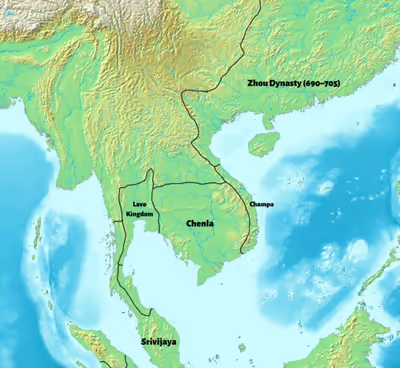
The New Book of Tang asserts that shortly after 706, the country was split into Land Chenla and Water Chenla. The names signify a northern and a southern half, which may conveniently be referred to as Upper (northern) and Lower (southern) Chenla. By the late 8th century Water Chenla had become dependent on the thalassocratic Shailendra dynasty on Java and the Srivijaya city-state on Sumatra. The last of Water Chenla's kings seems to have been killed and the polity incorporated into the Javanese monarchy around the year 790. Land Chenla maintained its integrity under Jayavarman II, who proclaimed the Khmer Empire in 802.
Land and Water Chenla
The Tang histories mentioned that after the end of the reign of shénlóng (神龍) (i.e. after 6 February 707) Zhēnlà came to be divided into two realms, Lùzhēnlà (陸真臘) ("Land Chenla", also called Wèndān (文單) or Pólòu (婆鏤)) and Shuīzhēnlà (水真臘) ("Water Chenla"), and returned to the anarchic state that had existed before it was unified under the kings of Funan and the first kings of Chenla. On the other hand, Water Chenla was associated with the Mekong Delta and had access to the river and its benefits, but this advantage had its downfalls as it made Water Chenla more susceptible to attacks.
Late in the 8th century AD, it faced war from Javanese pirates that ultimately took over the Mekong Delta and then later took over Chenla. However author Michael Vickery asserts that these categories of Water and Land Chenla created by the Chinese are misleading and meaningless because the best evidence shows that until 802 AD, there was no single, great state in the land of ancient Cambodia, but a number of smaller ones. In his later work Vickery read the eighth century as a period of consolidation for Chenla, following a seventh century of many small semi-independent units under local rulers, or poñ. Revire sets that reading against Pierre Dupont's study of 1943, which treated the same period as the breaking apart of Chenla into its Land and Water halves.
Both parts sent tribute to China in 717, and Land Chenla continued to do so for most of the century: a prince of Wendan with twenty-six accompanying officers was received at the Tang court in 753, an embassy including eleven trained elephants arrived in 771, and the last recorded mission was in 798.
In the view of the historian Sujit Wongthes, Land Chenla is located in Isan (northeast Thailand), while Water Chenla is situated on the Tonlé Sap area in Cambodia. Tatsuo Hoshino placed Wendan's outer capital at Mueang Fa Daet Song Yang in Kalasin province and its inner capital at Kantharawichai in Maha Sarakham province, an identification Hiram Woodward accepts while rejecting as tendentious Hoshino's further claim that the people of Wendan spoke a Tai language.
Decline
The number of inscriptions declined sharply during the eighth century. Woodward dates the change to about the 720s and notes that it extends to monumental construction as well, across almost the whole of Cambodia, a pattern he reads as consistent with warfare and depleted resources though also with a change of ideological outlook. He proposes that the Angkor region fell under the domination of Wendan during this period, and that Wendan was in turn defeated by Jayavarman II, citing the coincidence of its last embassy in 798 with Jayavarman II's accession in 802; he presents the reconstruction as a hypothesis. Ngernkerd and colleagues read the instability of the late 7th century as the opening through which Dvaravati expanded into what is now eastern Thailand, ground they take to have been under Bhavavarman II's authority until then. However, some theorists, who have examined the Chinese transcripts, claim that Chenla started falling during the 700s as a result of both internal divisions and external attacks by the Shailendra dynasty of Java, who eventually took over and joined under the Angkor kingdom of Jayavarman II. According to the Sdok Kak Thom inscription (1053), Jayavarman II and his son Indrayudha defeated a Cham army in 790, then moved to north of the Tonle Sap, established the city of Hariharalaya, 15 kilometers south of Angkor.
Individually, historians reject a classical decline scenario, arguing there was no Chenla to begin with, rather a geographic region had been subject to prolonged periods of contested rule, with turbulent successions and an obvious incapability to establish a lasting centre of gravity. Historiography ends this era of nameless upheaval only in the year 802, when Jayavarman II established the appropriately named Khmer Empire.
Society
Capital
According to George Cœdès, Champasak was the origin of the ruling dynasty of Chenla and Vat Phou its spiritual center. Coedès and contemporary scholars refer to the historical annals of the Sui dynasty, which mention Chenla and identify its royal residence to be near a mountain named Ling-jia-bo-po or Lingaparvata, a temple was constructed on its summit. Vat Phou is an enormously impressive Khmer Hindu temple located at the base of Mount Phu Kao in Laos, which leads theorists to speculate that Phu Kao is the mountain that is referenced in the passage and that Wat Phou could be the temple mentioned; however this view is not accepted by modern scholarship.
Authors Claude Jacques and Michael Vickery question the identification of Phu Kao as Lingjiabopo/Lingaparvata because there are a number of hills in Cambodia that apply to the vague descriptions. Thus, the debate remains and the existence of Chenla as a unitary state or a capital at Vat Phou is questionable. Since there is not much evidence or writings from the time period, not much can be said about the region. The Chinese annals are one of the very few sources scholars can analyze and derive information from.
The people of Chenla, whose base was Champassak in about 550, established their capital city at Isanapura (Sambhupura) by about 600.
According to Paul Pelliot, Sambhupura (Isanapura) was the capital of Land Chenla (Upper Chenla) and Vyadhapura was the capital of Water Chenla (Lower Chenla), but, according to George Coedès, Baladityapura (Aninditapura) was the capital of Water Chenla and Wen Tan (Wen Dan) was Land Chenla.
Rulers
Traditionally leaders were chosen based on their merit in battle and their ability to attract a large following; however, as rulers gained more power moving away from the commoners horizon, a shift from measure of capability towards patrilineal descent occurred. Adoption of the idea of the Hindu state with its consecrated military leader, the "Varman"—protector king was the ideological basis for control and supremacy.
All essential elements of Bhavavarman's life and most of his descendants are known only through epigraphy. Interpreted as to be Vīravarman's successor and after gaining independence ("he has conquered his throne at the tip of his sword") ruler of the eastern portions of his father's realm, he "built a temple in 598 during his reign in [...] the center of the kingdom of Bhavapura". Mahendravarman is, according to epigraphy, also Vīravarman's son and attributed as to be the conqueror of Funan.
Succession is unclear, because "this at the same time eliminates his son Bhavavarman I of the royal function" Historian Michael Vickery resolves: "Bhavavarman and...Citrasena [Mahendravarman's given name] attacked Funan" [together]. Īśānavarman is the founder of a new capital - Isanapura north of the Tonlé Sap (the archaeological site of Sambor Prei Kuk). His son Bhavavarman II - is mentioned only once in an inscription in the year 644. Jayavarman I is the last ruler of a united Chenla. He is the son and successor of the obscure Candravarman.
Religion
Funan legacy
During the reign of the Funan empire, residents were still burying their dead with grave goods, but also practicing cremation, according to archaeological finds. Both Hinduism and Buddhism arrived in Southeast Asia through the Funan trade networks. A few surviving inscriptions with verses in Sanskrit and some small statuary and other relics are physical indications of both Buddhist and Hindu belief systems present in Funan culture. The transition from Funan to Chenla is not clearly understood, but by the 6th century CE, the Kingdom of Chenla was established, with Chinese sources suggesting a people speaking the Khmer language conquered Funan and founded Chenla.
Royal Hindu and Buddhist cults
Archaeological evidence indicates Sambor Prei Kuk (Isanapura) was a major Chenla settlement and possibly the royal capital. The city was divided into three areas, each of which had a brick large sanctuary or temple, apparently centred around a lingam similar to Hindu stone representations of Shiva. Kings of Chenla mentioned in inscriptions generally carry the name of a local Hindu deity with the affix -varman (Sanskrit for "protected by"), such as "Bhavavarman" and "Isanavarman". The kings seem to have undergone a process of Indianization to consolidate and magnify their rule.
A sculpture called Harihara, a combined form of Vishnu and Shiva, is also frequently depicted in religious establishments. This could portray a Chenla belief that there is an equal balance between creation and destruction in the universe and that when one substance is terminated, another is produced to replace it. Other Hindu gods Brahma and Indra along with deities such as Krishna Govardhana, Lakshmi, etc. were also worshipped. An epigraph from Siem Reap Province testified that during the late 8th century, it was evidently that Buddhists in Cambodia worshipped bodhisattvas.
Also originating from India, Buddhism, although not as preeminent as Hinduism, peacefully coexisted with Hinduism in Chenla; two schools of Buddhism were identified from a sculpture found that depicted twelve images of Buddha. This shows that the kings did not seem to enforce their religious views on their people and that influences of all kinds were creating a diverse community in Chenla. According to the Indian historian Himanchu Prabha Ray, Buddhism was an effective motivating factor in the expansion of maritime trading networks from India to eastern lands while Brahmanic Hinduism revolved more around an agrarian economy.
Buddhist practice is attested on the western edge of the Chenla sphere as well. The Khao Rang inscription (K. 505), dated 561 śaka (639 CE) and found near the Thai border in Sa Kaeo province, commemorates gifts to a Buddhist vihāra. Dowling has argued that Buddhism nearly disappeared from Angkor Borei, and perhaps from Chenla, late in the seventh century. Her case rests on Yijing's report of Buddhists fleeing a country he calls Banan (跋南) after a wicked king seized power there. Revire discounts the report, since Yijing never visited Chenla and much of his information was second-hand and possibly out of date. He also finds unconvincing Dowling's identification of that king with Jayavarman I.
Naming or identifying oneself with a Hindu god, usually Śiva in the form of a liṅga, enhanced a ruler's legitimacy and eased the founding and restoring of temples. Alexis Sanderson calls the result a Śaivization of the land in ancient Cambodia, and Oliver Wolters's men of prowess is invoked for why an appeal to Indic deities answered local understandings of power. Paul Lavy holds that these elite-sponsored foundations were also a means for local rulers to control an area, and were instrumental in the development of early political entities. Lavy argues further that efforts by Khmer rulers to consolidate authority in the seventh and eighth centuries led to the deployment of Harihara, the composite of Śiva and Viṣṇu. Julia Estève contests that reading.
Local indigenous deity cults
Despite Hinduism and Buddhism apparently playing an important role in royal cults, textual evidence suggests they were only widely practiced by the Chenla elite. Farmers outside the urban centres generally had Khmer names rather than Sanskrit names, and paid tribute to regional landowners carrying the Khmer title poñ, who constructed temples dedicated to both Hindu and local deities. Wealth and power in these outlying agricultural regions was transmitted through the female line of inheritance, indicating matrilineal succession was probably the original norm in Southeast Asia. The local deities worshipped were usually female, and there is also evidence of ancestor worship. Although most of these local temples were built out of wood, and were thus lost, written documents make clear they were the norm in the Kingdom of Chenla. No doubt some locals converted to the new Indian religions, but the vast majority of the population probably venerated the local goddesses and gods and their ancestors in their own villages, while acknowledging the public Hindu and Buddhist cults, such as with occasional sacrifices and attending public ceremonies in Hindu temples in the cities.
It is also possible that some local deities were absorbed into the Hindu pantheon. Wat Phu in Champasak province, southern Laos, has been read as such a case. The mountain above the sanctuary came to be worshipped as a natural liṅga and was known as a Liṅgaparvata. Before Śaivism reached the site an indigenous cult of the mountain's spirit, named Podouli, seems to have been present. The Chenla kings maintained a liberal religious policy, allowing their subjects to practice their traditional local religions, until the Khmer Empire was established in the early 9th century.
Religious structures
By the close of the century, the Chenla region was dotted with temples and shrines to the Hindu Gods. Many commoners were involved in the upkeep of these religious complexes and citizens of Chenla were expected to donate land, goods, and slaves to them. The great temple foundations consisted of their own holdings of land and people, functioning as powerful corporations; even minor temples had establishments and collected taxes. While kings had established these temples as a means to increase their power, in reality, these structures might have been taking away valuable land and citizens from the empire; the taxes collected by the temples could have meant more wealth for the leader.
However, these structures may also have been a factor that stabilised the kingdom and allowed the king to expand and attract more civilians who followed Hindu beliefs as Hinduism served as a reason for people to follow the king's rule. Also, incorporation of these establishments could appeal to foreigners who would bring their trade, business, and goods to the area, making it more economically efficient.
Architecture
The design of the temples and shrines was greatly influenced by the prosperous Gupta state of northern and central India. The temple complexes were brick and stone based with a protruding statue representing a Hindu God or Buddha as the central focus of the building. Sandstone was the prominent material utilized for more important temples and was derived from the Kulen Mountains. Because of its heavy weight, it required a lot of manpower, which usually involved slaves.
Cremation burials lined with bricks were also discovered. These structures are supposed to be devoted to the veneration of members of the Brahmin caste since the burials had been carried out according to Hindu practice.
Social hierarchy
Social status was determined based on one's knowledge of language, primarily Khmer or Sanskrit. Sanskrit was the language of the Gods, thus it was considered more valuable; the division between who worked the fields and who completed more worthy tasks was based on how well they knew Sanskrit. People who succeeded in educating themselves earned higher ranks such as being an official or even royal servant. However the majority of residents who lacked the ability to gain Sanskrit names spent their lives producing a surplus for the benefit of temples and ancestral Gods. Sheldon Pollock dates the shift that gave the language that standing. By the fifth century it was no longer only a sacred language, and in the political and royal sphere it served chiefly to eulogise rulers.
Charles Higham derives the ranks themselves from the Late Iron Age. On his reading the local leaders who emerged in the Mun valley of northeast Thailand became the poñ, the title borne by regional landowners in the pre-Angkorian inscriptions. He traces their rise to iron working, to ploughed and perhaps irrigated rice fields by the fifth century CE, and to the control of salt. Piphal Heng argues from Thala Borivat on the Mekong that small proto-historic settlements were absorbed into larger ones between the fourth and seventh centuries, the larger then becoming pre-Angkorian centres. Both derive the poñ and the mratan from Late Iron Age elites.
Although a social hierarchy existed, there was no discrimination between genders. Women were not considered second class citizens rather many women played central roles in rituals, specialized in crafts, and were given ranks as high officials. This may be because until recently families followed matrilineal descent instead of a patriarchal society, thus some aspects of the earlier society were retained.
Slavery
Many commoners were assigned to serve as workers that cleaned, cooked, and built temples and shrines without any compensation. From analyzing ancient inscriptions, Judith Jacob has discovered that there were fourteen categories of slaves in Chenla distinguished by different origins and kinds of duties. These groups of people could be bought, sold, and given away, having no freedom to escape because their parents were in need of money or they had to pay off debts that they contracted or were passed on in their family.
Economy
The wealth of Chenla and its surrounding territories was derived from wet-rice agriculture and from the mobilization of manpower rather than from subsistence farming such as in the past. Productive lands were donated to temples where slaves worked the fields and helped the temples generate revenue. The kingdom sustained an extensive irrigation system which manufactured rice surpluses that formed the bulk of their trade. International trade is believed to have been essential to the kingdom. But by the time of early 7th century, Cambodian society was shifting from a trading economy to an agrarian one. Trading centers near the coast of Funan period were collapsing, while inland agrarian centers emerged.
In the remains of the main port, Oc Eo, (now in Vietnam) materials from Rome, Greece and Persia have been found, as well as artifacts from India and neighboring states. Indian influences might have been so alluring because Indian merchants who traded with early Cambodians had wealth and were prosperous, qualities to strive for, therefore there was little to no hesitance in adopting the religion of another culture.
Historiography and Chinese sources
It was Īśānavarman I who managed to absorb the ancient territories of Funan which led the New Book of Tang compiled by Ouyang Xiu and Song Qi in 1060 to attribute the effective conquest of the country to him. The earliest known date of the reign of Īśānavarman, a date that must not have been long after his accession, is that of his first embassy to the court of Suí China in 616–17. This king is also known from his own inscriptions, one incised at Īśānapura, dated 13 September 627 AD (K. 604), the other one at Khău Nôy (Thailand), dated 7 May 637 (K. 506). The same stone, Pch. 16 in the Thai inventory, is described by Lekkla as referring to Bhavavarman II.
After Īśānavarman, who ceased to reign around 637, the inscriptions tell us of a king named Bhavavarman (II). The only dated inscriptions we have from him, are that of Tà Kev (K. 79), dated 5 January 644 and of Poñā Hòr south of Tà Kev (K. 21). dated Wednesday, 25 March 655. A further stone from Aranyaprathet district in Sa Kaeo province, Thailand, the Ban Kut Tae inscription (Pch. 26), names him beside Īśānavarman and was probably moved from the Khao Noi hill. Then seemingly follows a certain king Candravarman, known from the undated inscription K. 1142 of unknown origin who hailed from the family of Īśānavarman. The son of Candravarman was the famous king Jayavarman I whose earliest inscriptions are from Tûol Kôk Práḥ, province Prei Vêṅ (K. 493) and from Bàsêt, province Bằttaṃbaṅ (K. 447), both dated 14 June 657.
Some 19 or 20 inscriptions dating from his reign have been found in an area extending from Vat Phu'u in the north to the Gulf of Siam in the south. According to the Xīn Táng shū the kingdom of Zhēnlà had conquered different principalities in Northwestern Cambodia after the end of the Chinese era name yǒnghuī (永徽) (i. e. after 31 January 656), which previously (in 638/39) paid tribute to China. The reign of Jayavarman I lasted about thirty years and ended perhaps after 690. It seems that after the death of Jayavarman I (his last known inscription K. 561 is dated 681/82), turmoil came upon the kingdom and at the start of the 8th century, the kingdom broke up into many principalities.
The region of Angkor was ruled by his daughter, Queen Jayadevī who complained in her Western Bàrày inscription K. 904, dated Wednesday, 5 April 713, of "bad times". The Táng histories tell us that after the end of the shénlóng (神龍) era (after 6 February 707) Zhēnlà came to be divided in two realms, Lùzhēnlà (陸真臘) ("Land Zhēnlà", also called Wèndān (文單) or Pólòu (婆鏤)) and Shuīzhēnlà (水真臘) ("Water Zhēnlà") and returned to the anarchic state that had existed before it was unified under the kings of Funan and the first kings of Zhēnlà.
Kings like Śrutavarman and Śreṣṭhavarman or Puṣkarākṣa are only attested very much later in Angkorian inscriptions; their historicity is doubtful. Land Zhēnlà sent an embassy to China in 717, aided Mai Thúc Loan's rebellion against the Chinese (722–723). Another embassy visiting China in 750 came probably from Water Zhēnlà. According to the Chinese Annals a son of the king of Wèndān had visited Chinas in 753 and joined a Chinese army during a campaign against Nanzhao (Chinese: 南詔; pinyin: Nánzhāo) in the following year.
After the Wèndān embassy in the year 771 the heir-apparent Pómí (Chinese: 婆彌) came to the imperial court and, on 13 December 771, he received there the title "Kaifu Yitong Sansi" (Chinese: 開府儀同三司; pinyin: Kāifǔ Yítóng Sānsī), one of the highest honorific titles. In 799 an envoy from Wèndān called Lītóují (Chinese: 李頭及) received a Chinese title, too. As rulers of Śambhupura are attested by the inscription K. 124, dated 803/04 a king Indraloka and three successive queens, Nṛpatendradevī, Jayendrabhā and Jyeṣṭhāryā. Two inscriptions refer to a ruler named Jayavarman: the first one, K. 103, hails from Práḥ Thãt Práḥ Srĕi south of Kompoṅ Čàṃ, dated 20 April 770, the second one from Lobŏ'k Srót in the vicinity of Kračèḥ near Śambhupura (K. 134), dated 781.
Cœdès called him Jayavarman Ibis, but probably he is identical with Jayavarman II, the founding father of the Angkorian kingdom, as Vickery has pointed out: "Not only was Jayavarman II from the South; more than any other known king, he had particularly close links with Vyādhapura. This place is recorded in only one pre-Angkor inscription, K. 109/655 [exactly: 10th February 656], but in 16 Angkor-period texts, the last dated 1069 [K. 449 from Pàlhàl, dated Sunday, 3rd May 1069] ... Two of them, K. 425/968 and K. 449/1069, are explicit records of Jayavarman II taking people from Vyādhapura to settle in Battambang."
Conflicting records
According to the inscription from Čăn Năk'ôn in Basăk/Laos (K. 363) Vīravarman was the father of Citrasena (royal title Mahendravarman) who was the younger brother of Bhavavarman. Obviously both princes had the same mother, but different fathers, which was corroborated by the Si Tep inscription (in present-day Thailand) giving the information that Bhavavarman was the son of a Prathivīndravarman and grandson of a Cakravartin whereas the inscription from Pak Mun in Ubon/Thailand informs us that the name of the father of Vīravarman was called Sārvabhauma.
All these inscriptions refer to a large territory ruled by these kings. It is recorded in the inscription from Robaṅ Romãs at Īśānapura (the archaeological site of Sambor Prei Kuk) that a certain Narasiṃhagupta, who was vassal (samāntanṛpa) of the successive kings Bhavavarman, Mahendravarman (the ruling name of Citrasena) and Īśānavarman erected on 13 April 598 during the reign of Bhavavarman a figure of Kalpavāsudeva (Vishnu).
This coincides with the oldest Chinese text that mentions Chenla, the Suí shū (Annals of the Suí Dynasty), compiled by Wèi Zhēng (580–643) in AD 636, which gives the information that at the beginning of the 7th century Chenla was ruled by Citrasena and Īśānavarman. The capital of the latter was Īśānapura, while his predecessor Bhavavarman I still resided at Bhavapura, a place which probably is located in the vicinity of the modern town of Thala Barivat (13°33′ N, 105°57′ E). An inscription dating from the reign of Īśānavarman I asserts that he was "the King of Kings, who rules over Suvarnabhumi as far as the sea" [Samudra-paryanta Suvarṇabhūmi], thus identifying Chenla with Suvarnabhumi.