

Sukhothai Kingdom
Siamese kingdom in Southeast Asia (1238–1438)
- 40 min read
- 6 chapters

Related on Lably
Through Post-classical history
Chronicle traditions date Sukhothai's beginnings to the 5th or 7th century and place it first under Lavo. They then have it ruled by a Monic dynasty from Haripuñjaya from the 950s, and from the mid-12th century by Siamese lines of the central Menam valley. Older scholarship held that the Xiān were briefly subordinate to Angkor between the late 12th and early 13th centuries, and read 1238 as Sukhothai's liberation from a Khmer garrison and the beginning of an independent Tai kingdom. Later work has questioned both points. It notes Siamese control of Sukhothai before 1238, and reads the events of that year as a contest between local lords who both drew on Khmer titles and alliances.
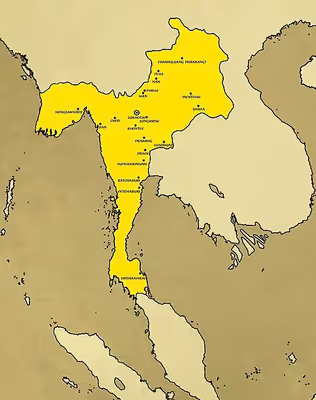
After 1238, Sukhothai was paired with Si Satchanalai, a relationship read variously as one polity with two centres and as two distinct polities under separate ruling lines. The polity is traditionally held to have reached its greatest extent under Ram Khamhaeng the Great, whom some historians credit with introducing Theravada Buddhism and the initial Thai script. Later scholars read the extent claimed in his inscription as a network of relationships with neighbouring polities rather than direct rule. Ram Khamhaeng also began relations with Yuan China, through which the kingdom developed the techniques to produce and export ceramics such as sangkhalok ware. After his death the tributaries fell away, a change also read as a reorganisation of the region into loose confederations. In 1349, during the reign of Li Thai, armies from Ayutthaya invaded and made Sukhothai a tributary, though how far that subjection went is debated. Sukhothai's nobility nonetheless continued for centuries to shape the Ayutthaya monarchy through the Sukhothai dynasty.
Sukhothai was long regarded in Thai historiography as "the first Thai kingdom", a description the Fine Arts Department has since dropped, according to Sujit Wongthes. The origins of the Thai people extend much further back in time. The ruins of the kingdom's capital, now 12 km (7.5 mi) outside the modern town of Sukhothai Thani in Sukhothai Province, are preserved as the Sukhothai Historical Park and have been designated a UNESCO World Heritage Site.
Etymology
The Thai name Sukhothai (Thai: สุโขทัย, Thai pronunciation: ) is a compound of Indic origin. It joins sukha (Sanskrit: सुख, lit. 'pleasant, happiness') to udaya (Sanskrit: उदय, lit. 'ascent, rise of the sun'), and is treated as a corrupted form of Sanskrit and Hindi Sukhodaya (Sanskrit: सुखोदय), Sukhada (Sanskrit: सुखदा), or Sukhadaya (Hindi: सुखदाय). The name has been rendered "the dawn of happiness", "the dawn of prosperity" and "rising happiness", and glossed as "the Happy Thai".
G. E. Gerini gave the city an earlier name still. On his account it rose about 70 BC as Sukda, Sukhada or Sukhodaya. The form Sukhothai came into use in central Siam later. The Mon-Khmer inhabitants of the territory are said to have pronounced it Sakkadéa, syncopated to Sakdéa or Sakda.
Sign in to keep reading
5 more chapters are free with a Lably account.
History
Early settlement and regional networks
Founding traditions
The traditions disagree about when Sukhothai was founded, and none of them is contemporary. One chronicle tradition places the founding of Sukhothai in 494 CE, followed by its twin city of Chaliang (เชลียง). The Legend of the Arhat (Tamnan Nithan Phra Arahant; ตำนานนิทานพระอรหันต์) instead gives 679 CE and names the founder as Indrajayadhirāja (อินทราไชยธิราช), from the city of Nakhon Luang (นครหลวง, "capital city", possibly Lavapura). He was deposed in 687 by Balidhiraja, elder son of Kalavarnadisharaja of Lavo. Who followed Balidhiraja is obscure in the surviving record.
From the late 7th to early 8th centuries, the lands south of the mountains of the Yom and Nan basins lay, on Tatsuo Hoshino's reading of the Cefu Yuangui and the Book of Tang, within the territory of Qiān, centred at Si Thep. On the same reading, those mountains, in present-day northern Thailand, formed the territory of Duō Mó Cháng (多摩萇).
By the latter half of the 8th century, a local textual tradition holds that Sukhothai and Lavo were subsequently brought under the authority of Padumasūriyavaṁśa (ปทุมสุริยวงศ์), presented in these narratives as the first Siamese sovereign. He has been identified with Pra Poat honne Sourittep pennaratui sonanne bopitra in the European accounts, whose reign is conventionally dated 757–800 CE.
For the 9th and early 10th centuries the city is generally presumed to have been abandoned after an incursion by the legendary Khom kingdom of Suvarṇakōmakam (สุวรรณโคมคำ), in the region of present-day Chiang Saen. However, two difficulties attach to that presumption. A separate tradition has Sukhothai playing an active part in the succession of the Dvaravati polity of Sambuka in the same period. Its ruler is said to have adopted Sambuka's prince Balaraj, backed his overthrow of his own father, and installed him as monarch of Sambuka, whose reign is put at 867 to 913 CE. Separately, Suvarṇakōmakam is widely identified as the predecessor of the Yonok Kingdom and is generally understood to have flourished before the 7th century, some two centuries before the incursion attributed to it.
Mon rulers and Tai Yuan incursions
Sukhothai and the rest of the upper Menam valley, including Si Satchanalai and Thung Yang (also known as Phichai Chiang Mai; พิชัยเชียงใหม่), came under the control of a Monic dynasty from Haripuñjaya. This followed the fall of Lavo to Tambralinga in 927 and of Rāmaññadesa (lit. 'the land of the Mon'; potentially the eastern Menam valley) to Angkor in 946. The Northern Chronicle records the dynasty as led by Abhayakamini from the 950s onward. He is reported to have taken Sukhothai around 957, having fled Haripuñjaya when its capital was captured by another Khom polity, Umoṅkaselā (อุโมงคเสลา), in what is now Fang. At the same time, the Phitsanulok area is recorded in the Ayutthaya Testimonies as having been governed by Sudhammaraja, a Xiān monarch who had relocated northward from the Phraek Si Racha region in the central Menam valley. Sukhothai's traditionally interpreted declaration of independence from Umoṅkaselā occurred in 1017, during the reign of Arunaraja.
Later, during the reign of Suvacanaraja of Si Satchanalai, which commenced around the 1050s, the upper Menam territories faced an incursion by a coalition of Tai Yuan mueangs under Śrīdharmatripiṭaka (ศรีธรรมไตรปิฎก) of Ngoenyang Chiang Saen. Before the fighting, the Xiān rulers of Phitsanulok, led by Vijayaraja, are recorded as having moved south to Phetchaburi. The conflict was ultimately resolved through negotiation. To establish a dynastic alliance, Suvacanarāja gave his only daughter in marriage to Śrīdharmatripiṭaka. This interdynastic union produced two princes, the elder of whom, Kesariraja, later became ruler of the Lavo Kingdom.
After these events, no further record explicitly attests to the continuation of this Monic dynasty. In contrast, Śrīdharmatripiṭaka is noted to have remained influential in the region, particularly through the reconstruction of Phitsanulok under his authority. Śrīdharmatripiṭaka is described as settling at Phitsanulok and holding power there until his death. The move has been tentatively dated to about 1106. His son, Kesariraja, is further recorded as having married a daughter of an otherwise unidentified ruler of Si Satchanalai. Their son later married a Xiān princess under Phra Chao Luang at Ayodhya.
The Tai element in the region's population has a chronology of its own. Historians have long held that the migration of Tai peoples into Mainland Southeast Asia was gradual and took place between the 8th and 10th centuries. Before the rise of Sukhothai several Tai polities existed in the neighbouring northern highlands, among them Ngoenyang of the Northern Thai people (present-day Chiang Saen) and Chiang Hung of the Tai Lue people (present-day Jinghong, China). Semi-legendary Shan documents record that the Mau Shan prince Sam Lung-pha of Mogaung raided the Menam valley and the Malay peninsula as far as Tawi (Dawei) and Yansaleng (possibly Junk Ceylon). He is said to have done so before founding the Tai kingdom of the Ahom in Assam in 1229. Briggs, who reports the tradition, calls the influx purported and suggests only that it may have had something to do with the establishment of the Tai kingdom of Sukhothai.
Local textual tradition, by contrast, places dynastic ties between the Mon monarchs of the Menam basin and the Tai nobles of the northern valleys considerably earlier, in the late 7th century. One of the sons of Balidhiraja of Sukhothai bears the Tai name Sai Thong Som and is traditionally held to have been born to a Tai queen consort from Yonok. That union is attributed to the northward expansion of the Lavo Kingdom into Yonok territory under Kalavarnadisharaja (r. 648–700), as recorded in the Northern Chronicle. The connection is said to have continued to the reign of Abhayakamini, whose consort came from Nan in Tai Ngoenyang.
Sukhothai and related city-state networks
Sukhothai stood on the routes linking the Mon city-states to the west, the Tai polities to the north and the Xiān polities of the lower Chao Phraya River basin to the south. Tanit Sorat reads that position as making it a regional entrepôt, developed to the level of a city-state by no later than 1127. That condition appears to have held until the traditional establishment of the Sukhothai Kingdom in 1238. Phiset Jiajanphong dates the town's beginning much later. He has Lavo standing behind the founding of Mueang Sukhothai after 1157, to gather forest products from deep inland for shipment to the larger city at Lopburi.
In the mid-12th century the upper and western Menam valley probably came under an emerging line of Siamese monarchs seated in the Phraek Si Racha region. The Ayutthaya Testimonies place Suryaraja, grandfather of Si Inthrathit, at Vicitraprakāra (วิเชียรปราการ, modern Kamphaeng Phet) from about 1157. His cousin, Pra Poa Noome Thele Seri, formally titled Sommedethia Pprappanom Tteleiseri Maahesa Vorauaarintti Raacha Boppitra, succeeded his relative at Mueang Sing around 1170. He also reconstructed Phetchaburi in 1157/58. The Instructions Given to the Siamese Envoys Sent to Portugal of 1684 and Du Royaume de Siam instead state that he was enthroned at Yassouttora Nacoora Louang or Tasoo Nacora Louang. Around 1167, however, Sri Dharmasokaraja II (r. 1157–1183) of Tambralinga reasserted authority over the Phraek Si Racha region and extended his reach northward as far as present-day Nakhon Sawan province, according to interpretations of the Dong Mè Nang Mưo’ng Inscription (K. 766), dated to 1167, following his acquisition of Lavo around 1157.
Pra Poa Noome Thele Seri has been proposed as Fang-hui-chih of Chen Li Fu. In 1180, he reasserted control over the Phraek Si Racha region, and the two European accounts have him move further north to Sukhothai–Lacontai about 1188/89. In the same year, he returned to the lower valley with his younger brother Uthong I of Mueang Chaliang, who took the vacant throne at Suphannaphum in the 1190s. He appointed his brother to oversee Mueang Sing, then moved to Phetchaburi and sent a tributary mission to the Chinese court in 1200 in the name of Chen Li Fu. In 1196, he attempted an incursion into Tambralinga, then ruled by Sri Dharmasokaraja II.
After the loss of the lower Menam valley, Sri Dharmasokaraja II returned to his principal domain at Tambralinga. Phraek Si Racha returned to its former dynastic line, while Lavo to the east was taken by Angkor under Jayavarman VII.
Michael Smithies has tentatively placed Pra Poa Noome Thele Seri in the line of Si Inthrathit, who later reigned over Sukhothai between 1238 and 1270. Pra Poa Noome Thele Seri's line in the lower valley became the Lavo dynasty of the Ayutthaya Kingdom, while Suryaraja's line in the upper valley became the Phra Ruang dynasty of Sukhothai.
Scholars have suggested that the royal house that ruled the Chen Li Fu polity at Phraek Si Racha had some connection with the Mahidharapura Kingdoms of the Phimai region. Walailak Songsiri puts the connection no higher than the royal name, suggesting that Mahidharavarman may be the name of a prominent ruler from the polities north of the Dangrek range. On her reading the name was taken up as a formal style for use with the Chinese court, perhaps with kinship ties. Some scholars hold that the polity remained under Angkorian suzerainty, while the 1200 mission has been read as an assertion of some autonomy.
The following table summarises rulers whom chronicle traditions and modern interpretations associate with Sukhothai before 1238. The dates are approximate, and the sequence of rulers from Sri Naw Nam Thum to 1238 remains disputed.
Formation of the regional mandala
Contest for Sukhothai
Sukhothai became the seat of Candraraja, son of Suryaraja, when he moved from Kamphaeng Phet after Pra Poa Noome Thele Seri left. His domain of Sukhothai–Kamphaeng Phet is recorded as tributary to Indaprasthanagara through a dynastic tie. Early Thai scholars sought to identify Indaprasthanagara with Angkor. However, the Ayutthaya Testimonies place Indaprastha east of Sankhaburi, and the Northern Chronicle says it is 15 days' travel north of Ayodhya. The testimonies add that Sukhothai–Kamphaeng Phet renounced the tribute in the beginning of the 13th century, after which Sukhothai won the ensuing war under the leadership of Si Inthrathit, then a crown prince.
After that victory Si Inthrathit was given Mueang Bang Yang, in the present-day Nakhon Thai district, which had previously served as the power base of his kinsman, Pra Poa Noome Thele Seri. There he married Nang Sueang, a Tai Lueang (ไทเลือง) princess and daughter of Sri Naw Nam Thum, ruler of Mueang Rat (เมืองราด), situated either in modern Lom Sak district or Thung Yang. Wilaiwan Khanittanan, who argues that the Tai of early Sukhothai came from the Red River basin, reports the same name, lueang (เลือง), as a surname among the Muong and Black Tai of northern Vietnam. Its bearers performed ritual at village and mueang level and kept the old Chinese calendar. She reads the Sukhothai oath inscription Pu Khun Chit Khun Chot (ปู่ขุนจิดขุนจอด; lit. 'Grandfather Khun Chit, Khun Chot') as naming people of that line, citing Prasert na Nagara for the reading. That Tai Lueang polity extended its reach into Mueang Chaliang early in the 13th century, as the reign of Rajadhiraj II weakened.
With Chaliang secured, Sri Naw Nam Thum and his son Pha Mueang pushed south to Sukhothai in 1219, overthrowing the Mon ruler E Daeng Phloeng. What remained of the older Mon aristocracy then revolted under Khom Sabat Khlon Lamphong and took the city back. The revolt that briefly restored Mon authority at Sukhothai coincided with what Santi Phakdeekham describes as Angkor's reassertion of control over Lavapura. Bang Klang Hao, a local chief later known as Si Inthrathit, took the city from Khom Sabat Khlon Lamphong in 1238 with military help from his brother-in-law Pha Mueang.
The Wat Si Chum Inscription sets out this campaign in stages. It gives Mueang Rat as a substantial polity, describing Pha Mueang as lord there with a large elephant force and many dependent towns. Bang Klang Hao asked for the levies of Mueang Rat. The two moved by separate routes, Bang Klang Hao taking Si Satchanalai while Pha Mueang advanced through Bang Khlong, whose ruler submitted and handed over the town. Pha Mueang then brought up the levies of Mueang Rat and Mueang Sa Kot. Chit Phumisak read the earlier move by Sri Naw Nam Thum as a first attempt that failed, the city holding out. He dated the point at which Mueang Rat ceased to answer to any outside power to about 1220, on the ground that it was able to commit its whole levy to the Sukhothai campaign.
Pha Mueang is recorded as returning to his own seat rather than taking Sukhothai for himself. That seat bears on the identification of Mueang Rat. Manit Vallibhotama, followed by Chit, places Mueang Rat at the old Khorat site in Sung Noen district, Nakhon Ratchasima province. They argue that Sri Sattha, Pha Mueang's grandson, is recorded as fighting Thao Ji Chan in his late teens, and that Dong I Chan lies about 70 km from that site, so the two territories adjoined. Griswold and Prasert na Nagara argue from the terrain for the Nan valley about 50 km upstream from Uttaradit, a reading Wyatt follows while noting that the town has never been found. On Phiset Jiajanphong's reading Mueang Rat lay at Thung Yang in Laplae near modern Uttaradit. That is the same ground as Phichai Chiang Mai, the northern polity of Sukhandhakhiri, whose sons Jayadatta and Jayasena married into the ruling house of Ayodhya. Jayasena held Ayodhya from 1253 and returned north in 1289 to succeed his father at Phichai Chiang Mai. What relationship, if any, connected the line of Pha Mueang with that of Sukhandhakhiri does not appear to have been examined.
The inscription does not say when or why Pha Mueang's family left the Sukhothai region. Phiset took Sri Sattha for the last of that line attested there. He was born at Sralwang Songkhwae, modern Phitsanulok, and his father Phaya Khamhaeng Phra Ram was either Pha Mueang's younger brother or his son. Sri Sattha entered the monkhood and left two daughters and no son.
A dual-centre polity
Some fifty kilometres north of Sukhothai stood its sister town Sri Sajanalaya, later Si Satchanalai, a political centre second only to the capital. Phiset Jiajanphong reads the Wat Si Chum Inscription as placing Sukhothai, Si Satchanalai, and Sralwang Songkhwae (modern Phitsanulok) under the rule of Pha Mueang's line. He argues that this arrangement existed under Pha Mueang's father, Sri Naw Nam Thum, before Sukhothai passed to Khom Sabat Khlon Lamphong following his father's death. Chusak Satienpattanodom instead interprets the period after 1238 as rule from two centres. Sukhothai went to Si Inthrathit's line, while Si Satchanalai, Mueang Rat, and Song Khwae stayed with Pha Mueang's line. He identifies Phaya Khamhaeng Phra Ram as Pha Mueang's younger brother, whereas Phiset leaves open whether he was Pha Mueang's brother or son.
The inscriptions name Sukhothai and Si Satchanalai together. Chusak interprets this pairing as a claim to superior rank and argues that Si Satchanalai was the seat of an heir before succession to Sukhothai. Phiset further infers that Mueang Rat ranked no lower than Sukhothai from Pha Mueang's role in consecrating Bang Klang Hao at Sukhothai before returning to Mueang Rat. Wyatt treats Sukhothai and Si Satchanalai as a paired-city polity rather than as a capital and a dependency, and uses the pairing as a model for other twin names of the period. Michael Vickery instead treats them as distinct towns. He notes that the inscriptions assign each its own hill with a Buddha footprint, and that Li Thai led an army from Si Satchanalai to take the throne at Sukhothai in 1347. He also questioned whether this Si Satchanalai was the walled town on the Yom, proposing a deserted site about 20 km to its south.
The arrangement later changed, although the timing and causes remain uncertain. Phiset suggests that Sralwang Songkhwae may have passed to Si Inthrathit's line during Ram Khamhaeng's reign, possibly with the consent of Pha Mueang's family. Chusak dates the transfer of Si Satchanalai to Ram Khamhaeng's rule to 1283, after Pha Mueang's death, based on the preface to the seventeenth-century Chindamani rather than an inscription. Phiset instead relates the question to the identity of Mueang Rat and the circumstances surrounding Pha Mueang's family, noting that Sri Sattha entered the monastic order after the political conditions changed. Phiset also cites the Northern Chronicle, which describes Hariphunchai, Thung Yang, Sawankhalok, and Boribun as separate kingdoms ruled by their own kings. Chusak notes that the chronicle was compiled only in the early Bangkok period, centuries after the events described.
Regional political network
Si Inthrathit died in 1270 and was succeeded by his son Ban Mueang, who was in turn succeeded by his brother Ram Khamhaeng the Great. Both rulers expanded Sukhothai beyond the boundaries established by their father. To the south, Ram Khamhaeng is said to have subjugated the mandala kingdoms of Suvarnabhumi (probably present-day Suphan Buri) and Tambralinga (present-day Nakhon Si Thammarat). To the north, Ram Khamhaeng placed Phrae and Muang Sua (present-day Luang Prabang, Laos), among other mandala city-states, under tribute. To the west, he supported the Mon people under Wareru, who is said to have eloped with his daughter, in their revolt against Pagan. Wareru subsequently founded a kingdom at Martaban, the predecessor of Hanthawaddy at present-day Bago. Martaban is traditionally counted as a Sukhothai tributary, although Sukhothai's authority may not have extended so far. Relations with Yuan China began during Ram Khamhaeng's reign, and Sukhothai started sending trade missions.
These relationships supported a claim to suzerainty extending from Luang Prabang to Nakhon Si Thammarat and from Vientiane to Pegu. However, the southern extent of this claim depends partly on a passage of contested date. Ligor is named as a dependency on the fourth face of the inscription and in the corresponding clause of the Ayutthaya Palace Law. Baker and Pasuk argue that the reference was inserted into both texts at a later date. Phiset Jiajanphong similarly argues that Ram Khamhaeng's reputation as a warrior king led later historians to overstate Sukhothai's territorial extent. He interprets the first inscription as describing a network of relationships with neighbouring polities, extending south to Suphannaphum and Nakhon Si Thammarat, rather than direct rule over them. Sujit had argued in 1983 that the list expressed an aspiration based on claims of kinship, since Lan Xang, Lavo–Ayodhya, Suphannaphum, and Nan retained their own rulers. He placed the northern limit at the Nan River and the southern at Nakhon Sawan. On his reading the territory reached east to Nakhon Thai and the Pa Sak valley, and west to the Ping River between Tak and Kamphaeng Phet. Srisak Vallibhotama, reading inscriptions 46 and 93, confines the kingdom's core to the lower Ping, Yom and Nan valleys and the upper Pa Sak. That ground is now covered by the provinces of Kamphaeng Phet, Nakhon Sawan, Phitsanulok, Phetchabun, Phichit, Sukhothai and Tak. Ram Khamhaeng's authority depended largely on his reputation as a warrior king, and the bonds of vassalage weakened soon after his death in 1298, with his successors exercising no comparable influence.
Political reorganisation and Ayutthayan influence
Fragmentation and reorganisation
Ram Khamhaeng was succeeded by his son Loe Thai. By the early 14th century Sukhothai held the Chao Phraya plain, with spurs west to the Hanthawaddy kingdom and south to the Nakhon Si Thammarat Kingdom. A Chinese notice of the same years gives a different picture. The Guangzhou gazetteer of 1297–1307 has Xiān controlling Shang-shui Sù gū dǐ, Sù gū dǐ being Sukhothai; Baker and Pasuk leave Shang-shui open, as either a further place name or a statement that Sukhothai lay upriver from Xiān.
The tributaries fell away quickly after Ram Khamhaeng's death. The dominions north of Uttaradit, among them the Lao kingdoms of Muang Sua and Vieng Chan Vieng Kham, present-day Vientiane, broke free. In 1319, Martaban in the west broke away. After 1321, Lan Na (the successor state to Ngoenyang) gained influence over Tak, one of the oldest towns in Sukhothai. To the south, Suphannaphum Kingdom and Nakhon Si Thammarat left early in Loe Thai's reign, cutting Sukhothai off from its vassals beyond them. The kingdom was soon back to what it had been, a small local power. The third inscription describes the same break-up from inside, naming Prabang (Nakhon Sawan), Chiang Tong, and Pan among the towns that ceased to answer to Sukhothai.
Baker and Pasuk describe the same decades as a reorganisation of the region rather than a simple contraction. Between the end of the 13th century and the middle of the 14th, three loose confederations took shape. Lan Na emerged in the far north with its capital at Chiang Mai, legendarily founded in 1296. Lan Xang formed around the middle Mekong in the mid-14th century. The third, along the fringe of the hills, acquired no name of its own and was known from Ayutthaya as the Northern Cities. Sukhothai belonged to the third, where its house was first among equals rather than sovereign. Under Ram Khamhaeng's successor the territory fragmented, nine or ten local chiefs going their own way.
Ayutthayan intervention
In 1323, Loe Thai was succeeded by his cousin, Ngua Nam Thum. In 1347, he was succeeded by Li Thai (Maha Thammaracha I), the son of Loe Thai. In 1349 armies from Ayutthaya invaded and made Sukhothai a tributary. The subjection is dated two ways. Cœdès places it at that invasion, while accounts drawn from the Ayutthaya chronicles date it to the submission of 1378. Li Thai was still campaigning between those dates. Inscriptions 8 and 9 record the fall of Phrae in 1359–60 and his reach extending to Nan, Luang Prabang and the Pa Sak valley. The centre of power shifted to Song Khwae, present-day Phitsanulok, and in 1378 Li Thai's successor, Lue Thai, submitted as a vassal. That submission came after a run of Ayutthayan raids on the northern towns from 1371–72, four of them on Chakangrao, and the capture of Phitsanulok, where Borommaracha I received Lue Thai's homage.
Sukhothai was not uniformly subordinate thereafter. Inscription 45 records a mutual-defence pact with Nan in 1393, and in 1397 Ramaracha of Ayutthaya came to Sukhothai and imposed Ayutthaya's law of abduction on it. He was succeeded by Sai Lue Thai (Maha Thammaracha III) in 1399. In 1400 Sai Lue Thai renounced Ayutthaya's overlordship and took Nakhon Sawan, an Ayutthayan frontier town, an episode recorded in inscription 46. Griswold and Prasert na Nagara read that reverse, and the standing Ayutthaya lost by it, as a cause of the fall of the Uthong house there.
Baker and Pasuk read those years differently at two points. Li Thai took Sukhothai by force, attacking the city and breaking its gates, and the title Phra Maha Thammaracha that he adopted then spread beyond him. Branches of his clan broke away to rule other cities; at times more than one town ruler held the title at once, and other clans developed titles of their own, particularly at Phichai and Kamphaeng Phet. They ascribe the move of the political centre to Phitsanulok not to the subjection of 1349 but to strategic or commercial advantage, or to a hinterland too poor to support a large population. They also note that Sukhothai's prominence as a political centre lasted less than a century.
A law stone found at Wat Sa Si in Sukhothai, Inscription 38, bears on the city's standing in these years. Prasert na Nagara read its ruler as Ramaracha, enthroned in 1395, and dated the law to 1397. M.C. Chand Chirayu Rajani objected that the figure is not legible and the date computed, and preferred the later Ayutthayan king Nakharinthrathirat. Phiset accepted the date of 1397 but gave the stone to Nakharinthrathirat while he governed Kamphaeng Phet apart from the Ayutthayan court, on the ground of his kinship with the rulers of Sukhothai. Nakharinthrathirat took the Ayutthayan throne in 1409. All three hold that the stone, though found at Sukhothai, was not made by Sukhothai people.
In 1424, after the death of Sai Lue Thai, his sons Phaya Ram and Phaya Ban Mueang fought for the throne. Intharacha of Ayutthaya intervened and installed Ban Mueang as Borommapan (Maha Thammaracha IV). When Borommapan died in 1438, Borommarachathirat II of Ayutthaya installed his son Ramesuan (the future Borommatrailokkanat of Ayutthaya) as Upparat in Sukhothai. The position resembled both that of a viceroy and that of an heir presumptive. The appointment established a form of personal union and created the Siamese Front Palace system. Ramesuan presumably brought Ayutthayan officials and a garrison with him, which ended Sukhothai's independence. The date and the settlement are given differently elsewhere. Charnvit Kasetsiri places the dispute in 1419 and has Intharacha divide the realm between the two brothers rather than install one of them. Chusak Satienpattanodom puts the settlement earlier still, in 1408, with the territory divided among four rulers. Prasert na Nagara takes the end of Sukhothai's statehood not at 1438 but at 1463, the year Borommatrailokkanat moved his court to Phitsanulok.
The Northern Cities under Ayutthayan overlordship
Under tributary status, the former territories of Sukhothai, known to the people of Ayutthaya as the Northern Cities (Thai: เมืองเหนือ, RTGS: Mueang Nua), continued under local aristocrats within Ayutthaya's overlordship, on the mandala pattern common to both. The two merged politically and culturally over the 15th and 16th centuries, and Sukhothai warfare, administration, architecture, religion and language all left marks on Ayutthaya. Sukhothai nobles linked themselves with the Ayutthayan elite through marriage alliances, and often played the role of kingmaker in Ayutthayan succession conflicts. Sukhothai commanders served prominently in the Ayutthayan army, its military tradition being reckoned the tougher. Griswold and Prasert na Nagara read the Nai Intrasonsak named in inscription 49 as an officer posted from Ayutthaya to Sukhothai, of the kind later titled yokkrabat.
How that process should be described is contested. Baker and Pasuk reject the older account of conquest or absorption, holding that it applies a model of sovereignty foreign to a region where a defeated ruler remained a king and an overlord imposed no administration. They note that Borommaracha I's five expeditions of the 1370s fall on the same places again and again, and that the chronicle verb ao means to take or attack rather than to hold. They also reject reading the tears of blood reported of the Phra Jinaraja image in 1438 as a figure for Sukhothai's subjection, since the chronicles use no such metaphor elsewhere. In its place they set the marriages, following Phiset Jiajanphong. Borommaracha I, Intharacha and Borommarachathirat II each took a daughter of Li Thai as consort, and the exchange ran both ways, a senior queen at Sukhothai bore an Ayutthaya title and donated an Ayutthaya-style Buddha image. Queens travelled with entourages of nobles, monks and craftsmen, while northern nobles went south to serve a wealthy merchant city that needed soldiers.
From 1456 to 1474, former Sukhothai territory became a battleground during the Ayutthaya-Lan Na War (1441–1474). In 1462, Sukhothai briefly rebelled against Ayutthaya and allied itself with their enemy, Lan Na. In 1463 Borommatrailokkanat moved the royal residence to Song Khwae, presumably to be nearer the front. He walled it together with its twin town of Chainat and probably gave the joined towns the name Phitsanulok. How long he stayed is disputed. The chronicles keep him there until his death in 1488, the Sangitiyavamsa has him abdicate after twenty years, and Chinese records report an abdication in 1482/3 on grounds of age. Contemporary Portuguese traders described Ayutthaya and Phitsanulok as "twin states".
The Northern Cities remained royal through this period. Their traditional titles were still in use in the 15th and early 16th centuries. They were Maha Thammaracha at Phitsanulok, Phaya Chaliang at Chaliang and Sawankhalok, Phaya Ramaraj at Sukhothai, and Phaya Saen Soi Thao or Dhammasokaraja at Kamphaeng Phet. Tomé Pires wrote of the ruler of Kamphaeng Phet that within his own territory he was like the king of the land. An inscription of 1510 shows him restoring the relic stupa, casting a Shiva image, dredging a river, setting boundary markers and repairing irrigation channels. The cities were flourishing rather than reduced. Chaliang–Satchanalai and Kamphaeng Phet were refortified and given new temple complexes in the manner of a royal capital, and the walls of Sukhothai gained two further rings. Piriya Krairiksh has argued partly on that ground that many buildings conventionally dated to the 13th and 14th centuries were built or much extended later. Kessara Srinaka reports that Piriya reached those datings from contemporary foreign maps, drawings and travel accounts, and that some of the works he redated were moved two to three centuries from the conventional attributions.
Writing in the 1550s from the reports of traders and mercenaries, João de Barros presented the core territory as two kingdoms. The northern was Chaumua, which he glossed as the northern people and in which he named Sukhothai and Sawankhalok. Below it lay Muantay, which he said was more properly called Sião. He added that the two spoke different languages, and some Portuguese maps of the period show Odia and Sian as separate places.
The Sukhothai dynasty at Ayutthaya
In 1548, Maha Chakkraphat named Khun Phirenthorathep, a noble of royal Phra Ruang descent, as the ruler of Phitsanulok. He was given the name Maha Thammaracha, after the historical kings of Sukhothai, and married a daughter of Maha Chakkraphat, which strengthened his claim on both the old line and the new. Despite this, the title of Upparat went to Maha Chakkraphat's son Ramesuan (who died in 1564) and later his brother Mahinthrathirat. After a series of wars with the Burmese Toungoo Empire, Maha Thammaracha took the Burmese side against Ayutthaya. In 1569, Ayutthaya under Mahinthrathirat fell to the Burmese, and Bayinnaung installed Maha Thammaracha (Sanphet I) as the vassal king in Ayutthaya and the first king of the Sukhothai dynasty.
In 1584, Maha Thammaracha and his son, the Upparat and future Naresuan the Great (Sanphet II), freed Ayutthaya from Burmese overlordship in the Burmese-Siamese War of 1584–1593. After the Battle of the Sittaung River, Naresuan forcibly relocated people from the northern cities of Phitsanulok, Sukhothai, Phichai, Sawankhalok, Kamphaeng Phet, Phichit, and Phra Bang closer to Ayutthaya. Since then, the ruins of the capital city of the former Sukhothai Kingdom have been preserved as the Sukhothai Historical Park and designated a World Heritage Site.
Modern reassessments
Readings of 1238
In the older account, which Briggs set out in 1950, the holder of the Khmer-style title commanded an occupying Khmer garrison, and the events of 1238 marked Sukhothai's liberation from Khmer suzerainty and the establishment of an independent Tai kingdom. Earlier scholarship took that year as the formal beginning of the polity. Donald K. Swearer likewise treats the events of 1238 as making Sukhothai the principal seat of Siamese political authority, which it remained until the end of the 14th century.
In 1956 Kachorn Sukhabanij pointed to records of Siamese control of Sukhothai before 1238. In 1981, Srisakra Vallibhotama argued that the Wat Si Chum Inscription described no more than a conflict among towns in the Sukhothai area, whose connections with Cambodia involved alliances and marriage. Sujit Wongthes identified Khom Sabat Khlon Lamphong as a ruler from a related polity of the Kamboja group centred on Lavo. Baker and Pasuk argue that both the ethnic framing and the idea of liberation were later constructions. They instead interpret the inscription as recording a victory by a local lord associated with Angkor over another warrior who held a Khmer title.
Walailak Songsiri offers a similar interpretation of the title. Chinese records apply kamrateng to the rulers of Sukhothai, Phrip Phri, and Chen Li Fu alike. She argues that the title, together with the accompanying Indic royal names, was adopted from the Khorat Plateau and the Tonlé Sap as a form of formal address at the Chinese court. On her reading it did not indicate political subordination. The more than sixty settlements dependent on Chen Li Fu had rulers of their own who did not bear the title.
In 2001, Wyatt set aside the ethnic interpretation, arguing that the division between the two sides was religious and cultural. He nevertheless found no adequate explanation for the timing of the revolt, given his premise that Angkor controlled the region. The grievances recorded in the Ram Khamhaeng inscription would, on this view, have persisted for a considerable period. A weakening of Angkor should therefore have produced similar risings at other times, such as after the Cham sack of Angkor in 1177, but no such risings are recorded. Wyatt also dates the events later, to about 1243, arguing from the generations. Si Inthrathit was the father of Ram Khamhaeng, who was reigning in the 1290s, so an action of 1220 would fall too early for him. His argument assumes that Pha Mueang had sworn an oath to a ruler at Angkor, and on the later dating that ruler would be Indravarman II rather than Jayavarman VII.
The epigraphic evidence bears on these interpretations. For the reign of Jayavarman VII, 1181–1218, Baker and Pasuk note that the Chao Phraya plain has yielded none of the temple-endowment inscriptions characteristic of Angkorian provinces. They add that his hospital and fire-house foundations, numbering 107 and 121 respectively, extended no farther west than Prachin Buri. They therefore interpret the spread of Angkorian styles across the plain as evidence of cultural influence rather than direct administration. Wyatt reaches a similar conclusion from a different body of evidence. Of the sixteen dated inscriptions from 1168 to 1219 that he examines, those from Grahi and Lopburi contain no indication of Angkorian political or administrative power. Inscriptions from Prachin Buri and the Khorat Plateau, however, provide evidence of its presence, including seven hospital inscriptions on the plateau dated to 1186. Wyatt adds that the absence of such references is not conclusive.
The affiliations of the victorious side also bear on the interpretation. Pha Mueang received a Khmer title, a regalia sword, and a princess in marriage from the ruler at Angkor. Bang Klang Hao later adopted the regnal name Si Inthrathit, the same title conferred on Pha Mueang, when Pha Mueang declined the two towns and invested him as their ruler. Baker and Pasuk compare this sequence with the founding of Lan Xang, in which a local chief travelled to Indaprasthanagara, returned with a princess from its ruling court as his wife, and subdued the surrounding chiefs. They argue that in both cases local rulers derived legitimacy from association with a dominant polity rather than from separation from it. Under the name Si Inthrathit, Bang Klang Hao is traditionally said to have secured Sukhothai and founded the Phra Ruang dynasty, whose influence subsequently extended over neighbouring settlements in the upper Chao Phraya valley.
Abandonment of the first-capital doctrine
The doctrine that Sukhothai was the first royal capital of the Thai nation has a documented origin. Chaipong Samnieng traces an early formulation of the idea to Thiao Mueang Phra Ruang (เที่ยวเมืองพระร่วง), written by Vajiravudh as crown prince in 1907 after his tour of the old towns of the lower north. In it, Vajiravudh proposed that Sukhothai was the first Thai state and the nation's first capital. Vajiravudh later set out the idea in the souvenir volume of the Siamese Kingdom Exhibition at Lumphini in 1925. He stated that between 1247 and 1350, when Sukhothai was the royal capital, the Thai nation had newly established itself as a consolidated whole, independent and subject to no one.
Saipan Puriwanchana identifies two currents behind this formulation. One was the nationalism that entered elite Siamese historical thinking between the reigns of Mongkut and Chulalongkorn. The other was the Romanticism that influenced Vajiravudh during his years of study in England from 1893 to 1901 and emphasized a great collective past. She adds that this picture rests on Inscription 1, the only Sukhothai inscription widely known in Thailand through school textbooks. Chaipong reports Thongchai Winichakul's view that the picture of Sukhothai built from the Ram Khamhaeng Inscription and the monuments was an attempt to create an ideal state and to hand its ideology on to the present state. Sujit Wongthes argues that the phrase was established a century ago by Thai elites along nationalist and racial lines. He had argued in 1983 that the doctrine excluded Ngoenyang/Lan Na, the northeast, and Nakhon Si Thammarat from Thai history.
Saipan presents the archaeological position, drawing on Srisakra Vallibhotama, as contradicting the doctrine. In this interpretation, Sukhothai was one polity among the ancient states of the Thai lands, a trading town on the Yom valued for its forest products and its position at the intersection of routes between city-states. Sujit Wongthes reports that the Fine Arts Department has since abandoned the phrase. Its 2015 publication, History of the Thai Nation (ประวัติศาสตร์ชาติไทย), previously described Sukhothai as the first kingdom regarded as a kingdom of the Thai. However, the later publication, Thai City-States on the Land of Suwannaphum (นครรัฐไทยบนแผ่นดินสุวรรณภูมิ), published in 2019, refers to Sukhothai simply as a state instead.
Society and culture
Wyatt sets Sukhothai in a region he treats as distinct from the rest of the Menam world. He divides the country of the period into three. The west was cosmopolitan and lived by sea trade, and the east was more urbanised and lay within the Angkorian cultural orbit. The north, on the Yom and the Nan, was a frontier where incoming and resident populations mixed. He traces the ancestry of the late-13th-century rulers to families who came down the Nan from the U River valley. The Sukhothai dialect, he notes, stands close to the Phuan of Xiang Khouang. He reads their movement as the working of an ultimogeniture in which elder sons were sent south to find towns of their own while the youngest inherited. They moved into country already held by Mōn and Khmer speakers. Baker and Pasuk take the cultural innovation of the period to have come from a collision of peoples, a social crisis and an influx of new ideas rather than from what earlier writing treated as a Tai genius.
Baker and Pasuk describe a steep social order beneath the warriors who fought the campaigns for Sukhothai. Successful warriors were rewarded with promotion, land, money, regalia and women, while those who failed were liable to be killed. At Sukhothai an officer titled nai sayotha marshalled manpower, and people were bought and sold in the market alongside animals.
Religion
Traditional historians have attributed Ram Khamhaeng's adoption of Theravada Buddhism as the state religion to his relations with Tambralinga, although this interpretation is disputed. He brought monks from Sri Thamnakorn to propagate it. A Lankan-trained monk later reordained 7,520 monks at Sukhothai, after which the king had his ministers and a thousand citizens ordained into the new order. The most fully documented conversion was that of Si Sattha, a grandson of Pha Mueang. In his inscription, he describes the impermanence of the world of rebirths, destroying his weapons, renouncing his princely caste, and leaving his home for the forest. He took the name Si Sattha, travelled throughout the region founding and restoring religious sites, and once bought every living creature in a market and set it free.
Art and architecture
Through the 13th and 14th centuries Sukhothai drew heavily on Khmer culture by way of Lavo, the regional centre. Monuments in that idiom survive in the Sukhothai Historical Park, among them the Ta Pha Daeng Shrine, Wat Phra Phai Luang and Wat Si Sawai. Baker and Pasuk caution that buildings and images of the Angkorian type are not by themselves evidence of rule. Of the Jayabuddhamahānātha images sent to twenty-three cities in 1191 they write that without corroborating evidence of military or administrative power a better characterisation is cultural diplomacy. The style turned towards Tai Yuan Lan Na work early in the 14th century, and from the reign of Ram Khamhaeng came under steady Mon and Sinhalese influence through Theravada Buddhism.
Language and writing
Sukhothai's language of rule shows the same mixture of influences as its art. The earliest Sukhothai inscription, dated 1292, carries titles of five separate origins. Kamraten an and somdet are Khmer, phra and phraya Mon, rajakumar generally Indic, khun Chinese, and chao and thao Tai. Wilaiwan Khanittanan takes phraya instead from the root that gives phia, the title of Tai rulers in Vietnam from early times. She sets the Sukhothai practice of calling a ruler pho beside the Vietnamese Bo Cai Dai Vuong recorded for 791. She also compares the regnal names Loe Thai, Li Thai and Lue Thai with those of the Vietnamese Lê and Lý houses. She notes, however, that Sukhothai falls within the Trần period, when that form was not in use in Vietnam. Christian Bauer finds the mixture in the syntax as well. In the Wat Si Chum Inscription he identifies a verb carrying an Old Mon prefix attested nowhere else in Sukhothai epigraphy, and concludes that the first language of its writer may not have been Thai but Mon. He reads the long periodic sentences of inscription 3, set up at Nakhon Chum in 1357, against Old Mon clause-stacking, where Griswold and Prasert had explained them by Li Thai's familiarity with Sanskrit and Pali. He warns that the mixture limits what the inscriptions can date. Where interference from another language must be assumed, an inscription of the 14th or 15th century may serve poorly as a chronological benchmark. The point bears on another text at the same temple. The date of the Jātaka glosses on the stone slabs there, which are registered separately from the inscription, has been placed both in the middle and in the late 14th century.
The Sukhothai script is traditionally attributed to Ram Khamhaeng and dated to 1283, although this attribution remains subject to scholarly discussion. Its earliest known witness is the Ram Khamhaeng Inscription, discovered by Mongkut nearly six centuries later. The script subsequently developed into the modern Thai script.
The claim of the Ram Khamhaeng inscription of 1292 to have invented Tai letters has been read narrowly. Hans Penth argued that Tai had been written in South Indian, Grantha, Mōn and Khmer alphabets for as much as two centuries earlier. Wyatt notes that the inscription speaks of "these Tai letters", claiming only one particular form. What was devised was the writing of vowels on the line and the dropping of tone marks. Khanittanan writes that another word in the same inscription, tribur, used of what enclosed the town, has long puzzled its readers. She proposes as a parallel the three encircling walls of Co Loa, the first capital of northern Vietnam. The reckoning of time points the same way. A northern sixty-year cycle of days and years appears in at least nine early inscriptions and is, on Wyatt's account, unique to Tai-language texts, where it is regularly identified as Thai in contradistinction to Khōm.
Economy
The capital stood in drainage country rather than on a floodplain and depended on stored water. The Saritphon dam south-west of the city fed the Sao Ho canal, which carried water through the walls to ponds and wells inside. Earthworks and a three-tier moat slowed the monsoon flood off the western hills. How much the land yielded is disputed. Suparat Ledpanishakun and Dhida Saraya hold that cultivation met local needs and no more, and place the kingdom's wealth in the trade in forest products. Four overland routes carried it, east to the Mekong, north to Luang Prabang, west through Chot in present-day Tak province to Martaban and Pegu, and south to the Gulf. Chusak Satienpattanodom rejects the view that the area was agriculturally marginal, arguing that the water table has fallen since and that the medieval landscape was wetter than the modern one.
Ceramic industry
Sukhothai’s best-known export was sangkhalok ware; this was the only period in which Siam made Chinese-style ceramics, and they are usually said to have fallen out of use by the 14th century. Baker and Pasuk give the industry a much longer life, with celadon from the Sukhothai kilns to the 1480s and a darker Sawankhalok ware from Chaliang–Satchanalai until the 1580s. The export trade ended only when Ming China lifted its ban on ceramic exports in 1567.
Excavation has since given the industry absolute dates. Radiocarbon dates from Tao Thuriang, the kiln field beside the moat of Wat Phra Phai Luang, led Thongchai Sako to read two periods of building. The first runs from about 1340 to 1400 and the second from the early 15th century to about 1530. At Si Satchanalai 186 kilns have been recorded on the Yom. Architectural ornament from the same kilns is found in monasteries of the Sukhothai and Ayutthaya kingdoms but not abroad. The export wares reached wrecks in the Gulf of Thailand and sites in Java, Sumatra, the Philippines, Sri Lanka and the Ryukyus. Suthipob Chantrapakajee states that the sale of the ware was a royal monopoly of Ayutthaya between 1438 and 1530.
Metal production
The Sixth Regional Office of the Fine Arts Department has surveyed the headwaters of the Mae Lamphan (แม่ลำพัน), a tributary of the Yom about 20 km north-west of the old city. It has recorded ancient mines there and more than a hundred iron-smelting furnaces. Ore was gathered at the surface and cut from pits more than 10 m deep along haematite and magnetite veins. The furnaces were cylindrical, 1.0 to 1.5 m across, with paired oval channels at the base for air, and worked by the direct bloomery process. Excavation beside the Kong Khai stream in 2018 opened a slag dump and a second pit holding at least six furnaces. Thermoluminescence on furnace walls and radiocarbon on charcoal in slag place production between 1128 and 1280.
Machetes, chisels and iron nails have also been excavated inside the walled city, which Theerasak Thanusilp reads as supply from the hills to the town. Bronze slag, crucibles with bronze residue and cast ornaments were found on the same ground. He proposes that Sukhothai bronze casting drew on metallurgical knowledge accumulated in these communities since the prehistoric period. He notes that no finished object has yet been found at a production site, and that the compositional and lead-isotope analysis needed to test the proposal has not been made.
Legacy
The Silajaruek of Sukhothai are hundreds of stone inscriptions that form a historical record of the period. Among the most important inscriptions are the Ram Khamhaeng Inscription (Inscription No. 1) and the Wat Si Chum Inscription, an account of the history of the region and of Sri Lanka. A third is the Wat Pa Mamuang inscription, a politico-religious record of Loe Thai.
Mongkut (Rama IV) is considered the champion of Sukhothai narrative history due to his discovery of Inscription No. 1, the "first evidence" of the history of Sukhothai. Mongkut said that he found a "first stone inscription" in Sukhothai which told of heroic kings such as Ram Khamhaeng, the administrative system, and other developments in what was considered the "prosperous time" of the kingdom. The story of Sukhothai was incorporated into Thailand's "national history" in the late 19th century by Mongkut as a historical work presented to the British diplomatic mission.
From then on, as a part of modern nation-building process, modern national Siamese history included the history of the Sukhothai Kingdom. Sukhothai was said to be the "first national capital", followed by Ayutthaya and Thonburi, until Rattanakosin, or today Bangkok. Sukhothai history was crucial among Siam's "modernists", both "conservative" and "revolutionary". Sukhothai history became even more important after the Siamese Revolution of 1932. Research and writing on Sukhothai history were abundant. Ideas derived from the inscription were studied and "theorised".
That succession was set out by Prince Damrong in 1914. For the period before Ayutthaya he worked from the Sukhothai inscriptions and from the Chinese dynastic annals, which Khun Chenchin'aksorn (Sudchai) translated for him. It was the translator who identified 暹國 in those annals as Sukhothai; Cœdès accepted the identification and carried it into The Indianized States of Southeast Asia. Yamamoto Tatsuro challenged it in 1989 from the Guangzhou gazetteer of 1297–1307, in which Sukhothai stands as the object of a verb meaning to control and Xiān as its subject, so the two cannot name one place. Yoneo Ishii accordingly argued for an approach free of the unilinear scheme, giving more weight to Sukhothai's western Mon neighbour. He read Ayodhya before 1351 as a trading centre of the post-Srivijayan order rather than a continuation of Sukhothai.
One of the most well-known topics was Sukhothai's "democracy" rule. Stories of the close relationship between the king and his people, vividly described as a "father-son" relationship, were considered the "seed" of ancient Thai democracy. However, changes in government took place when later society embraced "foreign" traditions, like those of Angkor, influenced by Hinduism and "mystic" Mahayana Buddhism. The story of Sukhothai became the model of "freedom". Chit Phumisak, a "revolutionary" scholar, saw the Sukhothai period as the beginning of the Thai people's liberation from their foreign ruler in Angkor.
During military rule beginning in the 1950s, Sukhothai was increasingly featured in the Thai national history curriculum. Sukhothai's "father-son" model for Thai democracy in contrast to Angkorian tradition became one of freedom from the "foreign ideology" of Cambodian communism. Other aspects of Sukhothai were also explored under the new curriculum, such as the commoner and slave status as well as economics. These topics became the subject of ideological controversy during the Cold War and the communist insurgency in Thailand.