


Related on Lably
Through Orthography
Thai is the most spoken of over 60 languages of Thailand by both number of native and overall speakers. Over half of its vocabulary is derived from or borrowed from Pali, Sanskrit, Mon and Old Khmer. It is a tonal and analytic language. Thai has a complex orthography and system of relational markers. Spoken Thai, depending on standard sociolinguistic factors such as age, gender, class, spatial proximity, and the urban/rural divide, is partly mutually intelligible with Lao, Isan, and some fellow Thai topolects. These languages are written with slightly different scripts, but are linguistically similar and effectively form a dialect continuum.
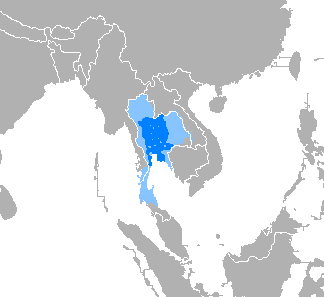
The Thai language is spoken by over 70 million people in Thailand as of 2024. Central Thai is the language of television, education, news reporting, and all forms of media. Most Thais in the northern (Lanna), the Southern (Tai) and the northeastern (Isan) parts of the country are therefore today bilingual in Central Thai and their own regional dialect. A study found that speakers of the Northern Thai language, also known as Phasa Mueang or Kham Mueang, have become few, most people in northern Thailand now speaking Standard Thai. They use mostly Central Thai words and only season their speech with the "Kham Mueang" accent. Standard Thai is based on the register of the educated classes by Central Thai and ethnic minorities in the area along the ring surrounding the Metropolis.
In addition to Central Thai, Thailand is home to other related Tai languages. Although most linguists classify these dialects as related but distinct languages, native speakers often identify them as regional variants or dialects of the "same" Thai language, or as "different kinds of Thai". As a dominant language in all aspects of society in Thailand, Thai initially saw gradual and later widespread adoption as a second language among the country's minority ethnic groups from the mid-late Ayutthaya period onward. Ethnic minorities today are predominantly bilingual, speaking Thai alongside their native language or dialect.
Classification
Standard Thai is classified as one of the Chiang Saen languages, the others being Northern Thai, Southern Thai and numerous smaller languages, which together with the Northwestern Tai and Lao-Phutai languages, form the Southwestern branch of Tai languages. The Tai languages are a branch of the Kra–Dai language family, which encompasses a large number of indigenous languages spoken in an arc from Hainan and Guangxi south through Laos and Northern Vietnam to the Cambodian border.
Standard Thai is the principal language of education and government and spoken throughout Thailand. The standard is based on the dialect of the central Thai people, and it is written in the Thai script.
Sign in to keep reading
7 more chapters are free with a Lably account.
History
Thai has undergone various historical sound changes. Some of the most significant changes occurred during the evolution from Old Thai to modern Thai. The Thai writing system has an eight-century history, and many of these changes, especially in consonants and tones, are evidenced in the modern orthography.
Early spread
According to the Ming dynasty Chinese source Yingya Shenglan (1405–1433) written by Ma Huan, the language of the Xiānluó (暹羅) or Ayutthaya Kingdom somewhat resembled the local patois pronounced in Guangdong. Ayutthaya, the capital of Thailand from 1351 to 1767 CE, was a bilingual society from its inception where both Thai and Khmer were spoken. This bilingualism was likely strengthened and maintained by the large number of Khmer-speaking captives the Thais relocated from Angkor Thom following their military victories in 1369, 1388, and 1431.
Toward the end of the Ayutthaya period Khmer fell out of everyday use and a language shift took place. Descendants of bilingual families came to use only Thai. Many Khmer elements passed into Thai during the shift, reaching every part of the language. The Thai of the late Ayutthaya period, which later became Rattanakosin or Bangkok Thai, was a thorough mixture of Thai and Khmer, with more Khmer words in use than Tai cognates. Khmer grammatical rules were used to coin new disyllabic and polysyllabic words and phrases, and Khmer expressions, sayings and proverbs were taken into Thai directly.
Thais borrowed and expanded their royal vocabulary (rajasap) using Khmer rules. They then developed it to suit their own cultural environment, drawing on Thai and on Pali, which came with Theravada Buddhism. An analysis of the Ayutthaya royal vocabulary found three elements, Thai, Khmer and Khmero-Indic, working closely together in formulaic expressions and in ordinary discourse. Because Indic elements had entered Khmer before Thai borrowed them, Khmero-Indic can be classified with Khmer.
The Mon contribution is harder to establish. Mathias Jenny holds that nothing conclusive can be said at the present state of research about structural Mon influence on Thai. He points instead to Christian Bauer's work on features of early Thai inscriptions and on lexical and grammatical items putatively borrowed from Mon. Where the evidence does not settle which language borrowed from which, as with dàan 'path' and sàphaan 'bridge', he leaves the direction open.
Bauer dated two of those loans from the sound changes each had to pass through. Thorahot (ทรหด) 'tough, unyielding' comes from Old Mon dirhat, and entered Thai no earlier than the 12th century and no later than the 15th. Thayae (ทะแย), a kind of song, is a Middle Mon loan that cannot have been taken up before the 13th century, which suggested to Bauer that Thai still had a voicing distinction after that date. The two donor languages can be hard to tell apart. Griswold and Prasert ṇa Nagara took karayā (กรยา), attested in an inscription of 1357, as a borrowing from Khmer; Bauer proposed Old Mon instead, allowing that the early Thai form his reading requires is still to be established. A Khmer loan in the same inscription, ปรยน parayana from Old Khmer paryyan, shows the same syllabified cluster in Early Thai. A second word is dated by its first appearance in the inscriptions. ขัน 'vessel, cup, for offerings' appears in 1369, spelt ขนน, and Bauer took it from Old Mon khal. He reports that Michel Ferlus, in conversation, preferred Old Khmer khan, and answers that no variation in vowel length is attested for the word in Khmer and none in Early Thai epigraphy.
Five of the eleven loans Bauer treats are grammatical markers, and one of the remaining six belongs to the core vocabulary. One of the eleven he assigned to Khmer rather than Mon, เฉพาะ 'especially', from Khmer chboḥ, attested in Middle Khmer. One he would not decide. ละ occurs in the Sukhothai corpus only in inscription 38, where the same text spells it three ways, and he held that its origin cannot be determined beyond its being either Khmer or Mon, the word having become obsolete in both. A core-vocabulary loan of the same kind is ทำ /tham/. Bauer took it and กระทำ /kraʔtham/ for doublets borrowed from Old Mon kindaṁ, attested since the 7th century and glossed by Shorto 'to perform, build, construct, make; rebuild'. Neither the simple base he reconstructs behind it nor its root is attested in Mon, and he argued for that base from a spoken Mon reflex of a related noun. Among the grammatical items he assigns to Mon is /chaʔ/ (จะ), in /chaʔ nán/ (จะนั้น) and /chaʔ níː/ (จะนี้) 'so, then, consequently'. He claims it for a Mon form that Shorto classes as a noun and that is attested only from Middle Mon in 1480. He reads /phrɔʔ chaʔ nán/ (เพราะจะนั้น) as a blend of Khmer /pruəh/ 'because' with the same element. The form is not attested in Epigraphic Thai.
The case Bauer makes for Mon influence beyond the lexicon rests on a single word. Early Thai sadāṁ, which occurs once in the whole Sukhothai corpus, he read as a blend of the Old Mon prefix s-, which marks the hypothetical, with Early Thai dāṁ. That verb is itself a doublet, borrowed from a Mon form attested only as the frequentative kindaṁ. At that one attestation the verb carries two markers of the same category, Early Thai cakk before it and the Mon prefix on it, which he took for interference rather than convergence. He set out seven environments in which the Mon prefix and cakk follow the same rule and called them an identical set of syntactic restrictions. He reached the Mon reading by elimination. No form in si-, sa- or s- is attested anywhere in the Thai epigraphic corpus, which rules out a Thai prefix, and a fossilised Mon cluster would have left a different Thai form. That negative rests on the whole Sukhothai corpus and on the north-eastern Thai corpus, and he noted that inscriptions from northern Thailand had not been comprehensively examined. Because the prefix occurs nowhere else, he suggested that the first language of that one writer may not have been Thai but Mon. He also displaced an explanation of Griswold and Prasert ṇa Nagara's. They had put the long periodic sentences of a Sukhothai inscription down to Maha Thammaracha I's familiarity with Sanskrit and Pali. Bauer answered that the same stacking of clauses is frequent in Old Mon and unknown in Khmer.
Old Thai
Old Thai had a three-way tone distinction on "live syllables" (those not ending in a stop), with no possible tonal distinction on "dead syllables" (those ending in a stop, i.e., either or the glottal stop that automatically closes syllables otherwise ending in a short vowel).
There was a two-way voiced versus voiceless distinction among all fricative and sonorant consonants, and up to a four-way distinction among stops and affricates. The maximal four-way distinction occurred in labials () and denti-alveolars (). A three-way distinction existed among velars () and palatals (), with the glottalized member of each set apparently missing.
The major change between Old and modern Thai was driven by the loss of the voicing distinction and the concomitant tone split. This transition likely occurred between 1300 and 1600 CE, possibly happening at different times across different parts of the Thai-speaking area. During this period, all voiced–voiceless pairs of consonants lost their voicing distinction:
- Plain voiced stops () became voiceless aspirated stops ().
- Voiced fricatives became voiceless.
- Voiceless sonorants became voiced.
However, in the process of these mergers, the former voicing distinction was transferred into a new set of tonal distinctions. Every tone in Old Thai split into two. The lower-pitched tone corresponds to a syllable that formerly began with a voiced consonant, the higher-pitched to one that formerly began with a voiceless consonant, glottalized stops included. An additional complication is that formerly voiceless unaspirated stops and affricates (original ) also caused original tone 1 to lower, but had no such effect on original tones 2 or 3.
The aforementioned consonant mergers and tone splits account for the complex relationship between spelling and sound in modern Thai. Modern "low"-class consonants were voiced in Old Thai, and the terminology "low" reflects the resulting lower tone variants. Modern "mid"-class consonants were voiceless unaspirated stops or affricates in Old Thai, precisely the class that triggered lowering in original tone 1 but not tones 2 or 3. Modern "high"-class consonants represent the remaining voiceless consonants in Old Thai (voiceless fricatives, voiceless sonorants, and voiceless aspirated stops).
The three most common tone "marks" (the lack of any tone mark, as well as the two marks termed mai ek and mai tho) represent the three original tones of Old Thai. The complex modern relationship between a tone mark and its actual tone is due to the various tonal changes that have occurred since then. Following the tone split, the tones shifted in their actual phonetic representation to the point where the former relationship between lower and higher tonal variants has been completely obscured. The six tones that resulted from the split have since merged into five in standard Thai. The lower variant of former tone 2 merged with the higher variant of former tone 3 to become the modern "falling" tone.
Old Thai (Sukhothai) consonant inventory
Historical Sukhothai pronunciation
Early Old Thai
Early Old Thai also apparently had velar fricatives as distinct phonemes. These were represented by the now-obsolete letters ฃ kho khuat and ฅ kho khon, respectively. During the Old Thai period, these sounds merged into the corresponding stops , causing the use of these letters to become unstable.
At some point in the history of Thai, an alveolo-palatal nasal phoneme also existed, inherited from Proto-Tai. The letter ญ yo ying is used to represent an alveolo-palatal nasal in words borrowed from Sanskrit and Pali; it is currently pronounced at the beginning of a syllable and at the end of a syllable. Most native Thai words reconstructed as beginning with are also pronounced in modern Thai, but they are generally spelled with ย yo yak, which consistently represents . This suggests that the shift of > in native words occurred in the pre-literary period. It remains unclear whether Sanskrit and Pali words beginning with were borrowed directly with a sound, or whether a was introduced and subsequently followed by a second change of > . The northeastern Thai dialect Isan and the Lao language still preserve the phoneme /ɲ/, which is represented in the Lao script by ຍ, as in the word ຍຸງ (, 'mosquito'). This letter is distinct from the phoneme and its Lao equivalent ຢ, seen in the word ຢາ (, 'medicine'). The orthographic distinction has been lost in informal written Isan using the Thai script, where both sounds are represented by ย .
Proto-Tai also featured a glottalized palatal sound, reconstructed as by Fang-Kuei Li (1977). Corresponding Thai words are generally spelled with หย, which implies an Old Thai pronunciation of (or ). However, a few such words are spelled อย, implying a pronunciation of and suggesting that the glottalization may have persisted into the early literary period.
Vowel developments
The vowel system of modern Thai contains nine pure vowels and three centering diphthongs, each of which can occur as short or long. According to Li (1977), however, many Tai languages possess only one such short–long pair (), and it is generally difficult or impossible to find minimal short–long pairs in Thai that involve vowels other than while maintaining consistent correspondences across the Tai family. More specifically, Li notes the following regarding Thai:
- In open syllables, only long vowels occur. (This assumes that all apparent cases of short open syllables are better described as ending in a glottal stop. This hypothesis is supported by the lack of tonal distinctions in such syllables, and the fact that a glottal stop is reconstructible across the Tai languages.)
- In closed syllables, the long high vowels are rare. Where they do exist, they typically correspond to diphthongs in other Tai languages.
- In closed syllables, both short and long mid and low vowels occur. Generally, however, only words with short and long can be traced back to Proto-Tai.
- Both of the mid back unrounded vowels () are rare, and words containing these sounds generally cannot be reconstructed back to Proto-Tai.
Furthermore, the vowel corresponding to the short Thai frequently has a different, often higher, quality in many Tai languages compared to the vowel corresponding to the Thai .
This evidence leads Li to posit the following:
- Proto-Tai had a system of nine pure vowels with no length distinction, possessing approximately the same qualities as modern Thai: high , mid , and low .
- All Proto-Tai vowels lengthened in open syllables, and low vowels also lengthened in closed syllables.
- Modern Thai largely preserved the original vowel lengths and qualities, but lowered to . This sound became short in closed syllables, thereby creating a phonemic length distinction between . Eventually, length became phonemic in all other vowels as well, and a new (both short and long) was introduced through a combination of borrowing and sound change. Li believes that the development of long from diphthongs, and the lowering of to to create a length distinction, had occurred by the time of Proto-Southwestern Tai, but the other missing modern Thai vowels had not yet developed.
Not all researchers agree with Li. Pittayaporn (2009), for example, reconstructs a similar system for Proto-Southwestern Tai but argues for the presence of a mid back unrounded vowel (which he transcribes as ), occurring only before final velar consonants (). He also argues that the Proto-Southwestern Tai vowel length distinctions can be traced back to similar distinctions in Proto-Tai.
Phonology
Consonants
Onset consonants ('Initials')
Standard Thai distinguishes three voice-onset times among plosive and affricate consonants:
English distinguishes voiced from voiceless aspirated . Thai has a third type of voicing, unaspirated , which occurs in English only as an allophone of , for example after as in the p of "spin". There is similarly a laminal denti-alveolar , , triplet in Thai. In the velar series there is a , pair and in the postalveolar series a , pair, without the corresponding voiced sounds and . (In loanwords from English, English and are borrowed as the tenuis stops and .) Among some younger speakers (such as younger female speakers from the Bangkok metropolitan area), postalveolar series are alveolar and . Among some older speakers (such as older speakers from Maeklong river basin), they can be stops and . That pronunciation is not standard. Voiced stops tend to vary from fully pulmonic to implosives. However, implosive pronunciation is rare among younger speakers due to standardization and influence of the standard dialect.
In each cell below, the first line indicates International Phonetic Alphabet (IPA), the second indicates the Thai characters in initial position. Note that several letters appearing in the same box have identical pronunciation. In such cases, one of the letters may serve as the "default", being more common and/or preferred for borrowings from English and such; for example, น in the case of "n" and ส for "s". The letter ห, the default "h" letter, is also used to help write certain tones (described below).
Coda consonants ('Finals')
As with many languages, there is a difference in the number of possibilities for coda consonants in Thai as compared to onset consonants. In Standard Thai, only nine consonants occur in coda position: /p t k ʔ m n ŋ j w/. Additionally, all plosive sounds are unreleased, so that syllable-final /p t k/ are pronounced as , , and respectively.
Of the consonant letters, excluding the disused ฃ and ฅ, six (ฉ ผ ฝ ห อ ฮ) cannot be used as a final and the other 36 are grouped as following.
Syllable structure and consonant clusters
In Thai, the maximal syllable shape is CCVC. In the core vocabulary (i.e. excluding loanwords), only clusters of two consonants occur, of which there are 11 combinations:
- (กร), (กล), (กว)
- (ขร, คร), (ขล, คล), (ขว, คว)
- (ปร), (ปล)
- (พร), (ผล, พล)
- (ตร)
The number of clusters increases in loanwords such as (ทร) in อินทรา (, from Sanskrit indrā) or (ฟร) in ฟรี (, from English free). These usually occur only in initial position, with , or as the second consonant and not more than two sounds at a time. In addition, ก may be Romanized as "g" and ป as "b" in those specific clusters to distinguish them from the corresponding aspirated stops.
Vowels
The vowel nuclei of the Thai language are given in the following table. The top entry in every cell is the symbol from the International Phonetic Alphabet. The second gives the spelling in the Thai script, where a dotted circle (◌) marks the position of the initial consonant after which the vowel is pronounced. A second dotted circle indicates that a final consonant follows.
Each vowel quality occurs in long–short pairs: these are distinct phonemes forming distinct words in Thai.
The long–short pairs are as follows:
There are also opening and closing diphthongs in Thai, which Tingsabadh & Abramson (1993) analyze as and . For purposes of determining tone, those marked with an asterisk are sometimes classified as long:
Additionally, there are three triphthongs. For purposes of determining tone, those marked with an asterisk are sometimes classified as long:
Tones
There are five phonemic tones: mid, low, falling, high, and rising, sometimes referred to in older reference works as rectus, gravis, circumflexus, altus, and demissus, respectively. The table shows an example of both the phonemic tones and their phonetic realization, in the IPA. Moren & Zsiga (2006) and Zsiga & Nitisaroj (2007) provide phonetic and phonological analyses of Thai tone realization.
Notes:
- Five-level tone value: Mid [33], Low [21], Falling [41], High [45], Rising [214]. Traditionally, the high tone was recorded as either [44] or [45]. This remains true for the older generation, but the high tone is changing to [334] among youngsters.
- For the diachronic changes of tone value, see Pittayaporn (2007).
- The full complement of tones exists only in so-called "live syllables", those that end in a long vowel or a sonorant ().
- For "dead syllables", those that end in a plosive () or in a short vowel, only three tonal distinctions are possible: low, high, and falling. Because syllables analyzed as ending in a short vowel may have a final glottal stop (especially in slower speech), all "dead syllables" are phonetically checked, and have the reduced tonal inventory characteristic of checked syllables.
Open ('unchecked') syllables
Closed ('checked') syllables
In some English loanwords, closed syllables with a long vowel ending in an obstruent sound have a high tone, and closed syllables with a short vowel ending in an obstruent sound have a falling tone.
Grammar
From the perspective of linguistic typology, Thai can be considered an analytic language. The word order is subject–verb–object, although the subject is often omitted. Additionally, Thai is an isolating language lacking any form of inflectional morphology whatsoever. Thai pronouns are selected according to the gender and relative status of speaker and audience.
Adjectives and adverbs
There is no morphological distinction between adverbs and adjectives. Many words can be used in either function. They follow the word they modify, which may be a noun, verb, or another adjective or adverb.
คน
khon
/
อ้วน
uan
/
'a fat person'
คน
khon
/
ที่
thi
อ้วน
uan
เร็ว
reo
/
'a person who becomes fat quickly'
Comparatives take the form "A X กว่า B" (kwa, ), 'A is more X than B'. The superlative is expressed as "A X ที่สุด" (thi sut, ), 'A is most X'.
เขา
khao
/
อ้วน
uan
กว่า
kwa
ฉัน
chan
/
'S/he is fatter than me.'
เขา
khao
/
อ้วน
uan
ที่สุด
thi sut
/
'S/he is the fattest (of all).'
Adjectives in Thai can be used as complete predicates. Because of this, many words used to indicate tense in verbs (see Verbs:Tense below) may be used to describe adjectives.
ฉัน
chan
/
หิว
hio
/
'I am hungry.'
ฉัน
chan
/
จะ
cha
หิว
hio
/
'I will be hungry.'
ฉัน
chan
/
กำลัง
kamlang
หิว
hio
/
'I am hungry right now.'
ฉัน
chan
/
หิว
hio
แล้ว
laeo
/
'I am already hungry.'
- Remark ฉันหิวแล้ว mostly means 'I am hungry right now' because normally, แล้ว () marks the change of a state, but แล้ว has many other uses as well. For example, in the sentence, แล้วเธอจะไปไหน (): 'So where are you going?', แล้ว () is used as a discourse particle.
Verbs
Verbs do not inflect. They do not change with person, tense, voice, mood, or number; nor are there any participles. The language being analytic and case-less, the relationship between subject, direct and indirect object is conveyed through word order and auxiliary verbs. Transitive verbs follow the pattern subject-verb-object.
ฉัน
chan
/
1SG
ตี
ti
hit
เขา
khao
/
3SG
'I hit him.'
เขา
khao
/
3SG
ตี
ti
hit
ฉัน
chan
/
1SG
'S/He hit me.'
In order to convey tense, aspect and mood (TAM), the Thai verbal system employs auxiliaries and verb serialization. TAM markers are however not obligatory and often left out in colloquial use. In such cases, the precise meaning is determined through context. This results in sentences lacking both TAM markers and overt context being ambiguous and subject to various interpretations.
ฉัน
chan
/
กิน
kin
ที่
thi
นั่น
nan
/
'I eat there.'
ฉัน
chan
/
กิน
kin
ที่
thi
นั่น
nan
เมื่อวาน
mueawan
/
'I ate there yesterday.'
ฉัน
chan
/
จะ
cha
กิน
kin
ที่
thi
นั่น
nan
พรุ่งนี้
phrungni
/
'I'll eat there tomorrow.'
The sentence chan kin thi nan can thus be interpreted as 'I am eating there', 'I eat there habitually', 'I will eat there' or 'I ate there'. Aspect markers in Thai have been divided into four distinct groups based on their usage. These markers could appear either before or after the verb. The following list describes some of the most commonly used aspect markers. A number of these aspect markers are also full verbs on their own and carry a distinct meaning. For example yu (อยู่) as a full verb means 'to stay, to live or to remain at'. However, as an auxiliary it can be described as a temporary aspect or continuative marker.
- Imperfective
- อยู่ yu
- ไป pai
- ยัง yang
- กำลัง kamlang
- เคย khoey
- Perfective
- ได้ dai
- Perfect
- แล้ว laeo
- มา ma
- Prospective/Future
- จะ cha
The imperfective aspect marker กำลัง (kamlang, , currently) is used before the verb to denote an ongoing action (similar to the -ing suffix in English). Kamlang is commonly interpreted as a progressive aspect marker. Similarly, อยู่ (yu, ) is a post-verbal aspect marker which corresponds to the continuative or temporary aspect.
เขา
khao
/
กำลัง
kamlang
วิ่ง
wing
/
เขา
khao
/
วิ่ง
wing
อยู่
yu
/
เขา
khao
/
กำลัง
kamlang
วิ่ง
wing
อยู่
yu
/
'He is running.'
Comparably, ยัง (yang, , still) is used in an incomplete action, and usually collocates with yu (อยู่) or any second marker in common use.
เขา
khao
/
ยัง
yang
เขียน
khian
อยู่
yu
/
He is still writing.
The marker ได้ (dai, ) is usually analyzed as a past tense marker when it occurs before the verb. As a full verb, dai means 'to get or receive'. However, when used after a verb, dai takes on a meaning of potentiality or successful outcome of the main verb.
เขา
khao
/
ได้
dai
ไป
pai
เที่ยว
thiao
เมือง
mueang
ลาว
lao
/
He visited Laos. (Past/Perfective)
เขา
khao
/
3SG
ตี
ti
hit
ได้
dai
/
POT
'He is/was allowed to hit' or 'He is/was able to hit.' (Potentiality)
แล้ว (laeo, ; 'already') is treated as a marker indicating the perfect aspect. That is to say, laeo marks the event as being completed at the time of reference. Laeo has two other meanings in addition to its use as a TAM marker. Laeo can either be a conjunction for sequential actions or an archaic word for 'to finish'.
เขา
khao
/
3SG
ได้
dai
PST
กิน
kin
/
eat
He ate.
เขา
khao
/
3SG
กิน
kin
eat
แล้ว
laeo
/
PRF
He has eaten.
เขา
khao
/
3SG
ได้
dai
PST
กิน
kin
eat
แล้ว
laeo
/
PRF
He's already eaten.
Future can be indicated by จะ (cha, ; 'will') before the verb or by a time expression indicating the future. For example:
เขา
khao
/
3SG
จะ
cha
FUT
วิ่ง
wing
/
run
'He will run' or 'He is going to run.'
Dative marker ให้ (hai, ; 'give') often used in a sentence to indicate prepositional or double objects.
เขา
khao
/
3SG
อ่าน
an
read
หนังสือ
nangsue
book
ให้
hai
/
DAT
'He reads book for (us).'
เขา
khao
/
3SG
ให้
hai
DAT
อ่าน
an
read
หนังสือ
nangsue
/
book
'He obligates (us) to read book.'
เขา
khao
/
3SG
ให้
hai
DAT
หนังสือ
nangsue
book
นักเรียน
nak rian
/
student
'He gives book to student.'
The passive voice is indicated by the insertion of ถูก (thuk, ) before the verb. For example:
เขา
khao
/
3SG
ถูก
thuk
PASS
ตี
ti
/
hit
'He got hit.'
The ถูก construction is traditionally an adversative passive, a feature common to many Southeast Asian languages where a passive construction is restricted to unfavorable meanings (e.g. "he was killed" but not "he was rewarded"), but in current usage is found with virtually all transitive verbs. This neutral usage first arose as an Anglicism as Thailand became Westernized in the early 20th century, but has since become pervasive. The adversative passive persists in the similar construction with โดน (don, ).
Negation is indicated by placing ไม่ (mai, ; not) before the verb.
- เขาไม่ตี, (khao mai ti) 'He is not hitting' or 'He doesn't hit'.
Thai exhibits serial verb constructions, where verbs are strung together. Some word combinations are common and may be considered set phrases.
เขา
khao
/
he
ไป
pai
go
กิน
kin
eat
ข้าว
khao
/
rice
'He went out to eat'
ฉัน
chan
/
I
ฟัง
fang
listen
ไม่
mai
not
เข้าใจ
khao chai
/
understand
'I don't understand what was said'
เข้า
khao
/
enter
มา
ma
/
come
'Come in'
ออก
ok
/
exit
ไป!
pai
/
go
'Leave!' or 'Get out!'
Nouns
Nouns are uninflected and have no gender; there are no articles. Thai nouns are bare nouns and can be interpreted as singular, plural, definite or indefinite. Some specific nouns are reduplicated to form collectives: เด็ก (dek, 'child') is often repeated as เด็ก ๆ (dek dek) to refer to a group of children. The word พวก (phuak, ) may be used as a prefix of a noun or pronoun as a collective to pluralize or emphasise the following word. (พวกผม, phuak phom, , 'we', masculine; พวกเรา phuak rao, , emphasised 'we'; พวกหมา phuak ma, '(the) dogs'). Plurals are expressed by adding classifiers, used as measure words (ลักษณนาม), in the form of noun-number-classifier:
ครู
khru
/
teacher
ห้า
ha
five
คน
khon
/
person
"five teachers"
While in English, such classifiers are usually absent ("four chairs") or optional ("two bottles of beer" or "two beers"), a classifier is almost always used in Thai (hence "chair four item" and "beer two bottle").
Possession in Thai is indicated by adding the word ของ (khong) in front of the noun or pronoun, but it may often be omitted. For example:
Nominal phrases
Nominal phrases in Thai often use a special class of words classifiers. As previously mentioned, these classifiers are obligatory for noun phrases containing numerals e.g.
ผู้หญิง
phuying
/
woman
สอง
song
two
คน
khon
/
CL
two women
Unlike any numeral, หนึ่ง ('one') can mark on both positions of classifier, but in different functions. The post-head one potentially marks a referent as indefinite article.
In the previous example khon (คน) acts as the classifier in the nominal phrase. This follows the form of noun-cardinal-classifier mentioned above. Classifiers are also required to form quantified noun phrases in Thai with some quantifiers such as ทุก ('all'), บาง ('some'). The examples below are demonstrated using the classifier khon, which is used for people.
However, classifiers are not utilized for negative quantification. Negative quantification is expressed by the pattern ไม่มี (mai mi, ) + NOUN.
Demonstratives
Thai has a three-way distinction for its demonstratives: proximal นี่ (ni, ; 'this/these'), medial นั่น (nan, ; 'that/those'), and distal โน่น (non, ; 'that/those over there') which is rarely used. The tone is changed depending on usage: as a pronoun, the proximal demonstrative is นี่ (ni, ); while นี้ (ni, ) is a modifier placed after nouns, prepositions, classifiers, etc. For example:
นี่
ni
/
this-PRO
คือ
kheu
be
โต๊ะ
to
table
ใหม่
mai
/
new
"this is a new table"
วาง
wang
/
put down
ถ้วย
thuai
bowl
บน
bon
on
นั้น
nan
/
that-PREP
"put a bowl on there"
The word ไหน (nai, ) plays the role of an interrogative determiner or pronoun.
The syntax for demonstrative phrases, however, differ from that of cardinals and follow the pattern noun-classifier-demonstrative. For example, the noun phrase "this dog" would be expressed in Thai as หมาตัวนี้ (literally 'dog (classifier) this').
Pronouns
Subject pronouns are often omitted, with nicknames used where English would use a pronoun. See Thai name#Nicknames for more details. Pronouns, when used, are ranked in honorific registers, and may also make a T–V distinction in relation to kinship and social status. Specialised pronouns are used for royalty, and for Buddhist monks. The following are appropriate for conversational use:
The reflexive pronoun is ตัวเอง (tua eng), which can mean any of: myself, yourself, ourselves, himself, herself, themselves. This can be mixed with another pronoun to create an intensive pronoun, such as ตัวผมเอง (tua phom eng, lit: I myself) or ตัวคุณเอง (tua khun eng, lit: you yourself). Thai also does not have a separate possessive pronoun. Instead, possession is indicated by the particle ของ (khong). For example, "my mother" is แม่ของผม (mae khong phom, lit: mother of I). This particle is often implicit, so the phrase is shortened to แม่ผม (mae phom). Plural pronouns can be easily constructed by adding the word พวก (phuak) in front of a singular pronoun as in พวกเขา (phuak khao) meaning 'they' or พวกเธอ (phuak thoe) meaning the plural sense of 'you'. The only exception to this is เรา (rao), which can be used as singular (informal) or plural, but can also be used in the form of พวกเรา (phuak rao), which is only plural.
Thai has many more pronouns than those listed above. Their usage is full of nuances. For example:
- "ผม เรา ฉัน ดิฉัน หนู กู ข้า กระผม ข้าพเจ้า กระหม่อม อาตมา กัน ข้าน้อย ข้าพระพุทธเจ้า อั๊ว เขา" all translate to "I", but each expresses a different gender, age, politeness, status, or relationship between speaker and listener.
- เรา (rao) can be first person (I), second person (you), or both (we), depending on the context.
- Children or younger women could use or be referred by word หนู (nu) when talking with an older person. The word หนู could be both feminine first person (I) and feminine second person (you) and also neuter first and neuter second person for children.
- หนู commonly means rat or mouse, though it also refers to small creatures in general.
- The second person pronoun เธอ (thoe) (lit: you) is semi-feminine. It is used only when the speaker or the listener (or both) are female. Males usually do not address each other by this pronoun.
- Both คุณ (khun) and เธอ (thoe) are polite neuter second person pronouns. However, คุณเธอ (khun thoe) is a feminine derogative third person.
- Instead of a second person pronoun such as คุณ ('you'), it is much more common for unrelated strangers to call each other พี่ น้อง ลุง ป้า น้า อา ตา or ยาย (brother, sister, aunt, uncle, granny).
- To express deference, the second person pronoun is sometimes replaced by a profession, similar to how, in English, presiding judges are always addressed as "your honor" rather than "you". In Thai, students always address their teachers by ครู, คุณครู or อาจารย์ (each meaning 'teacher') rather than คุณ ('you'). Teachers, monks, and doctors are almost always addressed this way.
Particles
The particles are often untranslatable words added to the end of a sentence to indicate respect, a request, encouragement or other moods (similar to the use of intonation in English), as well as varying the level of formality. They are not used in elegant (written) Thai. The most common particles indicating respect are ครับ (khrap, , with a high tone) when the speaker is a man, and ค่ะ (kha, , with a falling tone) when the speaker is a woman. Used in a question or a request, the particle ค่ะ (falling tone) is changed to a คะ (high tone).
Other common particles are:
Register
Central Thai is composed of several distinct registers, forms for different social contexts:
- Street or Common Thai (ภาษาพูด, phasa phut, spoken Thai): informal, without polite terms of address, as used between close relatives and friends.
- Elegant or Formal Thai (ภาษาเขียน, phasa khian, written Thai): official and written version, includes respectful terms of address; used in simplified form in newspapers.
- Rhetorical Thai: used for public speaking.
- Religious Thai: (heavily influenced by Sanskrit and Pāli) used when discussing Buddhism or addressing monks.
- Royal Thai (ราชาศัพท์, racha sap): influenced by Khmer, this is used when addressing members of the royal family or describing their activities. (See Monarchy of Thailand § Rachasap.)
Most Thais can speak and understand all of these contexts. Street and Elegant Thai are the basis of all conversations. Rhetorical, religious, and royal Thai are taught in schools as part of the national curriculum.
As noted above, Thai has several registers, each having certain usages, such as colloquial, formal, literary, and poetic. Thus, the word 'eat' can be กิน (kin; common), แดก (daek; vulgar), ยัด (yat; vulgar), บริโภค (boriphok; formal), รับประทาน (rapprathan; formal), ฉัน (chan; religious), or เสวย (sawoei; royal), as illustrated below:
Thailand also uses the distinctive Thai six-hour clock in addition to the 24-hour clock.
Vocabulary
Other than compound words and words of foreign origin, most words are monosyllabic.
Chinese-language influence was strong until the 13th century when the use of Chinese characters was abandoned, and replaced by Sanskrit and Pali scripts. However, the vocabulary of Thai retains many words borrowed from Middle Chinese.
Khmer was used as a prestige language in the early days of the Thai kingdoms which are believed to have been bilingual societies proficient in Thai and Khmer. There are over 2,500 Thai words derived from Khmer and half of the vocabulary are of Pali and Sanskrit origin that Thai borrowed via Khmer, surpassing the number of Tai cognates. These Khmer words span across all semantic fields. Thai scholar Uraisi Varasarin classified them into over 200 sub-categories. As a result, it is impossible for Thais, past and present, to engage in a conversation without incorporating Khmer loanwords in any given topic. The influence is particularly preponderant in regard to royal court terminology.
Later, most vocabulary was borrowed from Sanskrit and Pali; Buddhist terminology is particularly indebted to these. Indic words have a more formal register, and may be compared to Latin and French borrowings in English. Since the beginning of the 20th century, however, the English language has had the greatest influence, especially for scientific, technical, international, and other modern terms.
Arabic-origin
Chinese-origin
From Middle Chinese or Teochew Chinese.
English-origin
French-origin
Japanese-origin
Khmer-origin
From Old Khmer
Malay-origin
Mon-origin
From Old Mon and Middle Mon, in Christian Bauer's transcriptions.
Persian-origin
Portuguese-origin
The Portuguese were the first Western nation to arrive in what is modern-day Thailand in the 16th century during the Ayutthaya period. Their influence in trade, especially weaponry, allowed them to establish a community just outside the capital and practise their faith, as well as exposing and converting the locals to Christianity. Thus, Portuguese words involving trade and religion were introduced and used by the locals.
Tamil-origin
Writing system
Thai is written in the Thai script, an abugida written from left to right. The language and its script are closely related to the Lao language and script. Most literate Lao are able to read and understand Thai, as more than half of the Thai vocabulary, grammar, intonation, vowels and so forth are common with the Lao language.
The Thais adopted and modified the Khmer script to create their own writing system. While in Thai the pronunciation can largely be inferred from the script, the orthography is complex, with silent letters to preserve original spellings and many letters representing the same sound. While the oldest known inscription in the Khmer language dates from 611 CE, inscriptions in Thai writing began to appear around 1292 CE. Notable features include:
- It is an abugida script, in which the implicit vowel is a short in a syllable without final consonant and a short in a syllable with final consonant.
- Tone markers, if present, are placed above the final onset consonant of the syllable.
- Vowels sounding after an initial consonant can be located before, after, above or below the consonant, or in a combination of these positions.
Transcription
There is no universally applied method for transcribing Thai into the Latin alphabet. For example, the name of the main airport is transcribed variably as Suvarnabhumi, Suwannaphum, or Suwunnapoom. Guide books, textbooks and dictionaries follow different systems. For this reason, many language courses recommend that learners master the Thai script.
Official standards are the Royal Thai General System of Transcription (RTGS), published by the Royal Institute of Thailand, and the almost identical ISO 11940-2 defined by the International Organization for Standardization. The RTGS system is increasingly used in Thailand by central and local governments, especially for road signs. Its main drawback is that it does not indicate tone or vowel length. As the system is based on pronunciation, not orthography, reconstruction of Thai spelling from RTGS romanisation is not possible.
Transliteration
The ISO published an international standard for the transliteration of Thai into Roman script in September 2005 (ISO 11940). By adding diacritics to the Latin letters it makes the transcription reversible, making it a true transliteration. Notably, this system is used by Google Translate, although it does not seem to appear in many other contexts, such as textbooks and other instructional media.
Sample text
Article 1 of the Universal Declaration of Human Rights in Thai:
- Thai language in Thai Script
- มนุษย์ทั้งหลายเกิดมามีอิสระและเสมอภาคกันในเกียรติศักด[เกียรติศักดิ์]และสิทธิ ต่างมีเหตุผลและมโนธรรม และควรปฏิบัติต่อกันด้วยเจตนารมณ์แห่งภราดรภาพ
- Transliteration (RTGS)
- manut thang-laai koet-ma mi itsara lae samoephak kan nai kiattisak lae sitthi. tang mi hetphon lae manotham, lae khuan patibat to kan duai chettanarom haeng pharadonphap.
- Transliteration (Paiboon)
- mā-nút táng-lǎai gɤ̀ɤt-māa mīi ìt-sā-rà lɛ́ sā-mɤ̂ɤ-pâak gān nāi gìat-dtī-sàk lɛ́ sìt-tí. dtàang mīi hèt-pǒn lɛ́ mā-nōo-tām, lɛ́ kuān bpā-dtī-bàt dtɔ̀ɔ gān dûai jèet-dtā-nāa-rōm hɛ̀ng pā-rāa-dɔ̄ɔn-pâap.
- Transcription (IPA)
Article 1 of the Universal Declaration of Human Rights in English:
- Translation
- All human beings are born free and equal in dignity and rights. They are endowed with reason and conscience and should act towards one another in a spirit of brotherhood.