

Sea Peoples
Purported ancient tribal confederation of the Late Bronze Age
- 17 min read
- 4 chapters

Related on Lably
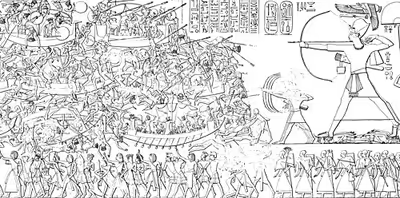
The modern concept of the Sea People originates in the work of the 19th-century Egyptologists Emmanuel de Rougé and Gaston Maspero, who drew on primary texts such as the reliefs on the Mortuary Temple of Ramesses III at Medinet Habu. Subsequent research developed their interpretation further, attempting to link these sources to other Late Bronze Age evidence of migration, piracy, and destruction. In early scholarship, the Sea Peoples were often regarded as a primary cause of the Bronze Age Collapse but recent work tends to view them as refugees fleeing a crisis which was already in motion.
History of the concept
The concept of the Sea Peoples was proposed by Emmanuel de Rougé, curator of the Louvre, in his 1855 work Note on Some Hieroglyphic Texts Recently Published by Mr. Greene, as an interpretation of the battles of Ramesses III described on the Second Pylon at Medinet Habu, based upon recent photographs of the temple by John Beasley Greene. De Rougé noted that "in the crests of the conquered peoples the Sherden and the Teresh bear the designation of the peuples de la mer (Sea Peoples)", in a reference to the prisoners depicted at the base of the Fortified East Gate. In 1867, de Rougé published his Excerpts of a dissertation on the attacks directed against Egypt by the peoples of the Mediterranean in the 14th century BC, which focused primarily on the battles of Ramesses II and Merneptah and which proposed translations for many of the geographic names included in the hieroglyphic inscriptions. De Rougé later became chair of Egyptology at the Collège de France and was succeeded by Gaston Maspero. Maspero built upon de Rougé's work and published The Struggle of the Nations, in which he described the theory of the seaborne migrations in detail in 1895–96 for a wider audience, at a time when the idea of population migrations would have felt familiar to the general population.
The migration theory was taken up by other scholars such as Eduard Meyer and became the generally accepted theory amongst Egyptologists and Orientalists. Since the early 1990s, however, it has been brought into question by a number of scholars.
The historical narrative stems primarily from seven Ancient Egyptian sources. Although in these inscriptions the designation "of the sea" does not appear in relation to all of these peoples, the term "Sea Peoples" is commonly used in modern publications to refer to the nine peoples.
Sign in to keep reading
3 more chapters are free with a Lably account.
Primary documentary records
The Medinet Habu inscriptions, from which the Sea Peoples concept was first described, remain the primary source and "the basis of virtually all significant discussions of them".
List of Sea Peoples
Three separate narratives from Egyptian records refer to more than one of the nine peoples, found in a total of six sources. The seventh and most recent source referring to more than one of the nine peoples is a list (Onomasticon) of 610 entities, rather than a narrative. These sources are summarized in the table below.
Ramesses II narrative
Possible records of sea peoples generally or in particular date to two campaigns of Ramesses II, a pharaoh of the militant 19th Dynasty: operations in or near the delta in the second year of his reign and the major confrontation with the Hittite Empire and allies at the Battle of Kadesh in his fifth. The years of this long-lived pharaoh's reign are not known exactly, but they must have comprised nearly all of the first half of the 13th century BC.
In his Second Year, an attack of the Sherden, or Shardana, on the Nile Delta was repulsed and defeated by Ramesses, who captured some of the pirates. The event is recorded on Tanis Stele II. An inscription by Ramesses II on the stela from Tanis which recorded the Sherden raiders' raid and subsequent capture speaks of the continuous threat they posed to Egypt's Mediterranean coasts:
the unruly Sherden whom no one had ever known how to combat, they came boldly sailing in their warships from the midst of the sea, none being able to withstand them.
The Sherden prisoners were subsequently incorporated into the Egyptian army for service on the Hittite frontier by Ramesses and fought as Egyptian soldiers in the Battle of Kadesh. Another stele source is the "Aswan Stele" (one of several stelae at Aswan), which mentions the king's operations to defeat a number of peoples including those of the "Great Green" (the Egyptian name for the Mediterranean).
The Battle of Kadesh was the climax of a campaign against the rival Hittite Empire and their allies in the Levant in the pharaoh's Year 5. Ramesses divided his Egyptian forces, which were then ambushed piecemeal by the Hittite army and nearly defeated, but Ramesses managed to recover and fight to a stalemate. Ramesses left inscriptions and depictions of his victory which survive on temples at Abydos, Karnak, Luxor and Abu Simbel. The "Poem of Pentaur", describing the battle, has also survived.
The poem relates that the previously captured Sherden were not only fighting for the Pharaoh but also involved in strategy: it was their idea to divide Egyptian forces into four columns. There is no evidence in Ramesses' inscriptions of any Sherden disloyalty or collaboration with the Hittites.
The poem also lists the Hittite allies who fought at Kadesh, among them some of the sea peoples spoken of in other Egyptian inscriptions who would later take part in the great migrations of the 12th century BC (see Appendix A to the Battle of Kadesh).
Merneptah narrative
The major event of the reign of the Pharaoh Merneptah (1213–1203 BC), 4th king of the 19th Dynasty, was his battle at Perire in the western delta in the 5th and 6th years of his reign, against a confederacy termed "the Nine Bows". Depredations of this confederacy had been so severe that the region was "forsaken as pasturage for cattle, it was left waste from the time of the ancestors".
The pharaoh's action against them is attested in a single narrative found in three sources. The most detailed source describing the battle is the Great Karnak Inscription; two shorter versions of the same narrative are found in the "Athribis Stele" and the "Cairo Column". The "Cairo column" is a section of a granite column now in the Cairo Museum, which was first published by Maspero in 1881 with just two readable sentences – the first confirming the date of Year 5 and the second stating: "The wretched [chief] of Libya has invaded with ——, being men and women, Shekelesh (S'-k-rw-s) ——". The "Athribis stela" is a granite stela found in Athribis and inscribed on both sides, which like the Cairo column, was first published by Maspero two years later in 1883. The Merneptah Stele from Thebes describes the reign of peace resulting from the victory but does not include any reference to the Sea Peoples.
The Nine Bows were acting under the leadership of the king of Libya and an associated near-concurrent revolt in Canaan involving Gaza, Ascalon, Yenoam and the Israelites. Exactly which peoples were consistently in the Nine Bows is not clear, but present at the battle were the Libyans, some neighboring Meshwesh, and possibly a separate revolt in the following year involving peoples from the eastern Mediterranean, including the Kheta (or Hittites), or Syrians, and (in the Israel Stele) for the first time in history, the Israelites. In addition to them, the first lines of the Karnak inscription include some sea peoples, which must have arrived in the Western Delta or from Cyrene by ship:
[Beginning of the victory that his majesty achieved in the land of Libya] -i, Ekwesh, Teresh, Lukka, Sherden, Shekelesh, Northerners coming from all lands.
Later in the inscription Merneptah receives news of the attack:
... the third season, saying: "The wretched, fallen chief of Libya, Meryey, son of Ded, has fallen upon the country of Tehenu with his bowmen – Sherden, Shekelesh, Ekwesh, Lukka, Teresh, Taking the best of every warrior and every man of war of his country. He has brought his wife and his children – leaders of the camp, and he has reached the western boundary in the fields of Perire"
"His majesty was enraged at their report, like a lion", assembled his court and gave a rousing speech. Later, he dreamed he saw Ptah handing him a sword and saying, "Take thou (it) and banish thou the fearful heart from thee." When the bowmen went forth, says the inscription, "Amun was with them as a shield." After six hours, the surviving Nine Bows threw down their weapons, abandoned their baggage and dependants, and ran for their lives. Merneptah states that he defeated the invasion, killing 6,000 soldiers and taking 9,000 prisoners. To be sure of the numbers, among other things, he took the penises of all uncircumcised enemy dead and the hands of all the circumcised, from which history learns that the Ekwesh were circumcised, a fact causing some to doubt they were Greek.
Ramesses III narrative
A number of primary sources about the Sea Peoples pertain to the reign of Ramesses III, who reigned from 1186 to 1155 BC. The battles were later recorded in two long inscriptions from his Medinet Habu mortuary temple, which are physically separate and somewhat different from one another. The Year 8 campaign is the best-recorded Sea Peoples invasion.
The fact that several civilizations collapsed around 1175 BC has led to the suggestion that the Sea Peoples may have been involved at the end of the Hittite, Mycenaean and Mitanni kingdoms.
A terminus ante quem for the destruction of the Hittite empire has been recognized in an inscription carved at Medinet Habu in Egypt in the eighth year of Ramesses III (1175 BC). This text narrates a contemporary great movement of peoples in the eastern Mediterranean, as a result of which "the lands were removed and scattered to the fray. No land could stand before their arms, from Hatti, Kode, Carchemish, Arzawa, Alashiya on being cut off. [ie: cut down]"
Ramesses' comments about the scale of the Sea Peoples' onslaught in the eastern Mediterranean are confirmed by the destruction of the states of Hatti, Ugarit, Ascalon and Hazor around this time. As the Hittitologist Trevor Bryce observes, "It should be stressed that the invasions were not merely military operations, but involved the movements of large populations, by land and sea, seeking new lands to settle."
This situation is confirmed by the Medinet Habu temple reliefs of Ramesses III which show that "the Peleset and Tjekker warriors who fought in the land battle [against Ramesses III] are accompanied in the reliefs by women and children loaded in ox-carts."
The inscriptions of Ramesses III at Medinet Habu record three victorious campaigns against the Sea Peoples that are considered bona fide, in Years 5, 8 and 12, as well as three considered spurious, against the Nubians and Libyans in Year 5 and the Libyans with Asiatics in Year 11. During Year 8, some Hittites were operating with the Sea Peoples.
The inner west wall of the second court describes the invasion of Year 5. Only the Peleset and Tjeker are mentioned, but the list is lost in a lacuna. The attack was two-pronged, one by sea and one by land. That is, the Sea Peoples divided their forces. Ramesses was waiting in the Nile mouths and trapped the enemy fleet there. The land forces were defeated separately.
The Sea Peoples attacked again Year 8 with a similar result. The campaign is recorded more extensively on the inner northwest panel of the first court. It is possible, but not generally believed, that the dates are only those of the inscriptions and both refer to the same campaign.
In Ramesses' Year 8, the Nine Bows appear as a "conspiracy in their isles". This time, they are revealed unquestionably as Sea Peoples: the Peleset, Tjeker, Shekelesh, Denyen and Weshesh, which are classified as "foreign countries" in the inscription. They camped in Amor and sent a fleet to the Nile.
He had built a fleet especially for the occasion, hidden it in the mouths of the Nile, and posted coast watchers. The enemy fleet was ambushed there, their ships overturned, and the men dragged up on shore and executed ad hoc.
The land army was also routed within Egyptian controlled territory. Additional information is given in the relief on the outer side of the east wall. This land battle occurred in the vicinity of Djahy against "the northern countries". When it was over, several chiefs were captive: of Hatti, Amor and Shasu among the "land peoples" and the Tjeker, "Sherden of the sea", "Teresh of the sea" and Peleset or Philistines.
The campaign of Year 12 is attested by the Südstele found on the south side of the temple. It mentions the Tjeker, Peleset, Denyen, Weshesh and Shekelesh.
Papyrus Harris I of the period, found behind the temple, suggests a wider campaign against the Sea Peoples but does not mention the date. In it, the persona of Ramses III says, "I slew the Denyen (D'-yn-yw-n) in their isles" and "burned" the Tjeker and Peleset, implying a maritime raid of his own. He also captured some Sherden and Weshesh "of the sea" and settled them in Egypt. As he is called the "Ruler of Nine Bows" in the relief of the east side, these events probably happened in Year 8; i.e. the Pharaoh would have used the victorious fleet for some punitive expeditions elsewhere in the Mediterranean.
The Rhetorical Stela to Ramesses III, Chapel C, Deir el-Medina records a similar narrative.
Onomasticon of Amenope
The Onomasticon of Amenope, or Amenemipit (amen-em-apt), gives slight credence to the idea that the Ramesside kings settled the Sea Peoples in Canaan. Dated to about 1100 BC (at the end of the 22nd dynasty) this document simply lists names. After six place names, four of which were in Philistia, the scribe lists the Sherden (Line 268), the Tjeker (Line 269) and the Peleset (Line 270), who might be presumed to occupy those cities. The Story of Wenamun on a papyrus of the same cache also places the Tjeker in Dor at that time. The fact that the Biblical maritime Tribe of Dan was initially located between the Philistines and the Tjekker, has prompted some to suggest that they may have originally been Denyen. Sherden seem to have been settled around Megiddo and in the Jordan Valley, and Weshesh (connected by some with the Biblical tribe of Asher) may have been settled further north.
Other documentary records
Egyptian single-name sources
Other Egyptian sources refer to one of the individual groups without reference to any of the other groups.
The Amarna letters, around the mid-14th century BC, including four relating to the Sea Peoples:
- EA 151 refers to the Denyen, in a passing reference to the death of their king;
- EA 38 refers to the Lukka, who are being accused of attacking the Egyptians in conjunction with the Alashiyans (Cypriotes), with the latter having stated that the Lukka were seizing their villages.
- EA 81, EA 122 and EA 123 refer to the Sherden. The letters at one point refer to a Sherden man as an apparent renegade mercenary, and at another point to three Sherden who are slain by an Egyptian overseer.
Padiiset's Statue refers to the Peleset, the Cairo Column refers to the Shekelesh, the Story of Wenamun refers to the Tjekker, and 13 further Egyptian sources refer to the Sherden.
Byblos
The earliest ethnic group later considered among the Sea Peoples is believed to be attested in Egyptian hieroglyphs on the Abishemu obelisk found in the Temple of the Obelisks at Byblos by Maurice Dunand. The inscription mentions kwkwn son of rwqq- (or kukun son of luqq), transliterated as Kukunnis, son of Lukka, "the Lycian". The date is given variously as 2000 or 1700 BC.
Ugarit
Some Sea Peoples appear in four of the Ugaritic texts, the last three of which seem to foreshadow the destruction of the city around 1180 BC. The letters are therefore dated to the early 12th century. The last king of Ugarit was Ammurapi (c. 1191–1182 BC), who, throughout this correspondence, is quite a young man.
- RS 34.129, the earliest letter, found on the south side of the city, from "the Great King", presumably Suppiluliuma II of the Hittites, to the prefect of the city. He says that he ordered the king of Ugarit to send him Ibnadushu for questioning, but the king was too immature to respond. He, therefore, wants the prefect to send the man, whom he promises to return. What this language implies about the relationship of the Hittite empire to Ugarit is a matter of interpretation. Ibnadushu had been kidnapped by and had resided among a people of Shikala, probably the Shekelesh, "who lived on ships". The letter is generally interpreted as an interest in military intelligence by the king.
- RS L 1, RS 20.238 and RS 20.18, are a set from the Rap'anu Archive between a slightly older Ammurapi, now handling his own affairs, and Eshuwara, the grand supervisor of Alasiya. Evidently, Ammurapi had informed Eshuwara, that an enemy fleet of 20 ships had been spotted at sea. Eshuwara wrote back and inquired about the location of Ammurapi's own forces. Eshuwara also noted that he would like to know where the enemy fleet of 20 ships are now located. Unfortunately for both Ugarit and Alasiya, neither kingdom was able to fend off the Sea People's onslaught, and both were ultimately destroyed. A letter by Ammurapi (RS 18.147) to the king of Alasiya—which was in fact a response to an appeal for assistance by the latter—has been found by archaeologists. In it, Ammurapi describes the desperate plight facing Ugarit. Ammurapi, in turn, appealed for aid from the viceroy of Carchemish, which actually survived the Sea People's onslaught; King Kuzi-Teshub I, who was the son of Talmi-Teshub—a direct contemporary of the last ruling Hittite king, Suppiluliuma II—is attested in power there, running a mini-empire which stretched from "Southeast Asia Minor, North Syria ... [to] the west bend of the Euphrates" from c. 1175 BC to 990 BC. Its viceroy could only offer some words of advice for Ammurapi.
Groups
The list of Sea Peoples groups include some which are securely identified and others which are not.
Lukka
The Lukka people are known from numerous other Hittite and ancient Egyptian records. While the Lukka lands were located in the later region of Lycia, Lukka people appear to have been highly mobile. The Lukka were never a unified kingdom, instead having a decentralized political structure. The Lukka people were famously fractious, with Hittite and Egyptian records describing them as raiders, rebels, and pirates. Lukka people fought against the Hittites as part of the Assuwa confederation, and later fought for the Hittites in the Battle of Kadesh.
Karkiya
Karkiya was a region in western Anatolia known from references in Hittite and Egyptian records. Karkiya was governed by a council of chiefs rather than a king, and was not a unified political entity. The Karkiyans had relations with the Hittite Empire, but were never part of the empire proper. Relations with the Hittites had ups and downs, and Karkiyan soldiers fought for the Hittites at the Battle of Kadesh, most likely as mercenaries. The name has been argued to be related to later terms for Caria, though the linguistic connection is not certain.
Peleset
Historians generally identify the Peleset with the later Philistines. The Peleset are generally regarded as originating somewhere within the Aegean cultural area; evidence for this identification comes from Genesis 10:14, which associates the Philistines with Caphtor and Casluhim, and Deuteronomy 2:23, which mentions the Caphtorim settling in Gaza. Aegean-style material remains such as Philistine Bichrome ware, as well as genetic evidence suggest that immigrants from Europe settled in sites such as Ashkalon at the beginning of the Iron Age. Both genetic and archaeological evidence suggests that any newcomers quickly acculturated and intermarried with local populations.
Shekelesh
The Shekelesh appear in the earlier Great Karnak Inscription, where they are described as auxiliary troops of the Libyan ruler Meryey. In the inscription, the Pharaoh Merneptah claims that he killed between 200 and 222 of them. They may also appear in Hittite records as the seafaring Shikalayu (Hittite: 𒅆𒅗𒆷𒅀𒌋 ši-ka-la-ia/u-u), though this connection is speculative. It has been hypothesized that the Shekelesh have some connection to Sicily, though evidence is sparse, and proposals vary as to whether Sicily was their original homeland, or if they settled there after the Bronze Age.
Sherden
The Sherden are previously mentioned in the records of Ramesses II, who claimed to have defeated them in his second year (1278 BC) when they attempted to raid Egypt's coast. The pharaoh subsequently incorporated many of them into his personal guard. They may also appear in the Amarna Letters, with their name rendered in Akkadian as "še-er-ta-an-nu". Based on onomastic similarities, similar weapons, presence in the same places of the Mediterranean and similar relationships with other peoples there, and other analysis of historical and archaeological sources, some archaeologists have proposed to identify the Sherden with the Nuragic civilization of Sardinia. Potential further evidence for this position comes from 12th century Nuragic pottery found at Pyla-Kokkinokremos, a fortified settlement in Cyprus.
Weshesh
The Weshesh are the most sparsely attested among the Sea People. They are only found in documents pertaining to the reign of Ramesses III, and no visual representation of them has ever been identified.
Ekwesh and Denyen
The Ekwesh and the Denyen have been tentatively identified with the Ancient Greek ethnonyms Ἀχαι(ϝ)οί, (Achai(w)oí) and Δαναοί, (Danaoí), which are attested in the Homeric epics.
Tjeker
The Tjeker are commonly known from the Story of Wenamun but also took part in the Battle of Perire against the Egyptians along with the Battle of the Delta under the rule of Ramesses III. They are thought to have settled along the coasts of early Palestine and to have been the people who developed Tel Dor from a town to a larger city. Much like other groups, their origins are unknown, though some historians have suggested they could have originated from Zakros, Crete, or that they may have originated from the Teucri tribe that roamed northwest Anatolia to the south of Troy, though this has been dismissed as "pure speculation" by Trevor Bryce.