

Trumpism
American right-wing to far-right populist political ideology
- 65 min read
- 9 chapters

Related on Lably
Through Ideology and President of the United States
Trumpism has been characterized by scholars as having authoritarian leanings, and has been associated with the belief that the president is above the rule of law. It has been referred to as an American political variant of the populist, radical right and the far-right, as well as the national-populist and neo-nationalist sentiment seen in multiple nations starting in the mid–late 2010s. Trump's political base has been compared to a cult of personality.
Over the course of the late 2010s and early 2020s, Trump supporters became the largest faction of the Republican Party, with the remainder often characterized as "the elite", "the establishment", or "Republican in name only" (RINO) in contrast. In response to these developments, many American conservatives opposed to Trumpism formed the Never Trump movement which opposes Trump and his political practices, often advocating to achieve a more traditional Republican Party.
Background and context
Some political scientists have attempted to explain support for Trumpism from a societal perspective and in the broader context of a wave of right-wing populism that came to prominence in the 2010s, underpinning Brexit and Trump's 2016 election. Theories cited by scholars include the "left behind" thesis that posits that the rise of right-wing populism in the West finds its roots in individuals or communities that feel that they have been neglected by the development of society and political decision-makers. Trends of globalization and deindustrialization have been identified by scholars as having contributed to economic and social deprivation that underpins this theorized phenomenon.
Some American scholars characterize the left behind thesis as a growing divergence between so-called "brain hubs" and "superstar cities" at one extreme and former manufacturing cities that have lost jobs and residents at the other. Others characterize the problem as being a divergence between regions that have enjoyed the benefits of globalization and technological advance and those that have borne the brunt of disruptive impacts related to these phenomena. A contested characterization of the left behind thesis is as a cultural backlash to long-term structural changes in gender equality, urban growth, education, immigration, economic instability, and terrorist attacks. The left behind theory has been supported and disputed by scholars and empirical research.
Eric Kaufmann's Whiteshift describes a Western societal trend in the 21st century that he says is perceived to be eroding white ethnic identity. He argues that Whiteshift and a progressive trope celebrating the projected demise of white majorities have been responsible for much of the reactionary populism since 2015. Kaufmann's thesis was criticised by Kenan Malik for omitting social context that Malik asserts is key to understanding politics.
Sign in to keep reading
8 more chapters are free with a Lably account.
Themes
Trumpism emerged during Trump's 2016 presidential campaign. Trump's rhetoric has its roots in a populist political method that suggests nationalistic answers to political, economic, and social problems. They are more specifically described as right-wing populist. Policies include immigration restrictionism, trade protectionism, isolationism, and opposition to entitlement reform.
Former national security advisor and close Trump advisor John Bolton disputes that Trumpism exists in any meaningful sense, adding that "[t]he man does not have a philosophy. And people can try [to] draw lines between the dots of his decisions. They will fail." Writing for the Routledge Handbook of Global Populism (2019), Olivier Jutel notes, "What Donald Trump reveals is that the various iterations of right-wing American populism have less to do with a programmatic social conservatism or libertarian economics than with enjoyment."
Trump has been described as a demagogue, and there exists a significant scholarly study on the use of demagogy and related themes within Trumpism. Trump explicitly and routinely disparages racial, religious, and ethnic minorities, and scholars consistently find that racial animus regarding blacks, immigrants, and Muslims are the best predictors of support for Trump. Trumpist rhetoric heavily features anti-immigrant, xenophobic, and nativist attacks against minority groups. Other identified aspects include conspiracist, isolationist, Christian nationalist, evangelical Christian, protectionist, anti-feminist, and anti-LGBTQ beliefs.
Grievance
Sociologist Michael Kimmel states that Trump's populism is "an emotion. And the emotion is righteous indignation that the government is screwing 'us.'" Kimmel posits that Trump manifests "aggrieved entitlement", a "sense that those benefits to which you believed yourself entitled have been snatched away from you by unseen forces larger and more powerful. You feel yourself to be the heir to a great promise, the American Dream, which has turned into an impossible fantasy ..."
Retribution
Vagueness
Communications scholar Zizi Papacharissi explains the utility of being ideologically vague and using terms and slogans that can mean anything the supporter wants them to mean. "When these publics thrive in affective engagement it's because they've found an affective hook that's built around an open signifier that they get to use and reuse and re-employ ... MAGA; that's an open signifier ... it allows them all to assign different meanings to it. So MAGA works for connecting publics that are different, because it is open enough to permit people to ascribe their own meaning to it."
Exit polling data suggests the campaign was successful at mobilizing the "white disenfranchised", the lower- to working-class European-Americans who are experiencing growing social inequality and who often have stated opposition to the American political establishment.
Some prominent conservatives formed a Never Trump movement, seen as a rebellion of conservative elites against the base.
Right-wing authoritarian populism
Trumpism has been described as right-wing authoritarian populist, and is broadly seen among scholars as posing an existential threat to American democracy. His presidency sparked renewed focus and research on restraining presidential power and the threats of a criminal presidency that had died down since the Nixon administration. Trump advocated for an extreme position of unitary executive theory, arguing that Article II gave him the right to "do whatever I want". The theory is a maximalist interpretation of presidential power formulated during the Reagan administration and pushed by the Federalist Society to undo post-Nixon reforms. Future presidents ran with "unitary-adjacent ideas" and aspects of theory held bipartisan support as part of the growing powers of the presidency. In February 2025, Trump wrote and pinned a comment on Truth Social and X: "He who saves his Country does not violate any Law", which the White House later reposted on X that day. The phrase itself is a variation of one attributed to Napoleon Bonaparte, and was noted to be in line with his administration's aggressive push for expanding presidential power under the theory.
Yale sociologist Philip S. Gorski warned against the threat of Trumpism, writing that
"the election of Donald Trump constitutes perhaps the greatest threat to American democracy since the Japanese attack on Pearl Harbor. There is a real and growing danger that representative government will be slowly but effectively supplanted by a populist form of authoritarian rule in the years to come. Media intimidation, mass propaganda, voter suppression, court packing, and even armed paramilitaries—many of the necessary and sufficient conditions for an authoritarian devolution are gradually falling into place."
Some academics regard such authoritarian backlash as a feature of liberal democracies. Disputing the view that the surge of support for Trumpism and Brexit is a new phenomenon, political scientist Karen Stenner and social psychologist Jonathan Haidt state that
the far-right populist wave ... did not in fact come out of nowhere. It is not a sudden madness, or virus, or tide, or even just a copycat phenomenon—the emboldening of bigots and despots by others' electoral successes. Rather, it is something that sits just beneath the surface of any human society—including in the advanced liberal democracies at the heart of the Western world—and can be activated by core elements of liberal democracy itself.
Stenner and Haidt regard authoritarian waves as a feature of liberal democracies, noting that the findings of their 2016 study of Trump and Brexit supporters was not unexpected. They wrote:
... normative threat tends either to leave non-authoritarians utterly unmoved by the things that catalyze authoritarians or to propel them toward being (what one might conceive as) their 'best selves.' In previous investigations, this has seen non-authoritarians move toward positions of greater tolerance and respect for diversity under the very conditions that seem to propel authoritarians toward increasing intolerance.
Author and authoritarianism critic Masha Gessen contrasted the "democratic" strategy of the Republican establishment making policy arguments appealing to the public, with the "autocratic" strategy of appealing to an "audience of one" in Donald Trump. Gessen noted the fear of Republicans that Trump would endorse a primary election opponent or otherwise use his political power to undermine any fellow party members that he felt had betrayed him.
The 2020 Republican Party platform simply endorsed "the President's America-first agenda", prompting comparisons to contemporary leader-focused party platforms in Russia and China. In January 2025, a CNN-SSRS poll found that 53% of Republicans viewed loyalty to Trump as central to their political identity and very important to what being a Republican is, beating values such as "a less powerful federal government (46%), supporting congressional Republicans (42%) or opposing Democratic policies (32%)".
Trumpism has been described as borrowing from the anti-parliamentarian political theory advocated by Carl Schmitt, and has received renewed attention as a historical reference.
Gender and masculinity
According to Philip Gorski, in Trumpian nostalgia, "decline is brought about by docility and femininity and the return to greatness requires little more than a reassertion of dominance and masculinity. In this way, 'virtue' is reduced to its root etymology of manly bravado." Michael Kimmel describes male Trump supporters who despaired "over whether or not anything could enable them to find a place with some dignity in this new, multicultural, and more egalitarian world. ... These men were angry, but they all looked back nostalgically to a time when their sense of masculine entitlement went unchallenged. They wanted to reclaim their country, restore their rightful place in it, and retrieve their manhood in the process."
Social psychologists Theresa Vescio and Nathaniel Schermerhorn note that "In his 2016 presidential campaign, Trump embodied HM [hegemonic masculinity] while waxing nostalgic for a racially homogenous past that maintained an unequal gender order. Trump performed HM by repeatedly referencing his status as a successful businessman ("blue-collar businessman") and alluding to how tough he would be as president. ... Trump was openly hostile to gender-atypical women, objectified gender-typical women, and mocked the masculinity of male peers and opponents." In their studies involving 2,007 people, they found that endorsement of hegemonic masculinity better predicted support for Trump than other factors, such as support for anti-establishment, anti-elitist, nativist, racist, sexist, homophobic, or xenophobic perspectives.
Kimmel was surprised at the sexual turn the 2016 election took and thinks that Trump is, for many men, a fantasy figure, an uber-male free to indulge every desire. "Many of these guys feel that the current order of things has emasculated them, by which I mean it has taken away their ability to support a family and have [a] great life. Here's a guy who says: 'I can build anything I want. I can do anything I want. I can have the women I want.' They're going, 'This guy is awesome!'"
Gender role scholar Colleen Clemens describes toxic masculinity as "a narrow and repressive description of manhood, designating manhood as defined by violence, sex, status and aggression ... where strength is everything while emotions are a weakness; where sex and brutality are yardsticks by which men are measured, while supposedly 'feminine' traits—which can range from emotional vulnerability to simply not being hypersexual—are the means by which your status as "man" can be taken away." Writing in the Journal of Human Rights, Kimberly Theidon notes the COVID-19 pandemic's irony of Trumpian toxic masculinity: "Being a tough guy means wearing the mask of masculinity: Being a tough guy means refusing to don a mask that might preserve one's life and the lives of others."
Tough guy bravado appeared on the internet prior to the attack on Congress on January 6, 2021, with one poster writing, "Be ready to fight. Congress needs to hear glass breaking, doors being kicked in ... . Get violent. Stop calling this a march, or rally, or a protest. Go there ready for war. We get our President or we die." Of the rioters arrested for the attack on the U.S. Capitol, 88% were men, and 67% were 35 years or older.
Opposition to transgender rights is a theme of Trumpism.
Christian Trumpism
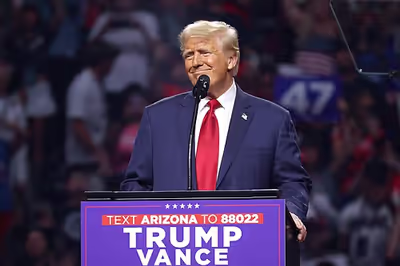
Donald Trump has strong support among white evangelical Christians, particularly among those who do not attend church regularly. Trump also maintains strong support with Christian nationalists, and his rallies take on the symbols, rhetoric and agenda of Christian nationalism. Trump described his 2024 presidential campaign as a "righteous crusade" against "atheists, globalists and the Marxists".
Some Christian Trump supporters view him as divinely ordained and "chosen by God", and some compare him to Jesus, with opposition to him seen as spiritual warfare. Trump shared and played a video entitled "God Made Trump" at several of his rallies explicitly comparing him to a messianic figure in religious terms. Trump is frequently described among some of his Christian supporters as an Old Testament hero, with Cyrus the Great or David frequently mentioned. The New York Times describes his supporters seeing him as one of several "morally flawed figures handpicked by God to lead profound missions aimed at achieving overdue justice or resisting existential evil". This framing has been described as "vessel theology" which allows for support of Trump and excuses his prior sexual misconduct and adultery. Trump has strong support with members of the dominionist New Apostolic Reformation, and many Trump administration officials are aligned with the group.
Methods of persuasion
Sociologist Arlie Hochschild writes that Trump's "speeches—evoking dominance, bravado, clarity, national pride, and personal uplift—inspire an emotional transformation" in followers, deeply resonating with their "emotional self-interest". Hochschild states that Trump is an "emotions candidate", appealing to the emotional self-interests of voters. To Hochschild, this explains the paradox raised by Thomas Frank's book What's the Matter with Kansas?, an anomaly which motivated her five-year immersive research into the emotional dynamics of the Tea Party movement which she believes has mutated into Trumpism.
Her book Strangers in Their Own Land was named one of the "6 books to understand Trump's Win" by The New York Times. Hochschild claims that voters were not persuaded by rhetoric to vote against their self-interest through appeals to the "bad angels" of their nature: "their greed, selfishness, racial intolerance, homophobia, and desire to get out of paying taxes that go to the unfortunate." She grants that the appeal to bad angels is made by Trump, but states that it "obscures another—to the right wing's good angels—their patience in waiting in line in scary economic times, their capacity for loyalty, sacrifice, and endurance", qualities she describes as a part of a motivating narrative she calls their "deep story", a social contract narrative that appears to be widely shared in other countries as well. She thinks Trump's approach towards his audience creates group cohesiveness by exploiting a crowd phenomenon Emile Durkheim called "collective effervescence", "a state of emotional excitation felt by those who join with others they take to be fellow members of a moral or biological tribe ... to affirm their unity and, united, they feel secure and respected."
Trumpian rhetoric employs absolutist framings and threat narratives rejecting the political establishment. The absolutist rhetoric emphasizes non-negotiable boundaries and moral outrage at their supposed violation.
Money-Kyrle pattern
A particular pattern is common for authoritarian movements. First, elicit a sense of depression, humiliation and victimhood. Second, separate the world into two opposing groups: a demonized set of others versus those who have the power and will to overcome them. This involves identifying the enemy supposedly causing the current state of affairs and then promoting conspiracy theories and fearmongering to inflame fear and anger. After cycling these first two patterns through the populace, the final message aims to produce a cathartic release of pent-up ochlocracy and mob energy, with a promise that salvation is at hand because the leader will deliver the nation back to its former glory. This three-part pattern was identified in 1932 by Roger Money-Kyrle who wrote Psychology of Propaganda. Reporting on Trumpist rallies has documented expressions of the Money-Kyrle pattern and associated stagecraft.
Trump rallies
Critical theory scholar Douglas Kellner compares the elaborate staging of Leni Riefenstahl's Triumph of the Will with that used in Trump rallies using the example of the preparation of photo op sequences and aggressive hyping of huge attendance expected for Trump's 2015 primary event in Mobile, Alabama, when the media coverage repeatedly cuts between the Trump jet circling the stadium, the rising excitement of rapturous admirers below, the motorcade and the final triumphal entrance of the individual Kellner claims is being presented as the "political savior to help them out with their problems and address their grievances".
Connolly thinks the performance draws energy from the crowd's anger as it channels it, drawing it into a collage of anxieties, frustrations and resentments about malaise themes, such as deindustrialization, offshoring, racial tensions, political correctness, a more humble position for the United States in global security, economics and so on. Connolly observes that animated gestures, pantomiming, facial expressions, strutting and finger pointing are incorporated as part of the theater, transforming the anxiety into anger directed at particular targets, concluding that "each element in a Trump performance flows and folds into the others until an aggressive resonance machine is formed that is more intense than its parts." Some compare the symbiotic dynamics of crowd pleasing to that of the professional wrestling style of events which Trump was involved with since the 1980s.
Some academics point out that the narrative common in the popular press describing the psychology of such crowds is a repetition of a 19th-century theory by Gustave Le Bon when organized crowds were seen by political elites as potential threats to the social order. In his book The Crowd: A Study of the Popular Mind (1895), Le Bon described a sort of collective contagion uniting a crowd into a near religious frenzy, reducing members to barbaric, if not subhuman levels of consciousness with mindless goals. Since such a description depersonalizes supporters, this type of Le Bon analysis is criticized because the would-be defenders of liberal democracy simultaneously are dodging responsibility for investigating grievances while also unwittingly accepting the same us vs. them framing of illiberalism. Connolly acknowledges the risks but considers it more risky to ignore that Trumpian persuasion is successful due to deliberate use of techniques evoking more mild forms of affective contagion.
Rhetoric
A constant barrage of rhetoric rivets media attention while obscuring actions such as neoliberal deregulation. One study concluded that significant environmental deregulation occurred during the first year of the Trump administration but, due to its concurrent use of racist rhetoric, escaped much media attention. According to the authors, the rhetoric served political objectives of dehumanizing its targets, eroding democratic norms, and consolidating power by emotionally connecting with and inflaming resentments among the base of followers and distracted media attention from deregulatory policymaking by igniting media coverage of the distractions.
According to civil rights lawyer Burt Neuborne and political theorist William E. Connolly, Trumpist rhetoric employs tropes similar to those used by fascists in Germany to persuade citizens (at first a minority) to give up democracy, by using a barrage of falsehoods, half-truths, personal invective, threats, xenophobia, national-security scares, religious bigotry, white racism, exploitation of economic insecurity, and a never-ending search for scapegoats. Neuborne found twenty parallel practices, such as creating what amounts to an "alternate reality" in adherents' minds, through direct communications, by nurturing a fawning mass media and by deriding scientists to erode the notion of objective truth; organizing carefully orchestrated mass rallies; attacking judges when legal cases are lost; using lies, half-truths, insults, vituperation and innuendo to marginalize, demonize and destroy opponents; making jingoistic appeals to ultranationalist fervor; and promising to stop the flow of "undesirable" ethnic groups who are made scapegoats for the nation's ills.
Connolly presents a similar list in his book Aspirational Fascism (2017), adding comparisons of the integration of theatrics and crowd participation with rhetoric, involving grandiose bodily gestures, grimaces, hysterical charges, dramatic repetitions of alternate reality falsehoods, and totalistic assertions incorporated into signature phrases that audiences are encouraged to join in chanting. Despite the similarities, Connolly stresses that Trump is no Nazi but is "an aspirational fascist who pursues crowd adulation, hyperaggressive nationalism, white triumphalism, and militarism, pursues a law-and-order regime giving unaccountable power to the police, and is a practitioner of a rhetorical style that regularly creates fake news and smears opponents to mobilize support for the Big Lies he advances."
In his 2024 book Trump and Hitler: A Comparative Study in Lying, cultural theorist Henk de Berg points to a number of further parallels between Trump's and Hitler's rhetoric; namely, the use of jokes and personal insults; the deliberate creation of controversy; interpretative openness, allowing different groups to recognize themselves in the argument; and oratorical meandering in cases where a coherent narrative would draw attention to the argument's inconsistencies. De Berg also points out that extremist language used by Trump's followers is often perceived as authentic, because in real life we also tend to overstate things (e.g., "My new boss is worse than Stalin").
Branding
Trump used personal branding to market himself as an extraordinary leader by using his celebrity status and name recognition. As one of the communications directors for the MAGA super PAC put it in 2016, "Like Hercules, Donald Trump is a work of fiction." Journalism professor Mark Danner explains that "week after week for a dozen years millions of Americans saw Donald J. Trump portraying the business magus [in The Apprentice], the grand vizier of capitalism, the wise man of the boardroom, a living confection whose every step and word bespoke gravitas and experience and power and authority and ... money. Endless amounts of money."
Political science scholar Andrea Schneiker regards the branding strategy of the Trump public persona as that of a superhero who "uses his superpowers to save others, that is, his country. ... a superhero is needed to solve the problems of ordinary Americans ... Hence, the superhero per definition is an anti-politician. Due to his celebrity status and his identity as entertainer, Donald Trump can thereby be considered to be allowed to take extraordinary measures and even to break rules."
Appeal to emotions
Historian Peter E. Gordon observes that "Trump, far from being a violation of the norm, actually signifies an emergent norm of the social order" where the categories of the psychological and political have dissolved. In accounting for Trump's election and ability to sustain high approval ratings among voters, Erika Tucker writes in the book Trump and Political Philosophy that though all presidential campaigns have strong emotions associated with them, Trump was able to recognize, and then to gain the trust and loyalty of those who felt strong emotions about perceived changes in the United States. She notes, "Political psychologist Drew Westen has argued that Democrats are less successful at gauging and responding to affective politics—issues that arouse strong emotional states."
Examining the populist appeal of Trump, Hidalgo-Tenorio and Benítez-Castro draw on the theories of Ernesto Laclau, writing, "The emotional appeal of populist discourse is key to its polarising effects, this being so much so that populism 'would be unintelligible without the affective component.' (Laclau 2005, 11)"
Trump uses rhetoric that political scientists have deemed to be both dehumanizing and connected to physical violence by Trump's followers.
Emotion, trust, and media
Scholar Michael Carpini states that "Trumpism is a culmination of trends that have been occurring for...decades...we are witnessing...a fundamental shift in the relationships between journalism, politics, and democracy." Carpini identifies "the collapsing of the prior [media] regime's presumed and enforced distinctions between news and entertainment." Examining Trump's use of media in Language in the Trump Era, professor Marco Jacquemet writes that this approach "assumes (correctly, it appears) that his audiences care more about shock and entertainment value in their media consumption than almost anything else."
Plasser and Ulram describe a media logic which emphasizes "personalization ... a political star system ... [and] sports based dramatization." Olivier Jutel notes that "Trump's celebrity status and reality-TV rhetoric of 'winning' and 'losing' corresponds perfectly to these values", asserting that "Fox News and conservative personalities from Rush Limbaugh, Glenn Beck and Alex Jones do not simply represent a new political and media voice but embody the convergence of politics and media in which affect and enjoyment are the central values of media production."
Studying paranoia in media, Jessica Johnson writes, "Rather than finding accurate news meaningful, Facebook users find the affective pleasure of connectivity addictive, whether or not the information they share is factual, and that is how communicative capitalism captivates subjects as it holds them captive." Looking back prior to social media, researcher Brian L. Ott writes: "I'm nostalgic for the world of television that [Neil] Postman (1985) argued, produced the 'least well-informed people in the Western world' by packaging news as entertainment. Twitter is producing the most self-involved people in history by treating everything one does or thinks as newsworthy. Television may have assaulted journalism, but Twitter killed it." Commenting on Trump's support among Fox News viewers, Mark Lukasiewicz has a similar perspective, writing, "Tristan Harris famously said that social networks are about 'affirmation, not information'—and the same can be said about cable news, especially in prime time."
Arlie Russell Hochschild holds that Trump supporters trust their preferred sources of information due to the affective bond they have with them. As Daniel Kreiss summarizes Hochschild, "Trump, along with Fox News, gave these strangers in their own land the hope that they would be restored to their rightful place at the center of the nation, and provided a very real emotional release from the fetters of political correctness that dictated they respect people of color, lesbians and gays, and those of other faiths ... that the network's personalities share the same 'deep story' of political and social life, and therefore they learn from them 'what to feel afraid, angry, and anxious about.'"
From Kreiss' account of conservative personalities and media, information became less important than providing a sense of familial bonding, where "family provides a sense of identity, place, and belonging; emotional, social, and cultural support and security; and gives rise to political and social affiliations and beliefs." Hochschild gives the example of a woman who states, "Bill O'Reilly is like a steady, reliable dad. Sean Hannity is like a difficult uncle who rises to anger too quickly. Megyn Kelly is like a smart sister. Then there's Greta Van Susteren. And Juan Williams, who came over from NPR, which was too left for him, the adoptee. They're all different, just like in a family."
Olivier Jutel notes that, "Affect is central to the strategy of Fox which imagined its journalism not in terms of servicing the rational citizen in the public sphere but in 'craft[ing] intensive relationships with their viewers' in order to sustain audience share across platforms." In this segmented market, Trump "offers himself as an ego-ideal to an individuated public of enjoyment that coalesce around his media brand as part of their own performance of identity." Jutel states that news media companies benefit from offering spectacle and drama. "Trump is a definitive product of mediatized politics providing the spectacle that drives ratings and affective media consumption, either as part of his populist movement or as the liberal resistance."
Researchers give differing emphasis to which emotions are important to followers. Michael Richardson argues that "affirmation, amplification and circulation of disgust is one of the primary affective drivers of Trump's political success." Richardson agrees with Ott about the "entanglement of Trumpian affect and social media crowds" who seek "affective affirmation, confirmation and amplification. Social media postings of crowd experiences accumulate as 'archives of feelings' that are both dynamic in nature and affirmative of social values."
Social trust expert Karen Jones follows philosopher Annette Baier in explaining that the masters of the art of creating trust and distrust are populist politicians and criminals, who "show a masterful appreciation of the ways in which certain emotional states drive out trust and replace it with distrust." Jones sees Trump as an exemplar of this who recognize that fear and contempt are tools that can reorient networks of trust and distrust in social networks to alter how a potential supporter "interprets the words, deeds, and motives of the other." She holds that "A core strategy of Donald Trump...has been to manufacture fear and contempt towards some undocumented migrants (among other groups)", a strategy which "has gone global ... in Australia, Austria, Hungary, Poland, Italy and the United Kingdom."
Falsehoods and misleading statements
There are many falsehoods which Trump presents as facts. Drawing on Harry G. Frankfurt's book On Bullshit, political science professor Matthew McManus argues that Trump is a bullshitter whose sole interest is to persuade, and not a liar (e.g. Richard Nixon) who takes the power of truth seriously and so deceitfully attempts to conceal it. Trump by contrast is indifferent to the truth or unaware of it. Unlike conventional lies of politicians exaggerating their accomplishments, Trump's lies are egregious, making lies about easily verifiable facts. At one rally Trump stated his father "came from Germany", even though Fred Trump was born in New York City.
Leaders at the 2018 United Nations General Assembly burst into laughter at his boast that he had accomplished more in his first two years than any other United States president. Visibly startled, Trump responded to the audience: "I didn't expect that reaction." Trump lies about the trivial, such as claiming that there was no rain on the day of his inauguration when in fact it did rain, as well as making grandiose "Big Lies", such as claiming that Obama founded ISIS, or promoting the birther movement, a conspiracy theory which claims that Obama was born in Kenya, not Hawaii. Connolly points to the similarities of such reality-bending gaslighting with fascist and post Soviet techniques of propaganda including Kompromat (scandalous material), stating that "Trumpian persuasion draws significantly upon the repetition of Big Lies."
Robert Jay Lifton, a scholar of psychohistory and authority on the nature of cults, emphasizes the importance of understanding Trumpism "as an assault on reality". A leader has more power if he is in any part successful at making truth irrelevant to his followers. Trump biographer Timothy L. O'Brien agrees, stating: "It is a core operating principle of Trumpism. If you constantly attack objective reality, you are left as the only trustworthy source of information, which is one of his goals for his relationship with his supporters—that they should believe no one else but him." Lifton believes Trump is a purveyor of a solipsistic reality which is hostile to facts and is made collective by amplifying frustrations and fears held by his community of zealous believers.
Research published in the American Sociological Review found that Trump's lying helped boost his "authentic appeal". It argued that in systems viewed as flawed or with low political legitimacy, a "flagrant violator of established norms" is seen "as an authentic champion" by being perceived as "bravely speaking a deep and otherwise suppressed truth" against a political establishment that does not appear to be working on behalf of the people. While a perceived establishment candidate "may be more likable or perceived to be more competent", voters question the candidates opposition to "the injustice that is said to have permeated the established political system". Andrew Gumbel, writing for The Guardian after the 2024 presidential election, wrote that many Trump voters in Youngstown, Ohio, saw both parties as filled with crooks and liars, but that Trump "comes across as someone who doesn't pretend to be anything other than what he is, and that perceived authenticity counts for more with many Youngstown voters than his character flaws or even his policy positions". Gumbel argued that voters preferred "gut instincts" to "carefully scripted messaging of a Democrat like Kamala Harris or even a mainstream Republican".
Social psychology
Dominance orientation
Social psychology research into the Trump movement, such as that of Bob Altemeyer, Thomas F. Pettigrew, and Karen Stenner, views the Trump movement as primarily being driven by the psychological predispositions of its followers, although political and historical factors (reviewed elsewhere in this article) are also involved. An article in Social Psychological and Personality Science described a study concluding that Trump followers prefer hierarchical and ethnocentric social orders that favor their in-group.
In the non-academic book, Authoritarian Nightmare: Trump and His Followers, Altemeyer and John Dean describe research which reaches the same conclusions. Despite disparate and inconsistent beliefs and ideologies, a coalition of such followers can become cohesive and broad in part because each individual "compartmentalizes" their thoughts and they are free to define their sense of the threatened tribal in-group in their own terms, whether it is predominantly related to their cultural or religious views (e.g. the mystery of evangelical support for Trump), nationalism (e.g. the Make America Great Again slogan), or their race (maintaining a white majority).
Altemeyer, MacWilliams, Feldman, Choma, Hancock, Van Assche and Pettigrew claim that instead of directly attempting to measure such ideological, racial or policy views, supporters of such movements can be reliably predicted by using two social psychology scales (singly or in combination), namely right-wing authoritarian (RWA) measures which were developed in the 1980s by Altemeyer and other authoritarian personality researchers, and the social dominance orientation (SDO) scale developed in the 1990s by social dominance theorists.
In May 2019, Monmouth University Polling Institute conducted a study in collaboration with Altemeyer in order to empirically test the hypothesis using the SDO and RWA measures. The finding was that social dominance orientation and affinity for authoritarian leadership are highly correlated with followers of Trumpism. This study further confirmed of the studies discussed in MacWilliams (2016), Feldman (2020), Choma and Hancock (2017), and Van Assche & Pettigrew (2016).
The research does not imply that the followers always behave in an authoritarian manner but that expression is contingent, which means there is reduced influence if it is not triggered by fear and what the subject perceives as threats. Similar social psychological techniques for analyzing Trumpism have been effective in identifying adherents of similar movements in Europe, including in Belgium and France (Lubbers & Scheepers, 2002; Swyngedouw & Giles, 2007; Van Hiel & Mervielde, 2002; Van Hiel, 2012), the Netherlands (Cornelis & Van Hiel, 2014) and Italy (Leone, Desimoni & Chirumbolo, 2014). Quoting comments from participants in focus groups made up of people who had voted for Democrat Obama in 2012 but flipped to Trump in 2016, pollster Diane Feldman noted the anti-government, anti-coastal-elite anger: "'They think they're better than us, they're P.C., they're virtue-signallers.' '[Trump] doesn't come across as one of those people who think they're better than us and are screwing us.' 'They lecture us.' 'They don't even go to church.' 'They're in charge, and they're ripping us off.'"
Comparisons to animal social behavior
Former speaker of the House Newt Gingrich explained the central role of dominance in his speech "Principles of Trumpism", comparing the needed leadership style to that of a violent bear. Psychology researcher Dan P. McAdams thinks a better comparison is to the dominance behavior of alpha male chimpanzees such as Yeroen, the subject of an extensive study of chimp social behavior conducted by renowned primatologist Frans de Waal. Christopher Boehm, a professor of biology and anthropology agrees, writing, "his model of political posturing has echoes of what I saw in the wild in six years in Tanzania studying the Gombe chimpanzees," and "seems like a classic alpha display."
Using the example of Yeroen, McAdams describes the similarities: "On Twitter, Trump's incendiary tweets are like Yeroen's charging displays. In chimp colonies, the alpha male occasionally goes berserk and starts screaming, hooting, and gesticulating wildly as he charges toward other males nearby. Pandemonium ensues as rival males cower in fear ... Once the chaos ends, there is a period of peace and order, wherein rival males pay homage to the alpha, visiting him, grooming him, and expressing various forms of submission. In Trump's case, his tweets are designed to intimidate his foes and rally his submissive base ... These verbal outbursts reinforce the president's dominance by reminding everybody of his wrath and his force."
Primatologist Dame Jane Goodall explains that like the dominance performances of Trump, "In order to impress rivals, males seeking to rise in the dominance hierarchy perform spectacular displays: Stamping, slapping the ground, dragging branches, throwing rocks. The more vigorous and imaginative the display, the faster the individual is likely to rise in the hierarchy, and the longer he is likely to maintain that position." The comparison has been echoed by political observers sympathetic to Trump. Nigel Farage, an enthusiastic backer of Trump, stated that in the 2016 United States presidential debates where Trump loomed up on Clinton, he "looked like a big silverback gorilla", and added that "he is that big alpha male. The leader of the pack!"
McAdams points out the audience gets to vicariously share in the sense of dominance due to the parasocial bonding that his performance produces for his fans, as shown by Shira Gabriel's research studying the phenomenon in Trump's role in The Apprentice. McAdams writes that the "television audience vicariously experienced the world according to Donald Trump", a world where Trump says "Man is the most vicious of all animals, and life is a series of battles ending in victory or defeat."
Collective narcissism
Cultural anthropologist Paul Stoller thinks Trump employed celebrity culture-glitz, illusion and fantasy to construct a shared alternate reality where lies become truth and reality's resistance to one's own dreams is overcome by the right attitude and bold self-confidence. Trump's father indoctrinated his children from an early age into the positive thinking approach to reality advocated by the family's pastor Norman Vincent Peale. Trump said that Peale considered him the greatest student of his philosophy that regards facts as not important, because positive attitudes will instead cause what you "image" to materialize. Trump biographer Gwenda Blair thinks Trump "weaponized" Peale's self-help philosophy.
Collective narcissism measures have been shown to be a powerful predictor of membership in authoritarian movements including Trump's.
In his book Believe Me which details Trump's exploitation of white evangelical politics of fear, Messiah College history professor John Fea points out the narcissistic nature of the fanciful appeals to nostalgia, noting that "In the end, the practice of nostalgia is inherently selfish because it focuses entirely on our own experience of the past and not on the experience of others. For example, people nostalgic for the world of Leave It to Beaver may fail to recognize that other people, perhaps even some of the people living in the Cleaver's suburban "paradise" of the 1950s, were not experiencing the world in a way that they would describe as 'great.' Nostalgia can give us tunnel vision. Its selective use of the past fails to recognize the complexity and breadth of the human experience ... ."
According to Fea, the hopelessness of achieving an idealized past "causes us to imagine a future filled with horror" leading to conspiratorial narratives that easily mobilize white evangelicals. As a result, they are easily captivated by a strongman such as Trump who repeats and amplifies their fears while posing as the deliverer from them. In his review of Fea's analysis of the impact of conspiracy theories on white evangelical Trump supporters, scholar of religious politics David Gutterman writes: "The greater the threat, the more powerful the deliverance." Gutterman's view is that "Donald J. Trump did not invent this formula; evangelicals have, in their lack of spiritual courage, demanded and gloried in this message for generations. Despite the literal biblical reassurance to 'fear not,' white evangelicals are primed for fear, their identity is stoked by fear, and the sources of fear are around every unfamiliar turn.
Social theory scholar John Cash notes that disaster narratives of impending horrors have a broad audience, pointing to a 2010 Pew study which found that 41 percent of those in the US think that the world will probably be destroyed by the middle of the century. Cash points out that certainties may be found in other narratives which also have the effect of uniting like minded individuals into shared "us versus them" narratives.
Cash thinks that psychoanalytic theorist Joel Whitebook is correct that "Trumpism as a social experience can be understood as a psychotic like phenomenon, that "[Trumpism is] an intentional [...] attack on our relation to reality." Whitebook thinks Trump's playbook is like that of Putin's strategist Vladislav Surkov who employs "ceaseless shapeshifting, appealing to nationalist skinheads one moment and human rights groups the next."
Cash compares Alice in Wonderland to Trump's ability to seemingly embrace disparate fantasies in a series of contradictory tweets and pronouncements, for example appearing to encourage the neo-Nazi protestors after Charlottesville or for audiences with felt grievances about America's first black president, the claim that Obama wiretapped him. Cash writes: "Unlike the resilient Alice, who ... insists on truth and accuracy when confronted by a world of reversals, contradictions, nonsense and irrationality, Trump reverses this process. ... Trump has dragged the uninhibited and distorted world of the other side of the looking-glass into our shared world."
Lifton sees important differences between Trumpism and typical cults, such as not advancing a totalist ideology and lack of isolation from the outside world. Lifton identifies similarities with cults that disparage the "fake world" created by the cult's titanic enemies.
Cultlike persuasion techniques are used, such as echoing of catch phrases. Examples include the use of call and response ("Clinton" triggers "lock her up"; "immigrants" triggers "build that wall"; "who will pay for it?" triggers "Mexico"), deepening the sense of unity between the leader and the community. Participants and observers at rallies have remarked on a liberating feeling which Lifton calls a "high state" that "can even be called experiences of transcendence".
Conspiracy theories
Conservative culture commentator David Brooks observes that under Trump, this post-truth mindset, heavily reliant on conspiracy themes, came to dominate Republican identity, providing its believers a sense of superiority since such insiders possess important information most people do not have. This results in an empowering sense of agency with the liberation, entitlement and group duty to reject "experts" and the influence of hidden cabals seeking to dominate them.
Prior to 2015, Trump already had established a bond with followers due to television and media appearances. For those sharing his political views, Trump's use of Twitter to share his views caused those bonds to intensify, causing his supporters to feel a deepened empathetic bond as with a friend—sharing his anger and outrage, taking pride in his successes, sharing in his denial of failures and his oftentimes conspiratorial views.
Brooks thinks sharing of conspiracy theories has become the most powerful community bonding mechanism of the 21st century.
Hofstadter's The Paranoid Style in American Politics describes the political efficacy of conspiracy theories. Some attribute Trump's political success to making such narratives a rhetorical staple. The conspiracy theory QAnon asserts that top Democrats run a child sex-trafficking ring and Trump is trying to dismantle it. An October 2020 Yahoo-YouGov poll showed that elements of the QAnon claims are said to be true by half of Trump supporters polled.
Some social psychologists see the predisposition of Trumpists towards interpreting social interactions in terms of dominance frameworks as extending to their relationship towards facts. A study by Felix Sussenbach and Adam B. Moore found that the dominance motive strongly correlated with hostility towards disconfirming facts and affinity for conspiracies among 2016 Trump voters but not among Clinton voters. Many critics note Trump's skill in exploiting narrative, emotion, and a whole host of rhetorical ploys to draw supporters into the group's common adventure as characters in a story much bigger than themselves.
It is a story that involves not just a community-building call to arms to defeat titanic threats, or of the leader's heroic deeds restoring American greatness, but of a restoration of each supporter's individual sense of liberty and control. Trump channels and amplifies these aspirations, explaining in one of his books that his bending of the truth is effective because it plays to people's greatest fantasies. By contrast, Clinton was dismissive of such emotion-filled storytelling and ignored the emotional dynamics of the Trumpist narrative.
Cult of personality
Trump's support has been compared to a cult of personality. Trump's message and self-representation involved the creation of an identity as a non-politician, businessman, and great leader, distancing himself from traditional politicians and from the traditional Republican Party. His strategy involved the creation of an ethos of "saving America" through populist intentions and fighting imagined enemies with "I versus them" rhetoric that constituted the formation of a cult of personality. Trump's contingent of hard-core supporters allowed him to maintain a grip on his political party even after several actions and controversies that would have discredited other politicians.
News media and commentators have widely characterized Trump as the object of a personality cult. His support was found to satisfy all parameters needed to determine a personality cult based on Max Weber's concept of charismatic authority. Research found examples of asymmetric bias by his supporters in favor of Trump, such as left-leaning individuals having alleged cases of "Trump derangement syndrome".
Other research has argued that Trump's personality cult revolves around an "all-powerful, charismatic figure, contributing to a social milieu at risk for the erosion of democratic principles and the rise of fascism" based on the analysis of psychoanalysts and sociopolitical historians. Research using the Big Five model of personality has found that his most loyal followers tend to score highly in conscientiousness / self-discipline, traits likely to be attracted to "personalistic, loyalty-demanding leaders" like Trump.
Several aspects of cult-like loyalty to Trump have been found to have religious parallels among certain supporters. Christian nationalism is strongly correlated with support for Trump. Certain evangelicals have referred to him in religious terms, casting him as a divinely ordained savior and "chosen one". Researchers have compared his followers as participating in a psychodynamic of shared psychosis.
Relationship with media
Culture industry and pillarization
Peter E. Gordon, Alex Ross, sociologist David L. Andrews and Harvard political theorist David Lebow look on Theodor Adorno and Max Horkheimer's concept of the "culture industry" as useful for comprehending Trumpism. As Ross explains the concept, the culture industry replicates "fascist methods of mass hypnosis ... blurring the line between reality and fiction", explaining, "Trump is as much a pop-culture phenomenon as he is a political one." Gordon observes that these purveyors of popular culture are not just leveraging outrage, but are turning politics into a more commercially lucrative product, a "polarized, standardized reflection of opinion into forms of humor and theatricalized outrage within narrow niche markets ... within which one swoons to one's preferred slogan and already knows what one knows. Name just about any political position and what sociologists call 'pillarization'—or what the Frankfurt School called 'ticket' thinking—will predict, almost without fail, a full suite of opinions."
Trumpism is from Lebow's perspective, more of a result of this process than a cause. In the intervening years since Adorno's work, Lebow believes the culture industry has evolved into a politicizing culture market "based increasingly on the internet, constituting a self-referential hyperreality shorn from any reality of referants ... sensationalism and insulation intensify intolerance of dissonance and magnify hostility against alternative hyperrealities. In a self-reinforcing logic of escalation, intolerance and hostility further encourage sensationalism and the retreat into insularity." From Gordon's view, "Trumpism itself, one could argue, is just another name for the culture industry, where the performance of undoing repression serves as a means for carrying on precisely as before."
From this viewpoint, the susceptibility to psychological manipulation of individuals with social dominance inclinations is not at the center of Trumpism, but is instead the "culture industry" which exploits these and other susceptibilities by using mechanisms that condition people to think in standardized ways. The burgeoning culture industry respects no political boundaries as it develops these markets with Gordon emphasizing "This is true on the left as well as the right, and it is especially noteworthy once we countenance what passes for political discourse today. Instead of a public sphere, we have what Jürgen Habermas long ago called the refeudalization of society."
What Kreiss calls an "identity-based account of media" is important for understanding Trump's success because "citizens understand politics and accept information through the lens of partisan identity. ... The failure to come to grips with a socially embedded public and an identity group–based democracy has placed significant limits on our ability to imagine a way forward for journalism and media in the Trump era. As Fox News and Breitbart have discovered, there is power in the claim of representing and working for particular publics, quite apart from any abstract claims to present the truth."
Profitability of spectacle and outrage
Examining Trumpism as an entertainment product, some media research focuses on outrage discourse, relating the entertainment value of Trump's rhetoric to the commercial interests of media companies. Outrage narratives on political blogs, talk radio and cable news shows were, in the decades prior, a new genre which grew due to its profitability.
Media critic David Denby writes, "Like a good standup comic, Trump invites the audience to join him in the adventure of delivering his act—in this case, the barbarously entertaining adventure of running a Presidential campaign that insults everybody." Denby claims that Trump is good at delivering entertainment that consumers demand. He observes that "The movement's standard of allowable behavior has been formed by popular culture—by standup comedy and, recently, by reality TV and by the snarking, trolling habits of the Internet. ... it's exactly vulgar sensationalism and buffoonery that his audience is buying. Donald Trump has been produced by America."
Trump made false assertions, mean spirited attacks and dog whistle appeals to racial and religious intolerance. CBS's CEO Les Moonves remarked that "It may not be good for America, but it's damn good for CBS," demonstrating how Trump's messaging is compatible with the financial goals of media companies. Peter Wehner, senior fellow at the Ethics and Public Policy Center considers Trump a political "shock jock" who "thrives on creating disorder, in violating rules, in provoking outrage."
The political profitability of incivility was demonstrated by the amount of airtime devoted to Trump's 2016 primary campaign—estimated at two billion to almost five billion dollars. The advantage of incivility was as true in social media, where "a BuzzFeed analysis found that the top 20 fake election news stories emanating from hoax sites and hyperpartisan blogs generated more engagement on Facebook (as measured by shares, reactions, and comments) than the top 20 election stories produced by 19 major news outlets combined, including The New York Times, Washington Post, Huffington Post, and NBC News."
Social media
Surveying research of how Trumpist communication is well suited to social media, Brian Ott writes that, "commentators who have studied Trump's public discourse have observed speech patterns that correspond closely to what I identified as Twitter's three defining features [Simplicity, impulsivity, and incivility]." Media critic Neal Gabler has a similar viewpoint writing that "What FDR was to radio and JFK to television, Trump is to Twitter." Outrage discourse expert Patrick O'Callaghan argues that social media is most effective when it utilizes the particular type of communication which Trump relies on. O'Callaghan notes that sociologist Sarah Sobieraj and political scientist Jeffrey M. Berry almost perfectly described in 2011 the social media communication style used by Trump long before his presidential campaign.
They explained that such discourse "[involves] efforts to provoke visceral responses (e.g., anger, righteousness, fear, moral indignation) from the audience through the use of overgeneralizations, sensationalism, misleading or patently inaccurate information, ad hominem attacks, and partial truths about opponents, who may be individuals, organizations, or entire communities of interest (e.g., progressives or conservatives) or circumstance (e.g., immigrants). Outrage sidesteps the messy nuances of complex political issues in favor of melodrama, misrepresentative exaggeration, mockery, and improbable forecasts of impending doom. Outrage talk is not so much discussion as it is verbal competition, political theater with a scorecard."
Due to Facebook's and Twitter's narrowcasting environment in which outrage discourse thrives, Trump's employment of such messaging at almost every opportunity was from O'Callaghan's account extremely effective because tweets and posts were repeated in viral fashion among like minded supporters, thereby rapidly building a substantial information echo chamber, a phenomenon Cass Sunstein identifies as group polarization, and other researchers refer to as a kind of self re-enforcing homophily. Within these information cocoons, it matters little to social media companies whether much of the information spread in such pillarized information silos is false, because as digital culture critic Olivia Solon points out, "the truth of a piece of content is less important than whether it is shared, liked, and monetized."
Citing Pew Research's survey that found 62% of US adults get their news from social media, Ott expresses alarm, "since the 'news' content on social media regularly features fake and misleading stories from sources devoid of editorial standards." Media critic Alex Ross is similarly alarmed, observing, "Silicon Valley monopolies have taken a hands-off, ideologically vacant attitude toward the upswelling of ugliness on the Internet," and that "the failure of Facebook to halt the proliferation of fake news during the [Trump vs. Clinton] campaign season should have surprised no one. ... Traffic trumps ethics."
O'Callaghan's analysis of Trump's use of social media is that "outrage hits an emotional nerve and is therefore grist to the populist's or the social antagonist's mill. Secondly, the greater and the more widespread the outrage discourse, the more it has a detrimental effect on social capital. This is because it leads to mistrust and misunderstanding amongst individuals and groups, to entrenched positions, to a feeling of 'us versus them'. So understood, outrage discourse not only produces extreme and polarising views but also ensures that a cycle of such views continues. (Consider also in this context Wade Robison (2020) on the 'contagion of passion' and Cass Sunstein (2001, pp. 98–136) on 'cybercascades'.)" Ott agrees, stating that contagion is the best word to describe the viral nature of outrage discourse on social media, and writing that "Trump's simple, impulsive, and uncivil Tweets do more than merely reflect sexism, racism, homophobia, and xenophobia; they spread those ideologies like a social cancer."
Robison warns that emotional contagion should not be confused with the contagion of passions that James Madison and David Hume were concerned with. Robison states they underestimated the contagion of passions mechanism at work in movements, whose modern expressions include the surprising phenomena of rapidly mobilized social media supporters behind both the Arab Spring and the Trump presidential campaign writing, "It is not that we experience something and then, assessing it, become passionate about it, or not", and implying that "we have the possibility of a check on our passions." Robison's view is that the contagion affects the way reality itself is experienced by supporters because it leverages how subjective certainty is triggered, so that those experiencing the contagiously shared alternate reality are unaware they have taken on a belief they should assess.
Similar movements, politicians and personalities
Historical background in the United States
The roots of Trumpism in the United States can be traced to the Jacksonian era according to scholars Walter Russell Mead, Peter Katzenstein, and Edwin Kent Morris. Eric Rauchway says: "Trumpism—nativism and white supremacy—has deep roots in American history. But Trump himself put it to new and malignant purpose."
Andrew Jackson's followers felt he was one of them, enthusiastically supporting his defiance of politically correct norms of the nineteenth century and even constitutional law when they stood in the way of public policy popular among his followers. Jackson ignored the U.S. Supreme Court ruling in Worcester v. Georgia and initiated the forced Cherokee removal from their treaty protected lands to benefit white locals at the cost of between 2,000 and 6,000 dead Cherokee men, women, and children. Notwithstanding such cases of Jacksonian inhumanity, Mead's view is that Jacksonianism provides the historical precedent explaining the movement of followers of Trump, marrying grass-roots disdain for elites, deep suspicion of overseas entanglements, and obsession with American power and sovereignty, acknowledging that it has often been a xenophobic, "whites only" political movement. Mead thinks this "hunger in America for a Jacksonian figure" drives followers towards Trump but cautions that historically "he is not the second coming of Andrew Jackson," stating that Trump's "proposals tended to be pretty vague and often contradictory," exhibiting the common weakness of newly elected populist leaders, commenting early in his presidency that "now he has the difficulty of, you know, 'How do you govern?'" Contradictorily, it has also been argued that Trump's historical precedent is in the Whig Party of Andrew Jackson's enemies. The Whigs and their successors the Know-Nothings were usually pro-tariff and anti-immigrant, and the party collapsed in the 1850s due to not taking a clear position on slavery.
Morris agrees with Mead, locating Trumpism's roots in the Jacksonian era from 1828 to 1848 under the presidencies of Jackson, Martin Van Buren and James K. Polk. On Morris's view, Trumpism also shares similarities with the post-World War I faction of the progressive movement which catered to a conservative populist recoil from the looser morality of the cosmopolitan cities and America's changing racial complexion. In his book The Age of Reform (1955), historian Richard Hofstadter identified this faction's emergence when "a large part of the Progressive-Populist tradition had turned sour, became illiberal and ill-tempered."
An article by National Public Radio's Ron Elving likens the populism of late-19th and early-20th century Populist politician William Jennings Bryan to the later right-wing populism of Trump. Bryan, while economically liberal, was socially and theologically conservative, supporting creationism, Prohibition and other aspects of Christian fundamentalism. However, Trump also draws inspiration from Bryan's 1896 and 1900 Republican opponent, William McKinley, both in regard to protectionist tariffs and imperialism.
Prior to World War II, conservative themes of Trumpism were expressed in the America First Committee movement in the early 20th century, and after World War II were attributed to a Republican Party faction known as the Old Right. By the 1990s, it became referred to as the paleoconservative movement, which according to Morris has now been rebranded as Trumpism. Leo Löwenthal's book Prophets of Deceit (1949) summarized common narratives expressed in the post-World War II period of this populist fringe, specifically examining American demagogues of the period when modern mass media was married with the same destructive style of politics that historian Charles Clavey thinks Trumpism represents. According to Clavey, Löwenthal's book best explains the enduring appeal of Trumpism and offers the most striking historical insights into the movement.
Writing in The New Yorker, journalist Nicholas Lemann states the post-war Republican Party ideology of fusionism, a fusion of pro-business party establishment with nativist, isolationist elements who gravitated towards the Republican and not the Democratic Party, later joined by Christian evangelicals "alarmed by the rise of secularism", was made possible by the Cold War and the "mutual fear and hatred of the spread of Communism". An article in Politico has referred to Trumpism as "McCarthyism on steroids".
Championed by William F. Buckley Jr. and brought to fruition by Ronald Reagan in 1980, the fusion lost its glue with the dissolution of the Soviet Union, which was followed by a growth of income inequality in the United States and globalization that "created major discontent among middle and low income whites" within and without the Republican Party. After the 2012 United States presidential election saw the defeat of Mitt Romney by Barack Obama, the party establishment embraced an "autopsy" report, titled the Growth and Opportunity Project, which "called on the Party to reaffirm its identity as pro-market, government-skeptical, and ethnically and culturally inclusive."
Ignoring the findings of the report and the party establishment in his campaign, Trump was "opposed by more officials in his own Party ... than any Presidential nominee in recent American history," but at the same time he won "more votes" in the Republican primaries than any previous presidential candidate. By 2016, "people wanted somebody to throw a brick through a plate-glass window", in the words of political analyst Karl Rove. His success in the party was such that an October 2020 poll found 58% of Republicans and Republican-leaning independents surveyed considered themselves supporters of Trump rather than the Republican Party.
Parallels with fascism and trend towards illiberal democracy
Trumpism has been likened to Benito Mussolini's Italian fascism by critics of Trump, and significant academic debate exists over the prevalence of fascism and neo-fascism within Trumpism. Historians and election experts have compared Trump's anti-democratic tendencies and egotistical personality to the sentiments and rhetoric of Mussolini and Italian fascism. Several scholars reject comparisons with fascism, instead viewing Trump as authoritarian and populist.
Some commentators have rejected the populist designation for Trumpism and view it instead as part of a trend towards a new form of fascism or neo-fascism, with some referring to it as explicitly fascist and others as authoritarian and illiberal. Others have more identified it as a form of mild fascism specific to the US. Some historians, including many employing new fascism to describe Trumpism, write of the hazards of direct comparisons with European fascist regimes of the 1930s, stating that while there are parallels, there are important dissimilarities.
Historian Robert Paxton changed his opinion about whether the democratic backsliding caused by Trumpism is in line with fascism. In 2017, Paxton believed it bore greater resemblance to plutocracy. Paxton changed his opinion following the 2021 storming of the United States Capitol, stating it is "necessary" to understand Trumpism as a form of fascism. Drawing on Umberto Eco's essay Ur-Fascism, which outlines 14 characteristics of fascism, Bret Devereaux discusses how Trumpism satisfies all 14. Sociologist Dylan John Riley calls Trumpism "neo-Bonapartist patrimonialism" because it does not capture the same mass movement appeal of classical fascism.
Federico Finchelstein believes intersections exist between Peronism and Trumpism in terms of their disregard for the political system. Christopher Browning considers the long-term consequences of Trump's policies and support which he receives from the Republican Party to be dangerous for democracy. In the German-speaking debate, the term "fascism" initially appeared sporadically, in connection with the crisis of confidence in politics and the media, and described the strategy of right-wing politicians who wish to stir up this crisis to profit from it. German literature has a more diverse range of analysis of Trumpism.
Others have argued that Trump is a totalitarian capitalist exploiting the "fascist impulses of his ordinary supporters that hide in plain sight." Michelle Goldberg compares Trumpism to classical fascist themes. The "mobilizing vision" of fascism is of "the national community rising phoenix-like after a period of encroaching decadence which all but destroyed it", which "sounds a lot like MAGA" (Make America Great Again) according to Goldberg. Similarly, like Trumpism, fascism sees a "need for authority by natural chiefs (always male), culminating in a national chieftain who alone is capable of incarnating the group's historical destiny." They believe in "the superiority of the leader's instincts over abstract and universal reason".
Conservative columnist George Will considers Trumpism similar to fascism, stating that Trumpism is "a mood masquerading as a doctrine". Will argues that national unity is based "on shared domestic dreads"—for fascists the "Jews", for Trump the media ("enemies of the people"), "elites" and "globalists". Solutions come not from tedious "incrementalism and conciliation", but from the leader (who claims "only I can fix it") unfettered by procedure. The political base is kept entertained with mass rallies, but inevitably the strongman develops a contempt for those he leads. Will argues both are based on machismo, and in the case of Trumpism, "appeals to those in thrall to country-music manliness: 'We're truck-driving, beer-drinking, big-chested Americans too freedom-loving to let any itsy-bitsy [COVID-19] virus make us wear masks.'"
In How to Lose a Country: The 7 Steps from Democracy to Dictatorship, Ece Temelkuran describes Trumpism as similar to rhetoric and actions of the Turkish politician Recep Tayyip Erdoğan. These are right-wing populism, demonization of the press, subversion of well-established and proven facts through the big lie, democratic backsliding such as dismantling judicial and political mechanisms; portraying systematic issues such as sexism or racism as isolated incidents, and crafting an ideal citizen.
Mark Blyth and Jonathan Hopkin believe similarities exist between Trumpism and similar movements towards illiberal democracies worldwide, but that Trumpism is not merely being driven by revulsion, loss, and racism. They argue that on the right and left, the global economy is driving the growth of neo-nationalist coalitions which find followers who want to be free of the constraints which are being placed on them by establishment elites whose members advocate neoliberal economics and globalism.
Others emphasize the lack of interest in finding real solutions to the social malaise which has been identified, and they believe those individuals and groups who are executing policy are actually following a pattern which has been identified by researchers like Leo Löwenthal and Norbert Guterman as originating in the post-World War II work of the Frankfurt School of social theory. Based on this perspective, books such as Löwenthal and Guterman's Prophets of Deceit offer insights into how movements like Trumpism dupe their followers by perpetuating their misery and preparing them to move further towards an illiberal form of government.
Soon after the assassination of Charlie Kirk, Trump claimed that "the radicals on the left are the problem" with political violence. Opinion editors, as well as both far-right commentators and Trump critics, have compared Charlie Kirk's killing to the Reichstag fire—the 1933 arson of the German parliament building that Hitler used as a pretext to suspend civil liberties and prosecute political opposition—some calling Kirk's killing Trump's "Reichstag fire moment". How Democracies Die author, professor Steven Levitsky, said that exploiting Charlie Kirk's killing to justify unleashing attacks on critics is "page one of the authoritarian playbook".
Trump's "enemy from within" remarks and threats to use the National Guard and military against "radical left lunatics" during the 2024 campaign and the aftermath of the Charlie Kirk assassination (especially the remarks of Stephen Miller) prompted historians Wendy Goldman and Timothy Snyder to compare these events to the Great Purge in the Soviet Union of the 1930s. At that time, an assassination prompted Joseph Stalin to proclaim vast non-existent conspiracies; to redefine dissent as terrorism and treason; to encourage people to inform on dissenters; and to engage in a campaign of prosecution, imprisonment, and execution of hundreds of thousands of political opponents.
Principal scholars
Laura K. Field in her 2025 book titled The Making of the MAGA New Right has tried to indicate the intellectual brain trust supporting Trump's Project 2025 movement by identifying and documented the top 35 participants in the New Right movement which encompasses Claremonters, Postliberals, National Conservatives and the Hard Right. The list is presented as including the following participants some or whom are retired or deceased as of 2025, listed as:
- Sohrab Ahmari, Postliberal and journalist.
- Costin Alamariu, Hard Right and Yale PhD.
- Michael Anton, author under "Publius Decius Mus" moniker.
- Larry P. Arnn, Claremonter and Claremont PhD.
- Steve Bannon, Hard Right and Trump strategist.
- Darren Beattie, Hard Right and Duke PhD.
- Allan Bloom, died 1992 and leading Straussian.
- Tucker Carlson, Hard Right and journalist at Fox News.
- Charles Cornish-Dale, Hard Right, and Oxford and Cambridge graduate.
- Chris Demouth, National Conservative and formerly with AEI.
- Patrick Deneen, Postliberal and Professor at Notre Dame.
- Ron Desantis, Governor of Florida.
- John C. Eastman, Claremonter and Director at Claremont Institute.
- Samuel T. Francis, died 2005 and Paleoconservative.
- Robert P. George, Leading Catholic intellectual at Princeton University.
- Paul Gottfried, Paleoconservative and writer.
- Josh Hammer, National Conservative and University of Chicago JD.
- Yoram Hazony, National Conservative and author of The Virtue of Nationalism (2018).
- Harry V. Jaffa, died 2015 and West Coast Straussian.
- Leo Strauss, died 1973, Professor University of Chicago, patriarch of Straussians.
Rush Limbaugh
Trump is considered by some analysts to be following a blueprint of leveraging outrage, which was developed on partisan cable TV and talk radio shows such as the Rush Limbaugh radio show—a style that transformed talk radio and American conservative politics decades before Trump. Both shared "media fame" and "over-the-top showmanship", and built an enormous fan base with politics-as-entertainment, attacking political and cultural targets in ways that would have been considered indefensible and beyond the pale in the years before them. Both featured "the insults, the nicknames", and conspiracy theories. Both maintained that global warming was a hoax, that Barack Obama was not a natural-born U.S. citizen, and that the danger of COVID-19 was vastly exaggerated. Both mocked people with disabilities.
Limbaugh, to whom Trump awarded the Presidential Medal of Freedom in 2020, preceded Trump in moving the Republican Party away from "serious and substantive opinion leaders and politicians", towards political provocation, entertainment, and anti-intellectualism, and popularizing and normalizing for "many Republican politicians and voters" what before his rise "they might have thought" but would have "felt uncomfortable saying". His millions of fans were intensely loyal and "developed a capacity to excuse ... and deflect" his statements no matter how offensive and outrageous, "saying liberals were merely being hysterical or hateful. And many loved him even more for it."
Trump has been additionally compared, at different levels, to the former Iranian President Mahmoud Ahmadinejad. "There was a joke in Iran during Trump’s first term that when he became president, Iran finally managed to export its revolution," according to Vali Nasr. Saeed Rahnema of the York University argues that their popularity is "the most worrying sign of social degradation at a global level".
Future impact
Writing in The Atlantic, Yaseem Serhan states Trump's post-impeachment claim that "our historic, patriotic, and beautiful movement to Make America Great Again has only just begun" should be taken seriously as Trumpism is a "personality-driven" populist movement, and other such movements—such as Berlusconism in Italy, Peronism in Argentina and Fujimorism in Peru, "rarely fade once their leaders have left office". Joseph Lowndes, a professor of political science at the University of Oregon, argued that while current far-right Republicans support Trump, the faction rose before and will likely exist after Trump. Bobby Jindal and Alex Castellanos wrote in Newsweek that separating Trumpism from Donald Trump himself was key to the Republican Party's future following his loss in the 2020 United States presidential election. However, Trump went on to win the 2024 United States presidential election with victories in all seven crucial swing states.
In 2024, President Kevin Roberts of the Heritage Foundation stated that he sees the role of Heritage as "institutionalizing Trumpism." Stating in June 2025 that "'The Age of Trump' Enters Its Second Decade", Peter Baker of The New York Times wrote "In those 10 years, Mr. Trump has come to define his age in a way rarely seen in America, more so than any president of the past century other than Franklin D. Roosevelt and Ronald Reagan".
Policies
Economic policy
Trumpism "promises new jobs and more domestic investment". Trump's hard line against export surpluses of American trading partners and protectionist trade policies led to a tense situation in 2018 with mutually imposed tariffs by the United States and the European Union versus China. Trump secures the support of his political base emphasizing neo-nationalism and criticism of globalization. One book suggested that Trump "radicalized economics" for white working- to middle-class voters by implying that "undeserving [minority] groups are getting ahead while their group is being left behind."
Foreign policy
In terms of foreign policy in the sense of Trump's "America First", unilateralism and isolationism has usually been preferred to a multilateral policy. National interests are particularly emphasized, especially in the context of economic treaties and alliance obligations. Trump has shown a disdain for traditional American allies such as Canada as well as transatlantic partners NATO and the European Union. Conversely, Trump has shown sympathy for autocratic rulers, such as Russian President Vladimir Putin, whom Trump often praised even before taking office, and during the 2018 Russia–United States Summit. The "America First" foreign policy includes promises by Trump to end American involvement in foreign wars, notably in the Middle East, while also issuing tighter foreign policy through sanctions against Iran, among other countries. Trump's proposals during his second presidency to expand the United States by acquiring Canada, Greenland, and the Panama Canal were described by CNN as part of his nationalist "America First" agenda and having "modern echoes of the 19th century doctrine of Manifest Destiny". The proposal to acquire Greenland would eventually trigger the Greenland crisis.
In June 2025, some supporters of Donald Trump in the United States, including Steve Bannon, Tucker Carlson, Rand Paul, Charlie Kirk, Saagar Enjeti, Mollie Hemingway and Marjorie Taylor Greene, criticized Trump's support for Israeli strikes against Iran and opposed possible United States involvement in the war. There is a significant divide within the Republican Party and the MAGA movement on whether the United States should get involved in such a war overseas. For example, Marjorie Taylor Greene said that the United States shouldn't get involved at all in foreign matters. In 2026, Trump intervened in Venezuela and began a war with Iran; leading many observers to doubt the sincerity of Trump's commitment to isolationism and non-interventionism.
Religious policy
Trump wove Christian religious imagery into his 2024 presidential campaign, characterizing it as a "righteous crusade" against "atheists, globalists and the Marxists". He stated that his aims included restoring the United States "as one nation under God with liberty and justice for all".
Trump has been critical of what he sees as a persecution of Christians. On February 6, following the National Prayer Breakfast, he signed an executive order to create a task force to "immediately halt all forms of anti-Christian targeting and discrimination within the federal government, including at the DOJ, which was absolutely terrible, the IRS, the FBI — terrible — and other agencies". Donald Trump appointed Attorney General Pam Bondi to lead the task force and appointed Paula White to direct the White House Faith Office.
Election subversion
Beyond the United States
Argentina
Javier Milei, an Argentinian Austrian economist who was elected in 2023 as president of Argentina, has sometimes been likened to Donald Trump. Many other commentators have stressed that the two men are different, however, describing Milei's views as mostly libertarian, such as rejecting protectionism and supporting free trade.
Australia
Trumpism is represented in Australia by the political party Trumpet of Patriots, founded in 2021. The party has pledged to "put Australians first and make Australia great again". It focuses on "gender, changing the immigration policy, bringing down the cost of living and free speech."
Brazil
In Brazil, Jair Bolsonaro, sometimes referred to as the "Brazilian Donald Trump", who is often described as a right-wing extremist, sees Trump as a role model and according to Jason Stanley uses the same fascist tactics. Like Trump, Bolsonaro finds support among evangelicals for his views on culture war issues. Along with allies he publicly questioned Joe Biden's vote tally after the 2020 United States presidential election.
Canada
Trumpism exists as a political current in Canada. Law professor Allan Rock, Canada's former attorney general and ambassador to the U.N., said Trump had "given expression to an underlying frustration and anger, that arises from economic inequality, from the implications from globalisation." Rock stated that the "overtly racist behaviour" associated with Trumpism emboldened racists and white supremacists, resulting in a rise in the number of these organizations and hate crimes in Canada.
According to an October 2020 poll of Canadian voters, the number of "pro-Trump conservatives" was growing in Canada. Maclean's said this was influencing Canadian political campaigns. Erin O'Toole, the leader of the Conservative Party of Canada, featured the slogan—"Take Back Canada"—in a video, stating "[j]oin our fight, let's take back Canada." When asked if his "Canada First" policy was different from Trump's "America First" policy, O'Toole said, "No, it was not." O'Toole criticized what he considered to be Trumpism following one of Liberal Deputy Prime Minister Chrystia Freeland's tweets being flagged as "manipulated media" and compared her to Trump's flagged tweets, prior to Twitter's acquisition by Elon Musk. Writing for The Hill in 2021, Markik Von Rennenkampff stated that there are "striking differences" between the Conservative Party under Erin O'Toole and the Republican Party under Trump, notably O'Toole supporting access to abortion and his support for Canada's single-payer health care system. Rennenkampff also described Canadian Conservatives as "far more closely aligned with Democrats than Republicans".
Following the 2022 Conservative Party leadership election, some journalists have compared Conservative Party leader Pierre Poilievre to American Republicans such as Donald Trump and Ted Cruz; however many journalists have dismissed these comparisons due to Poilievre's pro-abortion access, pro-immigration, and pro-same-sex marriage positions. In 2024, Zack Beauchamp of Vox stated that while Poilievre's rhetoric draws Trump comparisons, in terms of policy "he's actually considerably more moderate than Trump or European radicals".
During the 2025 Canadian federal election, Liberal Party of Canada staffers created Trump-style "Stop The Steal" buttons and were caught planting them at a Canada Strong and Free Network conference which was supporting the Conservative Party of Canada. In response, the Liberal Party spokesman Kevin Lemkay stated that such actions did not fit the prime minister's "commitment to serious and positive discourse" while Conservative Party spokesman Sam Lilly stated "it's clear that it's the Liberals who are attempting to bring American-style politics to our country".
Europe
Trumpism has also been said to be on the rise in Europe. Political parties such as the Finns Party, France's National Rally and Spain's far-right Vox party have been described as Trumpist in nature. Trump's former advisor Steve Bannon called Hungarian prime minister Viktor Orbán "Trump before Trump". Isabel Díaz Ayuso, member of the Spanish People's Party and president of the Community of Madrid, has also received the Trumpism label. George Simion, the founder of the Alliance for the Union of Romanians party and previous candidate in the 2025 Romanian presidential election is commonly referred to as the "Romanian Trump" due to his political style and ideological alignment being very similar to those of Donald Trump. A member of the AUR Alliance is the "Republican Party of Romania" which is heavily inspired by Trump. A Belgian political party named "TRUMP" in a backronym intentionally referencing Trump was founded in November 2025. Likewise in the June 2023 Greek parliamentary election, a party called "Republican Party of Greece – T.R.A.M.P." participated.
India
At the February 2025 meeting between Narendra Modi, Prime Minister of India, and Donald Trump, the former stated:
Borrowing an expression from America, our vision for a developed India is to make India great again, or MIGA ... When America and India work together, that is, when it's MAGA plus MIGA, it becomes a mega partnership for prosperity. ... And it is this mega spirit that gives new scale and scope to our objectives.
Iran
Donald Trump and his policy towards Iran have been praised by the Iranian opposition group 'Restart', led by Mohammad Hosseini, which also supports American military action against Iran and offered to fight alongside Americans to overthrow the Iranian government. The group has adopted the slogan "Make Iran Great Again".
Restart has been compared to QAnon by Ariane Tabatabai, in terms of "conspiracist thinking going global". Among conspiracy theories advocated by the group is that Iran's Supreme Leader Ali Khamenei has died (or went into coma) in 2017 and a double plays his role in public.
Israel
Israeli Prime Minister Benjamin Netanyahu's political views, strategies, and actions are frequently compared to Trumpism by political analysts and critics, who view the two leaders as mirror images pioneering populist methods to dominate domestic politics. Both leaders have been described as utilizing authoritarian rhetoric that taps into public unease and relies on existential fear, deploying distinct "bogeymen"—such as illegal immigrants for Trump and Arab citizens or external threats for Netanyahu—to mobilize their bases. This political style leverages high-stakes polarization to rally core supporters while demonstrating that norm-breaking behavior carries little political cost among swing voters.
A central parallel lies in their shared hostility toward independent state institutions and the mainstream media. Netanyahu has closely emulated Trump's rhetoric by repeatedly denouncing critical journalistic coverage as "fake news", while his supporters have directed intense hostility toward both domestic and foreign press. Furthermore, both figures have consistently attacked the legitimacy of their respective judicial systems, framing corruption investigations and constitutional checks as weaponized conspiracies by an elite "leftist Deep State" designed to thwart the people's will. Following controversial moves to dismiss independent professional officials, such as the Shin Bet domestic intelligence director Ronen Bar, Netanyahu explicitly linked his legal battles to Trump's, publicly declaring a shared struggle against institutional overreach. This rhetoric has trickled deeply into Israeli political discourse, culminating in public campaigns and ministerial demands to defy court rulings or seek external U.S. intervention against judges.
Beyond institutional battles, Netanyahu's administrative tactics have increasingly mirrored Trump's governance style, particularly through targeted efforts to purge professional civil service ranks and slot loyalists into key national positions. This convergence also extends to their immediate families; analysts have noted that both leaders have sons—Donald Trump Jr. and Eric Trump in the U.S., and Yair Netanyahu in Israel—who actively engage in highly aggressive, controversial social media warfare to attack political rivals and defend their fathers. In electoral campaigns, Netanyahu has further adopted Trumpian tactics by raising unsubstantiated claims of systemic voter fraud to delegitimize political opponents and justify restrictive polling measures.
In foreign policy, the alliance between Trump and Netanyahu has been characterized as deeply personalistic and transactional, rather than purely institutional. Netanyahu strongly aligned with Trump during his first term, successfully coaxing him to withdraw from the 2015 Iran nuclear deal in 2018. Following Trump's return to power in the 2024 election, Netanyahu saw a renewed opportunity for a comprehensive regional realignment. This ambition culminated in highly coordinated joint U.S.-Israeli military actions against Iran in early 2026. However, the relationship has also exposed the transactional vulnerabilities inherent to Trumpism; when joint operations failed to trigger immediate regime collapse in Tehran and resulted in global economic disruption, notable tensions emerged, with Trump publicly rebuking Netanyahu and unilaterally imposing strict military constraints on Israeli operations.
Japan
In Japan, in a speech to Liberal Democratic Party lawmakers in Tokyo on March 8, 2019, Steve Bannon said that Prime Minister Shinzo Abe was "Trump before Trump" and "a great hero to the grassroots, the populist, and the nationalist movement throughout the world." Shinzo Abe was described as a "right-wing nationalist" or "ultra-nationalist", but whether he was a "populist" is controversial.
Netto-uyoku is the term used to refer to netizens who espouse ultranationalist far-right views on Japanese social media. Netto-uyoku are typically very friendly not only to Japanese nationalists but also to Donald Trump, and oppose liberal politics. They began spreading Trump's conspiracy theories in an attempt to overturn the 2020 American presidential election.
Nigeria
According to The Guardian and The Washington Post, there is a significant affinity towards Trump in Nigeria. Donald Trump's comments on the ethno-religious conflicts between Christians and the predominantly Muslim Fulani tribe has contributed to his popularity among Christians in Nigeria, in which he stated: "We have had very serious problems with Christians who are being murdered in Nigeria. We are going to be working on that problem very, very hard because we cannot allow that to happen". Donald Trump is praised by the Indigenous People of Biafra (IPOB), a secessionist group that supports the independence of Biafra from Nigeria and is designated as a terrorist group by the Nigerian government. IPOB has claimed that he "believes in the inalienable right of an indigenous people to self-determination" and it also praised him for "the direct and serious manner he addressed and demanded immediate end to the serial slaughter of Christians in Nigeria, especially Biafran Christians".
After Trump's victory in the 2016 presidential election, IPOB leader Nnamdi Kanu wrote a letter to Trump stating he had a "historic and moral burden ... to liberate the enslaved nations in Africa". As Trump was inaugurated in January 2017, IPOB organized a rally in support of Trump that resulted in violent clashes with Nigerian security forces and resulted in multiple deaths and arrests. On January 30, 2020, IPOB leader Nnamdi Kanu attended a Trump rally in Iowa as a special VIP guest, at the invitation of the Republican Party of Iowa. According to a 2020 poll from Pew Research, 58% of Nigerians had favorable views of Donald Trump, the fourth highest percentage globally.
According to John Campbell of Council on Foreign Relations, Trump's popularity in Nigeria can be explained by a "manifestation of the widespread disillusionment in a country characterized by growing poverty, multiple security threats, an expanding crime wave, and a government seen as unresponsive and corrupt", and his popularity is likely stronger among wealthier urban Nigerians rather than the majority of Nigerians who live in rural areas or urban slums and are unlikely to have strong opinions on Trump.
Philippines
Sheila S. Coronel has argued that the political strategies of Ferdinand Marcos, who was president of the Philippines from 1965 to 1986, and Rodrigo Duterte, who held the same position from 2016 to 2022, share certain features with Trumpism, including disregard for facts, encouragement of fear, and a "loud, bombastic, hypermasculine" aesthetic; and that each has benefited from uncertain political environments.
Russia
Aleksandr Dugin, a Russian far-right political philosopher has described the political style of the incumbent Russian President Vladimir Putin as similar to Donald Trump due to their anti-globalist and anti-elite rhetoric in emphasizing nationalism and traditional values with Putin framing Russia as a defender against Western liberal elites, while Trump criticizes global institutions and claims they undermine American interests.
South Korea
The politics of Yoon Suk Yeol, the former president of South Korea, has been called "Trumpist" for his right-wing populist elements.