


Related on Lably
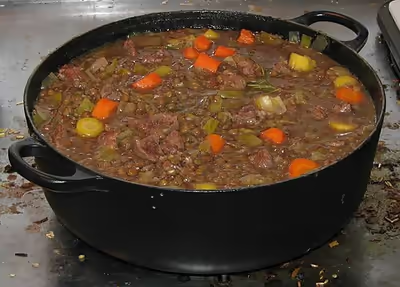
Stewing is suitable for the least tender cuts of meat that become tender and juicy with the slow, moist heat method. This makes it popular for low-cost cooking. Cuts with a certain amount of marbling and gelatinous connective tissue give moist, juicy stews, while lean meat may easily become dry.
Stews are thickened by reduction or with flour, either by coating pieces of meat with flour before searing or by using a roux or beurre manié, a dough consisting of equal parts fat and flour. Thickeners like cornstarch, potato starch, or arrowroot may also be used. Stew is very prominent in England, with beef stew and dumplings having been one of England's national dishes in the 14th century. Other European countries also have their own recipes.
History
Stews have been made since ancient times. The world's oldest known evidence of stew was found in Japan, dating to around 5000 BC during the Jōmon period. They made seafood whose ingredients varied with the seasons. The food was cooked in large conical or rounded pots with tapered or pointy bottoms that sat well in the soil and ash of the bonfire or hearth.
Amazonian tribes used the shells of turtles as vessels, boiling the entrails of the turtle and various other ingredients in them.
There are recipes for pork stews and fish stews in the Roman cookery book Apicius, believed to date from the 4th century AD. Le Viandier, one of the oldest cookbooks in French, written in the early 14th century by the French chef known as Taillevent, has ragouts or stews of various types in it.
Sign in to keep reading
2 more chapters are free with a Lably account.
Types
There are a large variety of stews, ranging from those including meat or seafood, to those that are vegetarian or vegan. Meat-based white stews also known as blanquettes or fricassées are made with lamb or veal that is blanched or lightly seared without browning, and cooked in stock. Brown stews are made with pieces of red meat that are first seared or browned, before a browned mirepoix and sometimes browned flour, stock and wine are added.
List of stews
- Baeckeoffe, a potato stew from Alsace
- Beef bourguignon, a French dish of beef stewed in red burgundy wine
- Bigos, a traditional stew in Polish cuisine
- Birria, a traditional stew from Mexico
- Bo kho (Vietnamese: bò kho), a beef stew in rich seasonings, served with bread, noodle or plain rice from Vietnam
- Bollito misto, consisting of beef, veal, and pork simmered in an aromatic vegetable broth from Italy
- Booyah, an American meat stew
- Bosnian pot, a stew with beef or lamb which is a national dish in Bosnia and Herzegovina
- Bouillabaisse, a fish stew from Provence
- Brongkos, a spicy Javanese meat with beans stew from Indonesia, made of Pangium edule, coconut milk, and various spices
- Brunswick stew, from Virginia and the Carolinas
- Burgoo, a Kentuckian stew
- Brudet, fish stew from Dalmatia regions, known in Greece as bourdeto
- Caldeirada, a fish stew from Portugal
- Carbonade flamande (stoofvlees), a traditional Belgian beef and onion stew made with Belgian beer
- Cawl, a Welsh stew
- Chakapuli, a Georgian stew made with lamb chops, coriander and tarragon leaves, and white wine
- Chanakhi, a Georgian lamb stew with tomatoes, aubergines, potatoes, greens, and garlic
- Charquicán, a Chilean dish
- Chicken mull, whole chicken and seasonings
- Chicken paprikash, chicken stew with paprika
- Chili con carne, a meat and chili pepper stew originating in Texas
- Chilorio, a pork stew from Sinaloa, Mexico
- Cincinnati chili, developed by Macedonian immigrants from Greece immigrants in the Cincinnati area
- Cholent, a slow-cooked Jewish dish
- Chorba (also spelt "shorba"), a stew like soup dish found in various North African, Middle Eastern, Central Asian, South Asian, and European cuisines
- Cochinita pibil, an orange color pork stew from Yucatán Peninsula, Mexico
- Cocido, a traditional Spanish and Portuguese strew with many variants (madrileño, montañés, à portuguesa, etc.)
- Cotriade, a fish stew from Brittany
- Cream stew, a yōshoku Japanese white stew
- Crow stew, a sour cream-based stew made with crow meat, popular in the United States during the Great Depression
- Daal, the Indian legume stew that has many varieties, a staple food throughout Asia
- Dalma, a traditional dish of Odisha, India; contains pulses with vegetables
- Daube, a French stew made with cubed beef braised in wine, vegetables, garlic, and herbs
- Dinuguan, pork blood stew from the Philippines
- Eintopf, ('one pot') the German word for a stew: many different regional specialty recipes for Eintopf are known in Germany. For example, the Kassel area has a type called Lumben un Fleeh in the local dialect (Standard German: Lumpen und Flöhe – 'rags and fleas'), which is quite similar to Irish stew. There are thicker German stews such as Hasenpfeffer or Labskaus; these would not usually be considered an Eintopf, though the technical difference is minor (longer cooking times and fewer vegetables)
- Estofadong baboy, pork stew from the Philippines
- Ewedu, vegetable stew from Nigeria
- Fabada asturiana, an Asturian bean and meat stew
- Feijoada, Brazilian or Portuguese bean stew
- Fårikål, traditional Norwegian stew with lamb or mutton and white cabbage
- Főzelék, a thick Hungarian vegetable dish
- Gaisburger Marsch, a German dish of stewed beef served with Spätzle and potatoes
- Gheimeh, an Iranian stew with cubed lamb and yellow split peas
- Ghormeh sabzi, an Iranian stew with green herbs, dried limes, beans, and sheep meat
- Goulash, a Hungarian meat stew with paprika
- Gumbo, a Louisiana creole dish
- Hachee, a Dutch type of stew with wine or vinegar
- Haleem, an Indian-Pakistani lentil and beef stew
- Hasenpfeffer, a sour, marinated rabbit stew from Germany
- Hayashi rice, a Japanese dish of beef, onions and mushrooms in red wine and demi-glace sauce, served with rice
- Irish stew, made with lamb or mutton, potato, onion, and parsley
- Ishtu, a curry in Kerala, India made from chicken or mutton, potato, and coconut milk
- Istrian stew or yota, or jota, a dish popular in Croatian and Slovenian Istra and NE Italy
- I-tal stew, a Rastafarian vegan dish of mostly Caribbean root vegetables and spices
- Jjigae, a diverse range of Korean stews
- Kaldereta, a goat meat stew from the Philippines
- Kalops, a traditional Swedish beef stew, with onions and carrots, served with potatoes and pickled beets
- Kare-kare, stewed beef or oxtail and vegetables in peanut sauce from the Philippines
- Karelian hot pot, from the region of Karelia in eastern Finland
- Kharcho is a traditional Georgian soup containing beef, rice, cherry plum purée, and chopped walnuts
- Khash, a traditional Armenian/Azerbaijani dish of pig's or cow's feet
- Khoresht, a variety of Persian stews, often prepared with saffron
- Kokkinisto, Greek stew with red meat, in a tomato passata with shallots, cinnamon, and other spices
- Kuurdak, a type of stew from Central Asia
- Kuzhambu, (also called Pulusu or Saaru, depending on region) a range of stews from southern India based on tamarind broth and vegetables, meat or fish
- Lobscouse, a Norwegian stew with beef, potato, onion, and carrot
- Lancashire hotpot, an English stew
- Lecsó, a summertime favourite in Hungary, vegetable stew with bell pepper and tomato as main ingredients
- Linseneintopf ("lentil stew")
- Lobby, a stew from Staffordshire, England
- Locro, a stew (mainly in the Andes region)
- Machanka, a Belarus and Ukraine pork stew
- Matelote, a French fish stew made with freshwater fish, fish stock, and wine
- Mechado, a Philippine beef stew
- Moppelkotze
- Moqueca, a Brazilian stew with fish (or shrimp, crab, or other seafood) as its main ingredient
- Mućkalica, a Serbian stew
- Nihari, an Indian meat stew, usually made with goat, chicken, lamb and less commonly beef. It is made overnight and served for breakfast.
- Nikujaga, a Japanese beef and potato stew
- Oil down, national dish of Grenada, made of breadfruit, salted meat, chicken, dumplings, callaloo, coconut milk, and spices
- Olla podrida, a Spanish red bean stew
- Pašticada, a Croatian stew from the region of Dalmatia
- Peperonata, an Italian stew made with peppers
- Pepposo, a Tuscan beef stew
- Pescado blanco, a white fish stew from Pátzcuaro, Michoacán, Mexico
- Pichelsteiner a traditional German stew
- Pörkölt, a Hungarian meat stew resembling goulash, flavoured with paprika
- Potjiekos, a South African stew
- Pot-au-feu, a simple French beef stew
- Pozole, a Mexican stew or soup
- Puchero, a stew from Andalusia, Spain, also common in South America and the Philippines
- Ratatouille, a French vegetable stew
- Rendang, an Indonesian spicy beef stew
- Ragoût, a French stew
- Sāmbār, a lentil-based spiced vegetable stew, cooked with pigeon pea and tamarind broth in South Indian cuisine
- Sancocho, a stew from the Caribbean
- Scouse, a stew commonly eaten by sailors throughout Northern Europe, popular in seaports such as Liverpool
- Semur, a typical Indonesian stew with beef or chicken, potatoes, carrots, various spices, and kecap manis (sweet soy sauce)
- Stufato, an Italian stew
- Steckrübeneintopf (based on rutabaga)
- Slumgullion, a watery stew of meat and vegetables
- Tagine, a Moroccan stew, named after the conical pot in which it is traditionally cooked or served
- Tocană, a Romanian stew prepared with tomato, garlic, and sweet paprika
- Tharid, a traditional Arab stew of bread in broth
- Wat, an Ethiopian and Eritrean stew
- Waterzooi, a Belgian stew
- Yahni, a Greek (γιαχνί), Turkish, and Persian stew