


Related on Lably
The playing pieces are called stones. One player uses the white stones and the other black stones. The players take turns placing their stones on the vacant intersections (points) on the board. Once placed, stones may not be moved, but captured stones are immediately removed from the board. A single stone (or connected group of stones) is captured when surrounded by the opponent's stones on all orthogonally adjacent points. The game proceeds until neither player wishes to make another move.
When a game concludes, the winner is determined by counting each player's surrounded territory along with captured stones and komi (points added to the score of the player with the white stones as compensation for playing second). Games may also end by resignation.
The standard Go board has a 19×19 grid of lines, containing 361 points. Beginners often play on smaller 9×9 or 13×13 boards, and archaeological evidence shows that the game was played in earlier centuries on a board with a 17×17 grid. The 19×19 board had become standard by the time the game reached Korea in the 5th century CE and Japan in the 7th century CE.
Go was considered one of the four essential arts of the cultured aristocratic Chinese scholars in antiquity. The earliest written reference to the game is generally recognized as the historical annal Zuo Zhuan (c. 4th century BCE).
Despite its relatively simple rules, Go is extremely complex. Compared to chess, Go has a larger board with more scope for play, longer games, and, on average, many more alternatives to consider per move. The number of legal board positions in Go has been calculated to be approximately 2.1×10170, which is far greater than the number of atoms in the observable universe, which is estimated to be on the order of 1080.
Names of the game
The name Go is a short form of the Japanese word igo (囲碁; いご), which derives from earlier wigo (ゐご), in turn from Middle Chinese (圍棋, Mandarin: wéiqí, lit. 'encirclement board game' or 'board game of surrounding'). In English, the name Go when used for the game is often capitalized to differentiate it from the common word go. In events sponsored by the Ing Chang-ki Foundation, it is spelled goe.
The Korean name baduk (바둑) is a native derived term, most likely originally consisting of 밭 (Yale: pàth, 'cultivated field') + *돍〯 (Yale: twǒlk, "stone", presumed dialectal variant of Seoul 돓〯 twǒlh, 'stone'). Less plausible etymologies include a derivation of Badukdok, referring to the playing pieces of the game, or a derivation from Chinese páizi (排子), meaning 'to arrange pieces'.
Sign in to keep reading
12 more chapters are free with a Lably account.
Overview
Go is an adversarial game between two players with the objective of capturing territory: that is, occupying and surrounding a larger total empty area of the board with one's stones than the opponent. As the game progresses, the players place stones on the board, creating stone "formations" and enclosing spaces. Once placed, stones are never moved on the board, but when "captured" are removed from the board. Stones are linked together into formations by being adjacent along the black lines, not on diagonals (of which there are none). Contests between opposing formations are often extremely complex and may result in the expansion, reduction, or wholesale capture and loss of formations and their enclosed empty spaces (or "eyes"). One essential aspect of the game is control of the sente (that is, controlling the offense, so that one's opponent is forced into defensive moves); this usually changes several times during play.
Initially, the board is bare. Players take turns, placing one stone per turn. As the game proceeds, players try to link their stones together into "living" formations (meaning that they are permanently safe from capture), while threatening to capture their opponent's stones and formations. Thus, stones have both offensive and defensive characteristics, depending on the situation.
An essential aspect of the game is that any formation of stones needs to have, or be capable of making, at least two enclosed open points known as eyes, in order to preserve itself from being captured. A formation having two or more eyes cannot be captured, even after it is surrounded by the opponent on the outside, because each eye constitutes a liberty that must be filled by the opponent as the final step in capture. Once surrounded, a formation with a single eye can be captured on the next move, by one's opponent filling the eye and completely surrounding all stones in the formation; however, with two eyes, completely surrounding the formation is impossible, as filling one eye does not capture the formation, and instead would simply sacrifice the stone filling that eye. Thus, a formation having two or more eyes is said to be unconditionally alive, meaning that it can never be captured, while a group that cannot form two eyes is said to be dead and can be captured unless it is subsequently connected to a formation with a second eye.
The general strategy is to place stones to fence-off territory, attack the opponent's weak groups (trying to kill them so they will be removed), and always stay mindful of the life status of one's own groups. Situations where mutually opposing groups must capture each other or die are called capturing races, or semeai. In a capturing race, the group with more liberties will ultimately be able to capture the opponent's stones. Capturing races and the elements of life or death are the primary challenges of Go.
In the end game, players may pass rather than place a stone if they think there are no further opportunities for profitable play. The game ends when both players pass or when one player resigns. In general, to score the game, each player counts the number of unoccupied points surrounded by their stones and then subtracts the number of stones that were captured by the opponent. The player with the greater score (after adjusting for handicapping called komi) wins the game.
In the opening stages of the game, players typically establish groups of stones (or bases) near the corners and around the sides of the board, usually starting on the third or fourth line in from the board edge rather than at the very edge of the board. The edges and corners make it easier to develop groups which have better options for life (self-viability for a group of stones that prevents capture) and establish formations for potential territory. Players usually start near the corners, because establishing territory is easier with the aid of two edges of the board. Established corner opening sequences are called joseki and are often studied independently. However, in the mid-game, stone groups must also reach in towards the large central area of the board to capture more territory.
Dame are points that lie in between the boundary walls of black and white, and as such are considered to be of no value to either side. Seki are mutually alive pairs of white and black groups where neither has two eyes.
Ko (Chinese and Japanese: 劫) is a potentially indefinitely repeated stone-capture position. The rules do not allow a board position to be repeated. Therefore, any move which would restore the previous board position would not be allowed, and the next player would be forced to play somewhere else. If the play requires a strategic response by the first player, further changing the board, then the second player could "retake the ko," and the first player would be in the same situation of needing to change the board before trying to take the ko back. And so on. Some of these ko fights may be important and decide the life of a large group, while others may be worth just one or two points. Some ko fights are referred to as picnic kos when only one side has a lot to lose. In Japanese, it is called a hanami ko.
Playing with others usually requires a knowledge of each player's strength, indicated by the player's rank (increasing from 30 kyu to 1 kyu, then 1 dan to 7 dan, then 1 dan pro to 9 dan pro). A difference in rank may be compensated by a handicap—e.g., Black may be allowed to place two or more stones on the board to compensate for White's greater strength. There are different rulesets (Korean, Japanese, Chinese, AGA, etc.), which are almost entirely equivalent, except for certain special-case positions and the method of scoring at the end.
Basic concepts
Basic strategic aspects include the following:
- Connection: Keeping one's own stones connected means that fewer groups need to make living shapes, and the player has fewer groups to defend.
- Cut: Keeping opposing stones disconnected means that the opponent needs to defend and make living shape for more groups.
- Stay alive: The simplest way to stay alive is to establish a foothold in the corner or along one of the sides. At a minimum, a group must have two eyes (separate open points) to be alive. An opponent cannot fill in either of two (or more) eyes in their opponent's formation, as any such move is suicidal: suicidal plays are prohibited.
- Mutual life (seki) is better than dying: A situation in which neither player can play on a particular point without then allowing the other player to play at another point to capture. The most common example is that of adjacent groups that share their last few liberties—if either player plays in the shared liberties, they can reduce their own group to a single liberty (putting themselves in atari), allowing their opponent to capture it on the next move.
- Death: A group that lacks living shape is eventually removed from the board as captured.
- Invasion: Establishing a new living formation in an area where one's opponent had dominance reduces one's opponent's score in proportion to the area one occupies.
- Reduction: Placing a stone far enough into the opponent's area of influence to reduce the amount of territory they eventually get, but not so far that it can be cut off from friendly stones outside.
- Sente: A play that forces one's opponent to respond (gote). A player who can regularly play sente has the initiative and can control the flow of the game.
- Sacrifice: Allowing a group to die in order to carry out a play, or plan, in a more important area.
The strategy involved can become very abstract and complex. High-level players spend years improving their understanding of strategy, and a novice may play many hundreds of games against opponents before being able to win regularly.
One fundamental strategy, and learning technique, is to play one's stones in the position that one's opponent would wish to play their stone. Relatedly, switching positions (white changing to play black, and vice versa) is a useful way to learn how to see one's opponent's opportunities and strategy.
Strategy
Strategy deals with global influence, the interaction between distant stones, keeping the whole board in mind during local fights, and other issues that involve the overall game. It is therefore possible to allow a tactical loss when it confers a strategic advantage.
Novices often start by randomly placing stones on the board, as if it were a game of chance. An understanding of how stones connect for greater power develops, and then a few basic common opening sequences may be understood. Learning the ways of life and death helps in a fundamental way to develop one's strategic understanding of weak groups. A player who both plays aggressively and can handle adversity is said to display kiai, or fighting spirit, in the game.
Opening strategy
In the opening of the game, players usually play and gain territory in the corners of the board first, as the presence of two edges makes it easier for them to surround territory and establish the eyes they need. From a secure position in a corner, it is possible to lay claim to more territory by extending along the side of the board. The opening is the most theoretically difficult part of the game and takes a large proportion of professional players' thinking time. The first stone played at a corner of the board is generally placed on the third or fourth line from the edge. Players tend to play on or near the 4–4 star point during the opening. Playing nearer to the edge does not produce enough territory to be efficient, and playing further from the edge does not safely secure the territory.
In the opening, players often play established sequences called joseki, which are locally balanced exchanges; however, the joseki chosen should also produce a satisfactory result on a global scale. It is generally advisable to keep a balance between territory and influence. Which of these gets precedence is often a matter of individual taste.
Middlegame and endgame
The middle phase of the game is the most combative, and usually lasts for more than 100 moves. During the middlegame, the players invade each other's territories, and attack formations that lack the necessary two eyes for viability. Such groups may be saved or sacrificed for something more significant on the board. It is possible that one player may succeed in capturing a large weak group of the opponent's, which often proves decisive and ends the game by a resignation. However, matters may be more complex yet, with major trade-offs, apparently dead groups reviving, and skillful play to attack in such a way as to construct territories rather than kill.
The end of the middlegame and transition to the endgame is marked by a few features. Near the end of a game, play becomes divided into localized fights that do not affect each other, with the exception of ko fights, where previously, the central area of the board related to all parts of it. No large weak groups are still in serious danger. Moves can reasonably be attributed some definite value, such as 20 points or fewer, rather than simply being necessary to compete. Both players set limited objectives in their plans, in making or destroying territory, capturing or saving stones. These changing aspects of the game usually occur at much the same time, for strong players. In brief, the middlegame switches into the endgame when the concepts of strategy and influence need reassessment in terms of concrete final results on the board.
Rules
Aside from the order of play (alternating moves, Black moves first or takes a handicap) and scoring rules, there are essentially only two rules in Go:
- Liberty rule states that every stone remaining on the board must have at least one open point (a liberty) directly orthogonally adjacent (up, down, left, or right), or must be part of a connected group that has at least one such open point (liberty) next to it. Stones or groups of stones which lose their last liberty are removed from the board.
- Repetition Rule (the ko rule) states that a stone on the board must never immediately repeat a previous position of a captured stone, thus only a move elsewhere on the board is permitted that turn. Since without this rule such a pattern of the two players repeating their prior moves (capturing stones in same places) could continue indefinitely, this rule prevents a stalemate.
Almost all other information about how the game is played is heuristic, meaning it is learned information about how the patterns of the stones on the board function, rather than a rule. Other rules are specialized, as they come about through different rulesets, but the above two rules cover almost all of any played game.
Although there are some minor differences between rulesets used in different countries, most notably in Chinese and Japanese scoring rules, these differences do not greatly affect the tactics and strategy of the game.
Except where noted, the basic rules presented here are valid independent of the scoring rules used. The scoring rules are explained separately. Go terms for which there is no ready English equivalent are commonly called by their Japanese names.
Basic rules
The two players, Black and White, take turns placing stones of their color on the intersections of the board, one stone at a time. The usual board size is a 19×19 grid, but for beginners or for playing quick games, the smaller board sizes of 13×13 and 9×9 are also popular. The board is empty to begin with. Black plays first unless given a handicap of two or more stones, in which case White plays first. The players may choose any unoccupied intersection to play on except for those forbidden by the ko and suicide rules (see below). Once played, a stone can never be moved and can be taken off the board only if it is captured. A player may pass their turn, declining to place a stone, though this is usually only done at the end of the game when both players believe nothing more can be accomplished with further play. When both players pass consecutively, the game ends and is then scored.
Liberties and capture
Vertically and horizontally adjacent stones of the same color form a chain (also called a string or group), forming a discrete unit that cannot then be divided. Only stones connected to one another by the lines on the board create a chain; stones that are diagonally adjacent are not connected. Chains may be expanded by placing additional stones on adjacent intersections, and they can be connected together by placing a stone on an intersection that is adjacent to two or more chains of the same color.
A vacant point adjacent to a stone, along one of the grid lines of the board, is called a liberty for that stone. Stones in a chain share their liberties. A chain of stones must have at least one liberty to remain on the board. When a chain is surrounded by opposing stones so that it has no liberties, it is captured and removed from the board.
Ko rule
Players are forbidden from making a move that returns the game to the immediately prior position. This rule, called the ko rule, prevents endless repetition (a stalemate). As shown in the example pictured: White had a stone, indicated by the red circle, captured by Black placing a stone at point 1. Black's stone at point 1 is now at risk of capture by the three adjacent White stones. If White were allowed to place its next stone on the point marked by the red circle, the board would return to its previous position. The ko rule forbids this kind of endless repetition. Thus, White must make a different move or pass. To capture Black's stone at point 1, White must attack Black elsewhere on the board so that Black moves to counter. If this attempt is successful, it is considered "gaining the sente"; once Black responds elsewhere on the board, White can take Black's stone at point 1, and the ko continues, but now Black must make a move elsewhere. A repetition of such exchanges is called a "ko fight". To stop the potential for ko fights, two stones of the same color would need to be added to the group, making either a group of five Black or five White stones.
While the various rulesets agree on the ko rule prohibiting returning the board to an immediately previous position, they deal differently with the relatively uncommon situation in which a player might recreate a past position that is further removed. See Rules of Go § Repetition for further information.
Suicide
A player may not place a stone such that it or its group immediately has no liberties unless doing so immediately deprives an enemy group of its final liberty. In the second case, the enemy group is captured, leaving the new stone with at least one liberty, so the new stone can be placed. This rule is responsible for the all-important difference between one and two eyes: if a group with only one eye is fully surrounded on the outside, it can be killed with a stone placed in its single eye. (An eye is an empty point or group of points surrounded by a group of stones).
The Ing and New Zealand rules do not have this rule, and there a player might destroy one of its own groups (commit suicide). This play would only be useful in limited sets of situations involving a small interior space or planning. In the example at right, it may be useful as a ko threat.
Komi
Because Black has the advantage of playing the first move, the idea of awarding White some compensation came into being during the 20th century. This is called komi, which gives white a 6.5-point compensation under Japanese rules, 6.5-point under Korean rules, and 15/4 stones, or 7.5-point under Chinese rules (number of points varies by rule set). Under handicap play, White receives only a 0.5-point komi, to break a possible tie (jigo).
Scoring rules
Two general types of scoring procedures are used, and players determine which to use before play. Both procedures almost always give the same winner.
- Area scoring procedure (including Chinese): counts the number of points a player's stones occupy and surround. It is associated with contemporary Chinese play and was probably established there during the Ming dynasty in the 15th or 16th century. Beginner-friendly, but takes longer to count. A player's score is the number of stones that the player has on the board, plus the number of empty intersections surrounded by that player's stones. If there is disagreement about which stones are dead, then under area scoring rules, the players simply resume play to resolve the matter. The score is computed using the position after the next time the players pass consecutively.
- Territory scoring procedure (including Japanese and Korean): counts the number of empty points a player's stones surround, together with the number of stones the player captured. In the course of the game, each player retains the stones they capture, termed prisoners. Any dead stones removed at the end of the game become prisoners. The score is the number of empty points enclosed by a player's stones, plus the number of prisoners captured by that player. Under territory scoring there can be an extra penalty for playing inside ones' territory, so if there is a disagreement extra play to resolve it would, in tournament settings, happen on a separate board, where the player claiming a group is dead would play first, and would demonstrate how to capture those stones. For further information, see Rules of Go.
Both procedures are counted after both players have passed consecutively, the stones that are still on the board but unable to avoid capture, called dead stones, are removed. Given that the number of stones a player has on the board is directly related to the number of prisoners their opponent has taken, the resulting net score, that is, the difference between Black's and White's scores is identical under both rulesets (unless the players have passed different numbers of times during the course of the game). Thus, the net result given by the two scoring systems rarely differs by more than a point.
Life and death
While not actually mentioned in the rules of Go (at least in simpler rule sets, such as those of New Zealand and the U.S.), the concept of a living group of stones is necessary for a practical understanding of the game.
When a group of stones is mostly surrounded and has no options to connect with friendly stones elsewhere, the status of the group is either alive, dead or unsettled. A group of stones is said to be alive if it cannot be captured, even if the opponent is allowed to move first. Conversely, a group of stones is said to be dead if it cannot avoid capture, even if the owner of the group is allowed the first move. Otherwise, the group is said to be unsettled: the defending player can make it alive or the opponent can kill it, depending on who gets to play first.
An eye is an empty point or group of points surrounded by a group of stones. If the eye is surrounded by Black stones, White cannot play there unless such a play would take Black's last liberty and capture the Black stones. (Such a move is forbidden according to the suicide rule in most rule sets, but even if not forbidden, such a move would be a useless suicide of a White stone.)
If a Black group has two eyes, White can never capture it because White cannot remove both liberties simultaneously. If Black has only one eye, White can capture the Black group by playing in the single eye, removing Black's last liberty. Such a move is not suicide because the Black stones are removed first. In the "Examples of eyes" diagram, all the circled points are eyes. The two black groups in the upper corners are alive, as both have at least two eyes. The groups in the lower corners are dead, as both have only one eye. The group in the lower left may seem to have two eyes, but the surrounded empty point marked a is not actually an eye. White can play there and take a black stone. Such a point is often called a false eye.
Seki (mutual life)
There is an exception to the requirement that a group must have two eyes to be alive, a situation called seki (or mutual life). Where different colored groups are adjacent and share liberties, the situation may reach a position when neither player wants to move first because doing so would allow the opponent to capture; in such situations therefore both players' stones remain on the board (in seki). Neither player receives any points for those groups, but at least those groups themselves remain living, as opposed to being captured.
Seki can occur in many ways. The simplest are:
- each player has a group without eyes and they share two liberties, and
- each player has a group with one eye and they share one more liberty.
In the "Example of seki (mutual life)" diagram, the two circled points are liberties shared by both a black and a white group. Both of these interior groups are at risk, and neither player wants to play on a circled point, because doing so would allow the opponent to capture their group on the next move. The outer groups in this example, both black and white, are alive. Seki can result from an attempt by one player to invade and kill a nearly settled group of the other player.
Tactics
Tactics deal with immediate fighting between stones, capturing and saving stones, life, death and other issues localized to a specific part of the board. Larger issues which encompass the territory of the entire board and planning stone-group connections are referred to as Strategy and are covered in the Strategy section above.
Capturing tactics
There are several tactical constructs aimed at capturing stones. These are among the first things a player learns after understanding the rules. Recognizing the possibility that stones can be captured using these techniques is an important step forward.
The most basic technique is the ladder. This is also sometimes called a "running attack", since it unfolds as one player trying to outrun the other's attack. To capture stones in a ladder, a player uses a constant series of capture threats (atari), giving the opponent only one place to place their stone to keep their group alive. This forces the opponent to move into a zigzag pattern (surrounding the ladder on the outside) as shown in the adjacent diagram to keep the attack coming. Unless the pattern runs into friendly stones along the way, the stones in the ladder cannot avoid capture. However, if the ladder can run into other black stones, thus saving them, then experienced players recognize the futility of continuing the attack. These stones can also be saved if a suitably strong threat can be forced elsewhere on the board, so that two Black stones can be placed here to save the group.
Another technique to capture stones is the so-called net, also known by its Japanese name, geta. This refers to a move that loosely surrounds some stones, preventing their escape in all directions. An example is given in the adjacent diagram. It is often better to capture stones in a net than in a ladder, because a net does not depend on the condition that there are no opposing stones in the way, nor does it allow the opponent to play a strategic ladder breaker. However, the ladder only requires one turn to kill all the opponent's stones, whereas a net requires more turns to do the same.
A third technique to capture stones is the snapback. In a snapback, one player allows a single stone to be captured, then immediately plays on the point formerly occupied by that stone; by so doing, the player captures a larger group of their opponent's stones, in effect snapping back at those stones. An example can be seen on the right. As with the ladder, an experienced player does not play out such a sequence, recognizing the futility of capturing only to be captured back immediately.
Reading ahead
One of the most important skills required for strong tactical play is the ability to read ahead. Reading ahead includes considering available moves to play, the possible responses to each move, and the subsequent possibilities after each of those responses. Some of the strongest players of the game can read up to 40 moves ahead even in complicated positions.
As explained in the scoring rules, some stone formations can never be captured and are said to be alive, while other stones may be in a position where they cannot avoid being captured and are said to be dead. Much of the practice material available to players of the game comes in the form of life and death problems, also known as tsumego. In such problems, players are challenged to find the vital move sequence that kills a group of the opponent or saves a group of their own. Tsumego are considered an excellent way to train a player's ability at reading ahead, and are available for all skill levels, some posing a challenge even to top players.
Ko fighting
In situations when the Ko rule applies, a ko fight may occur. If the player who is prohibited from capture is of the opinion that the capture is important because it prevents a large group of stones from being captured for instance, the player may play a ko threat. This is a move elsewhere on the board that threatens to make a large profit if the opponent does not respond. If the opponent does respond to the ko threat, the situation on the board has changed, and the prohibition on capturing the ko no longer applies. Thus the player who made the ko threat may now recapture the ko. Their opponent is then in the same situation and can either play a ko threat as well or concede the ko by simply playing elsewhere. If a player concedes the ko, either because they do not think it important or because there are no moves left that could function as a ko threat, they have lost the ko, and their opponent may connect the ko.
Instead of responding to a ko threat, a player may also choose to ignore the threat and connect the ko. They thereby win the ko, but at a cost. The choice of when to respond to a threat and when to ignore it is a subtle one, which requires a player to consider many factors, including how much is gained by connecting, how much is lost by not responding, how many possible ko threats both players have remaining, what the optimal order of playing them is, and what the size—points lost or gained—of each of the remaining threats is.
Frequently, the winner of the ko fight does not connect the ko but instead captures one of the chains that constituted their opponent's side of the ko. In some cases, this leads to another ko fight at a neighboring location.
History
Origin in China
The earliest written reference to the game is generally recognized as the historical annal Zuo Zhuan (c. 4th century BCE), referring to a historical event of 548 BCE. It is also mentioned in Book XVII of the Analects of Confucius and in two books written by Mencius (c. 3rd century BCE). In all of these works, the game is referred to as yì (弈). Today, in China, it is known as weiqi (simplified Chinese: 围棋; traditional Chinese: 圍棋; pinyin: wéiqí; Wade–Giles: wei ch'i), lit. 'encirclement board game'.
Go was originally played on a 17×17 line grid, but a 19×19 grid became standard by the time of the Tang dynasty (618–907 CE). Legends trace the origin of the game to the mythical Chinese emperor Yao (2337–2258 BCE), who was said to have had his counselor Shun design it for his unruly son, Danzhu, to favorably influence him. Other theories suggest that the game was derived from Chinese tribal warlords and generals, who used pieces of stone to map out attacking positions.
In China, Go had an important status among elites and was associated with ideas of self-cultivation, wisdom, and gentlemanly ideals. It was considered one of the four cultivated arts of the Chinese scholar gentleman, along with calligraphy, painting and playing the musical instrument guqin. In ancient times the rules of Go were passed on verbally, rather than being written down.
Spread to Korea and Japan
Go was introduced to Korea sometime between the 5th and 7th centuries CE, and was popular among the higher classes. In Korea, the game is called baduk (Korean: 바둑), and a variant of the game called Sunjang baduk was developed by the 16th century. Sunjang baduk became the main variant played in Korea until the end of the 19th century, when the current version was reintroduced from Japan.
The game reached Japan in the 7th century CE—where it is called go (碁) or igo (囲碁). It became popular at the Japanese imperial court in the 8th century, and among the general public by the 13th century. The game was further formalized in the 15th century. In 1603, Tokugawa Ieyasu re-established Japan's unified national government. In the same year, he assigned the then-best player in Japan, a Buddhist monk named Nikkai (né Kanō Yosaburo, 1559), to the post of Godokoro (Minister of Go).
Nikkai took the name Hon'inbō Sansa and founded the Hon'inbō Go school. Several competing schools were founded soon after. These officially recognized and subsidized Go schools greatly developed the level of play and introduced the dan/kyu style system of ranking players. Players from the four schools (Hon'inbō, Yasui, Inoue and Hayashi) competed in the annual castle games, played in the presence of the shōgun.
Internationalization
Despite its widespread popularity in East Asia, Go has been slow to spread to the rest of the world. Although there are some mentions of the game in western literature from the 16th century forward, Go did not start to become popular in the West until the end of the 19th century, when German scientist Oskar Korschelt wrote a treatise on the game. By the early 20th century, Go had spread throughout the German and Austro-Hungarian empires. In 1905, Edward Lasker learned the game while in Berlin. When he moved to New York, Lasker founded the New York Go Club together with (amongst others) Arthur Smith, who had learned of the game in Japan while touring the East and had published the book The Game of Go in 1908. Lasker's book Go and Go-moku (1934) helped spread the game throughout the U.S., and in 1935, the American Go Association was formed. Two years later, in 1937, the German Go Association was founded.
World War II put a stop to most Go activity, since it was a popular game in Japan, but after the war, Go continued to spread. For most of the 20th century, the Japan Go Association (Nihon Ki-in) played a leading role in spreading Go outside East Asia by publishing the English-language magazine Go Review in the 1960s, establishing Go centers in the U.S., Europe and South America, and often sending professional teachers on tour to Western nations. Internationally, the game had been commonly known since the start of the twentieth century by its shortened Japanese name, and terms for common Go concepts are derived from their Japanese pronunciation.
In 1996, NASA astronaut Daniel Barry and Japanese astronaut Koichi Wakata became the first people to play Go in space. They used a special Go set, which was named Go Space, designed by Wai-Cheung Willson Chow. Both astronauts were awarded honorary dan ranks by the Nihon Ki-in.
As of December 2015, the International Go Federation has 75 member countries, with 67 member countries outside East Asia. Chinese cultural centres across the world are promoting Go, and cooperating with local Go associations, for example the seminars held by the Chinese cultural centre in Tel Aviv, Israel, together with the Israeli Go association.
Competitive play
Ranks and ratings
In Go, rank indicates a player's skill in the game. Traditionally, ranks are measured using kyu and dan grades, a system also adopted by many martial arts. More recently, mathematical rating systems similar to the Elo rating system have been introduced. Such rating systems often provide a mechanism for converting a rating to a kyu or dan grade. Kyu grades (abbreviated k) are considered student grades and decrease as playing level increases, meaning 1st kyu is the strongest available kyu grade. Dan grades (abbreviated d) are considered master grades, and increase from 1st dan to 7th dan. First dan equals a black belt in eastern martial arts using this system. The difference among each amateur rank is one handicap stone. For example, if a 5k plays a game with a 1k, the 5k would need a handicap of four stones to even the odds. Top-level amateur players sometimes defeat professionals in tournament play. Professional players have professional dan ranks (abbreviated p). These ranks are separate from amateur ranks.
The rank system comprises, from the lowest to highest ranks:
Tournament and match rules
Tournament and match rules deal with factors that may influence the game but are not part of the actual rules of play. Such rules may differ between events. Rules that influence the game include: the setting of compensation points (komi), handicap, and time control parameters. Rules that do not generally influence the game are the tournament system, pairing strategies, and placement criteria.
Common tournament systems used in Go include the McMahon system, Swiss system, league systems and the knockout system. Tournaments may combine multiple systems; many professional Go tournaments use a combination of the league and knockout systems.
Tournament rules may also set the following:
- compensation points, called komi, which compensate the second player for the first move advantage of their opponent; tournaments commonly use a compensation in the range of 5–8 points, generally including a half-point to prevent draws;
- handicap stones placed on the board before alternate play, allowing players of different strengths to play competitively (see Go handicap for more information); and
- superko: Although the basic ko rule described above covers more than 95% of all cycles occurring in games, there are some complex situations—triple ko, eternal life, etc.—that are not covered by it but would allow the game to cycle indefinitely. To prevent this, the ko rule is sometimes extended to forbid the repetition of any previous position. This extension is called superko.
Time control
A game of Go may be timed using a game clock. Formal time controls were introduced into the professional game during the 1920s and were controversial. Adjournments and sealed moves began to be regulated in the 1930s. Go tournaments use a number of different time control systems. All common systems envisage a single main period of time for each player for the game, but they vary on the protocols for continuation (in overtime) after a player has finished that time allowance. The most widely used time control system is the so-called byoyomi system. The top professional Go matches have timekeepers so that the players do not have to press their own clocks.
Two widely used variants of the byoyomi system are:
- Standard byoyomi: After the main time is depleted, a player has a certain number of time periods (typically around thirty seconds). After each move, the number of full-time periods that the player took (often zero) is subtracted. For example, if a player has three thirty-second time periods and takes thirty or more (but less than sixty) seconds to make a move, they lose one time period. With 60–89 seconds, they lose two time periods, and so on. If, however, they take less than thirty seconds, the timer simply resets without subtracting any periods. Using up the last period means that the player has lost on time.
- Canadian byoyomi: After using all of their main time, a player must make a certain number of moves within a certain period of time, such as twenty moves within five minutes. If the time period expires without the required number of stones having been played, then the player has lost on time.
Notation and recording games
Go games are recorded with a simple coordinate system. This is comparable to algebraic chess notation, except that Go stones do not move and thus require only one coordinate per turn. Coordinate systems include purely numerical (4–4 point), hybrid (K3), and purely alphabetical. The Smart Game Format uses alphabetical coordinates internally, but most editors represent the board with hybrid coordinates as this reduces confusion.
Alternatively, the game record can also be noted by writing the successive moves on a diagram, where odd numbers mean black stones, even numbers mean white stones (or conversely when playing with a handicap), and a notation like "25=22" in the margin means that the 25th stone was played at the same location as the 22nd one, which had been captured in the meantime.
The Japanese word kifu is sometimes used to refer to a game record.
In Unicode, Go stones can be represented with black and white circles from the block Geometric Shapes:
- U+25CB ○ WHITE CIRCLE (○)
- U+25CF ● BLACK CIRCLE
The block Miscellaneous Symbols includes "Go markers" that were likely meant for mathematical research of Go:
- U+2686 ⚆ WHITE CIRCLE WITH DOT RIGHT
- U+2687 ⚇ WHITE CIRCLE WITH TWO DOTS
- U+2688 ⚈ BLACK CIRCLE WITH WHITE DOT RIGHT
- U+2689 ⚉ BLACK CIRCLE WITH TWO WHITE DOTS
Top players and professional Go
A Go professional is a professional player of the game of Go. There are six areas with professional go associations, these are: China (Chinese Weiqi Association), Japan (Nihon Ki-in, Kansai Ki-in), South Korea (Korea Baduk Association), Taiwan (Taiwan Chi Yuan Culture Foundation), the United States (AGA Professional System) and Europe (European Professional System).
Although the game was developed in China, the establishment of the Four Go houses by Tokugawa Ieyasu at the start of the 17th century shifted the focus of the Go world to Japan. State sponsorship, allowing players to dedicate themselves full-time to study of the game, and fierce competition between individual houses resulted in a significant increase in the level of play. During this period, the best player of his generation was given the prestigious title Meijin (master) and the post of Godokoro (minister of Go). Of special note are the players who were dubbed Kisei (Go Sage). The only three players to receive this honor were Dōsaku, Jōwa and Shūsaku, all of the house Hon'inbō.
After the end of the Tokugawa shogunate and the Meiji Restoration period, the Go houses slowly disappeared, and in 1924, the Nihon Ki-in (Japanese Go Association) was formed. Top players from this period often played newspaper-sponsored matches of 2–10 games. Of special note are the (Chinese-born) player Go Seigen (Chinese: Wu Qingyuan), who scored 80% in these matches and beat down most of his opponents to inferior handicaps, and Minoru Kitani, who dominated matches in the early 1930s. These two players are also recognized for their groundbreaking work on new opening theory (Shinfuseki).
For much of the 20th century, Go continued to be dominated by players trained in Japan. Notable names included Eio Sakata, Rin Kaiho (born in Taiwan), Masao Kato, Koichi Kobayashi and Cho Chikun (born Cho Ch'i-hun, from South Korea). Top Chinese and Korean talents often moved to Japan, because the level of play there was high and funding was more lavish. One of the first Korean players to do so was Cho Namchul, who studied in the Kitani Dojo 1937–1944. After his return to Korea, the Hanguk Kiwon (Korea Baduk Association) was formed and caused the level of play in South Korea to rise significantly in the second half of the 20th century. In China, the game declined during the Cultural Revolution (1966–1976) but quickly recovered in the last quarter of the 20th century, bringing Chinese players, such as Nie Weiping and Ma Xiaochun, on par with their Japanese and South Korean counterparts. The Chinese Weiqi Association (today part of the China Qiyuan) was established in 1962, and professional dan grades started being issued in 1982. Western professional Go began in 2012 with the American Go Association's Professional System. In 2014, the European Go Federation followed suit and started their professional system.
With the advent of major international titles from 1989 onward, it became possible to compare the level of players from different countries more accurately. Cho Hunhyun of South Korea won the first edition of the Quadrennial Ing Cup in 1989. His disciple Lee Chang-ho was the dominant player in international Go competitions for more than a decade spanning much of 1990s and early 2000s; he is also credited with groundbreaking works on the endgame. Cho, Lee and other South Korean players such as Seo Bong-soo, Yoo Changhyuk and Lee Sedol between them won the majority of international titles in this period. Several Chinese players also rose to the top in international Go from 2000s, most notably Ma Xiaochun, Chang Hao, Gu Li and Ke Jie. As of 2016, Japan lags behind in the international Go scene.
Historically, more men than women have played Go. Special tournaments for women exist, but until recently, men and women did not compete together at the highest levels; however, the creation of new, open tournaments and the rise of strong female players, most notably Rui Naiwei, have in recent years highlighted the strength and competitiveness of emerging female players.
The level in other countries has traditionally been much lower, except for some players who had preparatory professional training in East Asia. Knowledge of the game has been scant elsewhere up until the 20th century. A famous player of the 1920s was Edward Lasker. It was not until the 1950s that more than a few Western players took up the game as other than a passing interest. In 1978, Manfred Wimmer became the first Westerner to receive a professional player's certificate from an East Asian professional Go association. In 2000, American Michael Redmond became the first Western player to achieve a 9 dan rank.
Equipment
It is possible to play Go with a simple paper board and coins, plastic tokens, or white beans and coffee beans for the stones; or even by drawing the stones on the board and erasing them when captured. More popular midrange equipment includes cardstock, a laminated particle board, or wood boards with stones of plastic or glass. More expensive traditional materials are still used by many players. The most expensive Go sets have black stones carved from slate and white stones carved from translucent white shells (traditionally Meretrix lamarckii), played on boards carved in a single piece from the trunk of a tree.
Traditional equipment
Boards
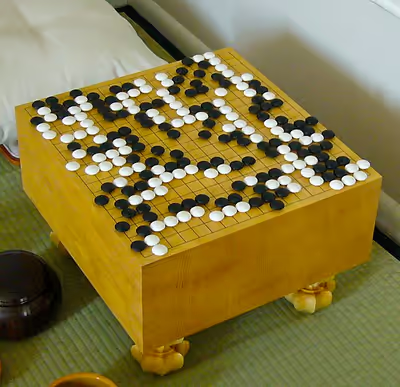
The Go board (generally referred to by its Japanese name goban 碁盤) typically measures between 45 and 48 cm (18 and 19 in) in length (from one player's side to the other) and 42 to 44 cm (16+1⁄2 to 17+1⁄4 in) in width. Chinese boards are slightly larger, as a traditional Chinese Go stone is slightly larger to match. The board is not square; there is a 15:14 ratio in length to width, because with a perfectly square board, from the player's viewing angle the perspective creates a foreshortening of the board. The added length compensates for this. There are two main types of boards: a table board similar in most respects to other gameboards like that used for chess, and a floor board, which is its own free-standing table and at which the players sit.
The traditional Japanese goban is between 10 and 18 cm (3.9 and 7.1 in) thick and has legs; it sits on the floor (see picture). It is preferably made from the rare golden-tinged Kaya tree (Torreya nucifera), with the very best made from Kaya trees up to 700 years old. More recently, the related California Torreya (Torreya californica) has been prized for its light color and pale rings as well as its reduced expense and more readily available stock. The natural resources of Japan have been unable to keep up with the enormous demand for the slow-growing Kaya trees; both T. nucifera and T. californica take many hundreds of years to grow to the necessary size, and they are now extremely rare, raising the price of such equipment tremendously. As Kaya trees are a protected species in Japan, they cannot be harvested until they have died. Thus, an old-growth, floor-standing Kaya goban can easily cost in excess of $10,000 with the highest-quality examples costing more than $60,000.
Other, less expensive woods often used to make quality table boards in both Chinese and Japanese dimensions include Hiba (Thujopsis dolabrata), Katsura (Cercidiphyllum japonicum), kauri (Agathis), and Shin Kaya (various varieties of spruce, commonly from Alaska, Siberia and China's Yunnan Province). So-called Shin Kaya is a potentially confusing merchant's term: shin means 'new', and thus shin kaya is best translated 'faux kaya', because the woods so described are biologically unrelated to Kaya. Table boards can be one-piece or two-piece; two-piece boards can be hinged to fold for easier storage, but properly spacing the hinge can cause gaps in the center of the board affecting appearance and play. Alternately, pegs, biscuits or mortise and tenon joints allow the board's halves to be more precisely joined while still able to be separated.
For tournament and casual play, goban are also commonly made of leather/suede, vinyl, neoprene-backed cloth (similar to mousepads), silicone or other flexible materials. These boards are much less expensive than their wood counterparts, and also allow the board to be easily rolled or folded for storage and transport, with some materials also affording some resistance to the board being jostled during play. The primary tradeoff is the difference in feel and sound when placing a stone on the softer material; the satisfying "clack" of a punctuated move is absent.
Stones
A full set of Go stones (goishi) usually contains 181 black stones and 180 white ones; a 19×19 grid has 361 points, so there are enough stones to cover the board, and Black gets the extra odd stone because that player goes first. However it may happen, especially in beginners' games, that many back-and-forth captures empty the bowls before the end of the game: in that case an exchange of prisoners allows the game to continue.
Traditional Japanese stones are double-convex, and made of clamshell (white) and slate (black). The classic slate is nachiguro stone mined in Wakayama Prefecture and the clamshell from the Hamaguri clam (Meretrix lusoria) or the Korean hard clam; however, due to a scarcity in the Japanese supply of these clams, the stones are most often made of shells harvested from Mexico. Historically, the most prized stones were made of jade, often given to the reigning emperor as a gift.
In China, the game is traditionally played with single-convex stones made of a composite called Yunzi. The material comes from Yunnan Province and is made by sintering a proprietary and trade-secret mixture of mineral compounds derived from the local stone. This process dates to the Tang dynasty and, after the knowledge was lost in the 1920s during the Chinese Civil War, was rediscovered in the 1960s by the now state-run Yunzi company. The material is praised for its colors, its pleasing sound as compared to glass or to synthetics such as melamine, and its lower cost as opposed to other materials such as slate/shell. The term yunzi can also refer to a single-convex stone made of any material; however, most English-language Go suppliers specify Yunzi as a material and single-convex as a shape to avoid confusion, as stones made of Yunzi are also available in double-convex while synthetic stones can be either shape.
Traditional stones are made so that black stones are slightly larger in diameter than white; this is to compensate for the optical illusion created by contrasting colors that would make equal-sized white stones appear larger on the board than black stones.
Bowls
The bowls for the stones are shaped like a flattened sphere with a level underside. The lid is loose fitting and upturned before play to receive stones captured during the game. Chinese bowls are slightly larger, and a little more rounded, a style known generally as Go Seigen; Japanese Kitani bowls tend to have a shape closer to that of the bowl of a snifter glass, such as for brandy. The bowls are usually made of turned wood. Mulberry is the traditional material for Japanese bowls, but is very expensive; wood from the Chinese jujube date tree, which has a lighter color (it is often stained) and slightly more visible grain pattern, is a common substitute for rosewood, and traditional for Go Seigen-style bowls. Other traditional materials used for making Chinese bowls include lacquered wood, ceramics, stone and woven straw or rattan. The names of the bowl shapes, Go Seigen and Kitani, were introduced in the last quarter of the 20th century by the professional player Janice Kim as homage to two 20th-century professional Go players by the same names, of Chinese and Japanese nationality, respectively, who are referred to as the "Fathers of modern Go".
Playing technique and etiquette
The traditional way to place a Go stone is to first take one from the bowl, gripping it between the index and middle fingers, with the middle finger on top, and then placing it directly on the desired intersection. One can also place a stone on the board and then slide it into position under appropriate circumstances (where it does not move any other stones). It is considered respectful towards White for Black to place the first stone of the game in the upper right-hand corner. (Because of symmetry, this has no effect on the game's outcome.)
It is considered poor manners to run one's fingers through one's bowl of unplayed stones, as the sound, however soothing to the player doing this, can be disturbing to one's opponent. Similarly, clacking a stone against another stone, the board, or the table or floor is also discouraged. However, it is permissible to emphasize select moves by striking the board more firmly than normal, thus producing a sharp clack. Additionally, hovering one's arm over the board (usually when deciding where to play) is also considered rude as it obstructs the opponent's view of the board.
Manners and etiquette are extensively discussed in 'The Classic of WeiQi in Thirteen Chapters', a Song dynasty manual to the game. Apart from the points above it also points to the need to remain calm and honorable, in maintaining posture, and knowing the key specialised terms, such as titles of common formations. Generally speaking, much attention is paid to the etiquette of playing, as much as to winning or actual game technique.
Computers and Go
Software players
Go long posed a daunting challenge to computer programmers, putting forward "difficult decision-making tasks, an intractable search space, and an optimal solution so complex it appears infeasible to directly approximate using a policy or value function". Prior to 2015, the best Go programs only managed to reach amateur dan level. On smaller 9×9 and 13x13 boards, computer programs fared better, and were able to compare to professional players. Many in the field of artificial intelligence consider Go to require more elements that mimic human thought than chess.
The reasons why computer programs had not played Go at the professional dan level prior to 2016 include:
- The number of spaces on the board is much larger (over five times the number of spaces on a chess board—361 vs. 64). On most turns there are many more possible moves in Go than in chess. Throughout most of the game, the number of legal moves stays at around 150–250 per turn, and rarely falls below 100 (in chess, the average number of moves is 37). Because an exhaustive computer program for Go must calculate and compare every possible legal move in each ply (player turn), its ability to calculate the best plays is sharply reduced when there are a large number of possible moves. Most computer game algorithms, such as those for chess, compute several moves in advance. Given an average of 200 available moves through most of the game, for a computer to calculate its next move by exhaustively anticipating the next four moves of each possible play (two of its own and two of its opponent's), it would have to consider more than 320 billion (3.2×10¹¹) possible combinations. To exhaustively calculate the next eight moves, would require computing 512 quintillion (5.12×10²⁰) possible combinations. As of March 2014, the most powerful supercomputer in the world, NUDT's "Tianhe-2", can sustain 33.86 petaflops. At this rate, even given an exceedingly low estimate of 10 operations required to assess the value of one play of a stone, Tianhe-2 would require four hours to assess all possible combinations of the next eight moves in order to make a single play.
- The placement of a single stone in the initial phase can affect the play of the game a hundred or more moves later. A computer would have to predict this influence, and it would be unworkable to attempt to exhaustively analyze the next hundred moves.
- In capture-based games (such as chess), a position can often be evaluated relatively easily, such as by calculating who has a material advantage or more active pieces. In Go, there is often no easy way to evaluate a position. However a 6-kyu human can evaluate a position at a glance, to see which player has more territory, and even beginners can estimate the score within 10 points, given time to count it. The number of stones on the board (material advantage) is only a weak indicator of the strength of a position, and a territorial advantage (more empty points surrounded) for one player might be compensated by the opponent's strong positions and influence all over the board. Normally a 3-dan can easily judge most of these positions.
It was not until August 2008 that a computer won a game against a professional level player at a handicap of 9 stones, the greatest handicap normally given to a weaker opponent. It was the Mogo program, which scored this first victory in an exhibition game played during the US Go Congress. By 2013, a win at the professional level of play was accomplished with a four-stone advantage. In October 2015, Google DeepMind's program AlphaGo beat Fan Hui, the European Go champion and a 2 dan (out of 9 dan possible) professional, five times out of five with no handicap on a full size 19×19 board. AlphaGo used a fundamentally different paradigm than earlier Go programs; it included very little direct instruction, and mostly used deep learning where AlphaGo played itself in hundreds of millions of games such that it could measure positions more intuitively. In March 2016, Google next challenged Lee Sedol, a 9 dan considered the top player in the world in the early 21st century, to a five-game match. Leading up to the game, Lee Sedol and other top professionals were confident that he would win; however, AlphaGo defeated Lee in four of the five games. After having already lost the series by the third game, Lee won the fourth game, describing his win as "invaluable". In May 2017, AlphaGo beat Ke Jie, who at the time continuously held the world No. 1 ranking for two years, winning each game in a three-game match during the Future of Go Summit. In October 2017, DeepMind announced a significantly stronger version called AlphaGo Zero which beat the previous version by 100 games to 0.
In February 2023, Kellin Pelrine, an amateur American Go player, won 14 out of 15 games against a top-ranked AI system in a significant victory over artificial intelligence. Pelrine took advantage of a previously unknown flaw in the Go computer program, which had been identified by another computer. He exploited this weakness by slowly encircling the opponent's stones and distracting the AI with moves in other parts of the board.
Software assistance
An abundance of software is available to support players of the game. This includes programs that can be used to view or edit game records and diagrams, programs that allow the user to search for patterns in the games of strong players, and programs that allow users to play against each other over the Internet.
There are several file formats used to store game records, the most popular of which is SGF, short for Smart Game Format. Programs used for editing game records allow the user to record not only the moves, but also variations, commentary and further information on the game.
Electronic databases can be used to study life and death situations, joseki, fuseki and games by a particular player. Programs are available that give players pattern searching options, which allow players to research positions by searching for high-level games in which similar situations occur. Such software generally lists common follow-up moves that have been played by professionals and gives statistics on win–loss ratio in opening situations.
Internet-based Go servers allow access to competition with players all over the world, for real-time and turn-based games. Such servers also allow easy access to professional teaching, with both teaching games and interactive game review being possible.
In popular culture
Apart from technical literature and study material, Go and its strategies have been the subject of several works of fiction, such as The Master of Go by Nobel Prize in Literature-winning author Yasunari Kawabata and The Girl Who Played Go (2001) by Shan Sa. Other books have used Go as a theme or minor plot device. For example, the 1979 novel Shibumi by Trevanian centers around the game and uses Go metaphors. In the novel Playground (2024) by Richard Powers, two of the main protagonists bond over their love of games, especially Go. Go features prominently in the Chung Kuo series of novels by David Wingrove, being the favourite game of the main villain.
The manga series Hikaru no Go and its anime adaptation, first released in Japan in 1998 and 2001 respectively, had a large impact in popularizing Go among young players, both in Japan and—as translations were released—abroad.
Similarly, Go has been used as a subject or plot device in film, such as Pi (π), A Beautiful Mind, Tron: Legacy, Knives Out, and The Go Master (a biopic of Go professional Go Seigen). 2013's Tôkyô ni kita bakari or Tokyo Newcomer portrays a Chinese foreigner Go player moving to Tokyo. In King Hu's wuxia film The Valiant Ones, the characters are color-coded as Go stones (black or other dark shades for the Chinese, white for the Japanese invaders), Go boards and stones are used by the characters to keep track of soldiers prior to battle, and the battles themselves are structured like a game of Go.
Go has also been featured as a plot device in a number of television series. Examples include Starz's science fiction thriller Counterpart, which is rich in references (the opening itself featuring developments on a Go board), and includes Go matches, accurately played, relevant to the plot. Also, in 2024 Netflix released the historical-fictional Korean series Captivating the King.
The corporation and brand Atari was named after the Go term, atari.
Hedge fund manager Mark Spitznagel used Go as his main investing metaphor in his investing book The Dao of Capital. The Way of Go: 8 Ancient Strategy Secrets for Success in Business and Life by Troy Anderson applies Go strategy to business. GO: An Asian Paradigm for Business Strategy by Miura Yasuyuki, a manager with Japan Airlines, uses Go to describe the thinking and behavior of business men.
Psychological perspectives
A 2004 review of literature by Fernand Gobet, de Voogt and Jean Retschitzki showed that relatively little scientific research had been carried out on the psychology of Go, compared with other traditional board games such as chess. Computer Go research has shown that given the large search tree, knowledge and pattern recognition are more important in Go than in other strategy games, such as chess. A study of the effects of age on Go-playing has shown that mental decline is milder with strong players than with weaker players. According to the review of Gobet and colleagues, the pattern of brain activity observed with techniques such as PET and fMRI does not show large differences between Go and chess. On the other hand, a study by Xiangchuan Chen et al. showed greater activation in the right hemisphere among Go players than among chess players, but the research was inconclusive because strong players from Go were hired while very weak chess players were hired in the original study. There is some evidence to suggest a correlation between playing board games and reduced risk of Alzheimer's disease and dementia.
Arthur Mary, a French researcher in clinical psychopathology, reports on his psychotherapeutic approaches using the game of Go with patients in private practice and in a psychiatric ward. Drawing on neuroscience research and employing a psychoanalytic (Lacanian) and phenomenological approach, he demonstrates how drives are expressed on the goban. He offers some suggestions to therapists for defining ways of playing Go that lead to therapeutic effects.
Analyses of the game
In formal game theory terms, Go is a non-chance, combinatorial game with perfect information. Informally that means there are no dice used (and decisions or moves create discrete outcome vectors rather than probability distributions), the underlying math is combinatorial, and all moves (via single vertex analysis) are visible to both players (unlike some card games where some information is hidden). Perfect information also implies sequence—players can theoretically know about all past moves.
Other theoretical taxonomy elements include:
- Go is bounded by a finite number of moves and every game must end with a victor or a tie (although ties are impossible in most rulesets).
- The strategy is associative because every strategy is a function of board position.
- The format is non-cooperative (that is, it's not a team sport).
- Positions are extensible, and so can be represented by board position trees.
- The game is zero-sum because player choices do not increase resources available, the rewards in the game are fixed and if one player wins, the other loses, and the utility function is restricted (in the sense of win/lose).
- However, ratings, monetary rewards, national and personal pride and other factors can extend utility functions, but generally not to the extent of removing the win/lose restriction, although affine transformations can theoretically add non-zero and complex utility aspects even to two player games.
In the endgame, it can often happen that the state of the board consists of several subpositions that do not interact with the others. The whole board position can then be considered as a mathematical sum, or composition, of the individual subpositions. It is this property of Go endgames that led John Horton Conway to the discovery of surreal numbers.
In combinatorial game theory terms, Go is a zero-sum, perfect-information, partisan, deterministic strategy game, putting it in the same class as chess, draughts (checkers), and Reversi (Othello).
The game emphasizes the importance of balance on multiple levels: to secure an area of the board, it is good to play moves close together; however, to cover the largest area, one needs to spread out, perhaps leaving weaknesses that can be exploited. Playing too low (close to the edge) secures insufficient territory and influence, yet playing too high (far from the edge) allows the opponent to invade. Decisions in one part of the board may be influenced by an apparently unrelated situation in a distant part of the board (for example, ladders can be broken by stones at an arbitrary distance away). Plays made early in the game can shape the nature of conflict a hundred moves later.
The game complexity of Go is such that describing even elementary strategy fills many introductory books. In fact, numerical estimates show that the number of possible games of Go far exceeds the number of atoms in the observable universe.
Go also contributed to the development of combinatorial game theory (with Go infinitesimals being a specific example of its use in Go).
Comparisons to other games
Go begins with an empty board. It is focused on building from the ground up (nothing to something) with multiple, simultaneous battles leading to a point-based win. Chess is tactical rather than strategic, as the predetermined strategy is to trap one individual piece (the king). This comparison has also been applied to military and political history, with Scott Boorman's book The Protracted Game (1969) and, more recently, Robert Greene's book The 48 Laws of Power (1998) exploring the strategy of the Chinese Communist Party in the Chinese Civil War through the lens of Go.
A similar comparison has been drawn among Go, chess and backgammon, perhaps the three oldest games that enjoy worldwide popularity. Backgammon is a "man vs. fate" contest, with chance playing a strong role in determining the outcome. Chess, with rows of soldiers marching forward to capture each other, embodies the conflict of "man vs. man". Because the handicap system tells Go players where they stand relative to other players, an honestly ranked player can expect to lose about half of their games; therefore, Go can be seen as embodying the quest for self-improvement, "man vs. self".